
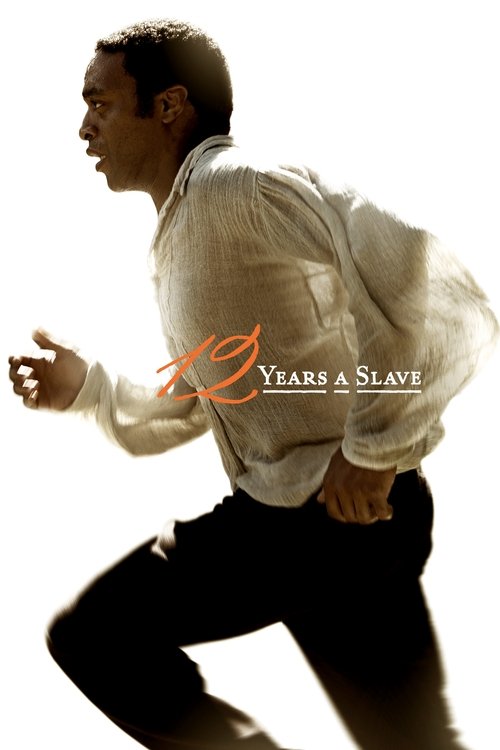
12 Years a Slave
"The extraordinary true story of Solomon Northup."
Overview
"12 Years a Slave" is a 2013 biographical drama based on the 1853 memoir of Solomon Northup, a free African American man from Saratoga Springs, New York. In 1841, Northup (played by Chiwetel Ejiofor), a skilled carpenter and violinist, is lured to Washington, D.C., by two men with the promise of a lucrative short-term job as a musician. However, he is drugged, kidnapped, and sold into slavery, stripped of his identity and given the name "Platt."
Shipped to New Orleans, he is purchased by plantation owner William Ford (Benedict Cumberbatch), a relatively kind man who recognizes Northup's intelligence. A conflict with a cruel carpenter named Tibeats (Paul Dano) leads to Northup being sold to the merciless and volatile cotton plantation owner Edwin Epps (Michael Fassbender). For the next decade, Northup endures unimaginable physical and psychological abuse under Epps's tyranny, all while desperately clinging to the hope of regaining his freedom and returning to his family.

Core Meaning
The core meaning of "12 Years a Slave" is to present an uncompromising and authentic depiction of the brutality of American slavery, stripping away romanticized notions of the Old South. Director Steve McQueen sought to immerse the audience in the visceral, day-to-day reality of bondage, making the historical atrocity a palpable and personal experience rather than a distant concept. The film's message is a powerful indictment of a system that dehumanized not only the enslaved but also the enslavers, corrupting the morality of all who participated in it. It serves as a stark reminder of the resilience of the human spirit in the face of unimaginable cruelty and the enduring hope for freedom and dignity.
Thematic DNA
The Dehumanizing Nature of Slavery
The film relentlessly portrays how slavery systematically strips individuals of their identity, humanity, and hope. Solomon is renamed "Platt," his free papers are stolen, and he is treated as property to be bought and sold. The constant physical and psychological violence, from whippings to verbal abuse, is designed to break the slaves' spirits and reduce them to mere laborers. The film shows this dehumanization affects the slave owners as well, brutalizing their own humanity and fostering sadism, as seen in the character of Edwin Epps.
Survival and Resistance
A central theme is the will to survive amidst utter despair. Solomon's initial assertion of his freedom is met with brutal punishment, forcing him to learn to suppress his identity to stay alive. His resistance becomes more subtle: feigning illiteracy, maintaining his dignity in small ways, and never relinquishing the hope of returning to his family. This theme is encapsulated in his declaration, "I don't want to survive. I want to live." The film explores different forms of survival, from quiet endurance to Patsey's desperate plea for death as an escape from her suffering.
The Corruption of Morality and Religion
"12 Years a Slave" examines how a fundamentally immoral institution was justified through social and religious norms. Slave owners like William Ford and Edwin Epps use Christianity to rationalize their ownership of human beings, quoting scripture to demand obedience. This hypocrisy is starkly contrasted with the genuine faith of the enslaved, who find solace and a sense of community in their spirituals. The film critiques the way religion was manipulated to uphold a brutal system, revealing the deep moral contradictions of the time.
The Fragility of Freedom and Injustice of Law
The film opens by establishing Solomon's life as a respected, free man, making his sudden abduction and enslavement all the more shocking. This contrast highlights the precariousness of freedom for Black people, even in the North. Solomon's legal status as a free citizen is rendered meaningless once he is in the hands of the slave trade. The law, which should protect him, is instead used to legitimize his bondage, as his kidnappers are never successfully prosecuted after his release.
Character Analysis
Solomon Northup
Chiwetel Ejiofor
Motivation
Solomon's primary motivation is to survive his ordeal and return to his family. The memory of his wife and children is his driving force, preventing him from falling into complete despair. He is also motivated by a desire to live, not just survive, clinging to his humanity and sense of self-worth despite his circumstances.
Character Arc
Solomon begins as a proud, educated, and free family man in New York. After his kidnapping, he is plunged into a brutal reality that forces him to suppress his identity and intellect to survive. His initial defiance gives way to a calculated and cautious endurance. Over twelve years, he witnesses and experiences unimaginable horrors, which nearly break his spirit. However, he never completely loses hope for freedom. His arc is one of resilience and the struggle to maintain his inner self—his dignity and identity—against a system designed to obliterate it. His eventual rescue and reunion with his family complete his journey, but he is a man forever changed by his trauma.
Edwin Epps
Michael Fassbender
Motivation
Epps is motivated by profit and the maintenance of absolute control over his slaves through fear and violence. On a psychological level, he is driven by his lustful obsession with Patsey and the torment this causes him, especially in relation to his jealous wife. His actions are often fueled by alcohol and a deep-seated sadism.
Character Arc
Edwin Epps is a cruel, sadistic, and alcoholic cotton plantation owner who is Solomon's master for ten years. He does not have a developmental arc in the traditional sense; rather, the film explores the depths of his depravity. He is a man corrupted by absolute power and the institution of slavery. He justifies his brutality with twisted interpretations of the Bible. His obsession with Patsey reveals his internal conflict and self-loathing, which he expresses through extreme violence towards her. Epps embodies the evil that the system of slavery breeds in those who hold power.
Patsey
Lupita Nyong'o
Motivation
Patsey is motivated by a desire to alleviate her suffering. She yearns for the simple dignity of being clean, which is denied to her by Mistress Epps. Ultimately, her motivation shifts to a desire for an end to her pain, even if it means death. She embodies the extreme suffering and lack of agency experienced by those in the most vulnerable positions within the slave system.
Character Arc
Patsey is a young slave on Epps's plantation who is the most efficient cotton picker. She is the object of both Master Epps's sexual abuse and Mistress Epps's jealous rage. Patsey's arc is a tragic descent into hopelessness. Initially shown to have a resilient spirit, the relentless abuse she suffers grinds her down to the point where she begs Solomon to kill her, seeing death as the only escape. Her story represents the horrific plight of enslaved women, who were subjected to unique forms of physical and sexual violence. She remains on the plantation when Solomon is freed, her fate unknown, symbolizing the countless individuals left behind by history.
Symbols & Motifs
The Violin
The violin symbolizes Solomon's former life of freedom, artistry, and identity. It is a tangible link to his family and his status as a respected individual in his community. As his journey in slavery progresses, the violin's meaning shifts. It becomes a tool for survival, earning him small favors, but also a symbol of his subjugation, as he is forced to play for his masters' entertainment. His ultimate destruction of the violin signifies a moment of profound despair and the crushing of his spirit under the weight of his bondage.
Solomon is a skilled violinist in his life in Saratoga Springs. After being enslaved, his first master, William Ford, gifts him a violin. He carves the names of his wife and children into it. He is later forced to play for the amusement of Edwin Epps. After being forced to whip Patsey, Solomon smashes his violin against a tree in a fit of rage and grief.
The Noose / The Hanging Scene
The extended, agonizing scene where Solomon is left hanging from a tree, with his feet barely touching the ground, is a powerful symbol of the constant, casual brutality of slavery and the helplessness of the enslaved. It represents the precariousness of life for a slave, where death is always imminent. The inaction of the other slaves, who continue their chores around him out of fear, symbolizes the way the system of slavery enforced complicity and suppressed empathy as a means of survival.
After a violent confrontation with the carpenter John Tibeats, Solomon is strung up and nearly lynched. He is left hanging for hours, struggling to breathe, while life on the plantation goes on around him. The other slaves watch from a distance, unable to intervene. He is eventually cut down by his master, William Ford.
Letters and the Inability to Write
The act of writing and sending a letter represents the only hope for liberation and a connection to the outside world. Solomon's literacy is a dangerous secret, as it defies the dehumanizing stereotype of a slave. His repeated, failed attempts to send a letter symbolize the immense difficulty of escaping slavery and the profound isolation of the enslaved. The eventual successful delivery of a letter is the key that unlocks his freedom.
Solomon attempts to secure his freedom by sending a letter to his family in New York. His first attempt is with a white field hand named Armsby, who betrays him to Epps. Fearing for his life, Solomon is forced to burn the letter. Years later, he confides in a Canadian carpenter, Samuel Bass, who agrees to mail letters for him, ultimately leading to his rescue.
Memorable Quotes
I don't want to survive. I want to live.
— Solomon Northup
Context:
After being kidnapped and put on a ship to the South, a fellow slave, Robert, advises Solomon to do and say as little as possible to survive. Solomon rejects this notion, expressing his profound desire to return to his former life, not just exist in bondage.
Meaning:
This quote, spoken early in his captivity, establishes Solomon's core struggle. It's not enough for him to simply endure the physical hardships of slavery; he wants to reclaim his life, his identity, and his humanity. It differentiates his perspective from that of those born into slavery who may see mere survival as the only attainable goal.
My name is Solomon Northup. I am a free man.
— Solomon Northup
Context:
Solomon repeats this or similar phrases several times, most notably to James H. Burch, the slave trader in Washington D.C., who responds by brutally beating him for daring to speak of his freedom.
Meaning:
This is a desperate and defiant assertion of his identity and legal status in the face of those who have stripped him of both. It is a recurring statement that underscores the central injustice of his situation. Each time he says it, he is met with violence, demonstrating that his truth has no power within the system of slavery.
I will not fall into despair. I will keep myself hearty until freedom is opportune.
— Solomon Northup
Context:
Solomon says this to himself and to Eliza, a fellow slave who is inconsolable after being separated from her children. He tries to impart his philosophy of endurance and hope as a means of surviving the trauma of their situation.
Meaning:
This line serves as Solomon's personal mantra for survival. It reflects his conscious decision to fight against the psychological toll of slavery and to hold onto hope, no matter how bleak his circumstances become. It is a testament to his mental and emotional fortitude.
Philosophical Questions
What is the nature of humanity in the face of absolute power and suffering?
The film delves into the psychological effects of the master-slave dynamic on both the oppressed and the oppressor. It questions whether inherent goodness can survive in a system designed to crush it. Solomon's struggle to maintain his dignity and identity explores the resilience of the human spirit. Conversely, the character of Edwin Epps illustrates how absolute power can corrupt and brutalize, seemingly erasing empathy and fostering sadism. The film asks what it means to be human when society denies one's humanity and how individuals respond to extreme, systemic cruelty.
Where is the line between law and morality?
"12 Years a Slave" powerfully illustrates the chasm that can exist between what is legal and what is morally right. The institution of slavery was protected by law, yet was a profound moral abomination. Characters like Epps use the law and a perverted sense of religious sanction to justify their horrific actions. The film forces the audience to confront the idea that legality is not a reliable measure of justice and that individuals have a moral responsibility to challenge unjust laws, as exemplified by the abolitionist character, Samuel Bass.
How does hope function in a seemingly hopeless situation?
The film is a profound meditation on the role of hope in survival. Solomon's hope for reunion with his family is the central force that keeps him from succumbing to despair. However, the film also explores the darker side of hope through Patsey, whose hope is so thoroughly extinguished by her relentless torment that she seeks death as her only release. The film poses the question of what allows hope to endure in some and be destroyed in others, and whether survival is possible without it.
Alternative Interpretations
While widely acclaimed, "12 Years a Slave" has been subject to various interpretations and critiques. One prominent discussion revolves around the concept of the "white savior." Some critics have argued that the film, by having Solomon's freedom ultimately secured by a benevolent white Canadian (Brad Pitt's character, Samuel Bass), reinforces a narrative where a white character is necessary for the salvation of a non-white protagonist. However, others counter that this is historically accurate to Solomon Northup's own account and reflects the reality of the power dynamics at the time.
Another interpretation focuses on the film's representation of resistance. Some analyses suggest that the film's focus on Solomon's individual suffering and endurance overshadows the history of collective slave resistance and revolt. The narrative is primarily one of personal survival rather than communal uprising. Additionally, comparisons between the film and the book highlight differing portrayals of certain characters. For example, Northup's memoir depicts his first master, William Ford, in a more sympathetic light than the film does, with the movie emphasizing the inherent hypocrisy of a "kind" slave owner.
Cultural Impact
"12 Years a Slave" had a profound cultural impact upon its release. It was widely hailed by critics as a landmark achievement in cinema and one of the most realistic and unflinching depictions of American slavery ever put on film. It challenged the romanticized "Gone with the Wind"-style portrayals of the antebellum South and forced a more direct and difficult conversation about this dark chapter in American history. The film's success, including winning the Academy Award for Best Picture, marked a significant moment for Black filmmakers, making Steve McQueen the first Black director of a Best Picture winner.
The film was praised for its historical accuracy, largely based on Northup's detailed 1853 memoir. It brought Solomon Northup's story to a global audience, renewing interest in his narrative and the broader history of the domestic slave trade. The film also sparked discussions about modern-day slavery and human trafficking, connecting the historical narrative to contemporary issues of social justice. Its raw and brutal honesty resonated with audiences, though some found the violence difficult to watch. Ultimately, "12 Years a Slave" is considered a vital educational tool and a powerful, essential piece of American cinema that has left a lasting legacy on how slavery is understood and represented in popular culture.
Audience Reception
Audience reception for "12 Years a Slave" was overwhelmingly positive, with many viewers deeply moved by its powerful and honest portrayal of slavery. It was widely regarded as a difficult but essential film to watch. Praised aspects included the masterful performances, particularly from Chiwetel Ejiofor, Lupita Nyong'o, and Michael Fassbender, as well as Steve McQueen's unflinching direction. Audiences found the film to be an emotionally harrowing and visceral experience that provided a stark, necessary education on the realities of slavery.
The main point of criticism, or at least caution, from some viewers was the graphic and brutal nature of the violence depicted. Some found certain scenes, like the prolonged whipping of Patsey, almost unbearable to watch, though most acknowledged that this brutality was central to the film's message and historical accuracy. A minority of viewers expressed fatigue with the genre of slave narratives, while others debated the film's ending and the role of Brad Pitt's character. Overall, the verdict was that it is a cinematic masterpiece and a culturally significant work that, despite its difficult subject matter, is a must-see.
Interesting Facts
- The film was shot on location in Louisiana at several historic plantations, including one that was very near the actual plantation where Solomon Northup was held.
- Director Steve McQueen first became interested in making a film about slavery but didn't have a specific story until his wife found Solomon Northup's memoir.
- This was the feature film debut for Lupita Nyong'o, who won the Academy Award for Best Supporting Actress for her role as Patsey.
- Cinematographer Sean Bobbitt shot the film on 35mm film, rather than digitally, to give it a more period-appropriate and epic feel.
- Michael Fassbender, who played the brutal slave owner Edwin Epps, found the role so petrifying that he had difficulty getting in and out of character during filming.
- The film omits one of Solomon's children from the book; in reality, he and his wife had three children, not two.
- Brad Pitt, whose company Plan B Entertainment co-produced the film, also has a small but pivotal role as Samuel Bass, the Canadian abolitionist who helps Solomon.
⚠️ Spoiler Analysis
Click to reveal detailed analysis with spoilers
Frequently Asked Questions
Explore More About This Movie
Dive deeper into specific aspects of the movie with our detailed analysis pages
Comments (0)
No comments yet. Be the first to share your thoughts!