Skip to content
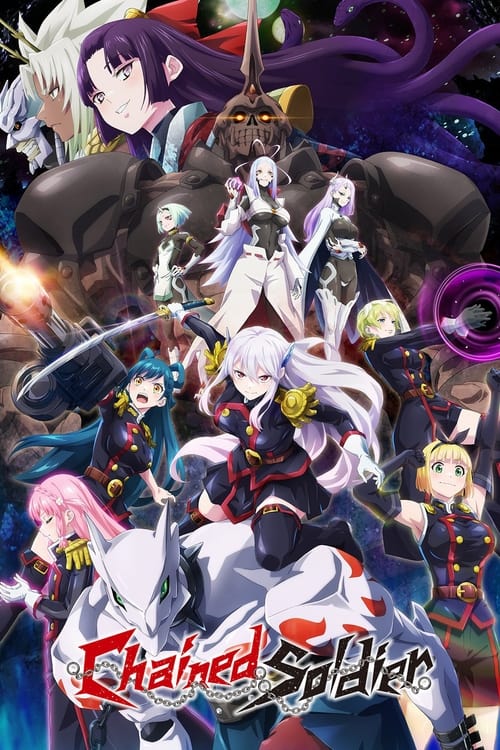
Chained Soldier
A pulse-pounding dark fantasy steeped in sensual tension and fierce adrenaline, where gilded chains bind duty and desire into an explosive crucible of monstrous conflict.
Chained Soldier

Chained Soldier

魔都精兵のスレイブ

04 January 2024 — 26 March 2026 Japan 2 season 24 episode Returning Series 8.0 (114)

Cast: Yuya Hirose, Akari Kito, Yume Miyamoto, Hina Tachibana, Maaya Uchida

Animation Sci-Fi & Fantasy Action & Adventure Reciprocal Empowerment and the Price of Power Redefining Value within a Matriarchal Hierarchy Familial Ties versus Factional Duty Ambition, Social Mobility, and Redemption

Overview

Chained Soldier (Mato Seihei no Slave) takes place in a world reshaped by disaster following the appearance of portals leading into Mato, a hazardous alternate dimension overrun by monstrous entities known as Shuuki. Within this dimension grow supernatural peaches—fruits granting superhuman abilities exclusively to women, drastically transforming society into a matriarchal hierarchy where men are relegated to auxiliary roles. High school student Yuuki Wakura, adrift and burdened by the disappearance of his older sister years earlier during a Mato disaster, accidentally stumbles through an open gateway into the demon world.

He is rescued by Kyouka Uzen, the formidable captain of the 7th Squad of the Anti-Demon Corps. Possessing the ability Slave, Kyouka can draw out the latent physical potential of living beings by enslaving them. When Kyouka places the collar on Yuuki, he transforms into a powerful battle beast capable of carving through demonic hordes. However, the contract imposes a strict supernatural rule: in exchange for using his power, the master is compelled to bestow an involuntary reward on the slave proportional to the energy expended, sparking an intimate and complex dynamic between them.

Across its run, the series charts Yuuki's integration into the 7th Squad as both an essential frontline vanguard and the squadron's domestic caretaker. As internal politics, joint-squad tournaments, and clashes between rival commanders test their strength, the narrative expands into a deeper war involving rogue humanoid factions, deep-seated government secrets within the Anti-Demon Corps, and the mystery behind Mato's origins and Yuuki's lost family.
Core Meaning

The central narrative deconstructs traditional dynamics of servitude, empowerment, and mutual codependence. Rather than treating submission as purely disempowering, the series explores how voluntary vulnerability and mutual debt can form an unbreakable bond. Through Yuuki's dual role—unleashed powerhouse in battle and domestic caregiver in daily life—the series asserts that true partnership requires both sides to pay a tangible cost, turning what appears to be an exploitative hierarchy into a framework of shared trust, reciprocal respect, and emotional connection.

Thematic DNA

Reciprocal Empowerment and the Price of Power 30%
Redefining Value within a Matriarchal Hierarchy 25%
Familial Ties versus Factional Duty 25%
Ambition, Social Mobility, and Redemption 20%

Reciprocal Empowerment and the Price of Power

Central to every engagement is the law of the Slave contract: immense physical power comes with an inescapable karmic debt. The bond demonstrates that authority without accountability is impossible.

Redefining Value within a Matriarchal Hierarchy

In a society that minimizes male utility due to the female-exclusive effects of the Mato peaches, Yuuki carves out profound indispensability through both combat resilience and unpretentious domestic support.

Familial Ties versus Factional Duty

Explored heavily when Yuuki encounters his transformed sister, Aoba, forcing him to navigate the friction between institutional loyalty to the Anti-Demon Corps and unconditional familial love.

Ambition, Social Mobility, and Redemption

Exemplified by Kyouka Uzen's unyielding drive to rise from a mocked commander of a weak squadron to the Supreme Commander of the Anti-Demon Corps, avenging her destroyed hometown.

Character Analysis

Yuuki Wakura

Yuya Hirose

Archetype: The Reluctant Guardian / Subversive Hero Key Trait: Boundless empathy and domestic diligence

Motivation

Protect those close to him and save his sister Aoba from her fate.

Character Arc

Evolves from an aimless high school graduate into an indispensable warrior and emotional anchor for multiple squadrons, mastering various combat forms under different riders.

Kyouka Uzen

Akari Kito

Archetype: The Ambitious Commander / Mentor Key Trait: Unwavering resolve and hidden tenderness

Motivation

Slay the Eight Gods of Thunder and become Supreme Commander to avenge her fallen village.

Character Arc

Transitions from a stern, results-oriented outcast captain to a confident, respected leader whose absolute trust in Yuuki enables tactical innovations.

All 5 characters and cast

Symbols & Motifs

The Slave Collar and Chain (Kusari)

Meaning:

Represents both literal servitude and the unbreakable spiritual conduit between master and servant.

Context:

Functions as a visual catalyst for unlocking latent power through surrender during battle transformations.

The Mato Peaches (Momo)

Meaning:

A symbol of divine yet divisive elevation, granting supernatural sovereignty to women while establishing social division.

Context:

Found exclusively in the Mato dimension, consumed by women to gain superhuman abilities that form the basis of the matriarchal society.

The Compulsory Reward Ritual

Meaning:

Symbolizes cosmic equilibrium and unavoidable vulnerability, stripping commanders of their stoic authority and forcing emotional intimacy.

Context:

Triggered involuntarily after battles, requiring the master to bestow physical gratification on Yuuki proportional to energy spent.

Yuuki's Apron and Cooking Utensils

Meaning:

Highlights domestic caretaking as a legitimate source of grounding and affection in contrast to battlefield violence.

Context:

Used during daily life at the 7th Squad dormitory where Yuuki serves as caretaker and prepares meals for the squad.

The Crimson Fog and Mato Portals

Meaning:

Represent the encroachment of trauma, alien landscapes, and suppressed truths lurking beneath modern civilization.

Context:

Seen at disaster sites and boundary zones where the hazardous Mato dimension bleeds into the human world.

Memorable Quotes

私の奴隷になりなさい!
— Kyouka Uzen

Context

Spoken during Yuuki's near-fatal encounter in the Mato portal in Season 1, Episode 1.

Meaning

The defining command that establishes the central pact of the series.

お前を誰よりも高く、強くしてやる
— Kyouka Uzen

Context

Delivered to Yuuki upon formalizing their partnership in Season 1, Episode 1.

Meaning

Kyouka's declaration of reciprocal purpose, signaling to Yuuki that his role is not mere cannon fodder but an equal rise to greatness.

All 4 quotes

Episode Highlights

Birth, Yuuki, Awakening

S1E1

Introduces the Mato dimension, the peach power dynamic, and the fateful first contract between Kyouka and Yuuki.

Significance:

Immediately establishes the foundational action-reward loop and the central premise of the series.

Whirlwind, Shushu, Together

S1E4

Kyouka temporarily lends Yuuki to 7th Squad members for combat support.

Significance:

Reveals that Yuuki's Slave form alters drastically based on who holds the reins, expanding tactical possibilities.

Battle, Tenka, Storm

S1E7

The joint tournament with the 6th Squad showcases high-tier spatial combat abilities.

Significance:

Introduces Tenka Izumo's overwhelming power and initiates her fascination with Yuuki.

Sister, Flash, Memories

S1E9

The discovery of humanoid Shuuki culminates in Yuuki confronting his transformed sister Aoba.

Significance:

Shifts the series from standard monster-hunting to a complex factional conflict involving government secrets.

Death Match, Aoba, Excite

S1E11

A full-throttle clash between the allied 6th/7th Squads and the Humanoid Shuuki faction.

Significance:

Demonstrates squad team synergy and combat capability without Yuuki's frontline presence.

Declaration, Kyouka, High Road

S1E12

Kyouka officially declares her intention to challenge the status quo of the Anti-Demon Corps at the Commander Conference.

Significance:

Teases the looming institutional war and sets up high-echelon political struggles.

Gathering of Chiefs, Thunder, Omen

S2E1

Introduces higher-echelon leaders, including Supreme Commander Ren Yamashiro.

Significance:

Establishes the Eight Gods of Thunder as the primary existential threat to humanity.

Covenant, Breaking Dawn, Horizon

S2E12

A massive confrontation bringing together squadron commanders against divine-tier Shuuki.

Significance:

Solidifies Yuuki's universal compatibility across commanders and repels the primary divine vanguard.

Philosophical Questions

Can true equality exist within a contract explicitly structured around hierarchy and submission?

Explored through Yuuki and Kyouka's evolving dynamic, where the formal master-slave structure requires reciprocal vulnerability, care, and mutual reliance to function effectively.

How does society redefine masculinity and purpose when biological advantage shifts entirely to another group?

Examined through Yuuki's integration into the 7th Squad, forging value not through dominance, but through supportive versatility, emotional grounding, and resilience.

Does retribution against historical trauma justify the moral compromises made in wartime?

Framed around Kyouka's relentless drive to avenge her destroyed village and the Anti-Demon Corps' suppression of humanoid Shuuki seeking asylum.

Alternative Interpretations

The Egalitarian Read: Yuuki's role subverts patriarchal entitlement without indulging misandry; both sexes require each other's distinct strengths to survive, illustrating interdependency.

Full ending explanation

Cultural Impact

Emerging in the post-2020 era of Jump+ digital expansions, Chained Soldier gained prominence by unapologetically embracing high-octane battle-ecchi themes reminiscent of late-2000s classics while incorporating modern battle shonen pacing. The franchise sparked widespread community discussion regarding the execution of ecchi adaptations versus action fidelity. While Season 1 faced scrutiny over visual inconsistencies, the transition to Studio Passione for Season 2 revitalized fan enthusiasm due to the studio's established pedigree in ecchi-action animation.

Audience Reception

Audience reception across the series highlights several distinct facets:

  • Manga Loyalty & Lore: Highly praised for faithful worldbuilding, brisk narrative pacing, and tactical battle mechanics.
  • Action & Reward Dynamic: Received mixed-to-positive responses, with fans celebrating the narrative integration of the reward sequences and Tenka Izumo's charisma.
  • Animation Quality: Season 1 by Seven Arcs faced criticism regarding CGI implementation for Shuuki monsters and subdued compositing compared to the manga artwork.
  • Studio Transition: Season 2 by Studio Passione was broadly praised for its visual upgrade, fluid animation, and richer aesthetic polish.

Interesting Facts

  • The series is written by Takahiro, creator of Akame ga Kill! and Yuki Yuna is a Hero, and illustrated by Yohei Takemura on Shueisha's Shonen Jump+ platform.
  • Season 1 was produced by studio Seven Arcs, whereas Season 2 transitioned to Studio Passione and Hayabusa Film.
  • Junji Nishimura served as general director for Season 1 alongside Goro Kuji, while Masafumi Tamura took over directorship for Season 2.
  • To accommodate broadcast standards, the series aired in two formats: a censored version on terrestrial networks and an uncensored cut on premium satellite network AT-X.
  • Renowned voice actress Kana Hanazawa was cast as Supreme Commander Ren Yamashiro for Season 2.

Easter Eggs

Momotaro Folklore Allusion

The foundational mythology directly invokes the Japanese folklore hero Momotaro (born from a giant peach and subduing demons with animal companions), completely inverting the trope into a matriarchal battle fantasy.

Takahiro's Signature Squad Lethality

Fans of Takahiro's previous work (Akame ga Kill!) will recognize distinct naming conventions and squad-level military structures.

Numerical Squadron Symbolism

The 7th Squad's specialty and equipment directly mirror lucky number seven concepts, contrasting with the dimensional reality-warping theme of the 6th Squad's 666-hop limit.

Frequently Asked Questions

Explore More About This Movie

Dive deeper into specific aspects of the movie with our detailed analysis pages

Comments (0)

Leave a comment

No comments yet. Be the first to share your thoughts!

Similar Movies