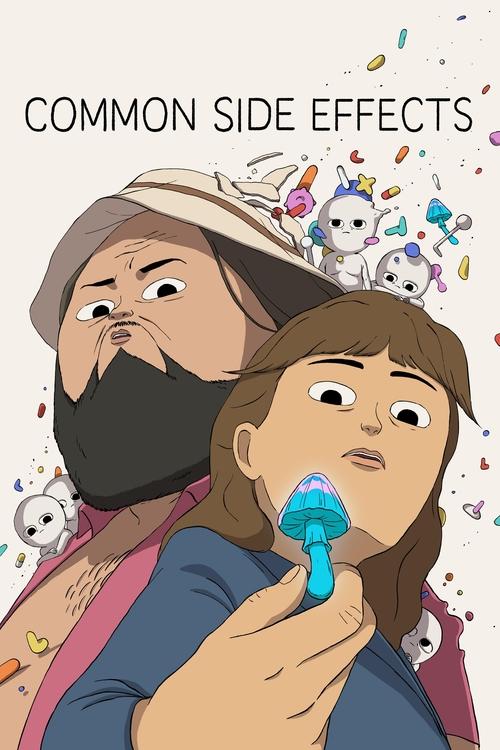
Common Side Effects
A psychedelic conspiracy thriller pulsating with dry humor and boiling rage. It is a neon-tinted fungal dream where clinical corporate sterility clashes with the untamed, healing warmth of the natural world.
Common Side Effects

Common Side Effects

02 February 2025 — 30 March 2025 United States of America 2 season 10 episode Returning Series ⭐ 8.4 (212)
Cast: Dave King, Emily Pendergast, Mike Judge, Martha Kelly, Joseph Lee Anderson
Drama Animation Sci-Fi & Fantasy Comedy
Corporate Greed and Devaluation of Life Human Incompetence vs. Malice The Trap of Systemic Debt Psychedelia and Spiritual Awakening

Overview

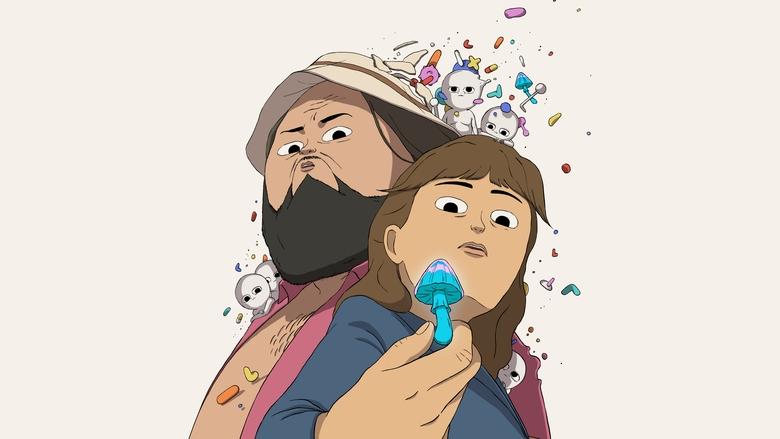
Common Side Effects is a serialized animated thriller that follows Marshall Cuso, a socially awkward but brilliant fungal researcher, and Frances Applewhite, his former high school lab partner. Their lives are upended when Marshall discovers the Blue Angel, a rare mushroom capable of curing any disease and even reversing death. This miraculous breakthrough puts them in the crosshairs of Reutical Pharmaceuticals, a corporate behemoth that views a universal cure as an existential threat to its bottom line.

As the series progresses, the narrative expands into a complex game of cat-and-mouse involving the DEA, international businessmen, and a shadowy government conspiracy. While Marshall remains idealistic and non-violent, Frances is forced to navigate her role as an assistant to the company's CEO, balancing her mounting personal debts against the moral weight of suppressing a world-altering discovery. The series artfully weaves together a propulsive mystery with surreal, hallucinogenic sequences that explore the spiritual and psychological boundaries of the human experience.

Core Meaning

At its core, Common Side Effects is a scathing critique of the monetization of human suffering and the systemic incompetence of modern institutions. The creators use the metaphor of a miracle mushroom to explore whether a broken society can actually handle a true "panacea." It suggests that the "system"—comprising Big Pharma, government bureaucracy, and capitalism—is not just flawed, but actively hostile to genuine wellness. The series argues that true healing requires an ego death and a reconnection with nature, rather than the synthetic, profit-driven interventions of a corporate state.

Thematic DNA

Corporate Greed and Devaluation of Life 30%
Human Incompetence vs. Malice 25%
The Trap of Systemic Debt 25%
Psychedelia and Spiritual Awakening 20%

Corporate Greed and Devaluation of Life

The series illustrates how Reutical Pharmaceuticals treats health as a commodity. Throughout the seasons, the antagonists—specifically Jonas Backstein—demonstrate that they would rather destroy a universal cure than lose the recurring revenue from treating chronic illnesses. This theme highlights the inherent conflict between for-profit medicine and human survival.

Human Incompetence vs. Malice

In contrast to traditional thrillers where villains are clinical geniuses, this series highlights the banality of evil through incompetence. Characters like CEO Rick Kruger are portrayed as bumbling and oblivious, suggesting that the system's cruelty often stems from a lack of foresight and a focus on mundane corporate tasks rather than intentional villainy.

The Trap of Systemic Debt

Frances Applewhite’s character arc is defined by her economic vulnerability. Her motivation to stay at Reutical, despite her conscience, is driven by student loans and her mother's medical expenses. The series shows how the system uses financial pressure to coerce moral compromise from ordinary people.

Psychedelia and Spiritual Awakening

Through the "Portal World" and the effects of the Blue Angel mushroom, the show explores altered states of consciousness. These sequences are not just visual flair but serve as a development path for characters to perceive truths about the interconnectedness of life that the material world hides.

Character Analysis

Marshall Cuso

Dave King

Archetype: The Reluctant Prophet
Key Trait: Principled Idealism

Motivation

To democratize healthcare and ensure the Blue Angel mushroom is free for everyone, driven by a deep, non-violent love for humanity and nature.

Character Arc

Marshall begins as an awkward, socially isolated mycologist. Over two seasons, he evolves from a victim of the system into an international fugitive and spiritual leader, eventually accepting that the mushroom's distribution requires him to step into a position of dangerous influence.

Frances Applewhite

Emily Pendergast

Archetype: The Everywoman
Key Trait: Moral Ambivalence

Motivation

Finding a way to care for her dementia-afflicted mother while escaping the crushing weight of her financial obligations.

Character Arc

Initially a pragmatist trapped by debt and corporate loyalty, Frances undergoes a moral awakening. She eventually betrays her employers at Reutical, realizing that her survival is intrinsically linked to Marshall's mission.

Rick Kruger

Mike Judge

Archetype: The Bumbling Bureaucrat
Key Trait: Cheerful Incompetence

Motivation

Job security and maintaining his status quo, often more concerned with mundane office tasks than the global conspiracy he is leading.

Character Arc

The CEO of Reutical remains largely static—a satirical figure of corporate vapidity. However, his moments of accidental empathy and his obsession with farming simulators reveal a man completely detached from the consequences of his company's actions.

Jonas Backstein

Danny Huston

Archetype: The Shadow Antagonist
Key Trait: Calculating Ruthlessness

Motivation

Personal survival at any cost; he wants the mushroom to cure his own cancer while keeping it from the public to maintain market control.

Character Arc

A ruthless board member who starts as a cold corporate shark but reveals his vulnerability through terminal illness. His arc ends in a horrific purgatory of his own making when he tries to hoard the mushroom's power.

Agent Copano

Joseph Lee Anderson

Archetype: The Truth-Seeker
Key Trait: Inquisitive Skepticism

Motivation

The need to "connect the dots" and uncover the truth behind the government’s involvement in pharmaceutical suppression.

Character Arc

A DEA agent whose initial obsession with conspiracy theories turns out to be justified. He eventually defects from the government to assist Marshall, becoming a protector of the very "drug" he was sent to destroy.

Symbols & Motifs

The Blue Angel Mushroom

Meaning:

Symbolizes the elixir of life and the potential for a utopia. It represents the raw, uncontrollable power of nature that threatens to render the artificial structures of society obsolete.

Context:

The central MacGuffin discovered by Marshall in Peru. It appears in various forms, from raw spores to the processed "Sparkl" food additive.

Socrates the Tortoise

Meaning:

Symbolizes patience and the key to organic growth. On a literal level, he represents the missing link in the mushroom’s cultivation, but metaphorically, he is the silent observer of human chaos.

Context:

Marshall’s pet; his guano is revealed to be the essential fertilizer for the Blue Angel mushroom, making him the most valuable asset in the series.

The Portal World

Meaning:

A liminal psychic space where the physical and spiritual meet. It represents the shared human soul and the possibility of communication beyond language and physical barriers.

Context:

The psychedelic realm characters enter after ingesting the mushroom or experiencing near-death, often inhabited by "Machine Elves" or white humanoid figures.

Memorable Quotes

Richard, you're a medical salesman. You don't sell health, you sell management.

— Jonas Backstein

Context:

Said in Season 1, Episode 3, during a board meeting where Rick proposes mass-producing the mushroom.

Meaning:

A defining statement on the nature of the pharmaceutical industry, distinguishing between actually curing people and the more profitable business of managing chronic symptoms.

The system isn't broken. It's working exactly how it's designed to.

— Marshall Cuso

Context:

Said in the Pilot episode during Marshall's initial confrontation with Rick Kruger.

Meaning:

Highlights the systemic nature of the show's conflict; the suffering of the poor is a feature of the healthcare industry, not a bug.

I'm non-violent, but my mushrooms might have other plans for your ego.

— Marshall Cuso

Context:

Season 1, Episode 7, when Marshall is being cornered by DEA agents.

Meaning:

A playful but ominous nod to the transformative and destructive power of psychedelics on the human psyche.

Episode Highlights

Pilot

S1E1

Marshall reunites with Frances and demonstrates the mushroom's power by resurrecting a dead pigeon. This sets the stakes for the entire series as Big Pharma immediately begins its pursuit.

Significance:

Establishes the core dynamic between the leads and the existence of the miracle drug.

In the System

S1E6

Marshall is imprisoned and must rely on Amelia to help him escape. This episode highlights how the pharmaceutical industry uses the legal system as a cage.

Significance:

Moves the plot into a higher stakes survival thriller and introduces key subplots about government corruption.

Blowfish

S1E7

Marshall fakes his death using tetrodotoxin to escape the morgue, a classic thriller beat executed with a dark, animated twist.

Significance:

Allows Marshall to go completely off the grid and sets up the second half of the season's chase.

Raid

S1E10

The FBI and DEA raid Hildy’s mushroom farm. Jonas Backstein overdoses on the mushrooms, leading to a terrifying sequence of body-horror and ego death.

Significance:

The Season 1 finale that reunites Marshall and Frances at Joshua Tree and leaves Jonas in a psychic purgatory.

Philosophical Questions

Is a universal cure ethical in an overpopulated world?

The series addresses this through the character of Hildy, who argues that the mushroom must be controlled and sold, rather than freely distributed, to avoid complete societal collapse.

Can an individual maintain their humanity while fighting a machine?

Explored through Frances, who constantly wonders if she has become 'part of the problem' by accepting a salary from the company she hates.

Alternative Interpretations

Some viewers interpret the series as a dark allegory for the internet, where the 'mushroom' represents the free flow of information and the 'pharmaceutical companies' represent tech conglomerates trying to paywall knowledge. Another reading suggests that the 'Machine Elves' in the portal are actually future versions of humanity or fungal-human hybrids trying to steer Marshall toward a specific outcome, implying that his 'free will' is an illusion of the mycelium.

Cultural Impact

Common Side Effects has been hailed as a bellwether for the 'Deep State TV' subgenre, capturing the widespread distrust of corporate healthcare in the mid-2020s. Critics have compared its cultural resonance to Breaking Bad, specifically for its unflinching look at how poverty drives crime. Its use of adult animation to tackle 'Medical Humanities' has opened doors for more serious, serialized dramas in a medium often reserved for sitcoms. The show sparked the viral hashtag #BlueAngelWarning, which audiences used to discuss real-world pharmaceutical transparency.

Audience Reception

The series received critical acclaim, holding a 91% critics' score on Rotten Tomatoes. Audiences praised the 'unlikely' chemistry between the dry, pragmatic Harrington and the manic, conspiracy-loving Copano. While the first season was universally loved for its pacing, some viewers found the body-horror in Jonas' finale hallucination to be genuinely disturbing. The show has a dedicated cult following that obsessively analyzes the 'Portal World' sequences for hidden lore.

Interesting Facts

  • Mike Judge voices the villainous CEO Rick Kruger and is known for improvised punchlines during table reads.
  • The character Frances wears a VR headset branded 'Scavengers Reign,' a nod to co-creator Joe Bennett's previous series.
  • A pharmaceutical bottle in Frances' mother's room is labeled 'PlaceboMax,' a satirical jab at the industry.
  • The creators were influenced by the films of the Coen brothers, particularly for the tone of the DEA agents Copano and Harrington.
  • The series' production began in 2019, long before the cultural shift in attitudes toward psychedelics and pharmaceutical companies post-2020.
  • The tortoise, Socrates, was originally named Nietzsche in early drafts of the script.

Easter Eggs

The 'Sacred Mushroom and the Cross' book in Hildy's lab.

A reference to John Marco Allegro's controversial theory linking Christianity to mushroom cults, emphasizing the show's spiritual undertones.

Koyaanisqatsi Visual Homages.

Several time-lapse sequences in the 'Portal World' mirror the 1982 experimental film, representing the clash between technology and nature.

⚠️ Spoiler Analysis

Click to reveal detailed analysis with spoilers

Frequently Asked Questions

Explore More About This Movie

Dive deeper into specific aspects of the movie with our detailed analysis pages

Comments (0)

Leave a comment

No comments yet. Be the first to share your thoughts!