Skip to content
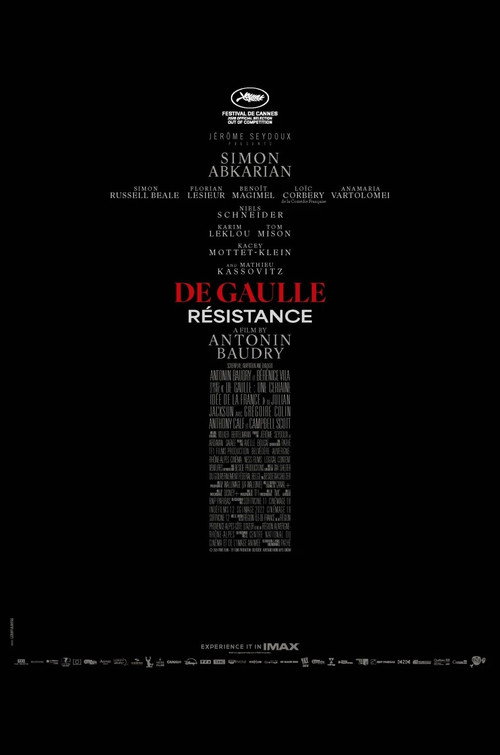
De Gaulle: Résistance
A grand historical tapestry of fierce defiance and isolation, where the voice of an unyielding exile sparks a flame across a continent swallowed by the iron shadow of defeat.
De Gaulle: Résistance

De Gaulle: Résistance

La bataille de Gaulle: L'âge de fer

"The general that refused to surrender."

03 June 2026 France 160 min 7.8 (173)

Director: Antonin Baudry

Cast: Simon Abkarian, Simon Russell Beale, Florian Lesieur, Benoît Magimel, Mathieu Kassovitz

Drama History Defiance, Legitimacy, and Political Faith The Geopolitics of War and Alliance Friction The Multitude of Resistance and Colonial Contribution Moral Duty vs. State Treason The Solitude and Burden of Visionary Leadership
Budget: $25,000,000
Box Office: $18,752,948

Overview

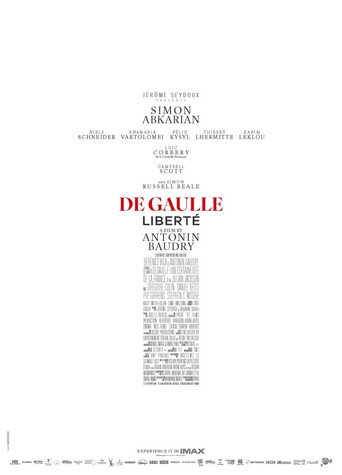
De Gaulle: Résistance (released domestically in France as La Bataille de Gaulle – Partie 1 : L'Âge de fer) is an epic historical drama and geopolitical thriller directed by Antonin Baudry. Adapted from British historian Julian Jackson's acclaimed biography A Certain Idea of France: The Life of Charles de Gaulle, the film serves as the opening chapter of Pathé's ambitious two-part cinematic diptych chronicling Charles de Gaulle's war years.

The narrative opens in June 1940 as France collapses under the blitzkrieg and the Vichy government prepares to sign an armistice with Nazi Germany. Refusing capitulation, an obscure two-star brigadier general named Charles de Gaulle flees to London with virtually no troops, political backing, or financial resources. Armed only with a microphone at the BBC and an unbending conviction, he makes his historic appeal to the French nation and sets out to forge the Free French Forces (la France libre) from the ground up.

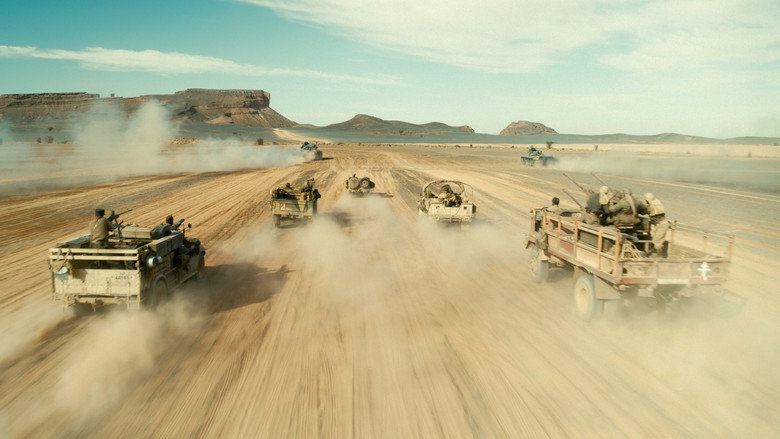
The storyline interweaves high-stakes diplomatic shouting matches in Whitehall between De Gaulle and British Prime Minister Winston Churchill with parallel grassroots resistance movements. As De Gaulle battles Anglo-American skepticism and the legitimacy of the collaborationist Vichy regime, the narrative follows military operations in French Equatorial Africa led by General Leclerc and the deserts of Libya under General Pierre Kœnig at Bir Hakeim, as well as student resistance fighters in occupied France and North Africa.
Core Meaning

Antonin Baudry demystifies the myth of Charles de Gaulle by portraying him not as an infallible bronze monument, but as an obstinate, vulnerable, and politically cunning outsider who engineered France's legitimacy out of sheer willpower.

The central message explores the nature of legitimate authority and true patriotism: when legal state institutions succumb to tyranny and moral compromise, the true spirit of a nation survives only through individual conscience, defiance, and collective sacrifice. Baudry underscores that sovereignty is not merely a legal entitlement, but an active, daily struggle waged against both foreign oppressors and geopolitical allies who would reduce a weakened nation to a subordinate pawn.

Thematic DNA

Defiance, Legitimacy, and Political Faith 30%
The Geopolitics of War and Alliance Friction 25%
The Multitude of Resistance and Colonial Contribution 20%
Moral Duty vs. State Treason 15%
The Solitude and Burden of Visionary Leadership 10%

Defiance, Legitimacy, and Political Faith

De Gaulle constructs a mandate in exile out of nothing, arguing that France's true sovereignty resides in resistance rather than Pétain's capitulation.

The Geopolitics of War and Alliance Friction

De Gaulle's stormy relationship with Winston Churchill and Franklin D. Roosevelt reveals the harsh calculus of Allied diplomacy, where France's postwar standing must be fiercely protected.

The Multitude of Resistance and Colonial Contribution

The narrative highlights that the Free French movement was built across Africa (Chad, Congo, North Africa) by colonial recruits, Foreign Legionnaires, and insurgent youth.

Moral Duty vs. State Treason

The film contrasts soldiers and citizens bound by formal oaths to Vichy with those who chose insubordination to uphold fundamental moral values.

The Solitude and Burden of Visionary Leadership

The personal isolation, family upheaval, and quiet tragedy of leading a movement from foreign soil while branded a traitor and sentenced to death at home.

Character Analysis

Charles de Gaulle

Simon Abkarian

Archetype: Defiant Leader / The Visionary Outcast Key Trait: Unbending stubbornness

Motivation

Rebuild French sovereignty and ensure France's legitimacy through active resistance.

Character Arc

Follows an arc from an unknown, isolated exile in June 1940 to an indispensable international statesman.

Winston Churchill

Simon Russell Beale

Archetype: Pragmatic Ally / The Formidable Benefactor Key Trait: Cantankerous vigor

Motivation

Win the global war for Britain while managing complex Allied alliances.

Character Arc

Balances personal admiration for De Gaulle's defiance with geopolitical frustration over his inflexibility.

All 6 characters and cast

Symbols & Motifs

The BBC Microphone

Meaning:

Symbolizes the reclamation of the French voice; a fragile, physical instrument that transforms words into an international resistance movement.

Context:

Used during Charles de Gaulle's radio appeals broadcast from London to occupied France.

The Peaked Military Képi

Meaning:

Represents De Gaulle's steadfast adherence to formal military honor amidst chaotic political collapse.

Context:

Worn by De Gaulle throughout his exile and diplomatic engagements.

The Desert Fort of Bir Hakeim

Meaning:

Serves as a crucible where French, foreign legionnaires, and colonial soldiers prove under siege that France remains an active military power.

Context:

Featured during the grueling defense led by General Pierre Kœnig in the Libyan desert.

Radio Static and Phonograph Records

Meaning:

An auditory motif reflecting censorship, distance, and the fragile connection between exiled leaders and the French public.

Context:

Heard during radio transmissions and communication sequences across occupied territories.

The Shadow of the Arc de Triomphe

Meaning:

A visual reminder of national pride standing under foreign occupation, inspiring underground demonstrations.

Context:

Appears in scenes depicting occupied Paris and student resistance activities.

Memorable Quotes

Quoi qu'il arrive, la flamme de la résistance française ne doit pas s'éteindre et ne s'éteindra pas.
— Charles de Gaulle

Context

Spoken during his historic June 18, 1940 radio appeal from the BBC studios in London.

Meaning

The cornerstone thesis of the entire diptych, crystallizing De Gaulle's absolute refusal to accept defeat.

Vous me reprochez d'être intraitable. Mais je n'ai rien d'autre que mon intransigeance pour faire respecter la France !
— Charles de Gaulle

Context

Shouted at Winston Churchill during a stormy conference over Allied strategy in Africa and the Levant.

Meaning

Captures the core paradox of De Gaulle's exile: possessing neither an army nor a treasury, stubborn dignity was his only diplomatic weapon.

All 4 quotes

Philosophical Questions

What constitutes legitimate authority when legal institutions submit to tyranny?

The film questions whether loyalty is owed to statutory laws (Pétain's government) or to fundamental ethical values (the Republic).

Can political intransigence be a moral necessity rather than a character flaw?

De Gaulle's refusal to compromise with powerful allies demonstrates when stubbornness becomes essential for national survival.

Is history driven by collective material forces or the will of singular individuals?

The tension between mass resistance in France and De Gaulle's unilateral decisions in London tests the limits of individual agency in history.

Alternative Interpretations

The Classical Heroic Reading: The film functions as an uncompromising tribute to French perseverance, vindicating the 'Great Man' theory of history where single-minded obstinacy reshapes destiny.The Critical Anti-Imperial Reading: A portrait exposing the ironies of Free France: De Gaulle's London leadership was completely dependent on colonial territories and African soldiers (tirailleurs) to prov...

Full ending explanation

Cultural Impact

The release of De Gaulle: Résistance in 2026 coincided with a wave of major French cinematic reflections on World War II (alongside László Nemes' Moulin and Emmanuel Marre's A Man of His Time). Against a backdrop of contemporary geopolitical crises and domestic political realignment in France, Baudry's film re-interrogates Gaullism—the rare historical reference point claimed across all sides of modern French political discourse. The film was praised for reviving the grand tradition of European epic cinema (such as The Longest Day and A Bridge Too Far) while infusing it with contemporary political sharpness.

Audience Reception

Critics and audiences widely lauded Simon Abkarian's nuanced, magnetic portrayal of De Gaulle—capturing his vocal cadence, awkward physical stature, and razor-sharp intellect without turning him into a caricature. The battle sequences (especially Bir Hakeim) and the sharp dialogue sparring between Abkarian and Simon Russell Beale (Churchill) received high acclaim.

Some international critics noted that the massive scope occasionally caused the film to resemble a fast-paced historical pageant, with certain secondary storylines and female characters receiving limited screen time. Overall, it was widely recognized as a major commercial and critical success in French cinema, balancing blockbuster production values with historical intelligence.

Interesting Facts

  • Screenwriter-director Antonin Baudry and co-writer Bérénice Vila adapted the script directly from British historian Julian Jackson's monumental 900-page work A Certain Idea of France: The Life of Charles De Gaulle.
  • Produced by Pathé alongside TF1 Films Production, the two-part film project carries an overall budget exceeding €70 million, making it France's biggest cinematic production of 2026.
  • The film received a high-profile Out of Competition world premiere at the 79th Cannes Film Festival on May 20, 2026, receiving a standing ovation.
  • To depict the Battle of Bir Hakeim and the campaigns in Chad and Libya, the production shot large-scale combat sequences with practical armor, sandstorms, and authentic period aircraft rather than relying exclusively on CGI.
  • The orchestral score for Part 1 was composed by Oscar winner Volker Bertelmann (Hauschka), creating an industrial, percussive musical atmosphere to reflect the 'Age of Iron'.
  • In France, Part 1 opened in theaters on June 3, 2026, followed closely by Part 2 (J'écris ton nom / De Gaulle: Liberté) on June 26/July 3, 2026, recreating an episodic cinematic event for audiences.

Easter Eggs

Paul Éluard's Poetic Link

The titles of the two films (L'Âge de fer and J'écris ton nom) form an artistic progression directly citing Paul Éluard's famous clandestine resistance poem Liberté ('Et par le pouvoir d'un mot / Je recommence ma vie / ... J'écris ton nom').

Thierry Lhermitte's Cameo/Role

Thierry Lhermitte, who famously played the eccentric foreign minister Alexandre Taillard de Vorms in Antonin Baudry's acclaimed satirical adaptation Quai d'Orsay (2013), makes a featured appearance in the film.

Colonel Passy and French Intelligence

The film includes appearances by André Dewavrin (known as 'Colonel Passy,' played by Pablo Cobo), highlighting the secretive founding of the BCRA (Bureau Central de Renseignements et d'Action) in London.

Félix Éboué and Colonial Honor

The script explicitly honors Chad Governor Félix Éboué (played by Vincent Fontano), who became the very first colonial administrator to rally to De Gaulle in August 1940, securing crucial territory for Free France.

Frequently Asked Questions

Explore More About This Movie

Dive deeper into specific aspects of the movie with our detailed analysis pages

Comments (0)

Leave a comment

No comments yet. Be the first to share your thoughts!

Similar Movies