Skip to content
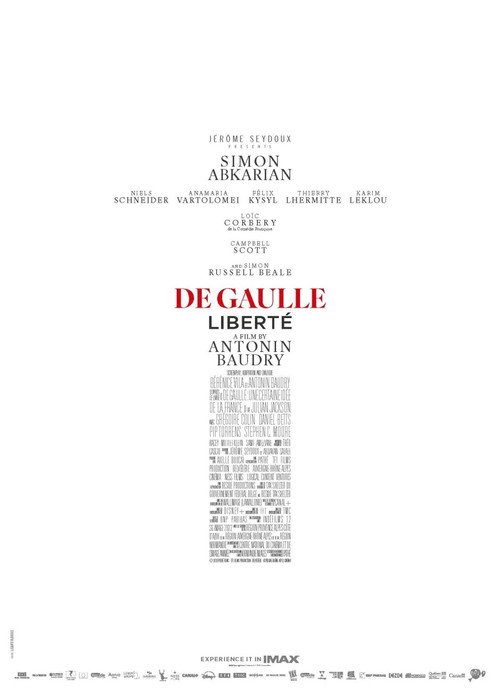
De Gaulle: Liberté
A soldier's exile hardens into a nation's dawn: the second half of Antonin Baudry's epic follows a stubborn silhouette from the desert to Paris, where a poem's word is finally written in daylight.
De Gaulle: Liberté

De Gaulle: Liberté

La Bataille de Gaulle : J’écris ton nom

26 June 2026 France 159 min 7.8 (175)

Director: Antonin Baudry

Cast: Simon Abkarian, Niels Schneider, Thierry Lhermitte, Karim Leklou, Anamaria Vartolomei

Drama History Legitimacy and the invention of a state Disobedience as a form of loyalty The man behind the monument The long road home Words as weapons
Budget: $25,000,000
Box Office: $13,764,497

Overview

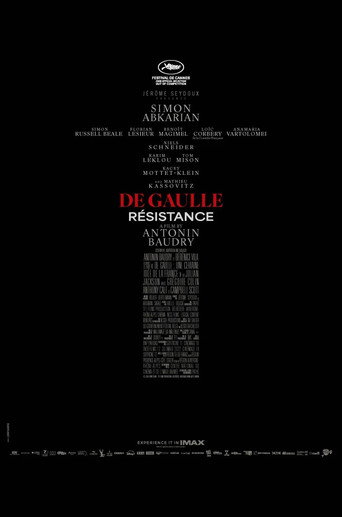
De Gaulle: Liberté — released in France as La Bataille de Gaulle — Partie 2 : J'écris ton nom — is the concluding half of Antonin Baudry's two-part epic on Charles de Gaulle, adapted with co-writer Bérénice Vila from Julian Jackson's biography A Certain Idea of France: The Life of Charles de Gaulle. Where the first instalment, L'Âge de fer (internationally Résistance), covered the birth of Free France from London, this part carries the story forward from the North African campaign in Libya through the Landings to the Liberation of Paris.

Simon Abkarian returns as de Gaulle, no longer the isolated voice of a radio broadcast but the contested head of a movement that must be turned into a state. The film's second great figure is General Philippe Leclerc, played by Niels Schneider, whose expanded presence here supplies the movement and momentum: his intransigence and his taste for disobedience rhyme with de Gaulle's own, and his armoured column provides the narrative thread that runs to the capital.

Baudry, returning to directing seven years after Le Chant du loup, treats the material less as a battle chronicle than as a study of legitimacy — how a man with no army, no territory and no mandate persuades allies, rivals and an occupied country that he speaks for France. Critics described this second part as more lyrical than the first, and its title borrows the closing refrain of Paul Éluard's poem Liberté.
Core Meaning

Baudry's subject is not victory but legitimacy: the question of who is entitled to speak in the name of a country that has, officially, surrendered. The diptych's structure makes the argument — the first film is iron, refusal and solitude; the second is the slow, costly conversion of that refusal into a recognised nation.

By building the film around Julian Jackson's biographical account rather than around hagiography, and by casting an actor who, in his own words, was torn away from the icon's pedestal in order to be rehumanised, the film insists that the monument was a man: obstinate, difficult, often alone, frequently wrong about people and unshakeable about principle.

The Éluard borrowing in the title carries the final claim. Liberté is a word one writes before one possesses it — on school notebooks, on sand, on ruins. The film proposes that Free France was exactly that: a name written first and made true afterwards, by soldiers like Leclerc who insisted on marching under it.

Thematic DNA

Legitimacy and the invention of a state 30%
Disobedience as a form of loyalty 25%
The man behind the monument 20%
The long road home 15%
Words as weapons 10%

Legitimacy and the invention of a state

De Gaulle's central battle in this half is not military but political: convincing the Allies, rival French factions and the occupied population that a movement born in exile is the lawful France. The film dramatises this through negotiation, humiliation and refusal rather than through combat.

Disobedience as a form of loyalty

Leclerc, as written for Niels Schneider, mirrors de Gaulle: both make insubordination a moral instrument, disobeying immediate orders in the name of a higher fidelity to France. Their kinship gives the narrative its through-line from Libya to the capital.

The man behind the monument

The film systematically undercuts the statue: the physical labour of Abkarian's transformation, the stiffness, the loneliness and the private cost are foregrounded so that the historical icon is returned to human scale.

The long road home

Geography carries the emotion — desert, sea, landing beaches, then Paris. Distance is measured not in kilometres but in years of exile, and the arrival is treated as the closing of a wound rather than a triumph.

Words as weapons

From the London broadcasts inherited from the first part to the Éluard poem that gives the film its title, language is shown to be the Free French army's first materiel: a name, repeated, becomes a fact.

Character Analysis

Charles de Gaulle

Simon Abkarian

Archetype: Reluctant founder / obstinate hero Key Trait: Intransigence

Motivation

To ensure that France is present at its own liberation, and therefore to guarantee it a place among the victors rather than the defeated.

Character Arc

Having survived exile and marginality in the first part, he moves from contested outsider to the recognised head of a fighting France — but the film tracks the cost: the isolation deepens even as the authority grows.

General Philippe Leclerc

Niels Schneider

Archetype: Loyal insurgent / the disciple who is also a double Key Trait: A taste for disobedience

Motivation

To bring French soldiers, under French command, into Paris — to make the liberation an act performed by the French themselves.

Character Arc

Given considerably more space than in the first film, he carries the action from the North African campaigns to the gates of the capital, his career becoming the concrete form of de Gaulle's abstraction.

Symbols & Motifs

The written name

Meaning:

Taken from Éluard's refrain, the act of writing liberty stands for asserting something that does not yet exist — a promise inscribed before it can be kept.

Context:

Embedded in the French title itself, the motif frames the whole film: the Free French cause exists first as a word spoken and written, and only afterwards as territory reconquered.

The armoured column

Meaning:

Leclerc's advancing division embodies continuity and stubborn forward motion — the physical proof of the abstraction de Gaulle has been defending.

Context:

Introduced in the desert campaigns and followed until its entry into Paris, it is the film's spine and the image that closes the diptych's argument.

The desert

Meaning:

Emptiness and trial: the wilderness where a movement with no country proves it can fight.

Context:

The Libyan sequences open the second part, placing the Free French in a landscape stripped of everything except conviction.

The immobile silhouette

Meaning:

De Gaulle's rigid, over-tall bearing functions as a symbol of intransigence — a body that refuses to bend as a stand-in for a nation refusing to capitulate.

Context:

Built literally, through Abkarian's daily prosthetic transformation, and used throughout as the film's recurring compositional signature.

Paris

Meaning:

Not merely a military objective but the proof of legitimacy: whoever enters the capital first defines what France will become after the war.

Context:

The city is the film's horizon line, invoked long before it is reached, and its liberation forms the climax.

Philosophical Questions

Who has the right to speak in the name of a nation?

De Gaulle holds no mandate, no territory and, initially, almost no troops, yet claims to be France. The film treats legitimacy as something asserted and then earned rather than conferred, and lets allies and rivals contest that claim at every stage.

When is disobedience the highest form of loyalty?

Both de Gaulle and Leclerc build their careers on refusing orders. By pairing them, the film asks whether fidelity to a principle can justify betrayal of a hierarchy — and declines to make the answer comfortable.

Can a word create a reality?

The Éluard title places the act of naming at the centre: liberty is written before it exists. The film follows that written name across the desert and the beaches until, in Paris, it briefly coincides with the world.

What does greatness cost the person who carries it?

Through Abkarian's laboriously constructed physical mask and the character's increasing isolation, the film weighs the price of becoming a symbol: the more completely de Gaulle succeeds as an emblem, the less of him remains available as a man.

Alternative Interpretations

The film as national reconciliation. One reading takes the Liberation finale at face value: a country divided by defeat is restored to itself, and de Gaulle's obstinacy is retrospectively vindicated. Audiences, whose ratings ran considerably higher than the critics', largely responded to the film in this register.

Full ending explanation

Cultural Impact

The project arrived as an event of French industrial cinema as much as a historical film: with a combined budget of some 74 to 85 million euros it ranks among the most expensive French productions ever made, and its release as two theatrical features rather than a series was itself an argument for the big screen at a moment of streaming dominance. The production's insistence on shooting in France — documented by the CNC under the banner 'impossible to shoot anywhere but in France' — gave it an additional patrimonial dimension.

Its lineage is literary and scholarly rather than mythological: by adapting the British historian Julian Jackson's biography, Baudry aligned the film with a revisionist, humanising strain of Gaullian historiography rather than with commemorative tradition. The Éluard citation in the title connects it to the poetic memory of the Occupation, and the emphasis on Leclerc redistributes the legend across more than one figure.

Reception was strong but not unanimous. On AlloCiné the film registered a press average of 3.5 out of 5 across 38 reviews against a markedly warmer spectator score of 4.4 out of 5 — the gap itself became part of the conversation, with several outlets, Écran Large among them, filing sharply negative verdicts while other critics called the second part a remarkable and striking conclusion and the confirmation of a success. Box office followed the usual pattern for a diptych, the first part taking around $19.4 million and the second around $13.8 million.

Audience Reception

The gap between the two constituencies is the story: on AlloCiné the film drew a press average of 3.5 out of 5 from 38 reviews against a spectator average of 4.4 out of 5. General audiences embraced it as the payoff the diptych had promised, praising Simon Abkarian's transformation — widely singled out as the film's centre of gravity — the scale and craft of the reconstruction, and the greater emotional openness of this half compared with the austere first part.

Favourable critics called it a remarkable and striking conclusion to an ambitious project, more lyrical than L'Âge de fer, and credited the ensemble for being in harmony with a rich and bold screenplay; the enlarged role of Niels Schneider's Leclerc was frequently cited as what gives the second film its drive.

The dissenting camp was blunt. Écran Large headlined its review as a general debacle, and scepticism generally clustered around the same points: the length and structural demands of a two-part release, the risk of reverence flattening the portrait, and the sense that the historical set pieces sit uneasily with the intimate study underneath. Commercially the second part took around $13.8 million against the first part's $19.4 million, the customary attrition for a sequel-shaped release.

Verdict: a divisive prestige epic that satisfied the public more than the press, carried by its lead performance and by the Leclerc thread that finally gives the diptych forward motion.

Interesting Facts

  • The two-part project had an estimated combined budget of 74 to 85 million euros — roughly 37 million per instalment — making it one of the most expensive French productions ever mounted.
  • The film adapts Julian Jackson's non-fiction biography 'A Certain Idea of France: The Life of Charles de Gaulle'; Antonin Baudry co-wrote the screenplay with Bérénice Vila.
  • Simon Abkarian spent 1 hour 40 minutes in the make-up chair before every shooting day: his forehead was shaved, his eyebrows plucked, ear prosthetics applied and special make-up used to reshape his eyelids.
  • Abkarian said the filmmakers had 'the intelligence to tear him away from his iconic place and breathe life, madness, and rehumanise him' rather than embalm the general.
  • Shooting on the second part resumed in June 2024 in France and wrapped on 12 July of that year.
  • The production was shot in France; a CNC feature on the making-of ran under the line 'Impossible to shoot anywhere but in France'.
  • Abkarian was first approached for the role of de Gaulle in May 2023, with his casting officially confirmed in August 2023; Niels Schneider was announced as General Leclerc.
  • The diptych marks Antonin Baudry's return to directing seven years after his submarine thriller 'Le Chant du loup' (2019).
  • The films premiered at the Cannes Film Festival in May 2026 before opening in France on 3 June 2026 ('Résistance' / 'L'Âge de fer') and 26 June 2026 ('Liberté' / 'J'écris ton nom').
  • The first part grossed around $19.4 million and the second around $13.8 million.

Easter Eggs

The French title 'J'écris ton nom'

It is the recurring closing line of Paul Éluard's Resistance-era poem Liberté — 'sur mes cahiers d'écolier… j'écris ton nom' — a text that was famously air-dropped over occupied France. Naming the film after the refrain, and leaving the word Liberté itself to the international title, turns the poem into an unspoken presence the audience is invited to complete.

The paired titles of the diptych

Part one is L'Âge de fer (The Iron Age), part two J'écris ton nom: metal against writing, refusal against promise. The pairing announces the structural argument of the whole project before a frame is seen.

Frequently Asked Questions

Explore More About This Movie

Dive deeper into specific aspects of the movie with our detailed analysis pages

Comments (0)

Leave a comment

No comments yet. Be the first to share your thoughts!

Similar Movies