Skip to content
The Rays and Shadows
A three-hour French historical fresco about a father and daughter who chose the wrong side — glamour and guilt lit like a newsreel burning slowly from the edges inward.
The Rays and Shadows

The Rays and Shadows

Les Rayons et les Ombres

18 March 2026 France 199 min 7.5 (110)

Director: Xavier Giannoli

Cast: Jean Dujardin, Nastya Golubeva Carax, August Diehl, Olivier Chantreau, Anna Próchniak

Drama History Collaboration as ambition rather than ideology Fathers, daughters and inherited guilt Cinema, celebrity and the manufacture of consent Occupation as social life Judgement, memory and the grey zone
Budget: $35,000,000

Overview

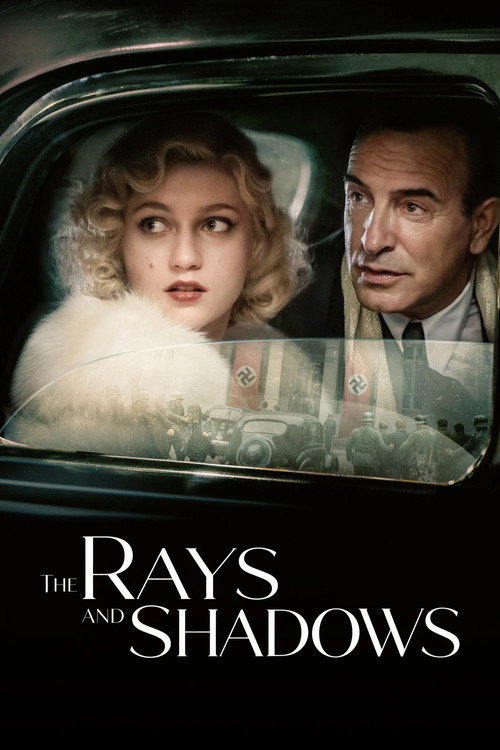
Xavier Giannoli's Les Rayons et les Ombres returns to Occupied France to tell the true story of Jean Luchaire, the influential French journalist who became one of the most visible voices of collaboration with Nazi Germany, and of his daughter Corinne, a young cinema star whose celebrity was inseparable from her father's political ascent. Around them orbits Otto Abetz, Germany's ambassador in Paris, a cultivated Francophile whose charm is the instrument of an occupation.

Narrated by Corinne, the film follows the family's rise through Parisian salons, editorial offices and film sets, where dinners, press deadlines and premieres gradually reveal themselves as the machinery of a regime. Giannoli, who developed the project over some seven years with the help of historians including Pascal Ory, deliberately refuses the familiar division of wartime France into heroic resisters and cartoon traitors, following instead the small accommodations, vanities and appetites through which ordinary ambition becomes complicity.

Running roughly three hours and fifteen minutes and produced by Gaumont on a budget of about €30.6 million, it is one of the largest French productions of its year: a period reconstruction of crowds, costumes and interiors built at the scale of a nineteenth-century novel, but pointed at the twentieth century's most uncomfortable French question — not who collaborated, but how a person talks themselves into it.
Core Meaning

The film's governing idea is announced by its title, borrowed from Victor Hugo's 1840 collection: light and shadow are not two camps but two aspects of the same person. Giannoli's wager is that collaboration is best understood not as monstrousness but as vanity given historical opportunity — the desire to be seen, published, invited, applauded, arriving at a moment when the price of those things happens to be a country.

By telling the story through a daughter's voice, the film makes a second argument: that political guilt is inherited without being chosen. Corinne is both an accomplice and a child, both a beneficiary and a casualty, and the film refuses to resolve her into either. What Giannoli seems to want to say is that a society which insists on absolute moral clarity after the fact will never understand how it lost that clarity in the first place — and that understanding is not absolution. The film asks its audience to sit inside the grey zone long enough to recognise the mechanisms, because those mechanisms are not historical curiosities.

Thematic DNA

Collaboration as ambition rather than ideology 28%
Fathers, daughters and inherited guilt 24%
Cinema, celebrity and the manufacture of consent 20%
Occupation as social life 16%
Judgement, memory and the grey zone 12%

Collaboration as ambition rather than ideology

The film's central proposition is that Jean Luchaire is not driven by conviction but by appetite: influence, money, access, the pleasure of mattering. Critics repeatedly noted the film's refusal of Manichaeism, and its dramaturgy bears this out — the treason is assembled from a hundred professional decisions, each individually defensible, that only become monstrous in aggregate. Giannoli described entering the film through the destinies of three people rather than through a thesis, and the result is a portrait of betrayal as a career.

Fathers, daughters and inherited guilt

Corinne narrates, and so the film is finally about what a child owes and inherits. Her stardom is her father's gift and her father's alibi; her love for him is genuine and disqualifying at once. The father–daughter duo — praised as the film's strongest axis — turns a political chronicle into a domestic tragedy in which love is the delivery mechanism for ruin.

Cinema, celebrity and the manufacture of consent

A collaborationist newspaperman and a film actress are two faces of the same industry: image production. The film watches Corinne's screen fame and her father's editorials as parallel factories of appearance, and lets glamour work on the viewer exactly as it worked on Paris — seductively, and with the meter running.

Occupation as social life

Rather than tanks and roundups, Giannoli stages the Occupation as dinners, receptions and cultural diplomacy, with Otto Abetz as its smiling impresario. The horror is kept at the edge of the frame precisely so that the audience experiences the comfort that made it possible — the film's most disturbing claim is how pleasant the shadow felt from inside.

Judgement, memory and the grey zone

The narration is retrospective, which means every scene is already evidence at a trial. The film examines how a nation composes its own account of itself afterwards, and how the survivors of disgrace are sentenced twice — once by a court and once by memory. The public argument that greeted the film's release became, unintentionally, part of this theme.

Character Analysis

Jean Luchaire

Jean Dujardin

Archetype: Antihero / tragic opportunist Key Trait: Charm deployed as a survival instinct

Motivation

To be central. Influence, money, and the intoxication of proximity to power — with the sincere belief, maintained to the end, that he was serving France by managing its defeat.

Character Arc

From ambitious, gregarious journalist to the emblematic voice of collaboration, and finally to a defendant with nothing left to sell. Dujardin — in a performance critics called brilliant and exceptional — plays him without villainy, which is what makes the descent legible: he never decides to betray, he only ever decides to advance.

Corinne Luchaire

Nastya Golubeva Carax

Archetype: Narrator / compromised innocent Key Trait: Luminous complicity

Motivation

Love of her father and hunger for the life he provides — and, retrospectively, the need to tell the truth about both without being forgiven for it.

Character Arc

From celebrated young screen actress to a woman narrating her own ruin. Hailed as the film's discovery, she moves from inheriting her father's world without questioning it, to seeing it clearly far too late, to becoming the one who must live with the account.

All 3 characters and cast

Symbols & Motifs

Rays and shadows (the Hugo title)

Meaning:

Taken from Victor Hugo's 1840 poetry collection, where the pairing evokes the duality of life and knowledge against death and ignorance. In the film it becomes the moral grammar: no character is only lit or only dark, and light itself is what casts the shadow.

Context:

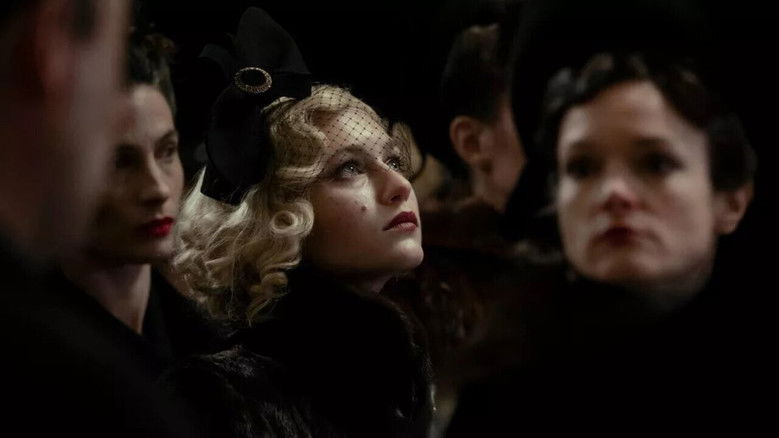
The title governs the film's design — faces half in lamplight, a star lit for the camera while the room behind her goes black — and reframes a political subject as a question about human doubleness.

The newspaper

Meaning:

The printed page as the instrument of collaboration: opinion turned into infrastructure. It symbolises how words, not weapons, do the work of an occupation.

Context:

Luchaire's journalism is the engine of his ascent and the material record that will convict him; the same pages that make him indispensable become the exhibit against him.

The film set and the screen

Meaning:

Performance as survival and as self-deception. Corinne's profession literalises the family's central activity: playing a version of themselves that they can bear to watch.

Context:

Her career is inseparable from her father's protection, so every shot of her acting is also a shot of the arrangement that pays for it.

The dinner table and the reception

Meaning:

Hospitality as politics. The banquet is where sovereignty is quietly handed over, one course at a time.

Context:

The Franco-German social world orchestrated around Abetz is staged as seduction rather than coercion, making conviviality the film's most compromising image.

Illness and the failing body

Meaning:

The physical decline that shadows Corinne reads as history entering the body — the private cost of a public disgrace, and a reminder that the reckoning outlives the verdict.

Context:

Her fragility is present long before the fall, so that the collapse of a regime and the collapse of a young woman's health rhyme rather than merely coincide.

Philosophical Questions

Is complicity a decision, or an accumulation of small non-decisions?

The film never stages a scene where anyone chooses treason. It stages dinners, commissions, deadlines and favours, and lets the audience notice — far later than the characters — that the choice was made distributively, in fragments none of which felt like a choice.

Does understanding someone excuse them?

Giannoli's refusal of Manichaeism forces the viewer to hold two positions at once: comprehension of how a man like Luchaire came to be, and refusal of what he did. The film's structure — an intimate account narrated by someone who loved him — keeps testing whether those two positions can coexist, which is exactly the tension that made the film controversial.

What does a child inherit from a parent's guilt?

Corinne is a beneficiary before she is old enough to be an accomplice, and is judged for a world she was born into. Through her the film asks whether guilt is transferable, and whether being punished for it is justice or merely the continuation of the same arbitrariness.

Can charm be a form of violence?

Abetz's cultivated Francophilia and Luchaire's warmth are the film's most effective weapons. By making seduction the mechanism of occupation, the film proposes that pleasantness can accomplish what coercion cannot — and that the seduced are not simply victims.

Who owns the story a nation tells about its worst years?

Narrated in retrospect by a disgraced woman, the film is an act of testimony from a source no one wants to believe. It raises the question of whether the discredited have the right to describe history — and what a country loses by refusing to listen.

Alternative Interpretations

As indictment. One reading takes the film as a straightforward, devastating prosecution: by showing how banal and sociable the path to treason was, Giannoli makes the guilt worse rather than lighter, since nothing exotic explains it. Under this view the absence of moralising is the moral position.

Full ending explanation

Cultural Impact

Arriving in March 2026 as one of the year's largest French productions, the film re-opened the most sensitive drawer in French national memory: not the Resistance, but the Occupation's collaborators, and specifically the Parisian press and cultural elite that made accommodation respectable. Critics singled out its refusal of Manichaeism — its willingness to treat the standard opposition of virtuous resisters and evil collaborators as a comforting simplification — and several reviews framed it explicitly as a study of the "grey zone."

That ambition made it contentious. The film drew political criticism, and Giannoli and Dujardin publicly pushed back, with the director arguing that attacking a film on political grounds while distorting the facts is illegitimate; his defence rested on the seven years of historical research behind the script, including consultation with historian Pascal Ory. The debate itself became part of the film's reception: a picture about how a society narrates its own compromises promptly generated an argument about how that society is allowed to narrate them.

Formally, the film was received as a continuation of Giannoli's project in Illusions perdues — a self-consciously novelistic, "Balzacian" cinema of ambition, journalism and social climbing — transplanted from the Restoration to the Occupation. Coming from a director whose previous film swept seven Césars, and mounted at €30.6 million by Gaumont, it stands as an argument that the large-scale literary historical fresco remains viable in French cinema.

Audience Reception

Praised: Jean Dujardin's performance drew the strongest consensus, described in reviews as brilliant and exceptional — a career-scale turn in which charm and rot are inseparable. Nastya Golubeva Carax was widely treated as the film's discovery, and the father–daughter duo as its emotional engine. Reviewers also admired the scale and craft of the reconstruction, the novelistic, "Balzacian" density of the writing, and above all the film's willingness to look at a complicated reality without ideological convenience; one Swiss outlet gave it a maximum five-star rating.

Criticised and debated: The runtime of roughly 3h15 is the most common practical reservation, with the film's density cutting both ways — ambitious for some viewers, demanding and dispersed for others. The larger controversy is political: whether a sympathetic, interiorised portrait of collaborators is courageous or complacent. Giannoli and Dujardin answered these attacks directly in the press, with the director insisting that criticising a film politically while misrepresenting the facts is not legitimate, and pointing to seven years of historical research.

Verdict: A major, divisive French film — received as one of the most serious attempts in years to dramatise the Occupation without heroes or monsters, admired for its performances and scope, and argued over precisely because it succeeds at making collaboration comprehensible.

Interesting Facts

  • Xavier Giannoli developed the project for roughly seven years, and says he discovered the story while reading a biography of Jean Luchaire.
  • Giannoli approached Jean Dujardin about the role seven years before release; Dujardin's response was that while something about it frightened him, something also tempted him.
  • The director consulted historians during his research, including Pascal Ory, telling him that given the sensitivity of the subject any falsehood would not be forgiven.
  • The title is borrowed from Victor Hugo's 1840 poetry collection Les Rayons et les Ombres, in which the pairing evokes the duality of life and knowledge against death and ignorance.
  • The film was produced by Gaumont on a budget of about €30.6 million, making it one of the most ambitious French productions of 2026, with large-scale period reconstruction, crowd scenes and costume work.
  • It runs approximately 3 hours and 15 minutes and was released in France on 18 March 2026.
  • It marks Giannoli's return five years after Illusions perdues, which won seven César Awards including Best Film.
  • Giannoli has said he entered the story through the destinies of three characters — Jean Luchaire, his daughter Corinne, and the German ambassador Otto Abetz — rather than through a historical thesis.
  • The film is structured around Corinne's narration, giving a collaborationist chronicle the shape of a daughter's memoir.
  • Ahead of and around its release, Giannoli and Dujardin publicly answered political criticism of the film, with Giannoli objecting that criticising a film for political reasons while misrepresenting the facts is not acceptable.

Easter Eggs

The Victor Hugo title

Naming a film about collaboration after an 1840 Hugo collection quietly enlists the great republican poet — the moral conscience of nineteenth-century France, and its most famous political exile — as a silent witness over a story about French people who chose the other side. The borrowed phrase does the film's thesis work before a single scene plays.

A film star inside a film about image-making

Casting the story's emotional centre as an actress lets Giannoli fold cinema into its own subject: the audience watches a screen performer being used by a propaganda machine, in a film that must itself seduce with glamour to make its point. It also connects the picture to Giannoli's recurring interest — from Illusions perdues onward — in how media manufactures reputation.

Frequently Asked Questions

Explore More About This Movie

Dive deeper into specific aspects of the movie with our detailed analysis pages

Comments (0)

Leave a comment

No comments yet. Be the first to share your thoughts!

Similar Movies