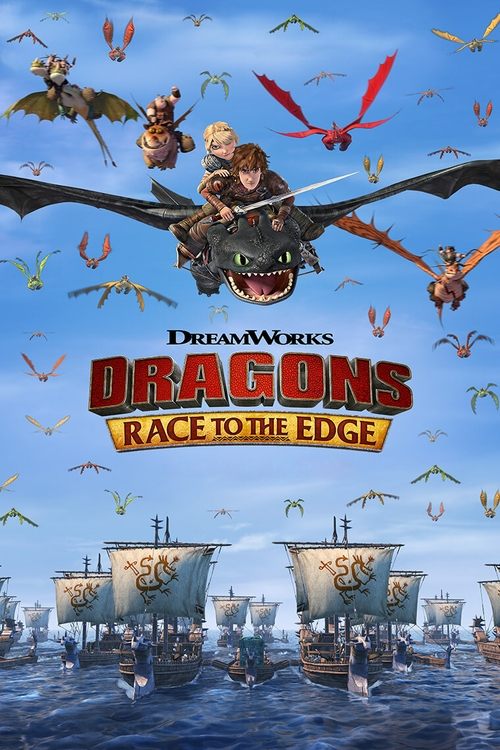
Dragons: Race to the Edge
Overview
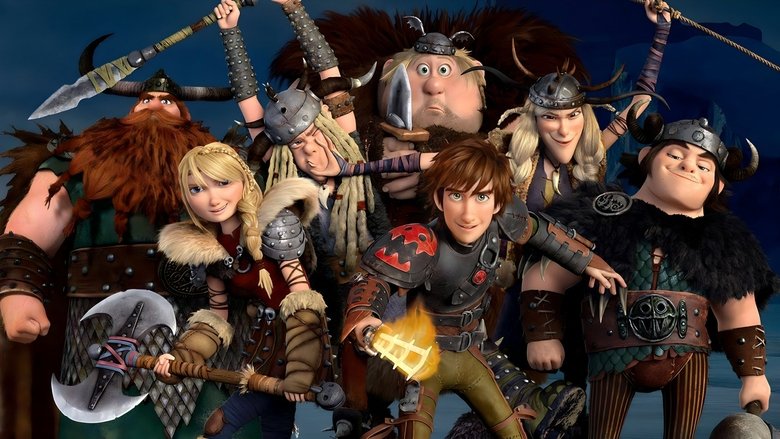
Dragons: Race to the Edge bridges the gap between the first How to Train Your Dragon film and its sequel, following Hiccup and the Dragon Riders as they journey beyond the borders of Berk. After discovering the mysterious Dragon Eye, an ancient artifact that projects maps and dragon secrets, the riders establish a new base of operations called Dragon's Edge. This outpost serves as their home and headquarters as they explore uncharted territories, discover new dragon species, and face threats far more dangerous than they ever encountered at home.
The series is defined by its escalation of stakes, introducing complex villains like the intellectual Viggo Grimborn and his Dragon Hunters, who challenge Hiccup not just physically, but strategically and philosophically. As the seasons progress, the show weaves a continuous narrative of war, betrayal, and alliance. It deeply explores the personal growth of each rider, transitioning them from the awkward teenagers of the first film to the competent, independent young adults seen in the second.
Ultimately, the series sets the stage for the darker tone of the second movie. It fills in crucial lore gaps, explaining the origins of Hiccup's flight suit and dragon blade, the evolution of his relationship with Astrid, and the rising threat of Drago Bludvist, whose army begins to form in the shadows of the series finale.
Core Meaning
The Transition from Follower to Leader. While the films focus on the bond between human and dragon, Race to the Edge is fundamentally about the burden of independence. The series posits that true adulthood isn't just about freedom; it's about the responsibility that comes with making your own choices, defining your own morality in a gray world, and accepting the consequences of leading others into danger.
Thematic DNA
Strategic Morality vs. Ruthless Pragmatism
Through the rivalry between Hiccup and Viggo Grimborn, the series explores two opposing worldviews. Viggo views the world as a game of Maces and Talons, where pieces (and lives) are expendable for the sake of victory. Hiccup, conversely, refuses to sacrifice anyone. This theme evolves as Hiccup learns that unwavering idealism has a cost, and Viggo eventually learns that some bonds transcend calculation.
Redemption and Second Chances
The series offers one of the most significant redemption arcs in modern animation through Dagur the Deranged. Initially a chaotic, murderous villain, Dagur's journey to finding a family (his sister Heather) and a purpose beyond violence demonstrates that no one is beyond saving if they are willing to do the work. This theme is echoed in the late-series turn of Viggo.
The Burden of Independence
Leaving Berk to build Dragon's Edge symbolizes the riders moving out of their parents' shadows. The theme is explored through the practical struggles of running a base, the interpersonal conflicts of living together, and the realization that they can no longer rely on Stoick to save them. It creates the competent team dynamic seen in the second film.
Trust and Betrayal
The series masterfully utilizes the long-con betrayal through the character of Trader Johann. For seasons, he is a comic relief ally, making his eventual reveal as a mastermind devastating. This teaches the riders (and the audience) that evil often wears a friendly face, a hard lesson in their maturation.
Character Analysis
Hiccup Horrendous Haddock III
Jay Baruchel
Motivation
To explore the world and protect dragons, eventually shifting to stopping the Dragon Hunters from extinguishing them.
Character Arc
Hiccup transforms from a curious explorer into a battle-hardened chief-in-waiting. He starts the series seeking adventure but ends it understanding the heavy price of leadership. His rivalry with Viggo forces him to outthink his enemies rather than just outfly them. By the end, he has developed the inventions (flight suit, inferno blade) and the mindset necessary for HTTYD 2.
Astrid Hofferson
America Ferrera
Motivation
To protect Hiccup and the team, and to prove her own competence as a leader.
Character Arc
Astrid softens her edges without losing her strength. She transitions from being just the 'muscle' to being Hiccup's true partner and second-in-command. The series develops their romance ('Hiccstrid') from awkward teasing to a committed partnership, culminating in their betrothal interactions.
Dagur the Deranged
David Faustino
Motivation
Initially revenge and power; later, family and acceptance.
Character Arc
Dagur begins as a crazed antagonist obsessed with killing Hiccup. Through the discovery that Heather is his sister, he finds a reason to love rather than hate. His arc is a slow, painful climb from madness to heroism, culminating in him sacrificing his ambition to save his family.
Viggo Grimborn
Alfred Molina
Motivation
To win the game of commerce and war; later, to correct his final mistake.
Character Arc
Viggo is Hiccup's dark reflection—a brilliant strategist who respects dragons only as resources. He dominates the middle seasons. His arc concludes when he is betrayed by his own superior (Johann/Krogan), leading him to realize that his code of honor has more in common with Hiccup than the ruthless villains he served.
Symbols & Motifs
The Dragon Eye
It symbolizes knowledge and perspective. It literally projects a new way of seeing the world, representing the expansion of the riders' horizons. However, it is also a tool that can be used for exploitation, symbolizing that knowledge itself is neutral—it is the wielder's intent that defines it.
Found in a graveyard of ships, it is the catalyst for the entire series. It unlocks maps and secrets only when combined with specific dragon fire, reinforcing the idea that understanding dragons is the key to unlocking the world.
Maces and Talons
A board game that symbolizes war and strategy. It represents Viggo's worldview that life is a zero-sum game of calculated sacrifices.
Viggo constantly references the game to explain his moves against the riders. The finale of his arc involves him playing a 'final move' that sacrifices himself to save Hiccup, subverting his own philosophy.
Dragon's Edge (The Outpost)
It represents autonomy and the 'college years'. It is a space between the safety of home (Berk) and the danger of the wider world.
The riders literally build it themselves. Its destruction or abandonment at the end of the series signifies the end of this transitional phase of their lives.
Memorable Quotes
There will always be a Hiccup and Astrid.
— Hiccup
Context:
Said during a tender moment (often referenced as the 'Blindside' episode or similar emotional beats) reassuring Astrid of their bond.
Meaning:
Defines the permanence and stability of their relationship amidst the chaos of war. It is a promise of unconditional support.
In Maces and Talons, as in life, the line between good and evil is often unclear. Black and white can become gray so easily.
— Viggo Grimborn
Context:
Spoken to Hiccup during one of their strategic confrontations, explaining his justifications for dragon hunting.
Meaning:
Encapsulates the show's mature exploration of morality. Viggo challenges Hiccup's simplistic view of right and wrong.
You have to look at the whole board, Hiccup.
— Viggo Grimborn
Context:
Recurring advice/taunt from Viggo throughout their rivalry.
Meaning:
A metaphor for strategy and leadership. It pushes Hiccup to stop reacting to immediate threats and start planning for the long term.
Episode Highlights
Dragon Eye of the Beholder (Parts 1 & 2)
The riders discover the Dragon Eye and the concept of 'Dragon's Edge'. It sets the entire premise of the series, introducing the new map and the desire to leave Berk.
Marks the beginning of the 'College Years' era and introduces the central MacGuffin of the series.
Maces and Talons (Parts 1 & 2)
Introduces Viggo Grimborn, the series' best villain. Hiccup is outsmarted for the first time by an enemy who anticipates his every move.
Shifts the tone from adventure to strategic warfare. Proves that Hiccup cannot just out-fly his problems.
Family on the Edge
Dagur reveals he is Heather's brother. The emotional core of the episode revolves around Heather's conflict between her new family (the riders) and her blood (Dagur).
Crucial for the Dagur redemption arc and deepens the lore of the Berserker tribe.
Buffalord Soldier
Astrid is infected with the Scourge of Odin, a fatal disease. Hiccup must find the rare Buffalord dragon to cure her. It is a high-stakes emotional rollercoaster.
Solidifies the depth of Hiccup and Astrid's feelings for each other before they are officially a couple.
Triple Cross
Viggo returns and seemingly betrays Hiccup again, only to reveal it was a double-cross to save him. Viggo sacrifices himself to allow Hiccup to escape.
The conclusion of Viggo's arc, proving he developed respect for Hiccup and finally played a move for something other than self-interest.
King of Dragons (Parts 1 & 2)
The series finale. The riders face the Bewilderbeast (King of Dragons) and the full might of the Dragon Hunters. The Edge is destroyed/abandoned.
Directly leads into the events of How to Train Your Dragon 2, showing the rise of Drago's influence and the reason the riders return to Berk.
Philosophical Questions
Do the ends justify the means?
Viggo argues that sacrificing a few dragons (or people) to win the war is necessary. Hiccup argues that compromising your morals for victory is a defeat in itself. The series validates Hiccup's view, but not without showing the severe personal cost of maintaining that purity.
Is knowledge neutral?
The Dragon Eye contains knowledge that can save dragons or hunt them to extinction. The series explores how technology and information are morally neutral, and it is the responsibility of the user to ensure they are used for good.
Alternative Interpretations
The 'Game of Thrones' for Kids: Critics often noted the political complexity of the show, particularly the faction wars between the Dragon Hunters, Defenders of the Wing, and Wingmaidens. Some interpret the series as a political drama where Hiccup learns statecraft, not just dragon training.
Viggo as Future Hiccup: An interpretation exists that Viggo represents what Hiccup could have become if he let his intellect detach from his empathy. Viggo's redemption suggests that intellect alone is empty without the moral compass that Hiccup provides.
Cultural Impact
Dragons: Race to the Edge is widely regarded as one of the best TV spin-offs of a major animated franchise. It successfully deepened the lore of the universe, introducing fan-favorite dragons like the Death Song and the Triple Stryke.
Culturally, it set a high bar for Netflix original animated series, showing that 'kids' shows' could have complex, serialized narratives with genuine character development and stakes. It enriched the viewing experience of the films; fans who watched the series view the events of How to Train Your Dragon 2 with much more emotional weight, particularly regarding the bond between the riders and the threat of Drago.
Audience Reception
The series was highly acclaimed by fans and critics alike. It holds high ratings on IMDB and is often cited as superior to the earlier Cartoon Network seasons (Riders/Defenders of Berk).
Praised: The redemption of Dagur, the complexity of Viggo, the 'Hiccstrid' romance development, and the expansion of the world.
Criticized: Some filler episodes (especially in early seasons) and the occasionally repetitive nature of the 'villain of the week' formula. However, the serialized nature of the later seasons was largely celebrated.
Interesting Facts
- T.J. Miller voiced Tuffnut for the entire series, but was replaced by Justin Rupple in the third film due to legal controversies.
- The character 'Chicken', Tuffnut's pet, became so popular that she was given her own arch-nemesis relationship with Snotlout.
- The series explains the origin of Hiccup's 'Inferno' dragon blade, showing him building and testing prototypes throughout the seasons.
- Alfred Molina (Viggo) voiced the villain so distinctly that the animators changed the character's facial expressions to match Molina's subtle acting choices.
- The 'Dragon Eye' was created specifically to give the riders a reason to leave Berk, acting as a plot device to generate new locations without contradicting movie canon.
- The series originally aired on Cartoon Network before moving to Netflix, which allowed for a darker tone and serialized storytelling in 'Race to the Edge'.
- Hiccup's flight suit evolves gradually over the series, bridging the gap between his leather vest in the first movie and the armored suit in the second.
Easter Eggs
Flux Capacitor Drawing
In some shots of Hiccup's design notes or the background of his hut, there are sketches resembling the Flux Capacitor from Back to the Future, a nod to the time-travel classic.
Drago Bludvist Mentions
Drago is name-dropped and his symbol is seen long before the finale, carefully foreshadowing the villain of the second movie without breaking continuity.
Changes in Intro Sequence
The map shown in the opening credits expands as the seasons progress, adding new islands like Melody Island and Vanaheim as the riders discover them.
⚠️ Spoiler Analysis
Click to reveal detailed analysis with spoilers
Frequently Asked Questions
Explore More About This Movie
Dive deeper into specific aspects of the movie with our detailed analysis pages
Comments (0)
No comments yet. Be the first to share your thoughts!