Futurama
Sci-fi satire meets poignant human drama. A symphony of retro-futuristic visuals and existential longing, where a delivery boy's journey through the 31st century becomes a timeless ballad about finding home, love, and meaning in a chaotic, indifferent universe.
Futurama

Futurama

"Defying gravity and common sense."

28 March 1999 — 15 September 2025 United States of America 10 season 154 episode Returning Series ⭐ 8.4 (3,604)
Cast: Billy West, Katey Sagal, John DiMaggio, Tress MacNeille, Maurice LaMarche
Animation Sci-Fi & Fantasy Comedy
The Found Family Determinism vs. Free Will Love Transcending Time Satire of Corporate Capitalism

Overview

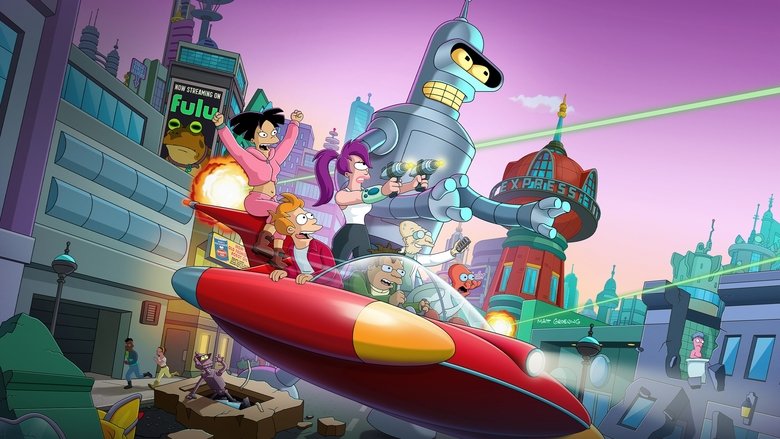
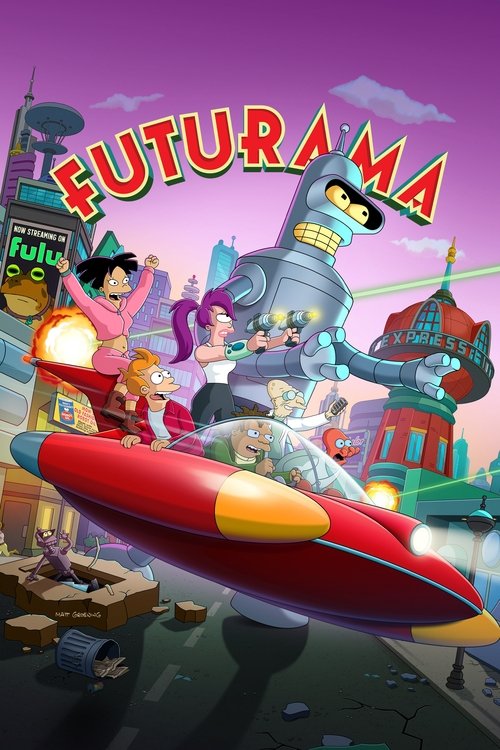
Futurama chronicles the adventures of Philip J. Fry, a 20th-century pizza delivery boy who is cryogenically preserved for 1,000 years and wakes up in New New York on New Year's Eve, 2999. He finds employment at Planet Express, an interplanetary delivery company run by his distant nephew, the senile Professor Farnsworth. Together with the cyclopean captain Leela and the hedonistic robot Bender, Fry travels the universe, encountering alien species, bureaucratic absurdities, and temporal paradoxes.

The series balances episodic sci-fi comedy with long-running character arcs, particularly the developing romance between Fry and Leela and the revelation of Fry's destiny as a savior of the universe. Unlike many animated sitcoms, Futurama maintains a strong continuity, rewarding viewers with payoffs to setups established seasons prior. The show explores the "world of tomorrow" not just as a backdrop for jokes, but as a setting to examine contemporary issues through a satirical lens.

Throughout its multiple cancellations and revivals—spanning Fox, DVD movies, Comedy Central, and Hulu—the series has evolved from a fish-out-of-water comedy into a rich ensemble dramedy. It tackles complex sci-fi concepts like time travel, alternate universes, and artificial intelligence, all while anchoring its narrative in the emotional bonds of its misfit crew, effectively creating a story about a "found family" drifting through the cosmos.

Core Meaning

At its heart, Futurama is a meditation on finding purpose and connection in a universe that doesn't care about you. While the future is depicted as a technological wonderland filled with robots and aliens, human nature remains unchanged: people are still lonely, greedy, insecure, and searching for love. The show suggests that in an infinite and often cynical universe, the only thing that truly matters is the small, chosen family we build and the moments of genuine connection we share.

Thematic DNA

The Found Family 30%
Determinism vs. Free Will 25%
Love Transcending Time 25%
Satire of Corporate Capitalism 20%

The Found Family

The crew of Planet Express consists of outcasts: a man out of time, a mutant rejected by society, a criminal robot, and a senile scientist. Across the seasons, the show deconstructs the traditional family unit and rebuilds it through the bonds of the crew. They dysfunctionally but fiercely love one another, proving that belonging is a choice rather than a birthright.

Determinism vs. Free Will

From Fry's destiny as the "chosen one" (pushed into the freezer by Nibbler) to Bender's quest for imagination and free will, the series constantly asks if characters are masters of their fate or puppets of destiny. The show often resolves this by having characters accept their roles willingly, finding agency within their predetermined paths.

Love Transcending Time

Romance in Futurama is rarely simple; it is often complicated by time travel, alternate realities, and space-time anomalies. The relationship between Fry and Leela serves as the emotional anchor, evolving from a one-sided crush to a profound bond that literally survives the end of the universe, suggesting love is the one constant in space-time.

Satire of Corporate Capitalism

The year 3000 is dominated by mega-corporations (MomCorp), aggressive advertising (dreams have commercials), and bureaucratic indifference. The show uses its sci-fi setting to hyperbolize late-stage capitalism, critiquing consumer culture and the commodification of everything, including emotion and religion.

Character Analysis

Philip J. Fry

Billy West

Archetype: The Everyman / The Fool
Key Trait: Heart over brain

Motivation

Initially to avoid work and have fun; later, driven by a deep desire to be worthy of Leela's love and to protect his friends.

Character Arc

Starts as an immature, aimless loser in the 20th century. In the future, he discovers he is unique (lacking a Delta brainwave) and essential to saving the universe. Over the series, he matures from a selfish slacker into a brave, self-sacrificing hero who wins Leela's heart not through competence, but through unwavering devotion and emotional honesty.

Turanga Leela

Katey Sagal

Archetype: The Action Girl / The Loner
Key Trait: Competence masking insecurity

Motivation

To find her origins and a place where she belongs; to prove her competence in a world that judges her appearance.

Character Arc

Begins as a guarded, lonely orphan believing she is an alien. She eventually discovers her true heritage as a sewer mutant, reconciling with her parents. Her arc is one of breaking down emotional walls, learning to accept her imperfections, and allowing herself to be loved by Fry, transitioning from a strict captain to a vulnerable partner.

Bender Bending Rodríguez

John DiMaggio

Archetype: The Anti-Hero / The Rogue
Key Trait: Sociopathic charm

Motivation

Self-preservation, hedonism, and a secret desire for validation and fame.

Character Arc

A robot programmed for bending who ostensibly cares only about himself. Throughout the series, he confronts his lack of free will and mortality. While he remains a criminal and narcissist, he develops a genuine (if often denied) affection for Fry, proving that he has transcended his programming to develop a soul.

Professor Hubert J. Farnsworth

Billy West

Archetype: The Mad Scientist
Key Trait: Amoral genius

Motivation

Science for science's sake (and profit), regardless of safety or ethics.

Character Arc

Fry's distant nephew and absolute genius. He oscillates between brilliance and senility. His arc involves confronting his own mortality, his failed relationships (with Mom), and his legacy as an inventor of doomsday devices.

Symbols & Motifs

The Cryogenic Tube

Meaning:

Symbolizes a second chance and the transition from a mundane past to a fantastical future. It represents the death of Fry's old life and the birth of his true potential.

Context:

Appears in the pilot as the catalyst for the entire series and is revisited in "The Why of Fry," recontextualizing it from an accident to a deliberate act of destiny.

The Holophonor

Meaning:

Represents the difficulty of communicating deep emotion and the intersection of art and love. It symbolizes Fry's inarticulate but sincere love for Leela.

Context:

Featured prominently in "Parasites Lost" and the original finale "The Devil's Hands Are Idle Playthings," where Fry uses it to create images of his feelings.

Seymour (The Dog)

Meaning:

A symbol of unconditional loyalty and the painful, unchangeable nature of the past. It represents the life and love Fry had to leave behind.

Context:

Central to the episode "Jurassic Bark," Seymour waits for Fry for years, becoming a fossil that Fry eventually chooses not to revive, preserving the dog's memory.

Seven Leaf Clover

Meaning:

Symbolizes jealousy turned into love, and the realization that the past wasn't as hostile as Fry remembered.

Context:

In "The Luck of the Fryrish," Fry believes his brother stole his clover and his life, only to discover his brother named his son after Fry in his honor.

The Planet Express Ship

Meaning:

The vessel of their adventures and a home in motion. It represents the crew's unity and their separation from the rest of society.

Context:

Used in almost every episode to transport the characters to new worlds; it is often damaged but always repaired, mirroring the crew's resilience.

Memorable Quotes

Bite my shiny metal ass!

— Bender

Context:

Used repeatedly throughout the series, often when Bender is annoyed, commanding someone, or making a dramatic exit.

Meaning:

Bender's catchphrase, encapsulating his rebellious, ego-centric, and dismissive attitude toward authority and social norms.

Good news, everyone!

— Professor Farnsworth

Context:

Spoken at the beginning of many episodes when the Professor assigns a new, usually suicidal, mission to the crew.

Meaning:

An ironic catchphrase, as the "news" is almost invariably terrible, dangerous, or life-threatening for the crew. It highlights the Professor's disregard for their safety.

You can't just give up. Is that what a dinosaur would do?

— Joey (to Fry)

Context:

From "The Tip of the Zoidberg," highlighting the bond between characters even in flashbacks.

Meaning:

A moment of simple, absurd encouragement that underscores Fry's childish optimism which often saves the day.

I don't want to live on this planet anymore.

— Professor Farnsworth

Context:

Spoken in "A Clockwork Origin" after discovering that creationists have explained away evolution with nonsense.

Meaning:

Expresses deep despair at the stupidity of humanity (or evolution). It became a massive internet meme representing loss of faith in society.

Shut up and take my money!

— Fry

Context:

From "Attack of the Killer App," when Fry is desperate to buy the new 'eyePhone' despite its obvious flaws.

Meaning:

Represents blind consumerism and enthusiastic desire. It became one of the most famous memes from the show.

Episode Highlights

Jurassic Bark

S4E7

Fry finds the fossil of his dog, Seymour, and attempts to clone him, but stops believing the dog lived a happy life without him. The ending reveals Seymour waited for Fry every day until he died. It is a masterclass in emotional storytelling.

Significance:

Established Futurama as a show capable of profound tragedy and emotional depth, distinguishing it from other animated comedies.

The Luck of the Fryrish

S3E4

Fry is angry at his brother Yancy for stealing his lucky clover and his identity. He discovers Yancy actually named his son Philip to honor his missing brother. The episode ends with a touching montage set to "Don't You (Forget About Me)."

Significance:

Deepens Fry's backstory and transforms his past from a source of resentment to one of love, crucial for his character's acceptance of his new life.

The Late Philip J. Fry

S6E7

The Professor invents a time machine that only goes forward. Fry, Bender, and the Professor watch the universe end and restart twice to get back home, while Leela runs Planet Express in their absence, leaving messages for Fry in the ground.

Significance:

Widely considered the best of the Comedy Central era, showcasing high-concept sci-fi, beautiful animation, and the enduring nature of Fry and Leela's relationship.

Roswell That Ends Well

S3E19

The crew accidentally travels back to 1947 Roswell. Fry inadvertently kills his grandfather and sleeps with his grandmother, becoming his own grandfather. The episode won an Emmy.

Significance:

A perfect example of the show's complex plotting, causal loops, and willingness to embrace bizarre sci-fi paradoxes for comedy.

The Devil's Hands Are Idle Playthings

S4E18

Fry makes a deal with the Robot Devil to gain musical skill to impress Leela. The episode culminates in an opera written by Fry. It was the original series finale.

Significance:

Marks a turning point in Fry and Leela's relationship, leaving it on a hopeful, romantic note that satisfied fans for years during the show's cancellation.

Meanwhile

S7E26

The Professor invents a "time button" that rewinds time 10 seconds. Fry breaks it, freezing the entire universe except for him and Leela. They live a long, happy life together in the frozen world before the Professor returns to reset everything.

Significance:

Served as the poignant second series finale, offering a perfect closure to the Fry/Leela romance before the Hulu revival undid the reset.

Philosophical Questions

Can Artificial Intelligence have a soul?

Through Bender, the show constantly explores this. Despite being a machine programmed for a specific task, Bender shows creativity, fear of death, and love. The episode "Free Will Hunting" explicitly asks if a robot can have free will if its actions are determined by programming, concluding that the illusion of choice is indistinguishable from the reality of it.

Is a predetermined life worth living?

Fry learns in "The Why of Fry" that his life was manipulated by Nibbler to save the universe. He initially despairs at being a pawn but eventually accepts his role because it led him to Leela. The show suggests that even if fate is fixed, the happiness found within it is real.

Does technology improve the human condition?

The year 3000 has FTL travel and instant gratification, yet characters are still miserable, lazy, and flawed. Futurama argues that technology changes our surroundings but not our fundamental nature or our need for connection.

Alternative Interpretations

The Coma Theory: A popular fan theory suggests Fry never woke up in the year 3000 but is in a coma after the freezer accident, and the entire series is his dying brain constructing a fantasy world based on his favorite sci-fi tropes.

The Loop: The finale "Meanwhile" ends with the Professor offering to reset time to before he invented the time button. Many interpreted this as the show looping back to the very first episode, creating a perfect circle—though the Hulu revival breaks this interpretation.

Utopian vs. Dystopian: While colorful and funny, the future is often interpreted as a dystopia where suicide booths are commercialized, robots have no rights, and corporations own everything. The series can be read as a warning about the trajectory of 20th-century consumerism.

Cultural Impact

Futurama holds a unique place in television history as a "smart" animated sitcom that respected its audience's intelligence. Created by Matt Groening during the height of The Simpsons' popularity, it offered a sharper, more satirical edge and a genuine love for science fiction.

Influence: It paved the way for emotionally resonant adult animation like Rick and Morty and BoJack Horseman, proving cartoons could handle complex sci-fi concepts and tragic character arcs. The "Futurama Theorem" is a legitimate contribution to mathematics.

Meme Culture: The show is a titan of internet culture, spawning ubiquitous memes like "Not sure if..." (Fry squinting), "Shut up and take my money!", and "I don't want to live on this planet anymore," which are used by millions who may not even watch the show.

Legacy: Its refusal to die—being revived three times due to fan demand—demonstrates an exceptionally loyal fanbase. Critics consistently praise its ability to mix low-brow humor with high-concept intellect, cementing it as one of the greatest sci-fi series of all time.

Audience Reception

Classic Era (Fox, S1-4): Widely acclaimed as the golden age. Praised for its wit, originality, and heart. Critics lamented its cancellation, blaming Fox's erratic scheduling.

The Movies (S5): Received mixed-to-positive reviews. While fans were happy to have the show back, some felt the pacing of the feature-length stories dragged compared to the snappy TV episodes.

Comedy Central Era (S6-7): Generally positive, though considered slightly more cynical and topical than the original run. Episodes like "The Late Philip J. Fry" are ranked among the series' best, while others were criticized for relying too heavily on current pop culture references.

Hulu Revival (S8/S11+): Reception has been mixed. Long-time fans appreciate the return and the visual update, but some critics feel the humor relies too much on "topical" jokes (about COVID, crypto, binge-watching) that feel dated, lacking the timeless sci-fi satire of the early seasons.

Interesting Facts

  • The writers created a real mathematical theorem, the 'Futurama Theorem' (or Ken Keeler's Theorem), solely to resolve the plot of the episode 'The Prisoner of Benda'.
  • The alien language 'Alienese' visible in the background is a real substitution cipher (and later a more complex code) that fans decoded, forcing writers to create even harder codes.
  • Matt Groening bought the rights to the '30th Century Fox' logo used at the end of episodes so Fox couldn't prevent him from using it.
  • Phil Hartman was originally cast to voice Zapp Brannigan, but after his death, Billy West took over the role, imitating Hartman's style as a tribute.
  • The sound of the Hypnotoad is a recording of a turbine engine played backward.
  • Nibbler's shadow can be seen in the pilot episode (Season 1, Episode 1) under the desk when Fry falls into the freezer, a detail added to set up the plot twist revealed years later in Season 4.
  • The show has been cancelled and revived three times: first by Fox, then revived as DVD movies, then by Comedy Central, and finally by Hulu.

Easter Eggs

Alien Language 1 & 2

Background graffiti often contains jokes written in 'Alienese'. The first version is a simple substitution cipher, while the second requires modular addition to decode, rewarding hardcore fans.

Nibbler's Shadow

In the pilot episode, Nibbler's shadow is visible as Fry falls into the cryo-tube. This foreshadows the revelation in 'The Why of Fry' that Nibbler intentionally pushed him to save the universe.

Owl Infestation

Owls are often seen as pests (like rats or pigeons) in New New York, implying they replaced traditional vermin in the future ecosystem.

Number 1729

The 'Hardy-Ramanujan number' appears frequently (e.g., Nimbus' registry number BP-1729, a universe number). It reflects the writers' mathematical background.

⚠️ Spoiler Analysis

Click to reveal detailed analysis with spoilers

Frequently Asked Questions

Explore More About This Movie

Dive deeper into specific aspects of the movie with our detailed analysis pages

Comments (0)

Leave a comment

No comments yet. Be the first to share your thoughts!