Fire Force
炎炎ノ消防隊
Overview
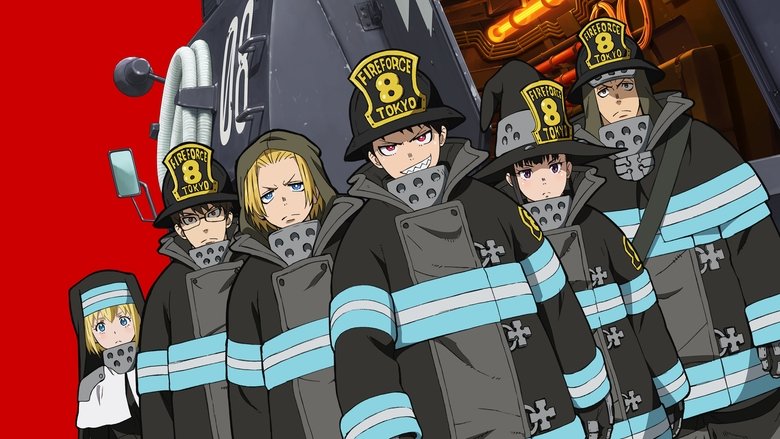
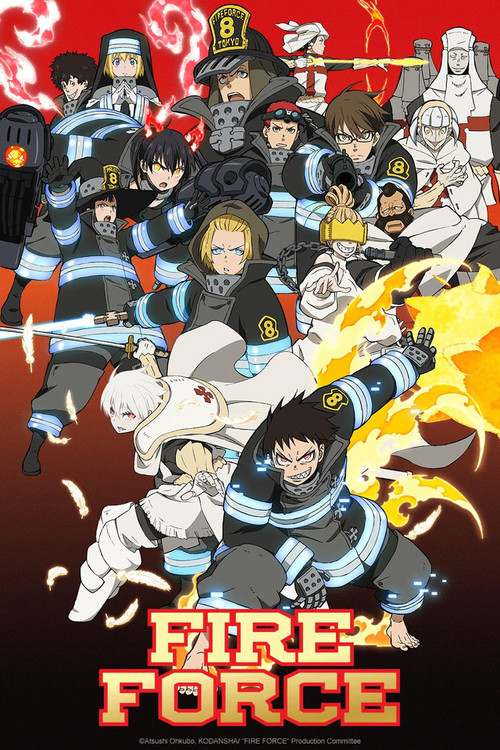
Fire Force (Enen no Shouboutai) is a high-octane dark fantasy that follows Shinra Kusakabe, a youth with the ability to ignite his feet, as he joins Special Fire Force Company 8. Set in a post-apocalyptic Tokyo where humanity huddles around the perpetual thermal energy plant Amaterasu, the series chronicles the battle against "Infernals"—humans transformed into living fire demons. Company 8 distinguishes itself by investigating the other seven companies for corruption while hunting for the white-clad cultists seeking to recreate the Great Cataclysm that once destroyed the world.
As the series progresses, the narrative expands from a monster-of-the-week procedural into a sprawling cosmological epic. Shinra and his allies unravel a conspiracy involving the Holy Sol Temple, Haijima Industries, and the Evangelist, a mysterious entity from another dimension known as Adolla. The conflict escalates into a war for the planet's soul, challenging the very concepts of life, death, and human perception. The story culminates in a meta-narrative twist that redefines the nature of their reality and connects the series to Creator Atsushi Ohkubo's wider body of work.
Core Meaning
At its heart, Fire Force is a story about redefining the value of life in the face of despair. It posits that human will and imagination have the power to shape reality. By contrasting the destructive nature of fire with its capacity to provide warmth and light, the series explores how humanity constructs faith and heroism to cope with the absurdity of death. Ultimately, it suggests that a world built on rigid dogma and suffering should be dismantled and reimagined into something more chaotic, free, and uniquely human—a creative act that literally births a new universe.
Thematic DNA
The Duality of Fire (Life vs. Destruction)
Fire is the central motif, represented simultaneously as a holy source of energy (Amaterasu) and a terrifying plague (Infernals). The series constantly questions whether fire is a tool for civilization or a weapon of the apocalypse. Shinra's struggle is to prove his flames are those of a hero, not a devil, effectively reclaiming the symbol of his trauma as a source of salvation.
Faith, Religion, and Institutional Corruption
The Holy Sol Temple governs society, yet the narrative methodically peels back layers of deception to reveal that the religion was manufactured by the villains to control humanity. The show critiques blind faith while acknowledging the comfort prayer brings to the grieving, embodied in the Sister's prayer, Látom, which offers peace even when the doctrine behind it is false.
Heroism vs. Perception
Shinra strives to be a "hero" to counter the public perception of him as a "devil" (due to his nervous grin). The series examines how heroes are made not by powers, but by the choice to protect others despite fear. Conversely, characters like Arthur Boyle derive actual power from their delusions, suggesting that believing in one's own narrative can manifest strength.
The Power of Human Imagination (Adolla)
As the series delves into the Adolla Link, it reveals that human collective consciousness influences reality. The chaotic, hellish dimension of Adolla infringes on the physical world because of humanity's fear and despair. The resolution hinges on harnessing this collective thought to reshape the world, moving from a rigid, despair-filled reality to one of 'madness' and creativity.
Character Analysis
Shinra Kusakabe
Gakuto Kajiwara
Motivation
To keep his promise to his mother to become a hero and to save his younger brother, Sho, from the White Clad.
Character Arc
Starting as a pariah labeled a "devil" for the fire that killed his family, Shinra joins Company 8 to find the truth. His journey transforms him from a vengeful boy into a true guardian. In the final arc, he transcends humanity to become a literal deity (Shinrabanshō-man), shouldering the world's despair to rewrite reality into a world where death is less tragic, effectively becoming the creator of the Soul Eater universe.
Arthur Boyle
Yusuke Kobayashi
Motivation
To live up to the image of the Knight King and defeat the "Dragon".
Character Arc
Arthur begins as a comic relief character who believes he is a knight king. However, his delusion is revealed to be his greatest strength, allowing him to manipulate plasma and reality. He evolves into the world's strongest warrior, engaging in a planetary-scale battle with the Dragon, proving that pure, unwavering belief can conquer impossible odds.
Akitaru Obi
Kazuya Nakai
Motivation
To investigate the corruption in the Fire Force and uncover the truth behind spontaneous human combustion.
Character Arc
As a captain with no pyrokinetic powers, Obi represents the peak of human physical determination. He remains the moral compass of Company 8, refusing to be corrupted by politics. His arc validates the idea that one does not need superpowers to be a hero, but rather discipline, courage, and compassion.
Tamaki Kotatsu
Saeko Kamijo
Motivation
To stop being protected and become a firefighter who can protect others.
Character Arc
Initially defined by her "Lucky Lecher Lure" gag and lack of confidence, Tamaki struggles with feelings of uselessness. Through training with Company 1 and 8, she learns to overcome her shame and weakness, eventually holding her own in battle. Her arc is a meta-commentary on her own objectification, turning her fire into a symbol of resistance.
Symbols & Motifs
Blue Stripes (Fire Force Uniform)
They symbolize the bonds between teammates and the line between life and death. The glowing blue represents the high temperature of purity and the solidarity required to face the inferno.
Captain Obi emphasizes that the stripes connect them in the smoke; they are a visual anchor in the chaotic, dark visuals of the Nether and battle scenes.
Látom
A prayer word (equivalent to "Amen") used to sanctify the souls of Infernals. It represents the mercy shown to victims who have lost their humanity.
Spoken by Sisters (like Iris) during the exorcism of Infernals, turning a violent act of killing into a sacred rite of passage.
The Smiling/Grinning Moon
A symbol of madness and a direct visual connection to the creator's previous work, Soul Eater. It represents the intrusion of the surreal into reality.
It appears frequently in the sky during key Adolla Link moments and becomes a permanent fixture in the sky during the series' climax.
Amaterasu
The source of all energy in Tokyo, symbolizing the sacrifice required to maintain order. It represents the false idol of the current civilization.
A giant thermal power plant worshipped by the Holy Sol Temple, later revealed to be powered by a human sacrifice (the First Pillar).
Memorable Quotes
Látom.
— Iris / Fire Force Members
Context:
Said after destroying the core of an Infernal to send their soul to the great flame of fire.
Meaning:
The iconic prayer ending that signifies the release of a soul from suffering. It encapsulates the series' blend of violence and sacred duty.
I smile whenever I feel tense. It’s my condition.
— Shinra Kusakabe
Context:
Season 1, Episode 1, explaining his "devil" face to Captain Obi.
Meaning:
Explains the core misunderstanding of his character; what looks like malice is actually a coping mechanism for trauma.
The blue stripes on our turnout gear are the ties that bind friends together in the world of flame and smoke. Never break them.
— Akitaru Obi
Context:
Season 1, Episode 2, instructing Shinra and Arthur on the importance of teamwork.
Meaning:
Highlights the themes of camaraderie and trust which are essential for survival in the Fire Force.
I will become a hero!
— Shinra Kusakabe
Context:
Repeated throughout the series, most notably during his first transformation and battles against the White Clad.
Meaning:
Shinra's mantra. It is a rejection of the "devil" label society placed on him and a declaration of his agency.
Episode Highlights
Shinra Kusakabe Enlists
Introduces the stunning visual style and the concept of Infernals. Shinra's first deployment showcases his 'Devil's Footprints' and establishes the tragic tone of the series as he puts a suffering woman to rest.
Sets the stage for the conflict and introduces the core cast and the mystery of the fire that killed Shinra's family.
The Burning Past
Shinra finally confronts Leonard Burns and learns the partial truth about the fire 12 years ago. The revelation that his brother Sho is alive and working for the Evangelist shatters his worldview.
Pivotal turning point that shifts Shinra's goal from revenge to rescue.
A Brother's Determination
The climactic battle between Shinra and Sho in the Nether. Shinra pushes his speed to the speed of light, experiencing Adolla Link and defying the laws of physics to reach his brother.
Showcases the series' highest animation quality (Sakuga) and establishes the deep bond and tragic separation between the brothers.
The Asakusa Fire Fight
Benimaru Shinmon, the strongest Fire Soldier, takes center stage. The town of Asakusa is defended in a spectacular display of traditional Japanese festival aesthetics mixed with fire combat.
Solidifies the alliance between Company 8 and Company 7, introducing Benimaru as a key mentor figure.
Shadows Cast by Divine Light
Shinra and Joker team up to storm the Holy Sol Temple. They uncover the dark history of the religion and the truth about Amaterasu's power source.
Crucial lore dump that reveals the institutional corruption at the heart of the Tokyo Empire.
Philosophical Questions
Does faith require truth to be valuable?
The series reveals the Holy Sol Temple is built on a lie, yet the comfort it provides is real. Characters like Iris struggle with whether to maintain the rituals that give people hope or to destroy the institution because of its corrupt origins.
Is a world of order preferable to a world of chaotic freedom?
The Evangelist seeks a unified, still world of death (Adolla), while Shinra fights for a world that is messy, dangerous, but alive. The ending explicitly chooses 'madness' (chaos/individuality) over the sterile 'order' of the villains.
What defines a hero?
Shinra is naturally feared, while the corrupt captains are revered. The series argues that heroism is an internal moral action—saving others at personal cost—rather than a social status or public image.
Alternative Interpretations
The Meta-Narrative on Creation: Some critics interpret the entire series as Ohkubo's commentary on the manga industry. The villains (White Clad) want to turn the world into a blank white page (despair/nothingness), while the heroes fight to fill it with life and color. Shinra's final act of creating a world of "madness" (the Soul Eater world) can be seen as the author choosing creativity and fun over rigid order.
Fire as Technology: The Infernals can be read as a metaphor for the dangers of unchecked technological advancement (thermal power) consuming humanity, with the Fire Force representing the balance between using technology for progress versus being destroyed by it.
Cultural Impact
Fire Force made a significant splash in the shonen genre due to its high-production value animation by David Production, particularly its innovative depiction of fire and sound design. It arrived during a peak era for shonen anime (alongside Demon Slayer) and carved out a niche with its darker, steampunk aesthetic and unique religious themes.
Culturally, the series sparked discussions about the use of fanservice in serious narratives, with the character Tamaki becoming a lightning rod for criticism regarding the "lucky lecher" trope. Despite this, the series is praised for its intricate world-building and the seamless blend of science fiction with supernatural fantasy. Its legacy is cemented by its audacious ending, which ties it to Soul Eater, creating a rare multi-series universe in anime history that rewards long-time fans of Atsushi Ohkubo.
Audience Reception
Visuals and Sound: Universally acclaimed. David Production's work on the fire effects, fight choreography, and the 'bass-boosted' sound design is frequently cited as some of the best in modern anime.
Story and Pacing: Generally positive. Viewers appreciated the mystery elements of the plot, though some felt the pacing in the middle of Season 1 was slow. The shift to a more cosmic scale in later seasons was praised for its ambition.
Criticism: The most significant and persistent criticism concerns the character Tamaki Kotatsu and the "Lucky Lecher Lure" gag. Many western critics and audiences found the excessive, forced fanservice during serious moments to be tone-deaf and detrimental to the show's tension.
Overall Verdict: Considered a modern shonen classic, specifically for animation enthusiasts and fans of Atsushi Ohkubo's unique style.
Interesting Facts
- The series is created by Atsushi Ohkubo, who also created 'Soul Eater'. He announced that 'Fire Force' would be his final manga series before retiring.
- The 'Látom' prayer gesture is similar to the sign of the cross but with a specific hand shape, which became a meme among fans.
- The animation studio, David Production, is also famous for animating 'JoJo's Bizarre Adventure', and they brought a similar heavy use of 'SFX' sound effect text on screen during fights.
- The ending theme 'Veil' by Keina Suda features live-action footage of the voice actress for the nun Iris, creating a unique mixed-media ending sequence.
- Shinra's nervous laughter condition is a real psychological phenomenon called 'Pseudobulbar affect' or simply a nervous response to trauma.
- The show had to be censored and edited in Japan during its first season due to the tragic Kyoto Animation arson attack which occurred just weeks after the anime premiered.
- The sound effects for the fire abilities, especially Shinra's bass-heavy propulsion, are widely praised for their unique, mechanical audio design.
Easter Eggs
The Moon's Face
Throughout the series, and especially in the final season, the moon begins to grin with a jagged smile. This is a direct reference to the iconic moon from Soul Eater, foreshadowing the connection between the two universes.
Excalibur
Arthur's plasma sword is named Excalibur, referencing the legendary sword. In the finale, the actual annoying creature 'Excalibur' from Soul Eater makes an appearance as Arthur's weapon transforms.
Soul Eater Characters in Finale
In the manga's conclusion (and expected in the anime finale), characters resembling Maka, Soul, and Death the Kid appear, confirming Fire Force is a prequel to Soul Eater.
⚠️ Spoiler Analysis
Click to reveal detailed analysis with spoilers
Frequently Asked Questions
Explore More About This Movie
Dive deeper into specific aspects of the movie with our detailed analysis pages
Comments (0)
No comments yet. Be the first to share your thoughts!