Star Trek: The Next Generation
"New stars. New stories. New worlds to explore."
Overview
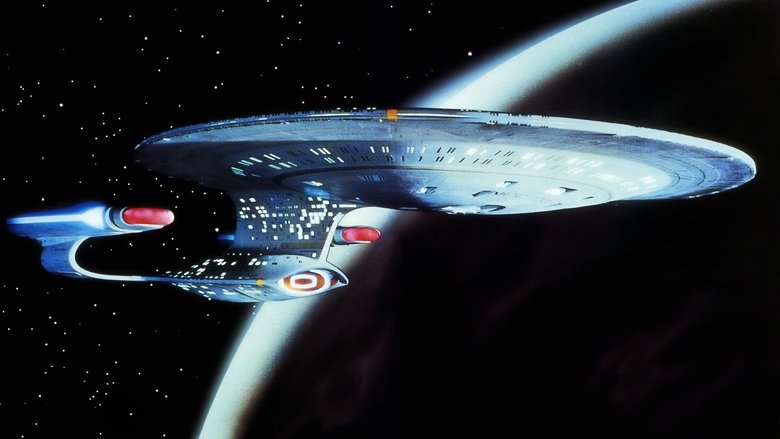
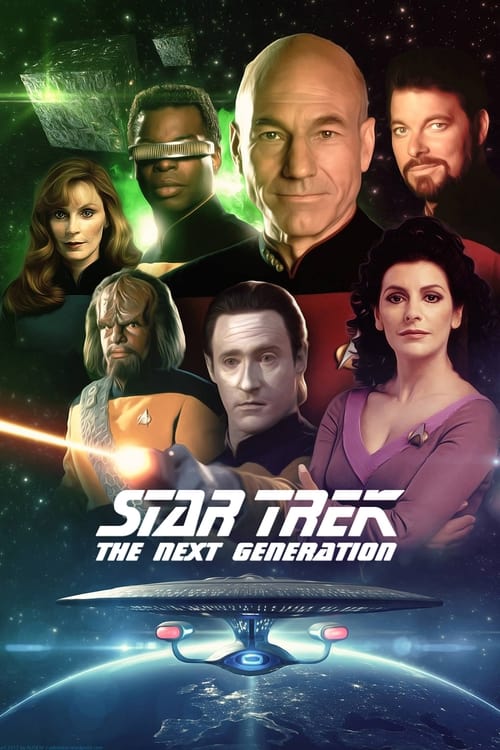
Star Trek: The Next Generation (1987–1994) revitalized the Star Trek franchise, moving the setting a century forward from the original series to the 24th century. It follows the voyages of the USS Enterprise-D, a massive Galaxy-class starship designed for deep space exploration and diplomacy. Unlike its predecessor's "Space Western" tone, TNG presents a more refined, cerebral, and communitarian future where the United Federation of Planets has achieved a near-utopian stability.
The series initially struggled to find its footing, often mimicking the campiness of the 60s, but found its legendary voice in its third season (a phenomenon now known as "Growing the Beard"). Over seven seasons, the crew encounters god-like entities, moral dilemmas, and existential threats like the Borg. The show balances episodic planet-of-the-week adventures with rich character dramas, culminating in the critically acclaimed finale "All Good Things...", which ties the entire seven-year journey into a perfect circle of time and meaning.
Core Meaning
At its heart, TNG is Gene Roddenberry's ultimate humanist manifesto: the belief that humanity is perfectible. It argues that with sufficient wisdom, technology, and empathy, we can solve any problem—from interstellar war to personal grief—without violence. The series posits that the ultimate frontier is not space, but the expansion of our own moral imagination and the definition of what it means to be alive.
Thematic DNA
The Measure of a Person
Through the android Data, the series relentlessly questions what constitutes a soul, sentient rights, and humanity. From the courtroom drama of "The Measure of a Man" to his quest for emotions, the show argues that humanity is defined by actions and choices, not biology.
Duty vs. Conscience
Captain Picard frequently faces the agonizing choice between the strict Prime Directive (non-interference) and the moral imperative to help suffering civilizations. The series explores the nuance of leadership, suggesting that true authority comes from ethical flexibility and wisdom, not just regulations.
The Collective vs. The Individual
The introduction of the Borg created a terrifying counter-argument to the Federation's ideals. While the Federation values voluntary cooperation among diverse individuals, the Borg enforce a soulless, involuntary homogeneity. This conflict highlights the sanctity of individual free will.
Family and Chosen Kinship
Unlike the military rigidness of other sci-fi, the Enterprise-D is a home. Families live on board, and the senior staff evolves into a tight-knit surrogate family. The weekly poker game symbolizes this bond—a ritual where rank is discarded in favor of friendship and vulnerability.
Character Analysis
Jean-Luc Picard
Patrick Stewart
Motivation
To uphold the principles of the Federation and the Prime Directive, proving that diplomacy is superior to force.
Character Arc
Starts as a somewhat stiff, uncomfortable-around-children captain who keeps an emotional distance. Over seven seasons, he softens into a father figure, learning to balance his immense intellect and duty with deep emotional vulnerability, culminating in him finally joining the crew's poker game.
Data
Brent Spiner
Motivation
To become more human and understand the elusive nature of emotion.
Character Arc
Begins as a naive machine mimicking human behavior. His journey is an asymptotic curve toward humanity; he gains an understanding of art, humor, friendship, and loss. Though he never becomes biological, he achieves a 'soul' through his choices and loyalty.
Worf
Michael Dorn
Motivation
To live with honor in a universe that often compromises it.
Character Arc
Initially a one-note growling warrior, Worf evolves into a complex figure torn between his Klingon heritage and Starfleet values. He accepts his discommendation to save the Empire, becoming a tragic figure of honor who sacrifices his social standing for the greater good.
William T. Riker
Jonathan Frakes
Motivation
To protect the captain and the ship, eventually shifting from ambition to loyalty.
Character Arc
Starts as a brash, career-focused officer eager for his own command. Over time, he realizes that the journey and the company he keeps are more valuable than the rank. He chooses to remain on the Enterprise, valuing his place in the 'family' over professional advancement.
Symbols & Motifs
The Enterprise-D
A "Hotel in Space" representing comfort, safety, and a mobile village. Its beige, carpeted interiors and curved lines symbolize a non-aggressive, evolved humanity that carries its civilization with it.
The ship is the primary setting, serving not just as a vessel of war or exploration, but as a home where children go to school and civilians live, reinforcing the peace-time mission.
The Poker Game
A ritual of humanity, bluffing, and friendship. It symbolizes the crew's bond beyond their professional duties and their exploration of human risk and intuition.
Featured periodically throughout the series and serving as the final, poignant scene of the entire show where Picard finally joins in, signifying his complete integration into the family.
The Visor
A symbol of how disability is reframed in the future as a difference in perspective. Geordi sees more than others, not less, suggesting technology can transcend physical limitations.
Worn by Chief Engineer Geordi La Forge in every episode, often used as a plot device to detect things the human eye cannot.
Earl Grey Tea, Hot
A symbol of Picard's disciplined, ritualistic, and somewhat old-fashioned nature. It represents a grounding comfort amidst the chaos of space.
Ordered by Captain Picard from the replicator in his ready room during moments of reflection or stress throughout the series.
Four Lights
A symbol of truth and the resilience of the human will against torture and gaslighting.
Used in the episode "Chain of Command" where Picard is tortured by a Cardassian who tries to force him to see five lights instead of four.
Memorable Quotes
Make it so.
— Jean-Luc Picard
Context:
Used by Picard throughout the series, usually at the end of a briefing in the Ready Room or on the Bridge.
Meaning:
The definitive command of the series, representing decisive leadership and the transition from discussion to action.
There are FOUR lights!
— Jean-Luc Picard
Context:
Season 6, Episode 11: Shouted at Gul Madred after Picard is released from torture, proving his mind was not broken.
Meaning:
A defiant declaration of objective truth in the face of torture and tyranny. It asserts that reality cannot be bent by power.
The line must be drawn here! This far, no further!
— Jean-Luc Picard
Context:
Star Trek: First Contact (Movie, ties into TNG arc): Often associated with the TNG era's peak dramatic conflict with the Borg.
Meaning:
A rare moment where Picard's diplomatic veneer cracks, revealing his deep trauma and rage against the Borg. It signifies the point where pacifism must yield to survival.
I am not a merry man!
— Worf
Context:
Season 4, Episode 20: Protested by Worf when Q transports the crew into a Robin Hood fantasy scenario.
Meaning:
A comedic highlight that perfectly encapsulates Worf's seriousness contrasting with the crew's whimsical situations.
Episode Highlights
The Best of Both Worlds (Parts I & II)
The Borg invade Federation space and assimilate Captain Picard, turning him into Locutus. Riker must step up and fire on his own captain to save humanity.
This cliffhanger transformed the series from a cult sci-fi show into a pop-culture phenomenon. It added real stakes, trauma, and continuity to the episodic format.
The Inner Light
Picard is struck by a probe and lives an entire lifetime (40+ years) as a man named Kamin on a dying planet, all in the span of 20 minutes of real time.
Widely considered the best episode of the franchise. It deepens Picard's character without a single space battle, focusing entirely on memory, love, and loss.
The Measure of a Man
Data is put on trial to determine if he is a sentient being with rights or property of Starfleet. Picard delivers a masterful defense.
Establishes the show's intellectual core. It defines the series' commitment to civil rights and philosophical debate over action.
Yesterday's Enterprise
A time rift alters reality, creating a war-torn timeline where the Federation is losing to the Klingons. Tasha Yar returns, and the crew must sacrifice their existence to restore the 'correct' timeline.
A brilliant exploration of alternative history and sacrifice, showing how fragile the show's utopian peace really is.
All Good Things...
Picard jumps between three time periods (past, present, future) to solve a spatial anomaly created by Q, threatening the origin of life itself.
One of the greatest series finales in TV history. It brings the show full circle to the pilot, affirming the crew's growth and the trial of humanity.
Philosophical Questions
What defines a person?
Explored primarily through Data and the hologram Moriarty. The series rejects biological definitions, arguing that self-awareness, the capacity to learn, and the desire for connection are the true markers of a soul.
Is safety preferable to freedom?
The Borg represent ultimate safety and order—a collective where no one is lonely or uncertain. The Federation represents the chaotic, dangerous, but essential freedom of the individual. The show consistently argues that suffering and risk are necessary prices for individuality.
Does absolute power corrupt absolutely?
Through the character of Q, the show explores omnipotence. Unlike human dictators, Q suggests that true omnipotence might lead to boredom or a different kind of morality, challenging the crew to prove that humanity is interesting enough to exist.
Alternative Interpretations
The 'Village' Theory: Critics often note that unlike the original series (a patrol boat in the wild west) or Deep Space Nine (a frontier fort), the Enterprise-D functions as a generic, safe 'village' or cruise ship. Some interpret this not as a lack of danger, but as a statement that humanity has mastered its environment so thoroughly that it can bring its domestic comfort into the void.
The Riker-Centric View: Some analyze the series as the coming-of-age story of Will Riker. He begins as the protagonist archetype (young, brash, Kirk-like) but learns that the ultimate form of leadership in this evolved century is support and stability, eventually choosing to stay 'Number One' longer than expected to learn from the wiser 'father' (Picard).
Cultural Impact
Star Trek: The Next Generation is a titan of television history that legitimized science fiction as a prestige genre for adults. It arrived during the cynical late 80s with an unapologetically optimistic view of the future, eventually becoming the highest-rated syndicated show of its era. It spawned the "Golden Age" of Star Trek, leading directly to Deep Space Nine, Voyager, and Enterprise.
Culturally, it introduced concepts like the "Holodeck" and the "Borg" into the global lexicon. Patrick Stewart's performance raised the bar for TV acting, blending Shakespearean gravitas with sci-fi. The show's influence extends to modern technology (touchscreens, tablets resembling PADDs) and ethics, with its episodes often used in law and philosophy schools to teach personhood and morality. It also cemented the "Trekkie" fandom as a global, multi-generational force.
Audience Reception
The 'Growing the Beard' Phenomenon: The series is famously bifurcated in reception. Seasons 1 and 2 are widely considered rocky, characterized by uneven writing, campy plots, and behind-the-scenes chaos. However, from Season 3 onward, the show is universally acclaimed as hitting a 'Golden Age,' with tighter scripts, better production values, and deeper character arcs.
Legacy: While some modern viewers find the episodic format and lack of interpersonal conflict (the 'Roddenberry Box') slow compared to modern serialized drama, TNG remains the most beloved entry in the franchise for the majority of the fanbase. It is viewed as the 'comfort food' of Star Trek—intellectual, safe, and morally consistent.
Interesting Facts
- Patrick Stewart wore a hairpiece (toupee) for his audition, but Gene Roddenberry disliked it and ordered him to play the role bald, which was revolutionary for a lead actor at the time.
- The 'Riker Maneuver'—Jonathan Frakes's habit of lifting his leg high over the back of chairs to sit down—was due to a back injury from his days working as a furniture mover.
- Gene Roddenberry insisted on a 'Roddenberry Box' rule early on: no interpersonal conflict between the main crew members, which frustrated writers but forced them to find drama in external ideas.
- Whoopi Goldberg asked to be on the show because she was inspired by Nichelle Nichols (Uhura) in the original series; she wanted to be part of the future.
- The character of Worf was originally intended to be a minor background character but became so popular that his role was significantly expanded.
- The sliding doors on the set were manually operated by stagehands who had to watch the actors' movements perfectly to open them on time.
Easter Eggs
Gene Roddenberry's Parrot
In several episodes, a schematic on the Master Systems Display in Engineering features a hidden pixel-art parrot, a tribute to Gene Roddenberry's nickname, 'The Great Bird of the Galaxy'.
Sherlock Holmes Mysteries
Data's fascination with Sherlock Holmes recurs throughout the series. These episodes (like "Elementary, Dear Data") pay homage to the classic detective stories while exploring the nature of fictional vs. real intelligence.
The Number 47
Writer Joe Menosky started a tradition of inserting the number 47 into scripts (shield frequency 47, sector 47, etc.) as an in-joke, claiming it occurs in nature more often than other numbers. This tradition spread to other Star Trek series.
NCC-1941
The USS Bozeman, which appears in "Cause and Effect", has the registry NCC-1941. This is a reference to the Steven Spielberg movie 1941; the model maker Greg Jein worked on both.
⚠️ Spoiler Analysis
Click to reveal detailed analysis with spoilers
Frequently Asked Questions
Explore More About This Movie
Dive deeper into specific aspects of the movie with our detailed analysis pages
Comments (0)
No comments yet. Be the first to share your thoughts!