Dune
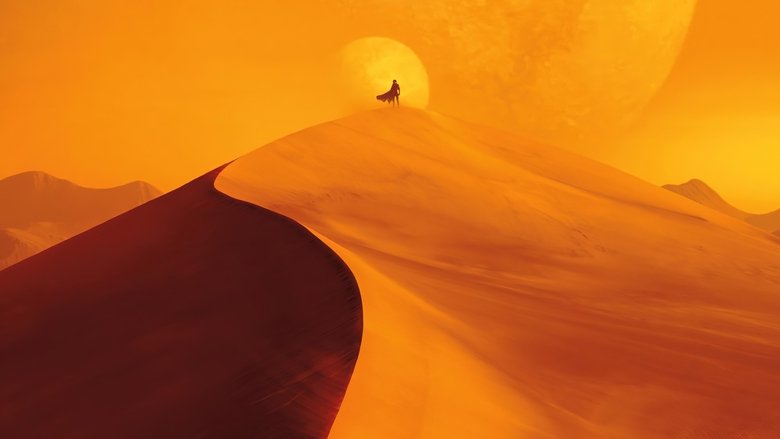
A sweeping desert odyssey where destiny whispers through shifting sands. Vast, brutalist monuments of power crumble before the primal, golden haze of an ancient world, where survival is a dance with fear.
Dune

Dune

"It begins."

15 September 2021 United States of America 155 min ⭐ 7.8 (14,201)
Director: Denis Villeneuve
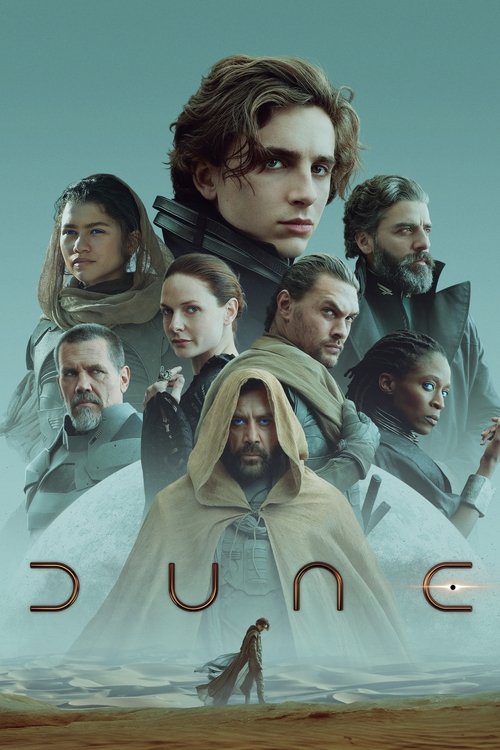
Cast: Timothée Chalamet, Rebecca Ferguson, Oscar Isaac, Jason Momoa, Stellan Skarsgård
Adventure Science Fiction
Ecology and Environmentalism Destiny vs. Choice Imperialism and Colonialism Power and Betrayal Fear and Self-Mastery
Budget: $165,000,000
Box Office: $407,573,628

Overview

Set in a far-distant future, Dune follows Paul Atreides, the brilliant and gifted heir of House Atreides, as his family is thrust into a treacherous political trap. The Padishah Emperor has ordered them to leave their lush home world of Caladan to take over the stewardship of Arrakis, a harsh desert planet that serves as the only source of the most precious substance in the universe: the spice melange. Known for its ability to extend human life and enable interstellar travel, the spice makes Arrakis the most dangerous and coveted prize in the galaxy.

As the Atreides family attempts to establish a peaceful rule and form alliances with the indigenous Fremen people, they are pursued by the malevolent House Harkonnen, the former rulers of Arrakis who seek to reclaim their wealth. Paul must navigate a web of betrayal, religious prophecy, and the unforgiving natural forces of the deep desert, including the gargantuan sandworms that roam beneath the dunes. His journey is not just one of survival, but a spiritual awakening to a destiny far greater—and more terrifying—than he ever imagined.

Core Meaning

At its heart, Dune is a cautionary tale about the dangers of messianic figures and the collision of ecology, religion, and power. Director Denis Villeneuve emphasizes the idea that human progress is often dwarfed by the scale of nature and time. The film explores the burden of legacy and the thin line between being a leader and being a tool of prophecy. It suggests that true power comes not from the exploitation of resources like spice, but from the mastery of one's own fear and the ability to adapt to a changing environment.

Thematic DNA

Ecology and Environmentalism 25%
Destiny vs. Choice 25%
Imperialism and Colonialism 20%
Power and Betrayal 15%
Fear and Self-Mastery 15%

Ecology and Environmentalism

The film portrays the planet Arrakis as a living, breathing entity that dictates the lives of its inhabitants. The scarcity of water and the reverence for the desert's ecosystem highlight the theme of environmental conservation and the consequences of resource exploitation.

Destiny vs. Choice

Paul Atreides is haunted by prescient visions of a bloody future. Much of his arc involves grappling with whether he is a master of his own fate or merely a puppet of a centuries-old breeding program designed by the Bene Gesserit.

Imperialism and Colonialism

The conflict between the Great Houses over Arrakis mirrors historical colonial struggles. The film critiques how empires view indigenous populations (the Fremen) as obstacles or tools while stripping their land of its natural wealth.

Power and Betrayal

The political maneuvering of the Emperor and the Harkonnens showcases the fragility of honor in the face of absolute power. The betrayal of House Atreides serves as a catalyst for Paul's transformation into a pragmatic survivor.

Fear and Self-Mastery

The "Litany Against Fear" is a central motif. The film posits that survival in a hostile universe requires an internal discipline that allows one to observe fear without being consumed by it.

Character Analysis

Paul Atreides

Timothée Chalamet

Archetype: The Reluctant Hero
Key Trait: Prescience

Motivation

Initially seeks to please his father and understand his visions; later motivated by survival and vengeance against the Harkonnens.

Character Arc

Begins as a sheltered noble youth troubled by visions. After the loss of his father and his house, he undergoes a baptism by fire in the desert, eventually killing his first opponent and joining the Fremen.

Lady Jessica

Rebecca Ferguson

Archetype: The Mentor / Protective Mother
Key Trait: Discipline

Motivation

To protect Paul at all costs, even if it means manipulating ancient prophecies to ensure their safety.

Character Arc

A Bene Gesserit who defied her order by bearing a son. She evolves from a royal consort to a desperate survivor who must guide her son into his dangerous destiny among the Fremen.

Duke Leto Atreides

Oscar Isaac

Archetype: The Tragic King
Key Trait: Honor

Motivation

To bring "Desert Power" to House Atreides through an alliance with the Fremen and to protect his family.

Character Arc

A man of honor who knows he is walking into a trap. He dies a martyr, attempting to take the Baron with him, leaving a legacy of integrity for his son.

Baron Vladimir Harkonnen

Stellan Skarsgård

Archetype: The Tyrant
Key Trait: Greed

Motivation

Reclaiming the wealth of Arrakis and eliminating House Atreides to secure his family's standing.

Character Arc

Remains a static force of pure avarice and cruelty. He successfully orchestrates the downfall of his rivals but fails to account for the survival of the Atreides heir.

Duncan Idaho

Jason Momoa

Archetype: The Loyal Warrior
Key Trait: Loyalty

Motivation

Absolute loyalty to House Atreides and deep affection for Paul.

Character Arc

The Atreides' master-at-arms who serves as a bridge to the Fremen. He sacrifices himself in a heroic last stand to allow Paul and Jessica to escape.

Symbols & Motifs

The Desert Mouse (Muad'Dib)

Meaning:

Symbolizes survival, adaptation, and wisdom. Despite its small size, it thrives in the harshest conditions by creating its own water, representing the Fremen's way of life and Paul's eventual path.

Context:

Paul observes the mouse twice: once in a holographic filmbook and later in the deep desert, where he finds inspiration in its resilience.

The Bull

Meaning:

Symbolizes legacy, tragic destiny, and the dangers of vanity. It represents the Atreides' history of facing overwhelming odds and the violent end that often follows.

Context:

A bull's head is displayed in the Atreides dining hall, a reminder of Paul's grandfather who died in a bullfight. It appears prominently during the fall of House Atreides.

Water

Meaning:

Symbolizes life, community, and the ultimate currency. On Arrakis, water is sacred; on Caladan, it is an abundant, taken-for-granted luxury.

Context:

Contrasts the lush oceans of Caladan with the "water discipline" of the Fremen, such as the act of spitting as a sign of respect (offering one's body's moisture).

The Ducal Signet Ring

Meaning:

Represents authority, responsibility, and the burden of leadership. It is the physical manifestation of the Atreides heritage.

Context:

Duke Leto wears it as a symbol of his power, and its passage to Paul signifies his transition from a son to the head of a fallen house.

Memorable Quotes

I must not fear. Fear is the mind-killer.

— Lady Jessica / Paul Atreides

Context:

Recited by Jessica during the Gom Jabbar test and later by Paul as they face the desert's dangers.

Meaning:

The central mantra of the Bene Gesserit, used to maintain focus and control during moments of extreme psychological or physical peril.

A great man doesn't seek to lead. He's called to it, and he answers.

— Duke Leto Atreides

Context:

Spoken to Paul on Caladan when Paul expresses doubt about his future as Duke.

Meaning:

Reflects the Duke’s philosophy on leadership—that it is a burden of duty rather than a pursuit of power.

Dreams make good stories, but everything important happens when we're awake.

— Duncan Idaho

Context:

Duncan says this to Paul early in the film to comfort him about his unsettling dreams of Arrakis.

Meaning:

A grounded, pragmatic counterpoint to the mystical and prophetic themes surrounding Paul's visions.

This is only the beginning.

— Chani

Context:

The final line of the film, spoken as Paul and Jessica walk into the desert with the Fremen.

Meaning:

A meta-textual line that signals the film is only the first part of a larger epic, while also hinting at Paul's looming rise to power.

Philosophical Questions

Is a predetermined destiny a gift or a prison?

The film explores this through Paul's prescience. He can see the future, but knowing it seems to lock him into a path of unavoidable violence, raising questions about whether free will can exist in the face of prophecy.

Does the survival of the species justify any level of violence?

Paul's visions of a 'holy war' fought in his name suggest that the path to human survival (The Golden Path) may require the deaths of billions, forcing the audience to weigh individual morality against cosmic necessity.

Alternative Interpretations

While often viewed as a standard Hero's Journey, many critics interpret Dune as a deconstruction of the 'Chosen One' trope. In this reading, Paul is not a savior but a tragic figure being molded by a religious conspiracy (the Missionaria Protectiva) into a weapon of mass destruction. Another perspective focuses on the ecofeminist reading, where Lady Jessica and the planet Arrakis itself are the true drivers of the plot, subtly manipulating the masculine structures of empire to birth a new world order. Some viewers also see the film as a reflection on the COVID-19 pandemic, emphasizing themes of isolation, the fragility of global systems, and the necessity of radical adaptation to an invisible, overwhelming force.

Cultural Impact

Dune (2021) succeeded where many previous attempts failed, debunking the myth that Frank Herbert's novel was "unfilmable." It revitalized the large-scale sci-fi epic, moving away from the fast-paced, quip-heavy style of the MCU toward a more somber, meditative, and visually-driven experience. Its success at the box office despite a day-and-date streaming release proved the enduring power of theatrical cinema. Critically, it won six Academy Awards, primarily in technical categories, cementing its status as a modern masterpiece of craftsmanship. It has also influenced fashion and aesthetic trends, with its 'desert chic' and brutalist costume designs appearing in high-fashion circles.

Audience Reception

Audiences were largely awestruck by the film's monumental scale and sound design, with many praising the casting of Timothée Chalamet and Oscar Isaac. However, a common point of criticism was the abrupt ending, as the film only covers the first half of the novel. Some viewers found the pacing too slow and the plot too dense with lore. Despite this, the 'verdict' was overwhelmingly positive, with fans of the book appreciating its faithfulness and newcomers being drawn in by its 'Star Wars for adults' atmosphere. It currently holds high scores on IMDb and Rotten Tomatoes, reflecting its status as a cult and commercial success.

Interesting Facts

  • Stellan Skarsgård spent roughly 80 total hours in the makeup chair to be transformed into the morbidly obese Baron Harkonnen; the 'fat suit' weighed 40 kilograms.
  • Composer Hans Zimmer, a massive fan of the book, declined working on Christopher Nolan's 'Tenet' to score 'Dune.' He spent months inventing new instruments and soundscapes to create an 'alien' musical language.
  • The 'Ornithopters' were designed based on the anatomy of dragonflies; the production built two full-scale models that weighed over 11 tons each.
  • The film was shot in the deserts of Jordan and Abu Dhabi. To achieve realistic lighting, they avoided green screens for exterior scenes, using 'sandscreens' (sand-colored backdrops) to ensure the light reflected naturally on the actors.
  • Director Denis Villeneuve has wanted to adapt 'Dune' since he was 14 years old; he kept a copy of the novel with him during the entire production.

Easter Eggs

The Baron's Oil Bath

A visual homage to David Lynch's 1984 adaptation. In the original book, the Baron doesn't bathe in black oil, but Villeneuve included it as a nod to the previous film's iconic imagery.

Jason Momoa's Secret 'Game of Thrones' Nod

During a fight scene, Jason Momoa performed a specific sword gesture that was a 'sly' reference to his time as Khal Drogo, which he added without telling Villeneuve.

Gom Jabbar 'What's in the Box?'

Some fans noted Paul's question, "What's in the box?" as a possible subtle nod to David Fincher's 'Seven,' though it is also a direct line from the novel.

⚠️ Spoiler Analysis

Click to reveal detailed analysis with spoilers

Frequently Asked Questions

Explore More About This Movie

Dive deeper into specific aspects of the movie with our detailed analysis pages

Comments (0)

Leave a comment

No comments yet. Be the first to share your thoughts!