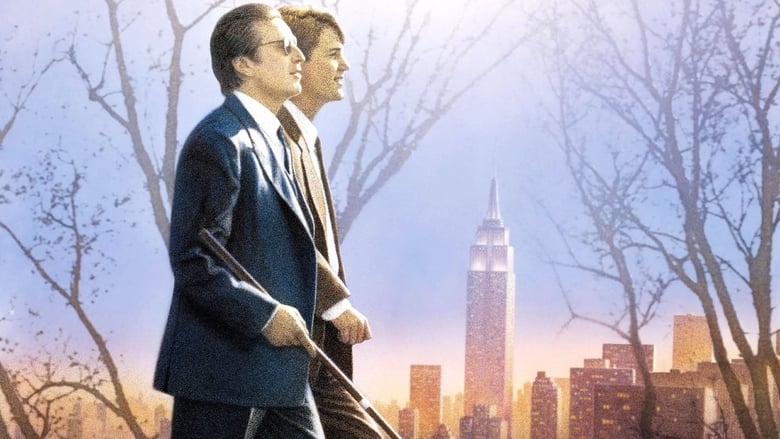
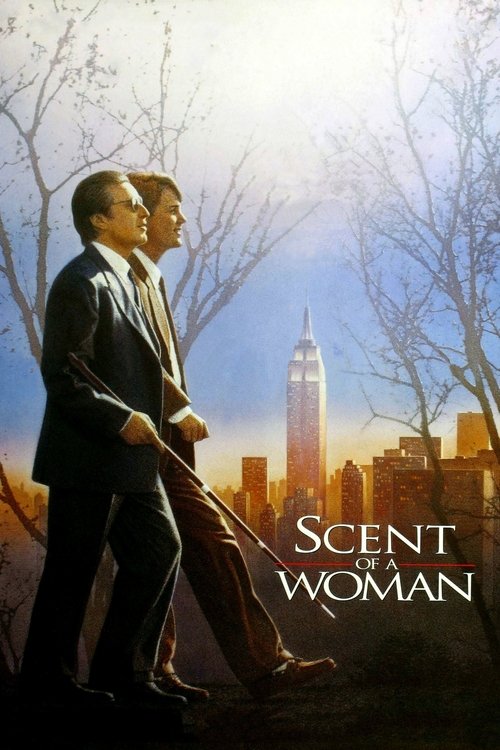
Scent of a Woman
"Col. Frank Slade has a very special plan for the weekend. It involves travel, women, good food, fine wine, the tango, chauffeured limousines and a loaded forty-five. And he's bringing Charlie along for the ride."
Overview
Charlie Simms, a scholarship student at the prestigious Baird prep school, accepts a temporary job over Thanksgiving weekend to look after Lieutenant Colonel Frank Slade, a blind, retired Army officer who has become bitter, cynical, and increasingly volatile. Charlie's primary motivation is to earn money for a plane ticket home, but he soon finds himself whisked away to New York City for a weekend of decadence that Slade intends to be his final act.
As the pair moves through the luxury of the Waldorf-Astoria and the thrill of driving a Ferrari, a deep bond forms between the naive student and the world-weary soldier. Charlie is simultaneously dealing with a moral crisis at school, where he is being pressured to snitch on classmates, while Frank is wrestling with a profound sense of purposelessness and a secret plan to end his own life.

Core Meaning
The core message of Scent of a Woman is that human integrity and connection are the only true remedies for a broken spirit. The film suggests that while life can be cruel and "amputate" one's physical abilities or social standing, the only irreparable loss is the loss of character. Director Martin Brest explores the idea that redemption is found not in grand accomplishments, but in the small, courageous choices to protect others and the willingness to "tango on" through life's inevitable mistakes.
Thematic DNA
Integrity vs. Self-Interest
Revealed through Charlie's refusal to name the students involved in a prank, despite the Headmaster's bribe of a Harvard recommendation. This theme is mirrored in Frank's final speech, which defines integrity as the refusal to sell out one's soul for personal gain.
Redemption and Second Chances
Frank Slade is a man who believes his life is over due to his blindness and past mistakes. Through his relationship with Charlie, he finds a new mission—mentoring the boy—which gives him a reason to live and a path toward self-forgiveness.
The Ethics of Loyalty
The film questions whether loyalty to peers is a virtue or a mask for cowardice. It examines the "rat ship" mentality of the school and contrasts it with the honorable, military-style loyalty that Frank ultimately displays toward Charlie.
Sight vs. Insight
Despite being blind, Frank "sees" people better than anyone else through his senses and intuition. The film emphasizes that physical sight is often a distraction from the true essence of a person's character.
Character Analysis
Frank Slade
Al Pacino
Motivation
Initially seeks a final weekend of hedonism before suicide; ultimately motivated by the desire to protect Charlie from the same moral compromise he has witnessed in his own life.
Character Arc
Transition from a suicidal, nihilistic alcoholic to a man who finds purpose in defending the integrity of a younger generation.
Charlie Simms
Chris O'Donnell
Motivation
Driven by his scholarship status and financial need, but increasingly by his burgeoning respect for Frank and his own internal moral compass.
Character Arc
Develops from a passive, intimidated student into a man of principle who is willing to sacrifice his future to maintain his honor.
Mr. Trask
James Rebhorn
Motivation
Wants to protect the reputation of the Baird School and maintain order by punishing the "outsider" student.
Character Arc
Remains a static antagonist, representing the institutional hypocrisy that values social standing and "snitching" over actual virtue.
George Willis, Jr.
Philip Seymour Hoffman
Motivation
Fear of social and academic fallout; desire to maintain his privileged status without personal consequence.
Character Arc
Fails the moral test, choosing the safety of his father's influence over the truth and his friendship with Charlie.
Symbols & Motifs
The Tango
Symbolizes the beauty, risk, and fluidity of life. It represents the idea that mistakes are part of the dance and can be overcome by simply continuing the rhythm.
The iconic scene where Frank dances with Donna in the restaurant, teaching her that getting "tangled up" isn't the end of the dance.
The Ferrari
Represents freedom, control, and the thrill of the past. For Frank, driving it is a desperate attempt to reclaim the autonomy and power he lost with his sight.
Frank drives the Ferrari through the streets of Brooklyn, demanding Charlie help him navigate as he experiences a moment of pure, dangerous liberation.
Perfume / Scent
Symbolizes a connection to the feminine, beauty, and the world at large. It is Frank's way of "seeing" the humanity and grace in others that he can no longer physically behold.
Frank identifies women by their perfume throughout the film, most notably at the end when he recognizes the scent of the political science professor.
The Colt .45
A symbol of death, finality, and the weight of the military past. It represents Frank's intention to maintain control over his exit from the world.
Frank prepares to use the weapon in the hotel room, leading to the film's most intense emotional confrontation with Charlie.
Memorable Quotes
Hoo-ah!
— Frank Slade
Context:
Used by Frank throughout the film to express his various moods and to punctuate his aggressive personality.
Meaning:
A versatile military exclamation that signifies affirmation, defiance, and a zest for life. It became the film's most enduring catchphrase.
No mistakes in the tango, Donna, not like life. It's simple. That's what makes the tango so great. If you make a mistake, get all tangled up, you just tango on.
— Frank Slade
Context:
Spoken to Donna on the dance floor when she expresses hesitation about making a mistake while dancing.
Meaning:
Encapsulates the film's philosophy that failure is not final and that one must keep moving forward despite errors.
I'm in the dark here! You understand? I'm in the dark!
— Frank Slade
Context:
Screamed during the suicide confrontation in the hotel room as Frank tries to push Charlie away.
Meaning:
Reveals the profound existential despair and isolation Frank feels, using his physical blindness as a metaphor for his mental state.
There is nothing like the sight of an amputated spirit. There is no prosthetic for that.
— Frank Slade
Context:
A key moment in the climactic speech at the Baird School hearing.
Meaning:
Argues that character and spirit are the only things that cannot be replaced once they are broken or sold out.
Philosophical Questions
What defines true leadership?
The film explores the contrast between Headmaster Trask's bureaucratic leadership, based on intimidation and bribery, and Frank Slade's leadership, which is based on shared sacrifice and moral clarity. It suggests that a leader is not someone who follows rules, but someone who protects those they lead.
Is loyalty absolute?
Through Charlie's dilemma, the film asks if one's duty to tell the truth to an institution outweighs one's duty of loyalty to peers. It ultimately sides with the idea that loyalty is a personal virtue, not an institutional requirement.
Alternative Interpretations
Some critics interpret the film not as a simple story of redemption, but as a critique of the American meritocracy, where the 'scholarship boy' (Charlie) is the only one who actually follows the moral code that the wealthy elite (Trask and the students) merely pretend to hold. Another reading views Frank Slade as a ghost-like figure—a remnant of a lost era of military honor that can no longer find a place in a corporate, cynical world. Some viewers also argue that the ending is a 'paternal fantasy' where the presence of a powerful father figure (Frank) is the only thing that can save an underprivileged youth from institutional bullying, highlighting a lack of systemic justice.
Cultural Impact
Scent of a Woman solidified Al Pacino's status as a legend, finally giving him the Oscar that had eluded him for decades. The 'Hoo-ah!' catchphrase entered the global lexicon as a generic expression of enthusiasm. The film is frequently cited as a definitive example of the 'mentor-mentee' genre and has influenced countless dramas about the unlikely bonds between youth and age. The tango scene is considered one of the most romantic and iconic sequences in 1990s cinema, often parodied but rarely matched in its emotional resonance. Historically, the film marked a peak for the mid-budget studio drama that relied on performance and dialogue rather than spectacle.
Audience Reception
Audience reception was overwhelmingly positive, particularly regarding Al Pacino's 'tour de force' performance. Viewers praised the film for its emotional depth and the chemistry between Pacino and O'Donnell. However, some critics found the film's runtime (over 2.5 hours) to be excessive and described certain scenes as overly sentimental or 'hammy'. Despite these minor criticisms, the film was a major box-office success, grossing over $134 million worldwide, and remains a beloved classic on home media.
Interesting Facts
- Al Pacino won his first and only Academy Award for Best Actor for this role after seven previous nominations.
- The film is a remake of the 1974 Italian film 'Profumo di donna', which was based on the novel 'Il buio e il miele'.
- Pacino spent months working with a school for the blind and reportedly stayed in character throughout the shoot, refusing to look people in the eye.
- The iconic 'Hoo-ah!' catchphrase was taught to Pacino by a military technical advisor and wasn't originally in the script as a recurring line.
- Jack Nicholson was the first choice for the role of Frank Slade, but he turned it down after reading the script.
- Philip Seymour Hoffman auditioned five times for the role of George Willis, Jr. before being cast.
- Gabrielle Anwar practiced the tango for three weeks, while Al Pacino did not rehearse it at all to maintain the spontaneity of the scene.
- The scene where Frank falls over a garbage can was an unscripted accident that was kept in the film.
Easter Eggs
Donald Trump Cameo
Donald Trump filmed a cameo scene where he gets out of a car at the Plaza Hotel, but it was cut from the final theatrical version of the film.
The Name 'Donna'
The name of the character Frank dances the tango with is a tribute to the original Italian title, 'Profumo di donna' (Scent of a Woman), as 'donna' means 'woman' in Italian.
Jack Daniel's Correction
Frank calls his whiskey 'John' Daniels. When Charlie corrects him, Frank jokes that he's known him so long it's a first-name basis, emphasizing his long-term relationship with alcohol as a coping mechanism.
⚠️ Spoiler Analysis
Click to reveal detailed analysis with spoilers
Frequently Asked Questions
Explore More About This Movie
Dive deeper into specific aspects of the movie with our detailed analysis pages
Comments (0)
No comments yet. Be the first to share your thoughts!