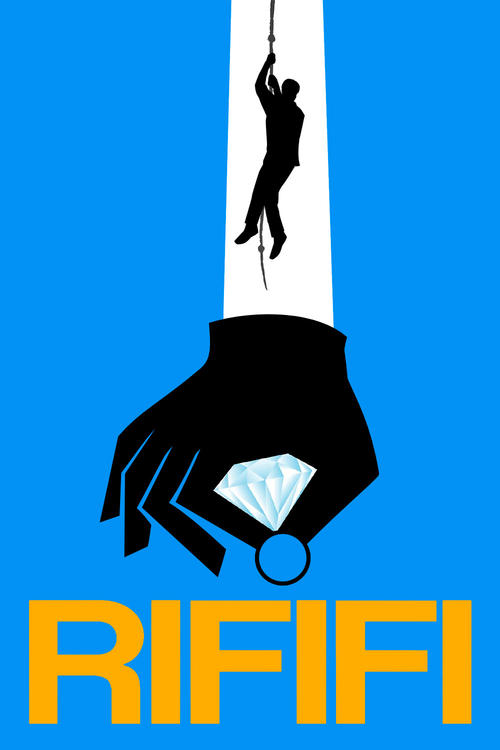
Rififi
Du rififi chez les hommes
"...Means Trouble!"
Overview
Rififi follows Tony "le Stéphanois," an aging gangster recently released from a five-year prison sentence. Physically weakened by illness and emotionally hollowed by the betrayal of his former lover, Tony initially rejects a proposal for a jewelry heist. However, driven by a desperate need for redemption and a stubborn adherence to a fading criminal code, he eventually agrees to lead a team in a high-stakes burglary of an exclusive Parisian jewelry store.
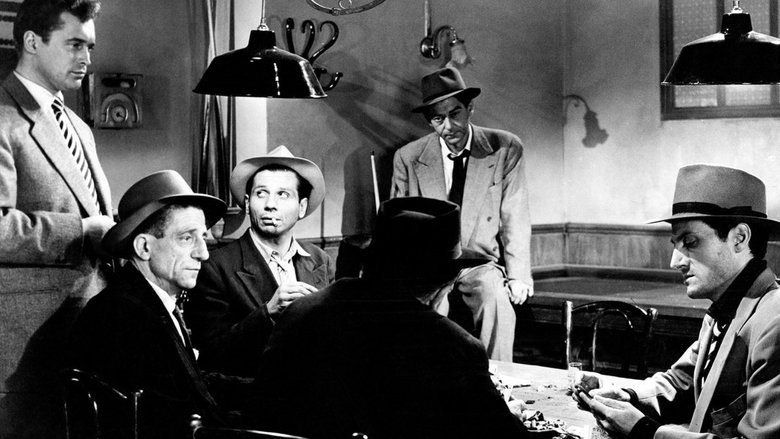
The film is legendary for its centerpiece: a meticulously detailed, half-hour heist sequence conducted in absolute silence. Working with Jo "le Suédois," the exuberant Mario, and the Italian safecracker César, Tony executes what appears to be the perfect crime. Yet, the narrative shifts from a technical masterclass into a grim tragedy as the gang's success is undermined not by the police, but by their own personal weaknesses and the arrival of a rival gang that plays by much more brutal rules.
Core Meaning
At its heart, Rififi is a meditation on the futility of the criminal life and the inevitable collapse of the "honor among thieves" myth. Director Jules Dassin, who was himself blacklisted and betrayed by colleagues during the McCarthy era, infused the film with a profound sense of existential isolation and the weight of professional integrity. The film suggests that while a crime can be technically perfect, the humans performing it are inherently flawed, and those flaws—be they greed, lust, or sentimentality—will eventually bring the entire structure crashing down. It serves as a tragic ode to a disappearing breed of men who live by rigid, often cruel, rules in a world that has become increasingly lawless and indifferent.
Thematic DNA
The Code of Honor and Betrayal
The film examines the strict, almost religious adherence to the underworld code. Tony represents the old guard for whom loyalty is absolute; his decision to execute a friend who "talked" reflects the brutal necessity of this code. This mirrors Dassin's own feelings regarding the Hollywood Blacklist and the colleagues who named names.
Human Frailty vs. Mechanical Perfection
The 30-minute silent heist represents the pinnacle of human skill and cooperation. However, the success of this "perfect machine" is undone by a single, impulsive act of vanity (César giving a stolen ring to a woman). The film posits that logic and skill are no match for emotion and ego.
The Weariness of Aging
Tony is introduced as a man whose time has passed. His hacking cough and gaunt appearance symbolize a character who is already a ghost in his own life. The heist is less about the money and more about proving he is still "the Stéphanois" before the end comes.
Urban Isolation and Fatalism
The grey, wintery streets of Paris act as a labyrinth from which the characters cannot escape. Every action they take leads them closer to an inevitable, tragic conclusion, emphasizing the noir concept of moira or fate.
Masculinity and "Rififi"
The title itself, slang for "rough and tumble" or "trouble among men," points to a specific type of performative, violent masculinity. The film critiques the destructive nature of these "tough guy" behaviors that ultimately destroy the families the men claim to protect.
Character Analysis
Tony "le Stéphanois"
Jean Servais
Motivation
Initially seeks revenge on his ex-lover and a return to his former stature, but his motivation shifts toward protecting his "family" and enforcing the rules of the game.
Character Arc
Begins as a broken man losing at cards and ends as a tragic figure who sacrifices his life to save his godson, reclaiming his dignity through a final, bloody act of loyalty.
Jo "le Suédois"
Carl Möhner
Motivation
Driven by loyalty to Tony and the desire to provide a better life for his wife and son.
Character Arc
A younger gangster who remains fiercely loyal to Tony, who took the fall for him years ago. His arc is defined by the tension between his love for his family and his commitment to the heist.
César "le Milanais"
Jules Dassin
Motivation
Driven by vanity and an obsession with women, which overrides his professional caution.
Character Arc
A flamboyant, lighthearted safecracker whose lack of discipline leads to his own execution. He transitions from a comic relief figure to the catalyst of the film's downfall.
Mario Ferrati
Robert Manuel
Motivation
Wants the grand score to live a life of luxury with his wife, Ida.
Character Arc
The optimist of the group who provides the plan. His jovial nature is eventually crushed by the grim reality of the Grutter gang's intervention.
Symbols & Motifs
The Silence
Symbolizes pure professionalism and the suspension of the outside world. In silence, the thieves are at their most unified and effective; when they start talking again, their world begins to fracture.
Used throughout the legendary 30-minute heist where no dialogue or music is heard.
The "Can Opener"
Represents manual ingenuity and precision. It elevates the burglary from a crude act of theft to a specialized craft, highlighting the thieves as artisans of the underworld.
The custom tool used to cut through the jewelry store's safe.
The Stolen Ring
Symbolizes vanity and the 'Judas' element. It is the physical manifestation of the breach in the code that leads to the gang's destruction.
César steals a single ring for his mistress, Viviane, which tips off the rival Grutter gang.
The Toy Penguin
Represents innocence and Tony's latent paternal instinct. It serves as a reminder of what the men are ostensibly fighting for (the next generation) and what they have ultimately corrupted.
Tony buys this for Jo's young son, Tonio, and it appears in the tragic final sequence.
Memorable Quotes
I liked you, Macaroni. But you know the rules.
— Tony "le Stéphanois"
Context:
Tony says this to César just before shooting him for betraying the gang to Grutter.
Meaning:
A chilling summary of the inevitability of the code. It highlights that personal affection cannot save a traitor in the underworld.
There's not a safe that can resist Cesar and not a woman that Cesar can resist.
— Mario Ferrati
Context:
Mario introducing César's reputation to the group during the planning stages.
Meaning:
Foreshadows the exact cause of the gang's downfall, linking César's professional skill with his fatal personal flaw.
You're not the only one that had an unhappy childhood... they are the tough ones, not you!
— Louise
Context:
Jo's wife, Louise, confronting the men about the path they've chosen.
Meaning:
A rare moment where the film's macho posturing is challenged, suggesting true strength lies in endurance rather than crime.
Philosophical Questions
Can there ever be a 'perfect' human endeavor?
The film uses the heist as a metaphor for human achievement. It suggests that even the most perfectly planned and executed act is ultimately subject to the chaos of human emotion.
What is the true cost of loyalty?
The film explores whether a code of honor that requires the killing of a friend is actually honorable or merely a different form of damnation.
Is redemption possible through sacrifice?
Tony's final drive to save the boy is often seen as a secular redemption. The film asks if one's past sins can be washed away by a single, final act of selfless violence.
Alternative Interpretations
Critics often read Rififi as a political allegory for the McCarthy-era witch hunts. In this reading, the heist represents the collective effort of blacklisted artists, and the betrayal by César (played by the director himself) represents those who 'named names' to save themselves. Another interpretation views the film as a subversion of the 'American Dream.' While American noirs of the era often suggested a way out, Rififi presents a world where the dream is dead upon arrival, and the only thing left is the dignity of one's professional craft. Some modern feminist critiques also focus on the film's misogyny, interpreting the brutal treatment of the female characters (like Mado) not just as noir realism, but as a reflection of the toxic, fragile masculinity that the film eventually punishes.
Cultural Impact
Rififi is widely considered the "father of the heist film." Before 1955, crime films focused on the planning or the aftermath; Rififi was the first to treat the execution of the crime as a meticulous, procedural art form. It paved the way for modern classics like The Killing, Ocean's Eleven, and Reservoir Dogs. Critically, it was a major spark for the French New Wave; François Truffaut, then a critic, famously stated that Dassin had made the best crime film he'd ever seen out of the worst novel he'd ever read. It also marked a triumphant comeback for Dassin, proving that blacklisted filmmakers could still produce world-class art. Philosophically, it introduced a new level of gritty realism and moral ambiguity to the genre, moving away from Hollywood's sanitized 'crime doesn't pay' tropes toward a more European, tragic existentialism.
Audience Reception
Upon its release, Rififi was a massive critical and commercial success, earning Jules Dassin the Best Director award at Cannes. Audiences were particularly captivated by the tension of the silent heist, which reportedly left theaters in stunned silence. However, it was controversial; some police departments and governments feared it served as a 'how-to' manual for burglars. Modern audiences and critics continue to praise its pacing and atmosphere, frequently citing it as one of the greatest films ever made. While some aspects of its gender politics are now viewed as dated or problematic, its technical mastery and tragic resonance remain undisputed.
Interesting Facts
- Director Jules Dassin was blacklisted in Hollywood and moved to France, making this film on a tiny budget of $200,000.
- Dassin played the role of César under the pseudonym 'Perlo Vita' because the actor he originally wanted was unavailable.
- The 30-minute silent heist scene was not in the original novel; Dassin added it to focus on the technical craft of the characters.
- The film's heist was so detailed that it was banned in several countries (like Mexico and Finland) because criminals were reportedly copying the techniques in real life.
- Dassin hated the original novel because of its racist and anti-Semitic undertones and only agreed to direct it after being unemployed for five years.
- The 'grey' look of the film was intentional; Dassin refused to shoot on sunny days to maintain a bleak atmosphere.
Easter Eggs
Dassin's Pseudonym: Perlo Vita
Dassin used the name Perlo Vita in the credits. This was a nod to his 'dead' career in Hollywood, as he felt he was living a new life in Europe after being blacklisted.
The Song 'Rififi'
The cabaret song sung by Magali Noël was written specifically to explain the title of the movie, as 'rififi' was obscure Parisian slang that even some French audiences didn't fully understand at the time.
⚠️ Spoiler Analysis
Click to reveal detailed analysis with spoilers
Frequently Asked Questions
Explore More About This Movie
Dive deeper into specific aspects of the movie with our detailed analysis pages
Comments (0)
No comments yet. Be the first to share your thoughts!