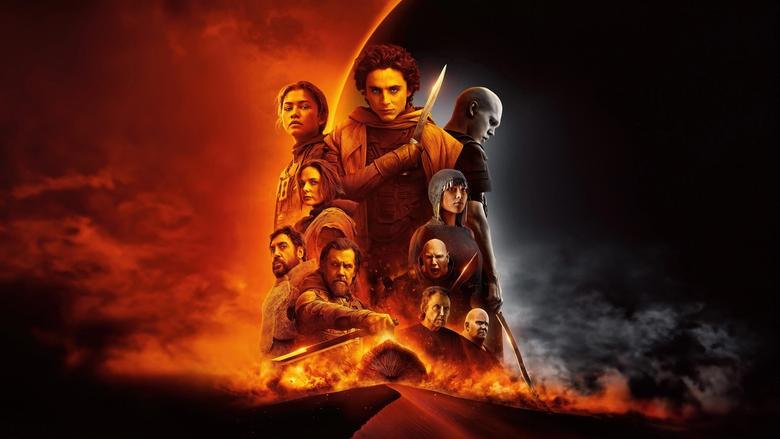
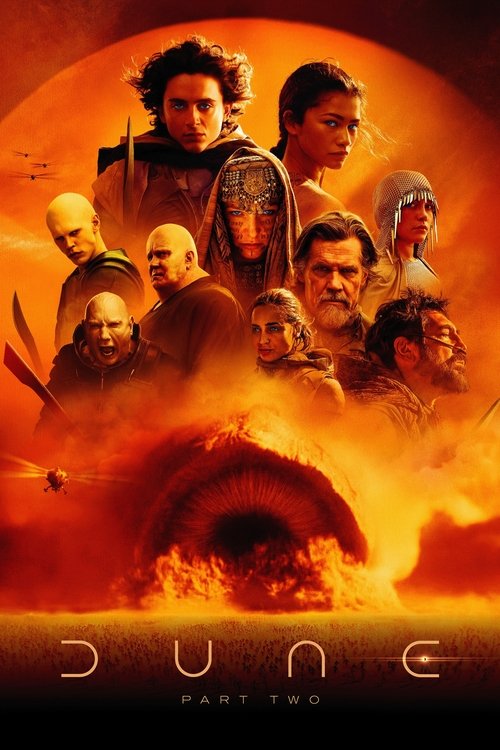
Dune: Part Two
"Long live the fighters."
Overview
"Dune: Part Two" continues the saga of Paul Atreides (Timothée Chalamet) as he aligns himself with the Fremen, the indigenous people of the desert planet Arrakis. Following the devastating attack on his family by House Harkonnen, Paul seeks revenge and endeavors to earn the trust of the Fremen, including the skeptical warrior Chani (Zendaya). Guided by his mother, Lady Jessica (Rebecca Ferguson), and the Fremen leader Stilgar (Javier Bardem), Paul grapples with his burgeoning prescient abilities and the messianic prophecies that surround him, which label him as the "Lisan al Gaib."
As Paul immerses himself in Fremen culture, learning to ride the colossal sandworms and leading raids against the Harkonnen spice-harvesting operations, his influence grows. This rise in power does not go unnoticed, prompting the ruthless Baron Vladimir Harkonnen (Stellan Skarsgård) to unleash his sadistic nephew, Feyd-Rautha (Austin Butler), to crush the Fremen rebellion. Paul is forced to confront his destiny, choosing between his love for Chani and the fate of the universe, all while trying to prevent a catastrophic holy war he has foreseen in his visions.

Core Meaning
"Dune: Part Two" explores the corrupting nature of power and the dangers of religious fanaticism. Director Denis Villeneuve subverts the traditional "chosen one" narrative, presenting a cautionary tale about how messianic figures can be manufactured and manipulated for political gain. The film scrutinizes the concept of a "white savior," ultimately revealing Paul Atreides not as a straightforward hero, but as a complex figure who becomes the very conqueror he feared. It delves into themes of colonialism, the exploitation of natural resources, and the collision of faith with politics, questioning the true cost of liberation and the ambiguous line between leader and tyrant.
Thematic DNA
The Dangers of Charismatic Leadership and Messianism
The film critically examines the rise of a charismatic leader and the fervent belief he inspires. Paul's journey is not a simple heroic arc but a descent into becoming a messianic figure who manipulates prophecy to lead a holy war. The narrative questions whether such leaders bring salvation or destruction, highlighting the dangers of surrendering critical thought to faith, as seen through the zealous eyes of Stilgar versus the skepticism of Chani.
Power, Corruption, and Revenge
Initially driven by a desire for revenge against those who destroyed his family, Paul's quest for justice becomes entangled with a thirst for power. The film illustrates how the pursuit of power, even with noble intentions, can corrupt. Paul's transformation is marked by his increasing willingness to embrace ruthless tactics, ultimately choosing to seize the imperial throne and launch a universe-spanning jihad.
Colonialism and Indigenous Resistance
The struggle between the Fremen and their Harkonnen and Imperial oppressors is a clear allegory for colonialism. The film portrays the Fremen's deep connection to their environment and their fight for self-determination against outside forces who wish only to extract their planet's most valuable resource, the spice. Paul's integration into their society and subsequent leadership raises complex questions about cultural appropriation and the role of an outsider in a liberation movement.
Fate vs. Free Will
Paul is haunted by prescient visions of a devastating future, a holy war fought in his name that will kill billions. Throughout the film, he struggles against this seemingly inevitable destiny. His decision to finally embrace the prophecy and drink the Water of Life represents a critical turning point, where he accepts his terrible purpose in order to navigate a "narrow way through" his enemies, suggesting a complex interplay between pre-ordained fate and the choices one makes.
Character Analysis
Paul Atreides
Timothée Chalamet
Motivation
Initially, his motivation is revenge against the Harkonnens and the Emperor for destroying his family. This evolves into a complex desire to protect the Fremen, secure his own power, and navigate a treacherous future he can now see, ultimately leading him to seize the Imperial throne.
Character Arc
Paul begins as a reluctant leader, haunted by visions of a holy war. He seeks to fight alongside the Fremen, not rule them. However, after a devastating Harkonnen attack and drinking the Water of Life, he embraces his messianic destiny. He transforms from a conflicted youth into a powerful, ruthless leader who is willing to sacrifice love and ignite a galactic war to achieve his revenge and secure power, fulfilling the very prophecy he feared.
Chani
Zendaya
Motivation
Her primary motivation is the freedom and well-being of her people, the Fremen. She believes in their strength to liberate themselves without relying on an outsider or a manipulative prophecy. She is also motivated by her genuine love for Paul, which puts her in direct conflict with his political ambitions.
Character Arc
Chani serves as the film's moral and emotional anchor. A skilled Fremen warrior, she is skeptical of the Bene Gesserit prophecy, viewing it as a tool of enslavement. She falls in love with Paul for who he is, not the messiah others see. As Paul embraces his fanatical leadership, her love turns to concern and ultimately heartbreak. She remains defiant, refusing to bow to him as he claims the throne and marries another for political power, choosing her own path.
Lady Jessica
Rebecca Ferguson
Motivation
Her motivation is the survival and ascendancy of her son, Paul. As a Bene Gesserit, she is conditioned to think in terms of power, bloodlines, and political manipulation. She sees the Fremen prophecy as the most effective tool to ensure Paul not only survives but triumphs over their enemies.
Character Arc
Lady Jessica evolves from a grieving mother into a powerful and manipulative religious figure. After becoming a Reverend Mother by drinking the Water of Life, she gains the memories of her ancestors and begins actively spreading the messianic prophecy to secure Paul's power. She communicates with her unborn, preternaturally aware daughter, Alia, and becomes a key architect of Paul's rise, pushing him towards the very future he dreads.
Feyd-Rautha Harkonnen
Austin Butler
Motivation
Feyd-Rautha is motivated by a pure lust for power, status, and violence. He seeks to prove his superiority and ruthlessness to his uncle, the Baron, and usurp him as the head of House Harkonnen and, potentially, the entire Empire.
Character Arc
Feyd-Rautha is introduced as the psychopathic and cunning heir to House Harkonnen. He is a formidable warrior and a cruel leader, representing a dark mirror to Paul. His arc is a straightforward path of violence and ambition, culminating in his role as the Emperor's champion in a final duel against Paul for control of the throne, a duel he ultimately loses.
Symbols & Motifs
Spice (Melange)
Spice represents power, control, and consciousness. It is the universe's most valuable substance, essential for interstellar travel, and it also induces prescient visions and expands consciousness. He who controls the spice, controls the universe, making it the central point of political and military conflict.
The entire conflict revolves around the control of Arrakis, the only source of spice. The Harkonnens brutally exploit the planet for it, while the Fremen have a deep, spiritual connection to it. Paul's consumption of spice and the Water of Life (a concentrated form of spice) unlocks his full prescient abilities, cementing his path as the Kwisatz Haderach.
Sandworms (Shai-Hulud)
The sandworms are a powerful symbol of the untamable nature of Arrakis and the deep ecological wisdom of the Fremen. They are both a source of immense danger and a key to the Fremen's survival and power. To ride a sandworm is a rite of passage, signifying a true connection to the desert and earning respect within Fremen society.
Paul's successful ride of a giant sandworm is a pivotal moment that solidifies his place among the Fremen and validates the prophecies for believers like Stilgar. In the film's climax, the Fremen use the sandworms as devastating cavalry in their assault on the Emperor's forces, turning the planet's native power against their colonizers.
Water
On the desert planet of Arrakis, water is the most precious resource, symbolizing life, community, and tradition. The Fremen's strict water discipline, collecting their own tears and the water from their dead, underscores the harshness of their environment and the value they place on life. Stilgar's quote, "Never give your water away, not even for the dead," emphasizes its immense value.
The ritual of sharing water is a sign of deep trust. Paul's willingness to give his water to Jamis's memory in the first film was a key step in his acceptance. The "Water of Life" is a poisonous liquid that Lady Jessica and later Paul must transmute to unlock their higher consciousness, tying water directly to spiritual transformation and forbidden knowledge.
Memorable Quotes
May thy knife chip and shatter.
— Paul Atreides
Context:
Spoken by Paul just before he begins his final duel against Feyd-Rautha. The fight will decide not only their personal fates but also who will control the Imperial throne.
Meaning:
This is a traditional Fremen saying before a duel to the death. When Paul says it to Feyd-Rautha, it signifies his complete assimilation into Fremen culture and his acceptance of their ways. It is a moment where he fully embraces his role, using the Fremen's own traditions to fuel his path to power.
This prophecy is how they enslave us!
— Chani
Context:
Chani says this during a conversation where the growing belief in Paul as the Lisan al Gaib is discussed. It highlights the growing ideological rift between her and the more fundamentalist Fremen, and eventually between her and Paul.
Meaning:
This line encapsulates Chani's core belief and the film's critical perspective on religion and power. She sees the messianic prophecy not as a source of liberation but as a sophisticated form of control designed by the Bene Gesserit to manipulate the Fremen people.
He who can destroy a thing has the real control of it.
— Paul Atreides
Context:
Paul says this as he threatens to use the Atreides' hidden atomic weapons to destroy the spice fields on Arrakis. This threat is his ultimate checkmate against the Emperor and the Great Houses, forcing them to concede to his demands.
Meaning:
This quote, taken directly from Frank Herbert's novel, is a succinct and powerful statement on the nature of ultimate power. It reveals Paul's deep understanding of political leverage. True control comes not from possessing a resource, but from having the ability to annihilate it entirely.
Lead them to paradise.
— Paul Atreides
Context:
After defeating Feyd-Rautha and securing the throne, Paul is informed that the other Great Houses refuse to acknowledge his ascendancy. He gives this order to Stilgar, officially launching the Fremen fleet to wage war across the galaxy.
Meaning:
This chilling command marks Paul's final transformation into a wartime messiah. "Paradise" is a loaded term; for his fanatical Fremen followers, it means a lush, green Arrakis and spiritual salvation. For the Great Houses who oppose him, it is a euphemism for their destruction. It's the moment he unleashes his holy war.
Philosophical Questions
What is the relationship between religion and political power?
The film delves deeply into how religious prophecy can be created and exploited as a tool for political control. The Bene Gesserit planted the Lisan al Gaib myth on Arrakis centuries ago to manipulate its population. Lady Jessica and Paul then consciously use this prophecy to rally the Fremen. The film asks whether power can ever be divorced from some form of faith or ideology, and it demonstrates how fervent belief, when harnessed by a charismatic leader, can become an unstoppable and terrifying political force.
Can a 'hero' truly exist, or are all leaders inevitably compromised?
"Dune: Part Two" actively subverts the hero's journey. Paul Atreides has all the makings of a classic protagonist: a noble birthright, a quest for revenge, and a desire to help an oppressed people. However, the narrative shows how the pressures of leadership, the temptation of absolute power, and the burden of precognition corrupt his initial intentions. The film forces the audience to question the very nature of heroism, suggesting that the path to becoming a savior can be indistinguishable from the path to becoming a tyrant.
To what extent are we bound by destiny?
Paul's prescience is a central element of his character. He is tormented by visions of a future holy war that will lead to the deaths of billions. The film explores the philosophical dilemma of knowing the future. Does this knowledge negate free will? Paul's struggle is whether to fight this terrible destiny or embrace it to achieve his goals. His ultimate choice suggests a complex relationship where fate might be inevitable, but the path one takes to meet it is still a matter of choice, albeit a horrifying one.
Alternative Interpretations
While the film presents Paul's journey as a tragic fall into villainy, an alternative interpretation views his actions as a necessary evil. From this perspective, Paul's embrace of his messianic role and the subsequent holy war are the "narrow way through"—the only possible path to defeating the corrupt Emperor and the sadistic Harkonnens and preventing even worse futures he has foreseen. His actions, though horrific, could be seen as a calculated sacrifice to place humanity on a more resilient long-term path, a concept central to the later books in the series.
Another interpretation focuses on the agency of the Fremen. While the film highlights the manipulation of the Bene Gesserit prophecy, one could argue that the Fremen are not simply passive believers. Their faith in the Lisan al Gaib is also a political tool they actively wield, a rallying point in a centuries-long struggle for freedom. They choose to believe in Paul because he offers them a tangible path to victory against their oppressors. His arrival doesn't create their desire for liberation but rather provides a catalyst for it.
Cultural Impact
Released in 2024, "Dune: Part Two" arrived as a monumental cinematic event, solidifying director Denis Villeneuve's adaptation as a defining sci-fi epic for the 21st century. The film was met with widespread critical acclaim, with many praising it as superior to its predecessor, citing its improved pacing, deeper character development, and breathtaking visual spectacle. It became a major box office success, surpassing the first film's gross and becoming one of the highest-grossing films of the year.
Culturally, the film sparked renewed interest in Frank Herbert's novels and invigorated discussions around its complex themes. Its exploration of theocratic authoritarianism, colonial violence, and environmental exploitation resonated strongly with contemporary audiences. The movie's subversion of the 'white savior' trope was a significant point of analysis, with critics noting how Villeneuve's adaptation makes Paul's villainous turn more explicit than some interpretations of the book. The film's influence extends to its technical achievements; the use of infrared cinematography for Giedi Prime and its commitment to the IMAX format were lauded as innovative and immersive. "Dune: Part Two" has been hailed as a triumph of large-scale, intelligent blockbuster filmmaking, proving that artistically ambitious and thematically complex stories can achieve massive commercial success.
Audience Reception
Audiences responded overwhelmingly positively to "Dune: Part Two," with many considering it a masterpiece of modern science fiction and an improvement on the first film. Viewers frequently praised the film's epic scale, stunning cinematography, and immersive world-building, often recommending the IMAX experience as essential. The action sequences, particularly Paul's sandworm ride and the final battle, were highlighted as visceral and masterfully executed. The performances of the cast were widely acclaimed, with Austin Butler's terrifying portrayal of Feyd-Rautha receiving special mention.
Points of criticism were relatively minor but did surface. Some viewers found the pacing, particularly in the third act, to be rushed, wishing for more time to let significant plot developments breathe. A few felt that the emotional connection between Paul and Chani could have been more developed to heighten the tragedy of its conclusion. Despite these points, the overall verdict from audiences was that the film was a spectacular and thought-provoking cinematic event that successfully delivered on the epic promise of its source material.
Interesting Facts
- The entire film was shot with IMAX-certified cameras, unlike the first film which was only partially shot in the format.
- To create the distinct, eerie look of the Harkonnen home world, Giedi Prime, cinematographer Greig Fraser shot the scenes using infrared cinematography, which captures light not visible to the human eye.
- Composer Hans Zimmer began writing and recording music for the score before the film was officially greenlit, providing director Denis Villeneuve with over 90 minutes of music to use as inspiration while writing the screenplay.
- Austin Butler, who plays Feyd-Rautha, trained for four months in Budapest with a former Navy SEAL member to prepare for the physically demanding role and the complex fight choreography.
- Anya Taylor-Joy has a secret cameo as the adult version of Paul's sister, Alia Atreides, appearing in one of his prescient visions. Her involvement was kept secret until the film's premiere.
- The crew was able to film during a partial solar eclipse, which was incorporated into the film's opening fight scene.
- Scenes for two actors, Stephen McKinley Henderson (reprising his role as Thufir Hawat) and Tim Blake Nelson, were cut from the final film, though Villeneuve gave them a special thanks in the credits.
Easter Eggs
Princess Irulan's opening narration.
The film opens with Princess Irulan narrating the events of the first film. This is a direct homage to the book "Dune," where each chapter begins with an epigraph from Irulan's future historical writings about Paul Atreides.
Lady Margot Fenring secures the Harkonnen bloodline.
The Bene Gesserit send Lady Margot Fenring to seduce Feyd-Rautha and become pregnant with his child. This is a crucial plot point from the books, ensuring the survival of the Harkonnen genetic material for their breeding program, regardless of the outcome of the conflict on Arrakis.
Gurney Halleck's baliset.
When Paul reunites with Gurney Halleck, Gurney is seen with his musical instrument, the baliset. This is a nod to his character in the books, where he is a renowned warrior-poet. Josh Brolin had even created music for deleted scenes in the first film.
⚠️ Spoiler Analysis
Click to reveal detailed analysis with spoilers
Frequently Asked Questions
Explore More About This Movie
Dive deeper into specific aspects of the movie with our detailed analysis pages
Comments (0)
No comments yet. Be the first to share your thoughts!