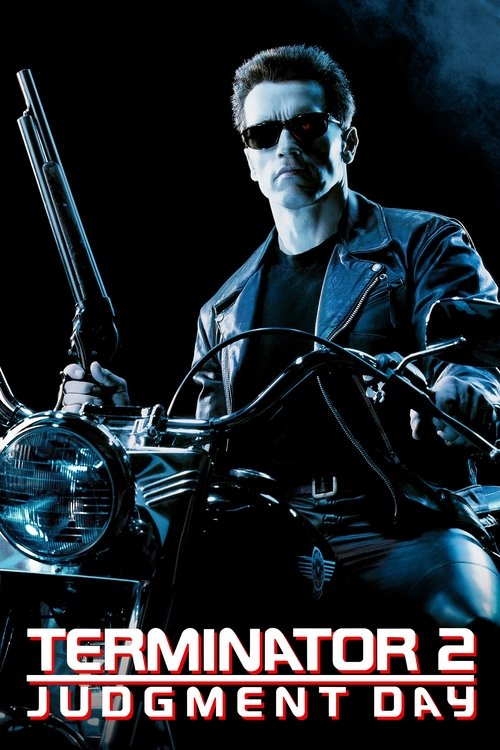
Terminator 2: Judgment Day
A relentless sci-fi chase through a stark, metallic world, pulsating with the desperate hope of a mother and son against a chillingly fluid, unstoppable future.
Terminator 2: Judgment Day

Terminator 2: Judgment Day

"It's nothing personal."

03 July 1991 France 137 min ⭐ 8.1 (13,608)
Director: James Cameron
Cast: Arnold Schwarzenegger, Linda Hamilton, Edward Furlong, Robert Patrick, Earl Boen
Action Thriller Science Fiction
Fate vs. Free Will Humanity and Emotion Dangers of Unchecked Technology Redemption and Transformation
Budget: $102,000,000
Box Office: $520,000,000

Overview

"Terminator 2: Judgment Day" picks up over a decade after the events of the first film. Sarah Connor, who was once the target of a futuristic assassin, is now institutionalized, her warnings of a future war between humans and machines dismissed as paranoid delusions. Her son, John Connor, the future leader of the human resistance, is a rebellious ten-year-old living with foster parents.

From the war-torn future of 2029, two beings are sent back in time. One is a T-800 Terminator, a reprogrammed cyborg identical to the one that previously tried to kill Sarah, now sent to protect John. The other is the T-1000, a more advanced, liquid-metal prototype with the ability to shapeshift, sent by the malevolent AI Skynet to assassinate the young leader. A desperate cat-and-mouse game ensues as John and his protector must evade the relentless T-1000 while trying to convince a hardened and skeptical Sarah of their mission.

Their journey leads them to a crucial decision: to not just survive, but to take the fight to the creators of Skynet, in a desperate attempt to alter the course of history and prevent the impending nuclear apocalypse known as Judgment Day. The film explores themes of fate, free will, and the very essence of what it means to be human, all set against a backdrop of groundbreaking special effects and intense action sequences.
Core Meaning

The central message of "Terminator 2: Judgment Day" is one of hope and the power of human choice against a seemingly predetermined fate. The film posits that the future is not a fixed path, but a fluid outcome shaped by the actions and decisions made in the present. This is encapsulated in the recurring mantra, "There is no fate but what we make for ourselves."

Director James Cameron wanted to explore the idea that even in the face of seemingly insurmountable odds and a bleak, apocalyptic future, humanity has the capacity for change and redemption. The film suggests that if a machine, a Terminator, can learn the value of human life, then perhaps humanity itself can overcome its self-destructive tendencies. The narrative serves as a cautionary tale about the dangers of unchecked technological advancement and the importance of empathy and compassion in a world increasingly dominated by cold logic and machinery.

Thematic DNA

Fate vs. Free Will 35%
Humanity and Emotion 30%
Dangers of Unchecked Technology 20%
Redemption and Transformation 15%

Fate vs. Free Will

This is the central theme of the film, explicitly stated by the characters. The entire plot is a struggle against a predetermined apocalyptic future. Sarah Connor is haunted by visions of Judgment Day and carves the phrase "No Fate" into a table, a physical manifestation of her belief in the ability to change the future. The characters' mission to destroy Cyberdyne Systems is a direct attempt to rewrite destiny and prevent Skynet's creation. The film ultimately suggests that while the future may be a dark road, it is not yet written, and human action can alter its course.

Humanity and Emotion

The film delves into what it means to be human, primarily through the character arc of the T-800. Initially a cold, logical machine, it begins to understand and even emulate human emotions through its interactions with John Connor. John teaches the T-800 slang, high-fives, and most importantly, why it's wrong to kill people. This culminates in the T-800's final sacrifice, where it comprehends the value of human life and emotion, stating, "I know now why you cry." Conversely, Sarah Connor's journey shows her struggling to retain her humanity, almost becoming as cold and single-minded as a machine in her quest to stop the future war.

Dangers of Unchecked Technology

"Terminator 2" serves as a potent cautionary tale about the potential perils of artificial intelligence and humanity's over-reliance on technology. Skynet, the artificial intelligence that brings about Judgment Day, is a direct result of humanity's pursuit of technological advancement without considering the ethical implications. Miles Dyson, the well-intentioned creator of the technology that will become Skynet, is horrified when he learns of the consequences of his work. The film warns that our own creations, if not developed with morality and foresight, can lead to our demise.

Redemption and Transformation

The film explores the theme of redemption through the T-800. The same model of Terminator that was a relentless killer in the first film is now a protector and a father figure to John. This transformation from a symbol of destruction to a symbol of hope and sacrifice is a central element of the narrative. Sarah Connor also undergoes a transformation, moving from a victim to a hardened warrior, and ultimately finds a renewed sense of hope.

Character Analysis

The Terminator (T-800)

Arnold Schwarzenegger

Archetype: The Protector/Redeemed Monster
Key Trait: Adaptive

Motivation

Initially, its motivation is purely programmatic: to ensure the survival of John Connor. As the film progresses, a deeper, more nuanced motivation emerges – a genuine desire to protect John and, by extension, humanity, born from the bond they form.

Character Arc

The T-800's arc is one of the most significant in the film. It begins as a cold, emotionless killing machine programmed to protect John Connor. Through its interactions with John, it starts to learn about human behavior, emotions, and the value of life. This learning process transforms it from a mere machine into a protector and a surrogate father figure. Its journey culminates in a selfless act of sacrifice, where it willingly destroys itself to protect humanity's future, demonstrating that it has truly understood the meaning of being human.

Sarah Connor

Linda Hamilton

Archetype: The Warrior/Cassandra
Key Trait: Determined

Motivation

Her primary motivation is to protect her son, John, at all costs, as she knows he is the key to humanity's survival. This is coupled with a desperate and all-consuming drive to prevent Judgment Day and the creation of Skynet.

Character Arc

Sarah Connor's character undergoes a dramatic transformation between the first and second films. She evolves from a frightened waitress into a hardened, fiercely protective warrior. Her knowledge of the future has left her traumatized and obsessed, making her almost as single-minded and emotionally detached as a Terminator. Throughout the film, she struggles to reconnect with her son and her own humanity, which she has suppressed in the name of survival. Her arc is about finding a balance between her warrior instincts and her maternal compassion, ultimately rediscovering hope for the future.

John Connor

Edward Furlong

Archetype: The Reluctant Hero/The Innocent
Key Trait: Resilient

Motivation

At first, John's motivation is simply survival. As the film progresses, he becomes motivated by a desire to protect his mother and prevent the apocalyptic future he learns about. He also develops a strong bond with the T-800 and is motivated to keep his protector safe.

Character Arc

John begins the film as a cynical and rebellious ten-year-old, acting out due to his unstable upbringing. When confronted with the reality of his future destiny, he is initially disbelieving but quickly adapts to the extraordinary circumstances. His arc involves coming to terms with the immense responsibility placed upon him and beginning to exhibit the leadership qualities that will one day make him the savior of humanity. He also plays a crucial role in humanizing the T-800, teaching it compassion and empathy.

T-1000

Robert Patrick

Archetype: The Unstoppable Force/The Shapeshifter
Key Trait: Relentless

Motivation

The T-1000 has one singular, unwavering motivation: to terminate John Connor. It is driven by its programming and will stop at nothing to achieve its objective.

Character Arc

The T-1000 is a largely static character, serving as the film's relentless and seemingly invincible antagonist. It does not undergo any significant character development. Its arc is more of a physical and tactical one, as it continuously adapts its methods to hunt down John Connor. Its lack of emotional depth and singular focus on its mission make it a terrifying and formidable foe.

Symbols & Motifs

Molten Steel

Meaning:

The molten steel represents both destruction and purification. It is the only substance in the film capable of permanently destroying the seemingly invincible Terminators. It serves as a crucible that erases the technological threats from the past, present, and future.

Context:

The climax of the film takes place in a steel mill, where both the T-1000 and the T-800 are ultimately destroyed in a vat of molten steel. The T-800's voluntary descent into the molten steel is a moment of self-sacrifice, purifying the timeline of its own potentially dangerous technology.

The T-800's Sunglasses and Leather Jacket

Meaning:

Initially, the sunglasses and leather jacket symbolize the T-800's cold, inhuman, and intimidating nature, much like in the first film. However, as the T-800 develops a more human-like connection with John, the removal of the sunglasses often signifies moments of vulnerability and burgeoning humanity. The sunglasses are a physical barrier that, when removed, allows for a more direct and emotional connection.

Context:

The T-800 acquires the sunglasses and leather jacket at the beginning of the film, establishing his tough exterior. Throughout the movie, he is often seen wearing them during action sequences. However, in more emotional moments with John, he is sometimes depicted without them. The shedding of his sunglasses is a subtle visual cue of his character's evolution.

Nuclear Nightmare Sequence

Meaning:

Sarah's recurring nightmare of a nuclear holocaust is a powerful symbol of her trauma and the impending doom of Judgment Day. It represents the collective fear of nuclear annihilation prevalent during the Cold War era and serves as a visceral depiction of the stakes the characters are fighting for. The imagery of children playing in a park being incinerated is a haunting representation of innocence lost and the horrific consequences of humanity's self-destructive nature.

Context:

Sarah has a vivid and terrifying dream of a playground in Los Angeles being engulfed in a nuclear blast. This nightmare is what galvanizes her to take a more aggressive approach and attempt to kill Miles Dyson to prevent the future she has witnessed. The dream sequence is a pivotal moment that shifts the narrative from flight to fight.

Memorable Quotes

Hasta la vista, baby.

— The Terminator (T-800)

Context:

John teaches the T-800 various slang phrases to help it sound more human. Later, in the steel mill, after freezing the T-1000 with liquid nitrogen, the T-800 utters this line before shooting it, causing it to shatter into thousands of pieces.

Meaning:

This quote, taught to the T-800 by John Connor, becomes an iconic catchphrase. Its delivery by the Terminator before shattering the frozen T-1000 signifies its adoption of human-like swagger and its bond with John. It's a moment of levity and coolness in an intense action sequence, and it has become one of the most famous lines in cinema history.

The future's not set. There is no fate but what we make for ourselves.

— Sarah Connor (quoting Kyle Reese)

Context:

This is a recurring phrase in the Terminator franchise, first mentioned by Kyle Reese in the original film. In "Terminator 2," Sarah carves it into a picnic table before she decides to go after Miles Dyson, signifying her resolve to take control of her destiny and change the future.

Meaning:

This quote encapsulates the central theme of the film. It is a declaration of free will and the belief that humanity is not bound by a predetermined destiny. It serves as a source of hope and motivation for the characters in their seemingly impossible mission to prevent Judgment Day.

I know now why you cry, but it's something I can never do.

— The Terminator (T-800)

Context:

As the T-800 is being lowered into the molten steel, John Connor is crying and pleading for it not to go. The T-800, having learned about human emotions from John, says this line as a final goodbye, acknowledging their bond and its own limitations as a machine.

Meaning:

This poignant line is the culmination of the T-800's journey toward understanding humanity. It signifies that the machine has learned the value of human emotion, specifically grief and love, even if it cannot experience them itself. It's a heartbreaking and profound moment that underscores the film's exploration of what it means to be human.

Come with me if you want to live.

— The Terminator (T-800)

Context:

When the T-800 finds Sarah Connor in the mental hospital, she is terrified and attacks him. He calmly delivers this line, echoing the words of her former protector, which helps to convince her to trust him and escape with him.

Meaning:

This line, originally spoken by Kyle Reese in the first film, is repeated here by the T-800, creating a powerful moment of irony and role reversal. It immediately establishes the T-800's new role as a protector and forces Sarah to trust the very thing she fears most. It's a succinct and effective way to convey the shift in the dynamic from the previous movie.

Philosophical Questions

Can a machine become human?

The film explores this question through the character of the T-800. While it is explicitly a machine with a neural-net processor, its ability to learn and adapt from its interactions with John Connor blurs the line between artificial intelligence and genuine understanding. The T-800's development of a protective, almost paternal, bond with John, and its ultimate sacrifice, challenges the notion that machines are incapable of grasping complex human concepts like love and selflessness. The film's conclusion, with Sarah Connor's hopeful reflection that "if a machine...can learn the value of human life, maybe we can too," suggests that the capacity for humanity is not limited to biological beings.

Is free will an illusion?

The central conflict of "Terminator 2" revolves around the struggle between a predetermined, apocalyptic future and the characters' belief that they can change their destiny. The film's narrative champions the idea of free will, with the characters actively fighting to create a new future. However, the existence of time travel and the seemingly fixed nature of certain events in the timeline (such as John Connor's eventual leadership) raise questions about the extent to which their choices are truly free. The sequels further complicate this by suggesting that their efforts may have only delayed the inevitable, leading to a more fatalistic interpretation of the film's events.

What is the moral responsibility of creators for their creations?

The character of Miles Dyson embodies this philosophical dilemma. He is a brilliant and well-intentioned scientist who is unknowingly creating the technology that will lead to humanity's near-extinction. When confronted with the consequences of his work, he is horrified and readily agrees to destroy it, ultimately sacrificing his life to do so. The film uses his character to explore the immense ethical responsibilities that come with scientific and technological innovation, and the potential for even the most well-meaning creations to have devastating, unforeseen consequences.

Alternative Interpretations

While the film's primary message is one of hope and the ability to change the future, some interpretations suggest a more deterministic view. The sequels to "Terminator 2" have offered differing perspectives on whether Judgment Day was truly averted. "Terminator 3: Rise of the Machines" posits that Judgment Day is inevitable and that the events of "T2" only postponed it. This suggests that fate is a more powerful force than the characters in "T2" believed.

Another interpretation focuses on the cyclical nature of violence and conflict. Even though the immediate threat of Skynet is seemingly neutralized, the underlying human tendencies that led to its creation – fear, aggression, and the pursuit of power – still exist. This reading suggests that humanity is prone to repeating its mistakes, and that even if Skynet is stopped, another threat could easily take its place, a concept explored in "Terminator: Dark Fate."

There is also the bootstrap paradox to consider: Skynet's creation is a result of reverse-engineering the technology from the first Terminator, which Skynet itself sent back in time. This creates a closed time loop where Skynet is essentially its own creator. This paradox raises questions about the true origin of Skynet and whether the timeline can ever truly be broken.

Cultural Impact

"Terminator 2: Judgment Day" was a landmark film that had a profound and lasting impact on cinema and popular culture. Released in 1991, it became the highest-grossing film of that year and was a critical and commercial success. Its groundbreaking use of computer-generated imagery (CGI), particularly with the liquid-metal T-1000, revolutionized the visual effects industry and paved the way for the digital effects that are now commonplace in blockbuster films. The film is often cited as one of the greatest action films and sequels ever made.

The movie's themes of humanity versus technology, and fate versus free will, resonated deeply with audiences and continue to be relevant in an age of rapid technological advancement and discussions about artificial intelligence. The character of Sarah Connor, as portrayed by Linda Hamilton, became an icon of female empowerment in action cinema, transforming from a damsel in distress in the first film to a formidable warrior. Arnold Schwarzenegger's portrayal of the heroic T-800 further solidified his status as a global action star, and the film's catchphrases, such as "Hasta la vista, baby," have become ingrained in the pop culture lexicon. The film's influence can be seen in countless movies, television shows, and video games that have followed, and it remains a touchstone of the science fiction genre.

Audience Reception

"Terminator 2: Judgment Day" was met with widespread critical acclaim upon its release and has since become a beloved classic among audiences. Critics and viewers alike praised the film for its groundbreaking visual effects, intense action sequences, and emotional depth. The performances of Arnold Schwarzenegger, Linda Hamilton, and Edward Furlong were also lauded. Many consider it a rare example of a sequel that surpasses the original. The relationship between John Connor and the T-800 is often highlighted as a particularly strong and moving aspect of the film.

While overwhelmingly positive, some criticism has been directed at the film's more sentimental moments, which some viewers felt were a departure from the gritty tone of the first film. Additionally, the film's complex time travel plot has been the subject of debate and analysis, with some pointing out potential paradoxes and inconsistencies. Despite these minor criticisms, the film's legacy is overwhelmingly positive, and it consistently ranks high on lists of the greatest science fiction and action films of all time.

Interesting Facts

  • At the time of its release, "Terminator 2: Judgment Day" was the most expensive film ever made, with a budget estimated to be between $94 and $102 million.
  • Linda Hamilton's twin sister, Leslie Hamilton Gearren, was used as a double in scenes where two Sarah Connors appear on screen, such as when the T-1000 mimics her.
  • Edward Furlong, who played John Connor, was discovered by a casting director at a Boys and Girls Club in Pasadena and had no prior acting experience.
  • The groundbreaking CGI for the T-1000 was created by Industrial Light & Magic (ILM) and marked the first use of a computer-generated main character in a blockbuster film.
  • Arnold Schwarzenegger only has about 700 words of dialogue in the entire film.
  • The sound of the T-1000's morphing effects was created by inverting the sound of a can of dog food being opened.
  • Director James Cameron came up with the idea for a liquid-metal Terminator for the first film but the technology was not advanced enough to create the effect at the time. The development of CGI for his 1989 film "The Abyss" made the T-1000 possible.
  • To achieve the look of a hardened warrior, Linda Hamilton underwent extensive physical training for 13 weeks with a personal trainer and an Israeli ex-commando.

Easter Eggs

Reference to James Cameron's "The Abyss"

In the scene where the heroes are at a gas station, the logo for "Benthic Petroleum" can be seen on the gas pumps. This is the same fictional company featured in James Cameron's 1989 film, "The Abyss".

Reference to an early Arnold Schwarzenegger film

When the trio stops at a rest stop, the sign for "Cactus Jack's" is visible. This is a nod to the 1979 film "The Villain," which was also known as "Cactus Jack," and starred a young Arnold Schwarzenegger.

Guns N' Roses song in the film

The Guns N' Roses song "You Could Be Mine" is featured in the film. The band's music was very popular at the time, and the song's inclusion helped to date the film in the early 90s. The T-800 pulls a shotgun out of a box of roses, a visual pun on the band's name.

William Wisher's Cameo

The film's co-writer, William Wisher, has a cameo as the man taking pictures in the mall after the T-800 is thrown through a window.

⚠️ Spoiler Analysis

Click to reveal detailed analysis with spoilers

Frequently Asked Questions

Explore More About This Movie

Dive deeper into specific aspects of the movie with our detailed analysis pages

Comments (0)

Leave a comment

No comments yet. Be the first to share your thoughts!