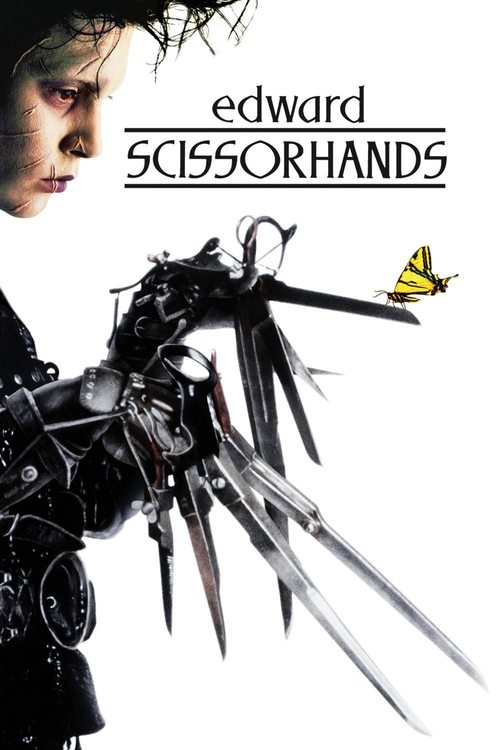
Edward Scissorhands
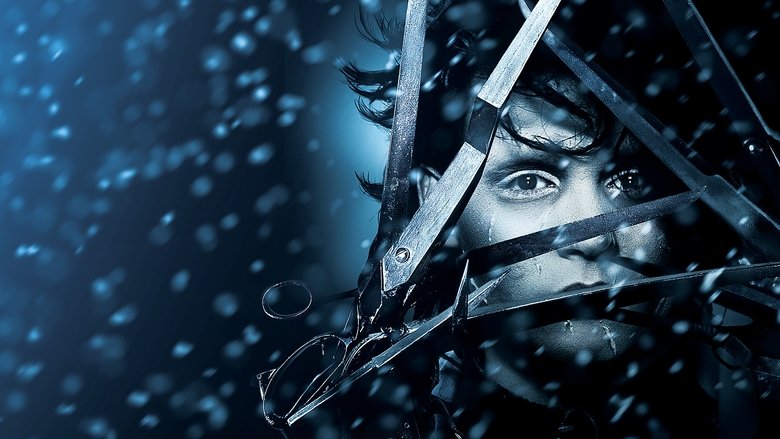
A hauntingly beautiful Gothic fairy tale clashing with pastel suburban satire. It explores the tragic isolation of an unfinished gentle soul whose hands created for art can only destroy what he longs to touch.
Edward Scissorhands

Edward Scissorhands

"Innocence is what he knows. Beauty is what she sees."

07 December 1990 United States of America 105 min ⭐ 7.7 (13,547)
Director: Tim Burton
Cast: Johnny Depp, Winona Ryder, Dianne Wiest, Anthony Michael Hall, Kathy Baker
Drama Fantasy Romance
Conformity vs. Individuality The Outsider / Isolation Creativity as both Gift and Curse Loss of Innocence
Budget: $20,000,000
Box Office: $86,024,005

Overview

Edward Scissorhands is a modern fairy tale that begins in a dark, dilapidated mansion atop a hill, where an eccentric inventor creates a human-like young man named Edward. Tragically, the inventor dies before completing Edward, leaving him with sharp metal scissors for hands. Years later, Peg Boggs, a kind-hearted Avon lady from the colorful, conformist suburb below, discovers the solitary Edward and brings him home to live with her family.

Initially, Edward is treated as a novelty by the neighborhood. His scissor hands allow him to create stunning topiary sculptures and avant-garde haircuts, earning him temporary popularity. He falls deeply in love with Peg's teenage daughter, Kim. However, his inability to fit into the rigid social norms, combined with the jealousy of Kim's bully boyfriend, Jim, leads to a series of misunderstandings that turn the fickle townspeople against him.

As the community's fascination turns to fear and hostility, Edward is forced to flee back to his mansion. The film culminates in a tragic confrontation that cements Edward's status as an eternal outsider, leaving a legacy of beauty and snow in a town that could not understand him.
Core Meaning

At its heart, Edward Scissorhands is a poignant fable about the pain of being different and the superficiality of social conformity. Director Tim Burton uses the contrast between the grotesque but gentle Edward and the 'normal' but cruel suburbanites to illustrate that true monstrosity lies in prejudice and intolerance, not physical appearance. The film serves as a metaphor for the artist's struggle—the very tools that make Edward special (his hands) also prevent him from experiencing human intimacy.

Thematic DNA

Conformity vs. Individuality 30%
The Outsider / Isolation 25%
Creativity as both Gift and Curse 25%
Loss of Innocence 20%

Conformity vs. Individuality

The film satirizes the rigid uniformity of American suburbia, visually represented by identical pastel houses and synchronized daily routines. Edward's unique appearance and creative spirit initially disrupt this monotony, but the community ultimately rejects him because he cannot be 'blended' into their norm.

The Outsider / Isolation

Edward represents the ultimate outsider—innocent, silent, and physically dangerous to those he tries to get close to. His isolation is both physical (the mansion) and emotional, highlighting the loneliness of those who do not fit societal molds.

Creativity as both Gift and Curse

Edward's hands allow him to create beautiful art (topiaries, ice sculptures) but also make him dangerous and incapable of simple human acts like holding hands. This symbolizes the double-edged nature of artistic sensitivity.

Loss of Innocence

Edward enters the town with a child-like purity. Through his interactions with the manipulative and fickle townspeople, he is forced to confront deception, jealousy, and violence, ultimately losing his naive view of the world.

Character Analysis

Edward Scissorhands

Johnny Depp

Archetype: The Tragic Hero / The Innocent Outsider
Key Trait: Gentle innocence despite dangerous appearance

Motivation

To be loved, accepted, and 'finished.' He primarily seeks to please those who show him kindness, especially Peg and Kim.

Character Arc

Edward moves from isolated innocence to social acceptance and finally to tragic exile. He learns the complexities of human nature—love, hate, and jealousy—but realizes he can never truly belong in the ordinary world.

Kim Boggs

Winona Ryder

Archetype: The Love Interest / The Convert
Key Trait: Empathy

Motivation

Initially social status and peer pressure, later driven by genuine love and a desire to protect Edward from the mob.

Character Arc

Kim starts as a shallow, popular teenager embarrassed by Edward. She evolves into a compassionate woman who sees past appearances, falling in love with Edward's soul and ultimately protecting him by letting him go.

Peg Boggs

Dianne Wiest

Archetype: The Mother Figure
Key Trait: Unwavering kindness

Motivation

Maternal instinct and a desire to help the 'sad' and lonely.

Character Arc

Peg is the catalyst who brings Edward down. She remains kind and well-meaning but ultimately realizes her attempt to integrate Edward into her world has caused him pain.

Jim

Anthony Michael Hall

Archetype: The Villain / The Bully
Key Trait: Intolerance

Motivation

Jealousy, greed, and a need to maintain social dominance.

Character Arc

Jim devolves from a possessive boyfriend to a violent antagonist. He represents the intolerance and cruelty hidden beneath the suburban surface.

Symbols & Motifs

The Scissors

Meaning:

They symbolize Edward's unfinished nature and the barrier to intimacy. They represent his ability to create art but also his potential to destroy, making physical love impossible.

Context:

Used throughout the film for creative acts (haircutting, gardening) and accidental harm (cutting faces, popping waterbeds), constantly reminding the audience of his separation from others.

The Mansion vs. Suburbia

Meaning:

The visual dichotomy between the dark, Gothic mansion and the bright, pastel suburb represents the conflict between the subconscious/individual and the conscious/conformist society.

Context:

The mansion looms constantly in the background of the bright town, serving as a reminder of the 'other' that the town tries to ignore.

Snow

Meaning:

Snow represents Edward's enduring legacy and the beauty he brought to the stagnant town. It is a byproduct of his creativity (ice sculpting).

Context:

The film is framed by an elderly Kim explaining the snow; it only snows because Edward is still up in the mansion sculpting ice, signifying he is still alive and creating.

Makeup

Meaning:

A tool for conformity and masking imperfections. Peg tries to cover Edward's scars, symbolizing society's attempt to hide reality and 'blend' everyone into a standard look.

Context:

Peg applies astringent and concealer to Edward's scars, telling him, 'Blending is the secret,' a mantra for the suburban lifestyle.

Memorable Quotes

I'm not finished.

— Edward Scissorhands

Context:

Spoken to Peg when she first meets him in the attic and notices his hands.

Meaning:

A literal and metaphorical statement. It explains his physical condition but also speaks to his feeling of incompleteness as a person without a place in the world.

Hold me.

— Kim Boggs

Context:

Kim asks Edward to hold her, and he sadly replies, 'I can't,' knowing he would hurt her.

Meaning:

This exchange encapsulates the central tragedy of their romance: Edward's physical nature makes intimacy dangerous, preventing him from comforting the woman he loves.

The light concealing cream goes on first. Then you blend, and blend, and blend. Blending is the secret.

— Peg Boggs

Context:

Peg is applying makeup to Edward's scarred face, trying to make him look 'normal.'

Meaning:

Summarizes the suburban ethos of conformity. It's not just about makeup; it's about suppressing individuality to fit into the community.

Sweetheart, you can't buy the necessities of life with cookies.

— Bill Boggs

Context:

Bill tries to teach Edward about money and loans when Edward wants to open a salon.

Meaning:

highlights the clash between Edward's innocent, value-driven worldview (doing things for kindness) and the capitalist reality of the suburbs.

Philosophical Questions

What defines humanity?

The film suggests that humanity is defined by empathy and the capacity for love, not by biological origin. Edward, an artificial creation, shows more compassion than the biological humans who persecute him.

Is true innocence compatible with society?

Edward's innocence is his defining trait, but it leaves him vulnerable to exploitation. The film posits that society inevitably corrupts or expels pure innocence; Edward can only remain pure by retreating into isolation.

Alternative Interpretations

While ostensibly a fairy tale, the film is often analyzed as a disability metaphor, showing how society fetishizes 'inspiration' (Edward's art) while refusing to accommodate the person's actual needs (his inability to function in daily life). Another reading views it as a Trans allegory, focusing on the experience of having a body that doesn't match one's soul and the need for medical intervention (the Inventor's hands) to feel complete. Critics also view it as a retelling of Frankenstein where the 'monster' is the most human character, and the 'normal' villagers are the true monsters, subverting the horror genre tropes.

Cultural Impact

Edward Scissorhands is widely considered Tim Burton's masterpiece and his most personal film. It established the defining 'Burtonesque' aesthetic—a mix of German Expressionism, Gothic horror, and suburban kitsch—that would dominate 90s pop culture. The film launched the decades-long creative partnership between Burton and Johnny Depp, moving Depp away from his 'teen heartthrob' image toward eccentric character roles. Culturally, it provided a powerful metaphor for the Goth subculture and disability, resonating with anyone who felt like an outsider. The score by Danny Elfman, particularly the 'Ice Dance' theme, became iconic and is frequently used in media to evoke wonder and melancholy.

Audience Reception

Upon release, the film was a critical and commercial success, resonating deeply with audiences. Critics praised Johnny Depp's ability to convey profound emotion with minimal dialogue and Tim Burton's visionary world-building. The film holds a high approval rating (around 90% on Rotten Tomatoes). While some contemporary critics found the suburban satire slightly heavy-handed, the overwhelming consensus is that it is a timeless, emotional masterpiece. Audiences particularly bonded with the tragic romance and the 'Ice Dance' sequence, which remains one of the most beloved scenes in cinema history.

Interesting Facts

  • Johnny Depp speaks only 169 words throughout the entire film.
  • The character of Edward was inspired by a drawing Tim Burton made in high school, reflecting his own feelings of isolation.
  • Screenwriter Caroline Thompson based Edward's character traits on her dog, particularly the eager-to-please and non-verbal nature.
  • The suburban neighborhood was a real housing development in Lutz, Florida. The production team painted the houses in faded pastel colors to achieve the specific visual style.
  • This was the legendary actor Vincent Price's final feature film role before his death.
  • The 'ice' shavings in the famous ice dance scene were actually made of crushed ice pumped through wind machines, not CGI.
  • Backstreet Boys member Nick Carter appears as an uncredited extra (a young boy on a Slip 'N Slide) early in the film.
  • Johnny Depp lost 25 pounds for the role and reportedly refused cooling agents for his leather suit to feel the character's discomfort.
  • The topiaries were not CGI; they were created by the art department using steel skeletons wrapped in chicken wire and artificial greens.

Easter Eggs

Nick Carter Cameo

Future Backstreet Boy Nick Carter appears as a neighborhood kid playing on a yellow Slip 'N Slide as Edward is driven into town.

Vincent Price's Role

Casting Vincent Price as the Inventor was a tribute to Burton's childhood hero. The role serves as a passing of the torch from the master of classic horror to the new auteur of the macabre.

Burton's Black and White Stripes

A signature Tim Burton visual motif (seen in Beetlejuice and Sleepy Hollow) appears on the collar of Jim's shirt during a dinner scene.

⚠️ Spoiler Analysis

Click to reveal detailed analysis with spoilers

Frequently Asked Questions

Explore More About This Movie

Dive deeper into specific aspects of the movie with our detailed analysis pages

Comments (0)

Leave a comment

No comments yet. Be the first to share your thoughts!