Straight Outta Nowhere: Scooby-Doo! Meets Courage the Cowardly Dog
"Two hounds are better than one!"
Overview
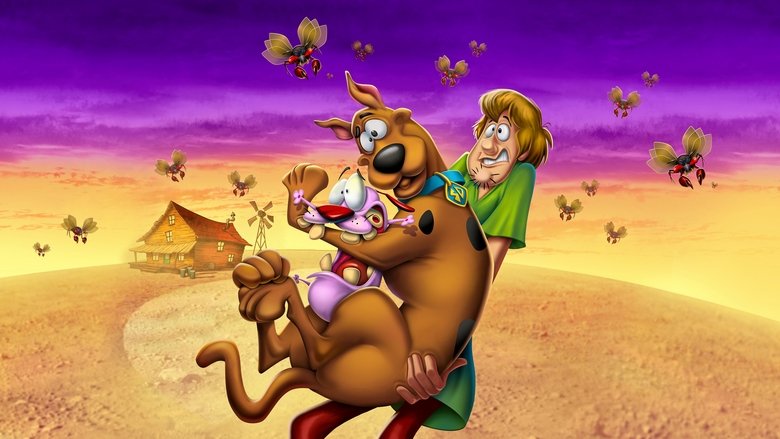
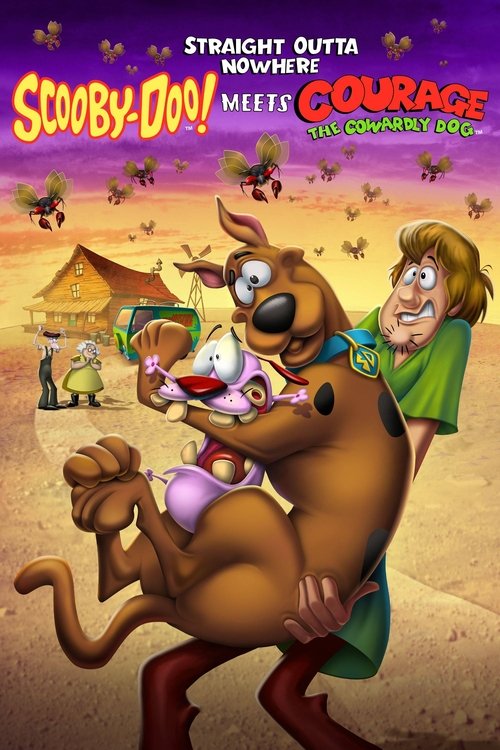
In this crossover event, Scooby-Doo and the Mystery Inc. gang are drawn to the desolate town of Nowhere, Kansas, by a strange high-frequency sound that seems to hypnotize dogs. Upon arrival, they encounter the elderly couple Muriel and Eustace Bagge, along with their fiercely anxious dog, Courage. The two groups quickly realize they are dealing with a shared threat: a giant, monstrous Cicada Queen and her buzzing army, which have descended upon the isolated farmhouse.
As the mystery deepens, the clashing methodologies of the two teams come to light. Velma and her friends attempt to apply logic and technology to the bizarre, supernatural occurrences that are commonplace in Courage's world, while Courage and Scooby bond over their shared terror. Investigating the source of the weirdness, they discover a "Dark Matter Meteor" buried deep beneath the Bagge property, which appears to be the catalyst for the town's history of surreal phenomena.
The climax reveals a nefarious plot by classic Courage villains, Katz and Le Quack, who have been using the meteor's reality-warping energy to hypnotize wealthy citizens. In a battle that defies physics, Courage must embrace his namesake to fight a kaiju-sized threat, ultimately proving that bravery is not the absence of fear, but the will to act despite it.
Core Meaning
The film's core meaning serves as a meditation on the nature of bravery and the conflict between logic and the absurd. By juxtaposing the rational world of Scooby-Doo (where every monster is a man in a mask) with the surreal existence of Courage (where monsters are real and inexplicable), the director validates both perspectives. Ultimately, it asserts that true courage is acting out of love in the face of terrifying, incomprehensible odds.
Thematic DNA
The Nature of Courage
The film deconstructs its title virtue through Shaggy and the dogs. While the heroes spend most of the runtime screaming and running, they inevitably step up when their loved ones are threatened. The narrative posits that being "cowardly" is a prerequisite for being brave, as action without fear is merely recklessness.
Logic vs. The Surreal
Velma represents the imposition of order and science upon the chaotic, dadaist world of Nowhere. Her attempt to explain the town's magic via the "Dark Matter Meteor" highlights the tension between the two franchises' philosophies: the need to solve the mystery versus the acceptance of the weird.
Unlikely Friendship
The bond between Scooby and Courage forms the emotional backbone of the story. Despite their different animation styles and backgrounds, they find solidarity in their shared anxiety, proving that fear can be a powerful unifying force.
Character Analysis
Courage
Marty Grabstein
Motivation
To protect Muriel at all costs ("The things I do for love").
Character Arc
Courage starts as a terrified observer, overwhelmed by the intrusion of Mystery Inc. Through his bond with Scooby, he realizes his own worth. In the finale, he harnesses the dark matter to become a giant, physically manifesting the inner strength he has always possessed.
Velma Dinkley
Kate Micucci
Motivation
To solve the mystery and find the logical truth.
Character Arc
Velma enters Nowhere convinced that everything has a logical explanation. She spends the film debunking the supernatural, eventually "solving" the town's magic with pseudo-science, maintaining her worldview even in the face of impossible absurdity.
Eustace Bagge
Jeff Bergman
Motivation
Greed and the desire for peace and quiet.
Character Arc
Eustace remains a static force of negativity, constantly belittling the dogs and refusing to acknowledge the danger. However, his obsession with his truck and chair provides comedic relief and accidental assistance to the plot.
Symbols & Motifs
The Dark Matter Meteor
It symbolizes the source of trauma and weirdness. It is the narrative device used to bridge the two universes, attempting to give a scientific "reason" for the inexplicability of the Courage universe.
Buried deep under the farmhouse, it glows with an eerie purple light and is credited as the cause of every monster Courage has ever faced, physically grounding the show's abstract horror.
The Computer and The Tablet
These represent the generational and stylistic bridge between the two shows. Courage's cynical, sentient desktop computer interfaces with Velma's modern tablet, symbolizing the merging of old-school surrealism with modern investigative logic.
Velma plugs her tablet into Courage's computer to analyze the meteor, allowing the two distinct technologies to "talk" and solve the plot.
The Cicada Queen
A symbol of consuming noise and swarm mentality. The cicadas' overwhelming sound drowns out thought, paralleling how fear can paralyze the mind.
The villain's main form, which terrorizes the farm and grows to kaiju proportions during the climax.
Memorable Quotes
The things I do for love!
— Courage
Context:
Spoken by Courage as he prepares to dive into danger to save Muriel from the villains.
Meaning:
Courage's catchphrase encapsulates his entire existence: his bravery is not innate, but born entirely from his devotion to Muriel. It defines the selfless nature of his heroism.
Courage isn't the absence of fear, true courage is taking action in the face of fear.
— Self-Help App / Shaggy
Context:
Read from a self-help app on a phone during a moment of panic, inspiring Shaggy and the dogs to keep going.
Meaning:
This is the thematic thesis of the film. It validates the protagonists' anxiety, reframing their cowardice as a necessary component of their bravery.
Stupid dog! You made me look bad!
— Eustace Bagge
Context:
Yelled at Courage early in the film when Eustace is inconvenienced by the chaos.
Meaning:
The classic line that establishes the domestic hostility Courage lives with, grounding the film in the nostalgic rhythm of the original series.
Philosophical Questions
Does rationalizing the unknown destroy its magic?
The film attempts to explain the surreal world of Nowhere using science (Dark Matter). This raises the question of whether understanding a mystery ruins its power. Does knowing why the monsters exist make them less terrifying, or does it simply provide a false sense of control over the chaos of existence?
Is bravery possible without fear?
Through Shaggy's speech and Courage's actions, the film explores the Aristotelian idea of courage. It posits that a fearless being cannot be brave; true virtue is found only in the struggle against one's own nature. The dogs are the bravest characters precisely because they are the most afraid.
Alternative Interpretations
The Velma Filter: Some critics interpret the film's explanation of the 'Dark Matter Meteor' not as canon fact, but as the story being told from Velma's perspective. In this reading, the magic of Nowhere is still real and inexplicable, but Velma's mind forces a scientific label (Dark Matter) onto it to cope with the absurdity, effectively 'sanitizing' the horror for her own sanity.
The Metaphor for Trauma: The 'frequency' that only the dogs can hear could be interpreted as a metaphor for the hyper-vigilance of anxiety. Both Scooby and Courage are constantly alert to threats their owners ignore, validating the experience of anxiety disorders where the sufferer perceives danger that others cannot see.
Cultural Impact
Straight Outta Nowhere serves as a significant artifact of millennial nostalgia, uniting two pillars of Cartoon Network's 'City Era' and 'Powerhouse Era'. Culturally, it acts as a swan song for the original Courage voice cast and a testing ground for merging distinct animation aesthetics. While not a theatrical blockbuster, it sparked intense discussion among animation fans regarding the 'gentrification' of Courage's abstract horror by explaining it through Scooby-Doo's procedural logic. It is widely regarded as a respectful, if slightly sanitized, tribute to the legacy of Thea White and the surrealist art of the original series.
Audience Reception
Praised: Audiences widely celebrated the interaction between Scooby and Courage, noting the chemistry between the two anxious dogs. The animation—specifically the way the characters' distinct outlines were preserved—was lauded as a visual treat. The tribute to Thea White was considered touching and respectful.
Criticized: Die-hard Courage fans critiqued the film for "Scooby-fying" the lore, specifically disliking the explanation of the supernatural elements via the meteor. Some felt the runtime was padded and that the pacing dragged in the second act. The lack of John R. Dilworth's involvement was also a point of contention for purists.
Verdict: A solid, heartwarming crossover that leans heavily on nostalgia, satisfying casual fans while sparking debate among lore purists.
Interesting Facts
- This film marks the final voice performance of Thea White (Muriel Bagge), who passed away from liver cancer shortly before the film's release. The movie is dedicated to her memory.
- The license plate on Eustace's truck reads 'DILLY', a reference to John R. Dilworth, the creator of 'Courage the Cowardly Dog', who was not involved in the production of this film.
- The opening credits feature cameos of villains from both franchises, including The Creeper and Space Kook from Scooby-Doo, and Freaky Fred and King Ramses from Courage.
- Jeff Bergman took over the voice of Eustace Bagge, as both previous voice actors (Lionel Wilson and Arthur Anderson) had passed away.
- This is the first time the characters from 'Courage the Cowardly Dog' have appeared in a feature-length film.
- The Mystery Machine's license plate changes to read 'ZOINKS' in this film.
- Courage's dialogue is significantly reduced compared to his original series; he speaks mostly in gibberish, screams, and pantomime until the very end.
Easter Eggs
King Ramses' Slab
The famous artifact from the terrifying 'King Ramses' Curse' episode appears in the museum display of the villains' lair, referencing one of the most iconic moments in Courage history.
The 'It's A Small World' Parody
During the climax, the characters act out a scene reminiscent of the chaotic door-chase tropes, but visualized with a surreal, repetitive background that mocks the classic Scooby-Doo chase sequences.
Villain Cameos in Intro
The intro sequence stylistically blends the silhouettes of villains like The Spooky Space Kook and Katz, paying homage to the rogues' galleries of both shows.
⚠️ Spoiler Analysis
Click to reveal detailed analysis with spoilers
Frequently Asked Questions
Explore More About This Movie
Dive deeper into specific aspects of the movie with our detailed analysis pages
Comments (0)
No comments yet. Be the first to share your thoughts!