The Incredibles
"Expect the incredible."
Overview
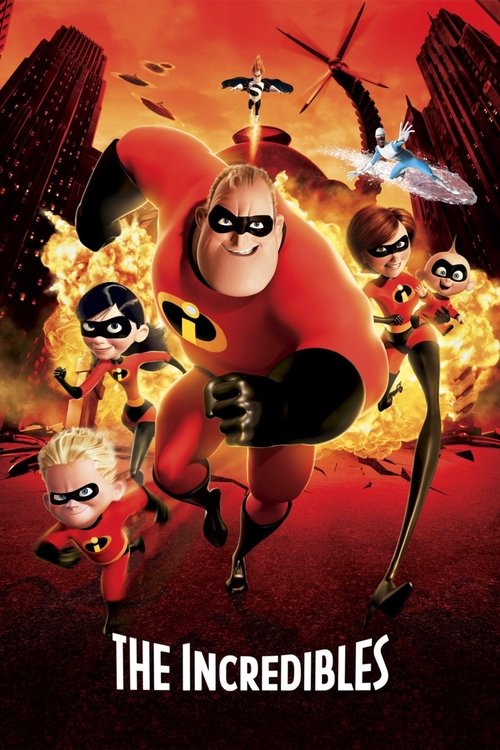
In a retro-futuristic version of the 1960s, superheroes—once celebrated protectors—have been forced into retirement by government mandates following a series of lawsuits. Bob Parr, formerly the mighty Mr. Incredible, now lives a mundane life as an insurance adjuster, suppressing his strength and longing for his glory days. His frustration strains his marriage to Helen (formerly Elastigirl) and their family life with children Violet and Dash, who must also hide their powers.
Bob's boredom leads him to accept a mysterious mission from a woman named Mirage, drawing him to a remote island to battle a rogue robot. Invigorated, he begins a secret double life, but soon discovers he has been lured into a trap by Syndrome, a vengeful former fanboy from his past. To save Bob and the world, Helen and the children must don their suits, embrace their true identities, and learn to fight not just as heroes, but as a family unit.
Core Meaning
At its heart, The Incredibles is a critique of forced conformity and a celebration of individual excellence. Director Brad Bird explores the tension between society's demand for equality (often portrayed as mediocrity) and the natural human drive to excel. The film ultimately argues that true power comes not just from individual talent, but from the unity of family and the acceptance of one's unique self, rejecting the idea that suppressing one's gifts benefits the collective.
Thematic DNA
Mediocrity vs. Exceptionalism
The film sharply contrasts the celebration of special talents with a society that demands everyone be 'normal.' Syndrome's goal to make everyone super so that 'no one will be' attacks the very concept of uniqueness, while Bob's struggle highlights the pain of suppressing one's true potential to fit in.
Family Dynamics and Unity
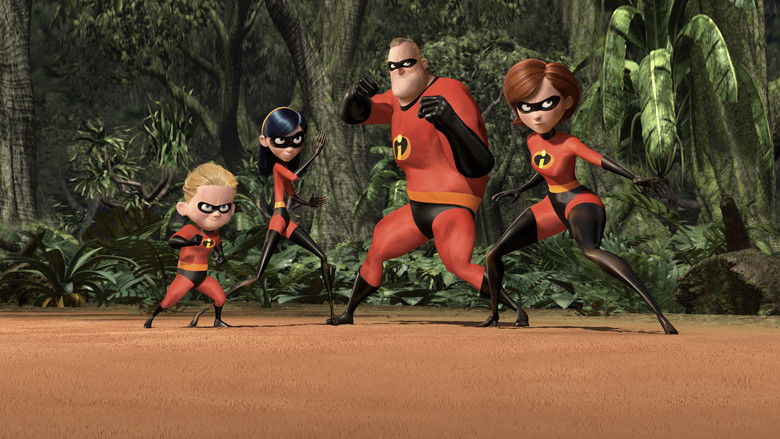
The superpowers of the Parr family mirror their family roles and emotional states (dad is strong but burdened, mom is pulled in all directions, teen girl wants to disappear, little boy has endless energy). The narrative arc moves them from disjointed individuals to a cohesive, mutually supportive unit.
Identity and Conformity
The 'masks' in the film represent the characters' true selves, while their civilian faces are the disguises. The story critiques a world where special individuals are forced to hide their gifts to make others feel comfortable, exploring the psychological toll of denying one's identity.
Mid-Life Crisis and Nostalgia
Bob's journey is a classic mid-life crisis: bored with his job, feeling physically diminished, and obsessing over his 'glory days.' The film deconstructs the danger of living in the past at the expense of the present family.
Character Analysis
Bob Parr / Mr. Incredible
Craig T. Nelson
Motivation
To relive his glory days and feel useful/powerful again.
Character Arc
Starts as a bored, nostalgic man seeking individual glory to validate his existence. Through capture and near-loss, he learns that his family is his 'greatest adventure' and that he doesn't have to be strong alone.
Helen Parr / Elastigirl
Holly Hunter
Motivation
To keep her family safe and together.
Character Arc
Initially focused on enforcing normalcy and protecting her family by hiding, she rediscovers her own power and confidence, learning to trust her children's capabilities in danger.
Buddy Pine / Syndrome
Jason Lee
Motivation
To prove he is 'super' and then eliminate the concept of specialness entirely.
Character Arc
Driven by resentment from a childhood rejection, he builds himself into a self-made 'hero' through technology. He represents toxic fandom and the desire to destroy what one cannot naturally possess.
Violet Parr
Sarah Vowell
Motivation
To fit in and not be seen as a freak.
Character Arc
Moves from a shy, hair-hiding recluse who wants to be invisible to a confident young woman who uses her force fields to protect others and asserts herself.
Edna Mode
Brad Bird
Motivation
To create perfect design and functional art.
Character Arc
Serves as the catalyst for the family's return to heroism, providing the tools (suits) and the philosophy ('No capes!', 'Pull yourself together!') needed to succeed.
Symbols & Motifs
Super Suits
They symbolize the acceptance of one's true self and family unity. Edna Mode's refusal to add capes represents a pragmatic rejection of ego and superficial heroism in favor of functionality and survival.
When Helen pilots the plane, she tells the kids to put on their masks, signaling the transition from hiding to action. The matching red suits visually unify them as a team for the first time.
Nomanisan Island
A play on the phrase 'No man is an island.' It symbolizes the isolation of Syndrome (who rejects connection) and the initial isolation of Bob (who tries to solve everything alone), contrasting with the family's eventual unity.
The setting for the film's second act, where Bob is imprisoned and must be rescued by his family, proving he cannot succeed as a solitary 'island'.
The Dinner Table
Represents the state of the family unit. Initially chaotic and disconnected, it becomes a place of shared understanding and cooperation by the end.
Early scenes show the family arguing and using powers destructively at the table; the final scene shows them working in tandem, even if just to eat dinner.
Memorable Quotes
No capes!
— Edna Mode
Context:
Edna lists various heroes who died due to wardrobe malfunctions involving capes when Bob asks for one on his new suit.
Meaning:
A humorous but practical rule that serves as a metaphor for shedding ego and vanity, which can be fatal. It deconstructs superhero tropes.
Honey, where's my super suit?
— Lucius Best / Frozone
Context:
Lucius sees a giant robot attacking the city and frantically tries to find his gear while his wife argues about their dinner plans.
Meaning:
Highlights the conflict between domestic life and superhero duty. It became one of the most iconic and quoted lines in animation history due to its delivery.
And when everyone's super... no one will be.
— Syndrome
Context:
Syndrome reveals his master plan to Bob: he will sell his inventions to the world after he has had his fun playing hero.
Meaning:
Encapsulates the villain's nihilistic philosophy: if exceptionalism is mass-produced and artificial, true greatness ceases to exist. It attacks the concept of unique talent.
I never look back, darling! It distracts from the now.
— Edna Mode
Context:
Edna says this to Bob when he visits her mansion, dismissing his nostalgia.
Meaning:
A life philosophy that contrasts sharply with Bob's obsession with the past. It encourages focusing on current potential and action.
You sly dog! You got me monologuing!
— Syndrome
Context:
Syndrome catches himself ranting to Mr. Incredible and realizes he has given the hero time to try something.
Meaning:
A meta-commentary on comic book villain tropes, acknowledging the cliché of the bad guy explaining his plan while the hero looks for an escape.
Philosophical Questions
Does society celebrate mediocrity at the expense of greatness?
The film asks if 'participation trophy' culture (Dash's graduation) and laws forcing special people to hide their gifts harmful to society's progress.
What is the nature of true heroism?
It contrasts Syndrome's manufactured, fame-seeking heroism with the Supers' innate drive to help others, asking if heroism is defined by ability or intent.
Alternative Interpretations
A prominent critical reading views the film through an Ayn Rand / Objectivist lens, arguing that it champions a 'Ubermensch' philosophy where the naturally gifted ('Supers') are held back by a jealous, mediocre society and government bureaucracy. Critics point to Syndrome representing the danger of 'democratizing' power ('If everyone is super, no one is'). However, others interpret it as a rejection of toxic masculinity and isolationism, noting that Bob only succeeds when he accepts help and values his family over his individual ego.
Cultural Impact
The Incredibles is considered a landmark in animation for its mature tone, bringing a level of sophistication and violence (guns, death, marital strife) previously unseen in Pixar films. It is frequently cited as one of the greatest superhero films of all time, predating the Marvel Cinematic Universe boom. Culturally, it sparked debates about 'Objectivism' in children's media due to its themes of exceptionalism. It also heavily influenced the genre by deconstructing the 'Golden Age' of comics and focusing on the human consequences of the superhero life, effectively serving as a 'Watchmen' for family audiences.
Audience Reception
The film was a massive critical and commercial success, holding a 97% rating on Rotten Tomatoes. Audiences praised its sharp wit, kinetic action sequences, and the relatable family dynamic that grounded the fantastical elements. It won two Academy Awards (Best Animated Feature and Best Sound Editing). Some parents initially criticized the PG rating and intensity of the violence, but it has since been cemented as a beloved classic that appeals equally to adults and children.
Interesting Facts
- Brad Bird provided the voice for Edna Mode himself after several actresses failed to capture the specific accent and attitude he wanted.
- This was the first Pixar film to feature an all-human cast of main characters, requiring new technology to animate skin, hair, and cloth realistically.
- The film was originally pitched as a hand-drawn 2D animated film before Bird brought it to Pixar.
- The name of the villain's island, 'Nomanisan', is a pun on the famous quote 'No man is an island', referencing Bob's initial desire to work alone.
- DC Comics appeared to be an influence, but the film is often called 'The best Fantastic Four movie ever made' due to the similar power set (Strength, Invisibility, Stretching, Fire/Human Torch analogue in Jack-Jack).
- Unlike most Pixar films, the Pizza Planet Truck is notoriously difficult to find or arguably missing, with director Brad Bird stating he wasn't focused on including every Pixar tradition.
- Spencer Fox, the voice of Dash, was actually a 10-year-old boy, and Brad Bird made him run laps around the studio to sound genuinely out of breath for recording.
Easter Eggs
Frank and Ollie Cameo
Two old men witnessing the Underminer at the end are caricatures of Frank Thomas and Ollie Johnston, legendary Disney animators (two of the 'Nine Old Men') who mentored Brad Bird.
Die Hard 3 Reference
The scene where Frozone is held at gunpoint by a cop and says 'I'm just getting a drink' mirrors a scene in Die Hard with a Vengeance involving Samuel L. Jackson (who voices Frozone).
A113
The classroom number A113 is heard when Mirage gives coordinates for the meeting room ('Room A113') and is seen on the level Bob is held in. It references the CalArts classroom where many Pixar animators studied.
Doc Hudson / Cars
In the final battle, a car resembling a Hudson Hornet (Doc Hudson from the upcoming film Cars) can be seen parked on the street.
⚠️ Spoiler Analysis
Click to reveal detailed analysis with spoilers
Frequently Asked Questions
Explore More About This Movie
Dive deeper into specific aspects of the movie with our detailed analysis pages
Comments (0)
No comments yet. Be the first to share your thoughts!