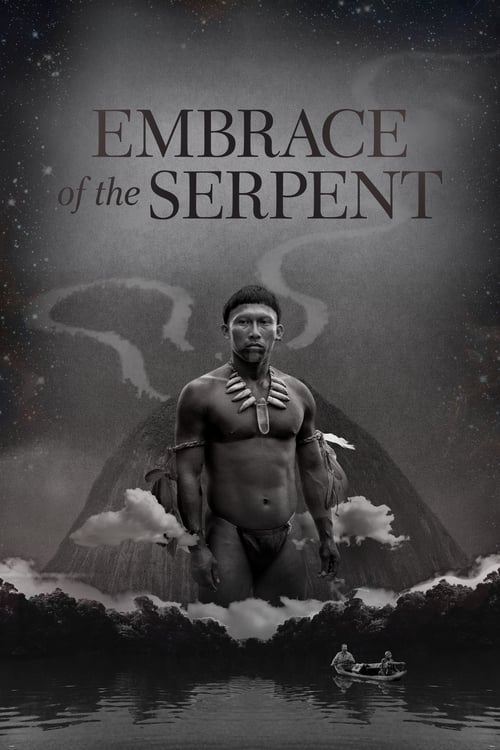
Embrace of the Serpent
El abrazo de la serpiente
"A poetic and haunting journey into a lost world."
Overview
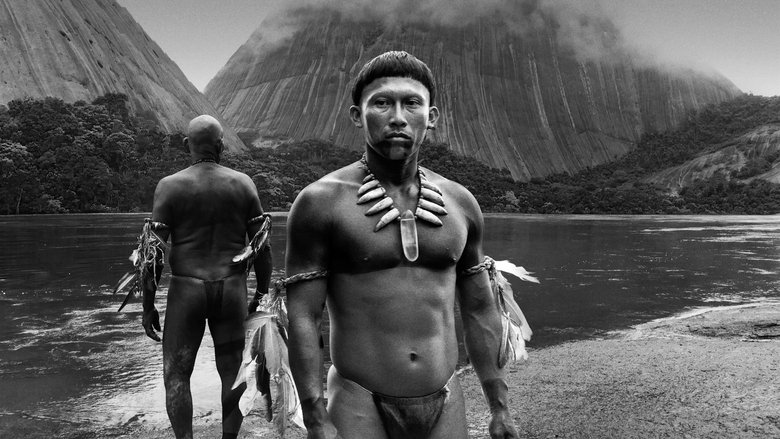
In the early 20th century, Karamakate, a powerful Amazonian shaman and the last survivor of his tribe, lives in voluntary isolation in the depths of the Colombian jungle. His solitude is interrupted twice, decades apart, by two Western scientists: Theodor Koch-Grünberg in 1909 and Richard Evans Schultes in 1940. Both men are searching for the sacred yakruna plant, a rare psychedelic flower believed to possess healing powers and the ability to teach men to dream.
The film weaves these two timelines together as parallel journeys down the same river. In the first, a young, resentful Karamakate agrees to help the sickly Theo only because he believes the white man can lead him to other survivors of his people. Decades later, an aged, forgetful Karamakate—who fears he has become a chullachaqui, a hollow shell of his former self—guides Evan, hoping to reclaim his lost memories. As they travel, the film reveals the devastating scars left by the rubber barons and missionaries, portraying the jungle not just as a setting, but as a wounded, living protagonist.
Core Meaning
The film is a profound elegy for the indigenous cultures and wisdom lost to the voracious appetite of Western colonialism. Director Ciro Guerra challenges the traditional "explorer" narrative by centering the indigenous perspective, presenting the jungle not as a resource to be conquered, but as a complex, sentient entity—the "Serpent" of the title—that demands respect and surrender. It suggests that true knowledge comes not from collecting specimens or drawing maps, but from listening to the river and allowing oneself to be embraced by the terrifying, beautiful mystery of existence.
Thematic DNA
The Destruction of Indigenous Knowledge
Through the extinction of the Cohiuano people and Karamakate's fading memory, the film illustrates the catastrophic loss of cultural wisdom. Theo and Evan seek to extract knowledge (plants, rubber), while the rubber barons and missionaries actively destroy it, representing a form of "epistemic violence."
Time as a River
The film rejects linear Western time in favor of a circular, simultaneous indigenous conception of time. The two timelines (1909 and 1940) constantly bleed into one another, suggesting that the past, present, and future are all flowing together in the same river currents.
The Colonial Gaze vs. Indigenous Perspective
Unlike films like Apocalypse Now or Fitzcarraldo, which view the jungle as a chaotic hell to be tamed, this film adopts the gaze of the "other." It critiques the white man's obsession with possessions (compasses, luggage) and their inability to just be in the world without consuming it.
The Chullachaqui (The Hollow Double)
The concept of the chullachaqui—a hollow spirit that looks like a person but lacks a soul—serves as a metaphor for the alienation of modern man and the loss of cultural identity. Old Karamakate fears he has become one, a ghost drifting without purpose until he passes his knowledge to Evan.
Character Analysis
Karamakate
Nilbio Torres (Young) / Antonio Bolívar (Old)
Motivation
Initially, to find the survivors of his tribe; later, to remember who he was and to teach Evan how to truly "see" before he fades away.
Character Arc
He begins as a wrathful warrior, hating the "whites" for destroying his people. In his old age, he is a "chullachaqui," a hollow shell who has forgotten his wisdom. Through his journey with Evan, he reclaims his purpose, not by saving his people physically, but by transmitting their spirit to the white man, ensuring the "song" survives.
Theodor "Theo" Koch-Grünberg
Jan Bijvoet
Motivation
To find the Yakruna plant to cure his terminal illness and to document the indigenous cultures.
Character Arc
A sickly German ethnographer who respects the natives but is ultimately tethered to his Western material attachments (his compass, his journals). He fails to fully "surrender" to the jungle's logic and dies unable to be fully healed.
Richard "Evan" Evans Schultes
Brionne Davis
Motivation
Ostensibly to study plants (and find rubber), but subconsciously to find meaning and complete Theo's unfinished journey.
Character Arc
He arrives as a pragmatist seeking rubber for the war effort but disguises his intent. Unlike Theo, he eventually learns to let go of his Western tools (he throws away his luggage) and is granted the sacred vision, becoming the vessel for Karamakate's lost knowledge.
Manduca
Yauenkü Miguee
Motivation
To help Theo (who bought his freedom) and to bridge the gap between the white world and the indigenous world.
Character Arc
A westernized native who travels with Theo. He represents the possibility of integration. He is rejected by Karamakate as a traitor but proves his worth by showing that he uses Western tools to help his people, challenging Karamakate's rigid isolationism.
Symbols & Motifs
The Yakruna Plant
It symbolizes ultimate knowledge, enlightenment, and the connection to the ancestors. However, it also represents the danger of commodification; Karamakate destroys it to prevent it from being used for rubber cultivation or "turned into death" by the West.
Both scientists seek it for different reasons—Theo for a cure, Evan for rubber (initially). In the climax, it triggers the film's only burst of color, representing true sight.
The Serpent / The River
The river is the Serpent, the mother of humanity, and the physical manifestation of time. "Embracing the serpent" means surrendering to the flow of the universe and shedding the ego.
Seen in the winding aerial shots of the Amazon river and referenced in the creation myth Karamakate tells. The title refers to the giant anaconda that descended from the Milky Way.
The Jaguar
A symbol of the shaman and predator, but also of Theo's spiritual imbalance. It represents a force that can consume if not respected.
Theo has a vision of a jaguar; later, a jaguar is seen eating a serpent, symbolizing the disruption of the natural order and Theo's failure to integrate his knowledge.
Butterflies
Transformation and the presence of the spiritual realm.
A swarm of brilliant white butterflies surrounds Evan at the end of the film, signifying his metamorphosis and the successful transmission of Karamakate's legacy.
Memorable Quotes
That is the most reasonable thing I've heard a white man say.
— Old Karamakate
Context:
When Evan first meets Old Karamakate and tries to explain his presence in the jungle.
Meaning:
Karamakate says this after Evan claims he has "devoted his life to plants." It marks the beginning of their bond and highlights the indigenous view that plants are higher beings worthy of devotion, not just resources.
You are the snake!
— Young Karamakate
Context:
During a heated moment in the canoe as tensions rise between the characters.
Meaning:
Karamakate realizes that Theo is not just a sick man, but a cosmic force—or perhaps he realizes Theo is the one destined to be consumed or transformed. It signifies a moment of spiritual recognition of Theo's role in the cosmic cycle.
The river has three, five, a thousand edges. A child can understand that easily, but not you.
— Old Karamakate
Context:
When Evan tries to define the river geographically, and Karamakate corrects him with a mystical perspective.
Meaning:
A critique of Western binary logic (Evan says the river has two banks). Karamakate sees the river as a multidimensional living entity, illustrating the limitation of the Western scientific worldview.
It is not a story. It is a dream, you must follow it.
— Old Karamakate
Context:
Referring to the journey and the information in Theo's journals.
Meaning:
Validates the "dream time" as more real than historical fact. It instructs Evan (and the audience) to abandon logic and follow the intuitive path.
Philosophical Questions
Can knowledge be owned?
The film contrasts the Western view of knowledge as something to be cataloged, owned, and exploited (rubber, maps, compasses) with the Indigenous view of knowledge as a collective, living spirit. Karamakate argues that forbidding the compass to his people is wrong because "knowledge belongs to all," yet he destroys the Yakruna to prevent its misuse, presenting a complex ethical paradox.
Who is the real savage?
By showing the madness of the rubber barons and the horrific cults at the missions, the film flips the "Heart of Darkness" narrative. The jungle is a place of order and law; it is the Western influence that brings chaos, insanity, and savagery.
What is the nature of time?
The editing style, which cuts fluidly between 1909 and 1940 without clear markers, forces the viewer to experience time as the Amazonians do: not as a straight line, but as a vast, simultaneous river where ancestors and descendants coexist.
Alternative Interpretations
The Chullachaqui Theory: Some critics interpret the entire 1940 timeline as a journey of a "ghost." Since Old Karamakate claims he is a chullachaqui (empty shell), perhaps the "real" Karamakate died long ago, and Evan is interacting with the lingering spirit of the jungle's memory.
Evan as Theo's Reincarnation: The film hints that Evan is not just a successor but a spiritual continuation of Theo. Karamakate treats them as two halves of the same soul; Theo failed the trial, so Evan returned to complete it. The "two men" Karamakate speaks of could be the duality within one eternal Western soul seeking redemption.
Cultural Impact
Embrace of the Serpent is a landmark in Latin American cinema, widely regarded as one of the most important films about the Amazon ever made. Historical Context: It emerged during a time of renewed interest in indigenous rights and environmental conservation in Colombia. Cinematic Influence: It subverted the "jungle adventure" genre (like Fitzcarraldo or The Mission) by stripping the white explorer of his heroism and centering the indigenous worldview. Reception: It received near-universal critical acclaim (96% on Rotten Tomatoes), won the Art Cinema Award at Cannes, and brought global attention to Colombian cinema. Legacy: It sparked discussions about "epistemicide" (the killing of knowledge) and is frequently cited in anthropological and post-colonial studies for its respectful collaboration with indigenous communities.
Audience Reception
Praised: Audiences were mesmerized by the stunning black-and-white cinematography and the immersive sound design. Many appreciated the unique perspective of seeing the story through indigenous eyes and found the film to be a hypnotic, spiritual experience.
Criticized: Some viewers found the pacing too slow and meditative. A few felt the "crazy priest" sequences were too grotesque or jarring compared to the rest of the film's quiet tone.
Verdict: Generally considered a masterpiece of modern world cinema, offering a haunting and intellectually stimulating experience for patient viewers.
Interesting Facts
- The film was the first Colombian production to be nominated for the Academy Award for Best Foreign Language Film.
- The character of Karamakate is fictional, but the two scientists, Theodor Koch-Grünberg and Richard Evans Schultes, were real historical figures whose diaries inspired the film.
- Antonio Bolívar, who played Old Karamakate, was one of the last remaining members of the Ocaína people; he had to be retaught his own language for the film as he had forgotten much of it, mirroring his character's arc.
- Director Ciro Guerra chose to shoot in black and white because he felt it was impossible to faithfully reproduce the "true" colors of the Amazon, which are beyond human description; B&W also reflects the vintage daguerreotype photos taken by the real explorers.
- The film was shot on location in the Colombian Amazon (Vaupés region) and Venezuela, requiring the crew to undergo rituals of protection with local shamans.
- The "Messiah" character in the 1940 timeline is based on real historical figures who created cults in the Amazon during the rubber boom, blending Catholicism with indigenous beliefs.
- The production involved working with nine different indigenous communities, and the script was translated into several indigenous languages including Cubeo, Huitoto, Tikuna, and Wanano.
Easter Eggs
Man inside the butterfly drawing
In Theo's journal, there is a drawing of a man inside a butterfly. This foreshadows the ending where Evan is surrounded by butterflies, symbolizing his metamorphosis and the fulfillment of the prophecy contained in the book.
Color sequence at the end
The sudden shift to color during Evan's Yakruna vision represents the attainment of "true sight." It suggests that the entire black-and-white film was a "dream" or a memory, and only through the sacred plant does one see the reality of the Amazon.
The jaguar eating the serpent
Seen briefly in a vision, this reverses the natural order (anacondas usually eat jaguars or coexist). It symbolizes the spiritual imbalance Theo brought to the jungle and the destructive potential of his "jaguar" energy (predatory western science).
⚠️ Spoiler Analysis
Click to reveal detailed analysis with spoilers
Frequently Asked Questions
Explore More About This Movie
Dive deeper into specific aspects of the movie with our detailed analysis pages
Comments (0)
No comments yet. Be the first to share your thoughts!