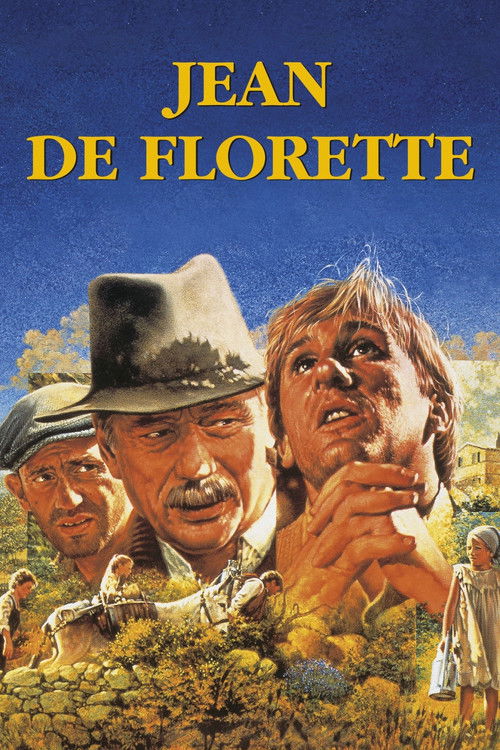
Jean de Florette
A sun-drenched Greek tragedy set in 1920s Provence, where the golden light of the French countryside belies a cruel tale of greed, betrayal, and the relentless indifference of nature. It is a heartbreaking visual poem about the human spirit crushed by the weight of destiny.
Jean de Florette

Jean de Florette

"For some men, land and water are more precious than flesh and blood."

27 August 1986 France 121 min ⭐ 7.7 (599)
Director: Claude Berri
Cast: Yves Montand, Gérard Depardieu, Daniel Auteuil, Elisabeth Depardieu, Margarita Lozano
Drama
Greed and Materialism The Outsider vs. The Community Man vs. Nature Fate and Lineage
Budget: $4,940,939

Overview

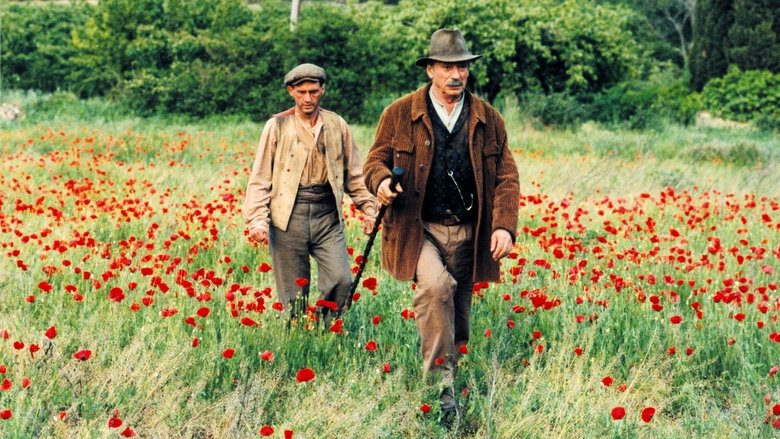
In the idyllic hills of Provence during the 1920s, César Soubeyran (Yves Montand), a wealthy and manipulative patriarch known as 'Le Papet', and his simple-minded nephew Ugolin (Daniel Auteuil) conspire to acquire a neighboring property. They dream of growing profitable carnations but require a water source to do so. When they discover a hidden spring on the land, they secretly block it with cement to drive down the property's value, hoping to buy it cheap from the inheritor.

The land passes to Jean Cadoret (Gérard Depardieu), a hunchbacked tax collector from the city and the son of an old local woman named Florette. Optimistic and armed with agricultural textbooks, Jean moves his family to the farm, unaware of the locals' treachery. He toils endlessly under the scorching sun to fetch water from miles away, battling the elements and his own physical limitations. While Ugolin befriends Jean to monitor his failure, the villagers remain silent accomplices to the slow destruction of the outsider's dream.

Core Meaning

The film serves as a meditation on the destructive power of greed and the inescapability of fate. It critiques the insular nature of rural communities ('the clan') where outsiders are viewed with suspicion and cruelty. At its heart, it explores the tragic irony that the pursuit of legacy (César's obsession with the Soubeyran line) can lead to the destruction of one's own blood. It posits that nature is indifferent to human suffering, and that knowledge (Jean's books) is often powerless against the brutality of experience and deceit.

Thematic DNA

Greed and Materialism 30%
The Outsider vs. The Community 25%
Man vs. Nature 25%
Fate and Lineage 20%

Greed and Materialism

The Soubeyrans are driven by the desire for wealth (carnations) and legacy. This greed strips them of basic humanity, allowing them to watch a man work himself to death for a resource they have stolen. The film shows how greed can rationalize the most heinous acts of cruelty under the guise of 'survival' or 'business'.

The Outsider vs. The Community

Jean is the ultimate outsider—urban, educated, and physically deformed. The village's collective silence regarding the blocked spring highlights the xenophobia and tribalism of rural life. The community protects 'its own' (the Soubeyrans) against the 'alien' intruder, making them complicit in the tragedy.

Man vs. Nature

The film vividly depicts the harshness of the Provençal landscape. Despite its beauty, the land is unforgiving. Jean attempts to tame nature with science and logic (his books), but he is defeated by the primal realities of drought, heat, and geology. The land yields only to those who understand its cruel secrets.

Fate and Lineage

The characters seem trapped in a destiny they cannot control. César's actions are driven by a need to preserve his family line, yet his machinations unknowingly destroy it. The name 'Florette' hangs over the film as a ghost of the past, influencing the present in ways the characters only fully grasp when it is too late.

Character Analysis

Jean Cadoret (Jean de Florette)

Gérard Depardieu

Archetype: The Tragic Hero / The Idealist
Key Trait: Resilience

Motivation

To escape the city, live authentically off the land, and provide a self-sufficient life for his wife and daughter.

Character Arc

Jean arrives as a joyous, optimistic dreamer who believes nature is benevolent. Over the course of the film, he is physically and emotionally broken by the relentless drought and labor. He transitions from a man of intellect to a desperate beast of burden, ultimately dying in his quest for water without ever losing his essential goodness.

César Soubeyran (Le Papet)

Yves Montand

Archetype: The Villain / The Patriarch
Key Trait: Ruthlessness

Motivation

To secure the family fortune and lineage by acquiring the land to grow carnations, ensuring the Soubeyran name survives.

Character Arc

César remains static in his ruthlessness throughout the first film. He is the puppet master, calculating and cold. He feels no remorse for Jean, viewing him only as an obstacle to the Soubeyran legacy. His arc is a setup for the devastating fall in the sequel.

Ugolin Soubeyran

Daniel Auteuil

Archetype: The Accomplice / The Fool
Key Trait: Weakness

Motivation

To grow his carnations and please his uncle, while struggling with his own developing conscience.

Character Arc

Ugolin is torn between his subservience to his uncle and a genuine, albeit twisted, affection for Jean. He befriends Jean to spy on him but finds himself admiring Jean's spirit. He suffers from guilt but is too weak and greedy to stop the betrayal. He cries for Jean's misfortune while causing it.

Symbols & Motifs

The Spring (Water)

Meaning:

Water represents life, truth, and wealth. Its blockage symbolizes the suppression of truth and the moral barrenness of the Soubeyrans. When it flows, life flourishes; when it is hidden, death follows. It is the central currency of the film.

Context:

The film revolves entirely around the presence and absence of water. The blocked spring is the source of Jean's misery, while the distant spring he treks to represents his futile struggle.

The Carnations

Meaning:

They symbolize beauty born of cruelty. The flowers are the motivation for the crime; they require the very water that Jean is denied. They represent a luxury that destroys the necessities of life.

Context:

Ugolin treasures his carnations, showing them to Papet as the future of their fortune, contrasting their delicate beauty with the dirty, callous deed required to grow them.

The Hunchback

Meaning:

Jean's physical deformity symbolizes his resilience and his status as an outsider. It leads the locals to underestimate him ('A hunchback cannot be a farmer'), but also physically manifests the burden he carries.

Context:

Throughout the film, Jean's physical labor is made more painful and heroic by his condition. It visually distinguishes him from the rugged, upright posture of the locals.

Jean's Books

Meaning:

They represent theoretical knowledge and optimism versus the harsh reality of experience. They symbolize Jean's naive belief that the world is rational and can be mastered through study.

Context:

Jean constantly refers to his books for farming advice, which the locals mock. The books fail him not because they are wrong, but because they cannot account for human treachery.

Memorable Quotes

C'est pas moi qui pleure, c'est mes yeux.

— Ugolin

Context:

Spoken to Papet when Ugolin returns after Jean's death. Papet asks why he is crying, and Ugolin denies his own sadness.

Meaning:

This line perfectly encapsulates Ugolin's cognitive dissonance. He feels the physical manifestation of grief and guilt but refuses to intellectually or morally accept responsibility for his actions. He separates his body's reaction from his 'self'.

Un paysan peut devenir bossu, mais c'est rare qu'un bossu devienne paysan.

— César (Papet)

Context:

Spoken early in the film when discussing Jean's arrival and the likelihood of his failure.

Meaning:

A display of the locals' prejudice and skepticism. It highlights the physical determinism they believe in—that biology and tradition dictate one's place in the world, and Jean defies this natural order.

Je suis le maire et je suis le maire parce que j'ai le téléphone !

— Local Official

Context:

A comedic moment that underscores the backwardness and insularity of the village politics.

Meaning:

Illustrates the petty power dynamics and the lack of true justice or governance in the village. Status is determined by trivial possessions rather than merit.

Philosophical Questions

Is evil an active force or the absence of empathy?

The film explores this through Ugolin, who is not inherently malicious but rather weak and easily led. It asks whether standing by and benefiting from injustice (as the villagers do) is morally equivalent to committing the injustice oneself.

Does the end justify the means?

César believes that preserving the family line justifies theft and indirect murder. The film ruthlessly deconstructs this utilitarian view by showing that the 'means' (killing Jean) ultimately destroys the 'end' (the family line itself).

Can man ever truly master nature?

Jean's scientific approach fails not because science is wrong, but because he ignores the human and chaotic elements of his environment. The film suggests a limitation to human agency when pitted against the indifferent forces of the earth and fate.

Alternative Interpretations

While primarily a story of greed, some critics interpret the film as a parable of colonialism or xenophobia. Jean represents the immigrant or the 'other' who tries to assimilate and contribute but is destroyed by a nativist system rigged against him. Others view it through a religious lens, seeing Jean as a Christ-like figure—a sacrificial lamb who suffers and dies due to the sins of the community, with his death eventually leading to a form of purification (or retribution) in the sequel.

Cultural Impact

Jean de Florette is a landmark in French cinema. It single-handedly revived the 'Heritage Film' (cinéma du patrimoine), a genre characterized by high production values, period settings, and a celebration of French history and landscape. It achieved massive international success, becoming one of the highest-grossing foreign-language films in the US and UK. Culturally, it romanticized the Provence region, leading to a real-estate boom and an influx of British expatriates (the 'Year in Provence' effect). Critics praised it for elevating a rural melodrama to the status of Greek tragedy, with performances—particularly by Montand and Depardieu—that are considered among the finest in French history.

Audience Reception

Audiences were universally captivated by the film's visual beauty and emotional power. It is frequently cited as one of the most heartbreaking films ever made, with many viewers expressing deep frustration and anger at the injustice suffered by Jean. The performances are consistently praised, particularly Depardieu's likability and Montand's chilling villainy. Some modern viewers find the pacing slow, but most agree the deliberate build-up enhances the tragic payoff. The ending is often described as a 'gut punch' that compels immediate viewing of the sequel.

Interesting Facts

  • The film was shot back-to-back with its sequel, 'Manon des Sources', over a period of seven months.
  • At the time of its release, it was the most expensive French film ever made.
  • Yves Montand's wife, Simone Signoret, died during the production of the film, adding a layer of real-life tragedy to his performance.
  • To prepare for the role, Daniel Auteuil wore false teeth to give Ugolin his distinctive rat-like appearance and altered his voice.
  • The film is based on Marcel Pagnol's novel, which Pagnol himself had adapted from his own earlier 1952 film 'Manon des Sources'. This 1986 version restores the full two-part saga.
  • Director Claude Berri planted the carnations and olive trees months before filming began to ensure they looked authentic to the seasons.
  • The role of Jean de Florette was originally offered to Coluche, a famous French comedian, before going to Gérard Depardieu.
  • The film sparked a massive increase in tourism to Provence, particularly from British travelers, and revitalized the 'Heritage Cinema' genre in France.

Easter Eggs

Papet's reaction to the name 'Jean de Florette'

When Ugolin first mentions that the inheritor is 'Jean de Florette' (Jean, son of Florette), the camera lingers on Yves Montand's face. His subtle flinch and hesitation hint at his secret romantic history with Florette, foreshadowing the devastating twist in the sequel.

The comb and the letter

César is seen handling a comb and an old letter. These items are not just keepsakes but crucial plot devices that will eventually reveal he is Jean's father in Manon des Sources. Their presence here is a setup for the tragedy of filicide.

Manon's silent observation

Throughout the film, Jean's daughter Manon is often seen silently watching the adults. This establishes her role as the witness and eventual avenging angel in the sequel. Her gaze at the end, when she sees the men unblock the spring, is the pivot point of the entire saga.

⚠️ Spoiler Analysis

Click to reveal detailed analysis with spoilers

Frequently Asked Questions

Explore More About This Movie

Dive deeper into specific aspects of the movie with our detailed analysis pages

Comments (0)

Leave a comment

No comments yet. Be the first to share your thoughts!