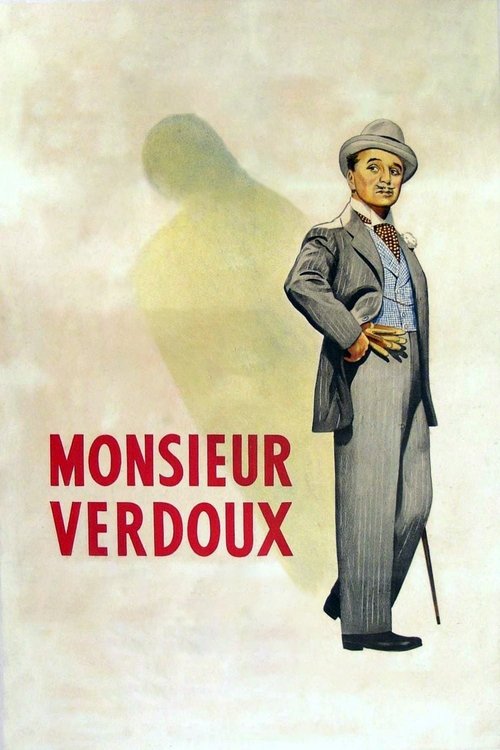
Monsieur Verdoux
A chillingly elegant dance between murder and manners, where a dapper gentleman prunes roses with one hand and disposes of wives with the other. A dark satire exposing the hypocrisy of a world that condemns retail killing while wholesaling slaughter in war.
Monsieur Verdoux

Monsieur Verdoux

"A Comedy of Murders."

26 September 1947 United States of America 124 min ⭐ 7.7 (461)
Director: Charlie Chaplin
Cast: Charlie Chaplin, Mady Correll, Allison Roddan, Robert Lewis, Audrey Betz
Drama Crime Comedy
The Business of Murder vs. The Murder of War Capitalism and Dehumanization The Duality of Man
Budget: $2,000,000

Overview

Henri Verdoux is a refined and suave Parisian bank teller who, after losing his job of thirty years during the Great Depression, devises a sinister new profession to support his invalid wife and young son. Adopting various aliases, he travels the country wooing wealthy widows, marrying them, and then ruthlessly murdering them to claim their fortunes. His life becomes a frantic juggling act of train schedules, stock market investments, and the disposal of bodies, all while maintaining the façade of a respectable bourgeois family man.

As his criminal enterprise grows, Verdoux encounters a variety of obstacles, including the loud-mouthed and indestructible Annabella Bonheur, whose sheer luck repeatedly saves her from his poisons. He also meets a destitute young woman whom he spares after discovering her touching optimism and love for her invalid husband—a mirror to his own past decency. As the police close in and the world marches toward World War II, Verdoux's philosophy on life and death hardens, leading to a provocative confrontation with the justice system.
Core Meaning

The central thesis of the film is a biting critique of capitalism and the hypocrisy of modern society regarding violence. Chaplin argues that society's moral outrage is selective: it condemns the individual murderer (the "amateur") while celebrating and rewarding the mass murderers of war and the ruthless exploitation of business (the "professionals"). Verdoux reflects the world back at itself, suggesting that in a ruthless economic system, crime is simply a logical business extension of survival.

Thematic DNA

The Business of Murder vs. The Murder of War 40%
Capitalism and Dehumanization 30%
The Duality of Man 30%

The Business of Murder vs. The Murder of War

Verdoux repeatedly draws parallels between his "business" of killing wives for money and the state's business of waging war. He treats murder with the cold efficiency of a bank teller, arguing that "numbers sanctify"—killing one person makes you a villain, but killing millions makes you a hero. This theme exposes the moral relativism of a society drifting toward global conflict.

Capitalism and Dehumanization

The film portrays a world where human value is determined solely by economic utility. Verdoux, discarded by his bank after decades of loyal service, adopts the ruthless logic of capitalism to survive. He views his wives not as people but as assets to be liquidated, mirroring how the economic system views workers like him as disposable commodities.

The Duality of Man

Verdoux is a walking paradox: a tender, vegetarian animal lover who saves a caterpillar from being stepped on, yet ruthlessly incinerates human bodies. This duality suggests that "evil" is not a monstrous aberration but can coexist with gentleness and love, often born from desperate circumstances.

Character Analysis

Henri Verdoux

Charlie Chaplin

Archetype: Tragic Antihero / The Gentleman Killer
Key Trait: Sophisticated ruthlessness

Motivation

To provide financial security for his invalid wife and son after being discarded by the economic system, viewing murder as a necessary "business" transaction.

Character Arc

Starts as a desperate man justifying crime for his family's survival, evolves into a cynical philosopher exposing society's hypocrisy, and finally accepts his fate with a serene, almost saintly detachment, realizing his own irrelevance in a violent world.

The Girl

Marilyn Nash

Archetype: The Mirror / The Innocent
Key Trait: Life-affirming optimism

Motivation

Initially to survive while retaining her belief in the beauty of life; later, to enjoy the material comforts she once lacked.

Character Arc

She begins as a destitute street wanderer intended as a victim. Her optimism and love for her invalid husband disarm Verdoux, saving her life. She returns later as the wealthy mistress of a munitions magnate, having succumbed to the cynical world Verdoux critiques.

Annabella Bonheur

Martha Raye

Archetype: The Unstoppable Force / Comic Relief
Key Trait: Obnoxious invincibility

Motivation

To enjoy her money and her status, completely unaware she is being targeted for murder.

Character Arc

She remains static throughout—loud, crass, and oblivious. She serves as a chaotic element that Verdoux cannot control, surviving his elaborate murder attempts through sheer dumb luck and vitality.

Symbols & Motifs

The Incinerator

Meaning:

It symbolizes the industrialization of death and the cold, mechanical nature of Verdoux's crimes. It represents how he reduces human life to ash for profit, mirroring the efficiency of the Holocaust and the machinery of war.

Context:

It is shown billowing black smoke in the background of his garden while he engages in mundane or gentle activities, creating a horrific contrast between domestic normalcy and hidden atrocity.

The Rose and the Caterpillar

Meaning:

These represent Verdoux's lingering humanity and his aesthetic appreciation for life, highlighting the cognitive dissonance of his character. He values innocent, helpless nature while destroying human life.

Context:

In a famous scene, Verdoux gently picks up a caterpillar to save it from being stepped on, scolding his son for being cruel to a cat, all while an incinerator burns a victim in the background.

Train Wheels

Meaning:

The recurring visual motif of train wheels symbolizes the relentless, mechanical forward motion of fate and modern industrial life. It underscores Verdoux's frantic existence and the inescapable machine of society.

Context:

Rapid montages of spinning train wheels are used to transition between Verdoux's different lives and aliases, emphasizing the repetitive, grinding nature of his "business."

Memorable Quotes

One murder makes a villain; millions a hero. Numbers sanctify, my good fellow!

— Henri Verdoux

Context:

Delivered in the courtroom (and reiterated to the reporter in his cell) after he has been sentenced to death, using his final moments to indict the society condemning him.

Meaning:

This is the film's defining statement. It succinctly captures the anti-war message and the critique of state-sanctioned violence, pointing out that morality is often just a matter of scale.

Despair is a narcotic. It lulls the mind into indifference.

— Henri Verdoux

Context:

Spoken to the Girl when she asks him about his pessimistic outlook during their first meeting.

Meaning:

Verdoux explains how he copes with the horror of his existence and the state of the world. It suggests that apathy is a survival mechanism for the downtrodden.

Wars, conflict - it's all business.

— Henri Verdoux

Context:

Spoken to the reporter in his prison cell shortly before his execution.

Meaning:

Reflects the Marxist critique that war is driven by economic profit rather than ideology or justice. It aligns Verdoux's personal crimes with the geopolitical crimes of nations.

I shall see you all... very soon... very soon.

— Henri Verdoux

Context:

His final words to the court after being sentenced to death, breaking the fourth wall to address the audience/society.

Meaning:

A chilling prophecy directed at the courtroom spectators. He implies that in a world rushing toward atomic war and destruction, their death is just as imminent as his own.

Philosophical Questions

Is morality merely a question of scale?

The film posits that society's definition of 'evil' is arbitrary. Killing one person is a crime, but killing thousands in war is heroism. This forces the viewer to question the legitimacy of state-sanctioned violence versus individual violence.

Does the end justify the means?

Verdoux acts out of love for his family, using horrific means (murder) to achieve a noble end (providing for them). The film challenges the audience to draw the line where a 'job' becomes a crime, especially when the economic system itself is predatory.

Is society the true criminal?

By presenting Verdoux as a capable man discarded by a bank after 30 years, the film asks if society creates its own monsters. Is Verdoux a born killer, or is he a product of a ruthless environment that values profit over human dignity?

Alternative Interpretations

The Suicide Theory: Some critics interpret Verdoux's capture as a form of suicide. After losing his wife and child (which happens off-screen), he seems to deliberately let himself be caught, having lost his motivation to continue the 'business' of survival. His rejection of his lawyer's defense suggests he wants to die.

Verdoux as the Tramp's Ghost: Another reading suggests Verdoux is the cynical reincarnation of the Tramp. Where the Tramp was a victim of capitalism who remained optimistic, Verdoux is a victim who adopted the system's ruthlessness. His execution signifies the final impossibility of the Tramp's existence in the modern, industrial world.

Cultural Impact

Monsieur Verdoux is a landmark film that marks the death of the 'Little Tramp' and the birth of Chaplin as a biting political satirist. Released in 1947, at the dawn of the Cold War and the Red Scare, it was met with hostility in the US. The film's anti-capitalist and anti-war messages led to accusations that Chaplin was a Communist, contributing to his eventual exile from the United States. While it was reviled by the American public and press at the time (who couldn't reconcile the beloved clown with a serial killer), it was celebrated in Europe, particularly by French critics like André Bazin.

Today, it is considered a dark masterpiece and a precursor to the black comedies of the 1960s like Dr. Strangelove. It influenced the 'Comedy of Murders' subgenre and challenged the boundaries of what was acceptable subject matter for a comedy, paving the way for more cynical and morally complex cinema.

Audience Reception

Contemporary (1947): The film was a disaster in the US. Audiences were shocked and alienated by Chaplin playing a murderer. He was booed at the premiere, and the film was picketed by groups like the American Legion and the Catholic War Veterans due to his perceived anti-American/communist sentiments. It was pulled from theaters quickly.

Modern: The film has undergone a complete critical rehabilitation. It is now praised for its audacity, sharp wit, and prophetic social commentary. Modern audiences appreciate the dark humor and the complexity of the character, viewing it as one of Chaplin's most intelligent and mature works. It holds a high rating on Rotten Tomatoes and is part of the Criterion Collection.

Interesting Facts

  • The film was based on the real-life French serial killer Henri Désiré Landru, who was guillotined in 1922.
  • The original idea for the film came from Orson Welles, who wanted to direct Chaplin. Chaplin refused to be directed by anyone else but bought the idea, crediting Welles with 'Based on an idea by Orson Welles'.
  • Chaplin was sued by a real bank employee named Henri Verdoux during the film's release, forcing the production to add more disclaimers.
  • This was the first feature film where Chaplin completely abandoned his 'Tramp' character, marking a major turning point in his career.
  • The film was a massive box office flop in the United States and was booed at its premiere due to Chaplin's political controversies and the dark subject matter.
  • The censorship board (PCA) rejected the script initially, demanding the removal of anti-patriotic sentiments and references to the 'business' of war; Chaplin had to fight to keep the subtext.
  • Writer James Agee famously defended the film, calling Chaplin's performance one of the greatest ever put on film, despite the negative public reaction.

Easter Eggs

Musical reference to 'A Woman of Paris'

The tune Verdoux plays on the piano is the theme from Chaplin's 1923 drama A Woman of Paris. It serves as a subtle self-reference to his only other drama that focused on tragedy and social critique rather than comedy.

Visual echo of 'Modern Times'

The final shot of Verdoux walking away from the camera toward the guillotine visually echoes the iconic ending of Modern Times where the Tramp walks down the road. However, instead of walking toward a horizon of hope, Verdoux walks toward certain death, symbolizing the death of the Tramp's optimism.

Orson Welles credit

The opening credits feature 'Based on an idea by Orson Welles'. This is a rare instance of Chaplin acknowledging an outside creative influence, born from a failed collaboration where Welles wanted to direct Chaplin as the killer.

⚠️ Spoiler Analysis

Click to reveal detailed analysis with spoilers

Frequently Asked Questions

Explore More About This Movie

Dive deeper into specific aspects of the movie with our detailed analysis pages

Comments (0)

Leave a comment

No comments yet. Be the first to share your thoughts!