Skip to content
Fackham Hall
A giddy, custard-cream-and-cyanide send-up of the English country house: stately rooms polished to a mirror shine, and every reflection pulling a rude face back at you.
Fackham Hall

Fackham Hall

"Born to aristocracy. Bred for idiocy."

05 December 2025 United Kingdom 97 min 6.7 (206)

Director: Jim O'Hanlon

Cast: Damian Lewis, Katherine Waterston, Thomasin McKenzie, Ben Radcliffe, Tom Felton

Comedy Class as performance Parody as affectionate demolition Forbidden romance across the stairs Guilt, innocence and who gets believed Nostalgia and the lie of the good old days
Box Office: $4,862,325

Overview

Fackham Hall (2025) is a period satirical comedy set in 1930s England, directed by Jim O'Hanlon and co-written by Jimmy Carr, Patrick Carr and the Dawson Brothers (Steve and Andrew Dawson), with Tim Inman also credited among the writing team. It takes deliberate aim at the genre once known as Merchant Ivory or Masterpiece Theatre and now universally shorthanded as "the Downton Abbey genre," playing it in the joke-dense, everything-at-the-wall register of Airplane! and the Monty Python features.

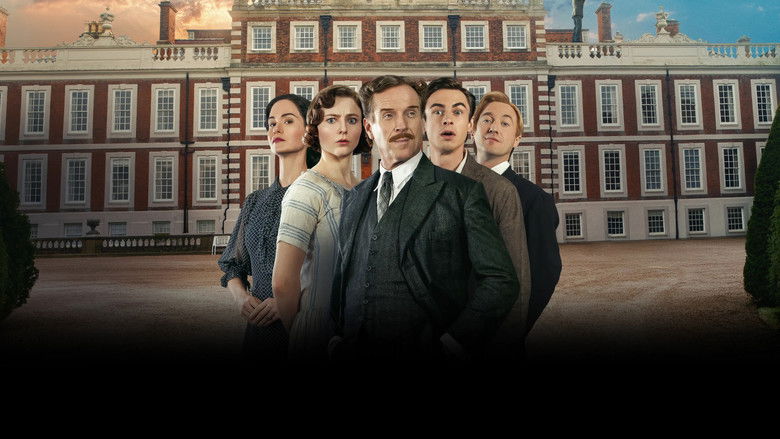
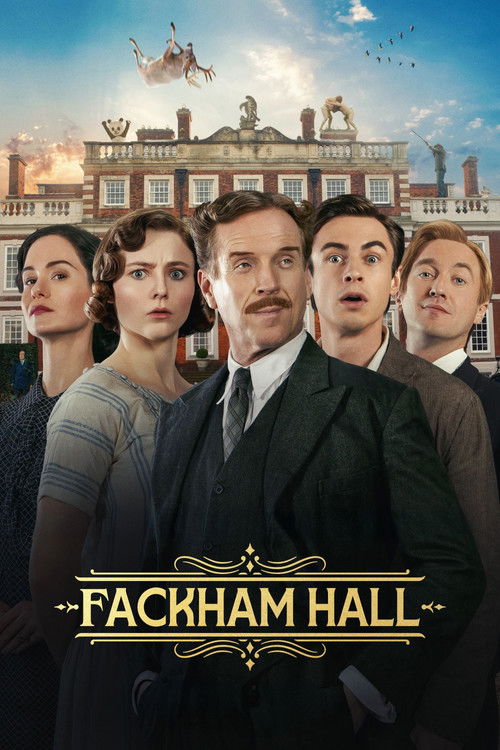
The story follows Eric Noone (Ben Radcliffe), a loveable pickpocket who talks his way into a job at an eccentric English manor house. He climbs the servants' hierarchy with suspicious speed, and a forbidden romance blooms with Rose Davenport (Thomasin McKenzie), the daughter of the house. Around them circulate Lord Davenport (Damian Lewis), a stuffed shirt with a twinkle of clueless entitlement, Lady Davenport (Katherine Waterston), and a below-stairs staff presided over by housekeeper Ms. McAlister (Anna Maxwell Martin), with Tom Felton, Emma Laird, Tom Goodman-Hill and Sue Johnston filling out the household.

Then someone turns up dead. Eric is framed for the murder, and the film pivots from upstairs-downstairs romance into a country-house whodunit played entirely for absurdity, driving toward a comic showdown. Released by Bleecker Street in the United States on 5 December 2025 and by Entertainment Film Distributors in the UK on 12 December 2025, it took roughly $4.8 million at the box office.

Core Meaning

At its heart, Fackham Hall argues that the modern heritage drama is itself a kind of costume — a gorgeous, expensively upholstered lie about English class that audiences have agreed to find soothing. O'Hanlon's stated pitch was that the film should look like a brand-new $50 million high-end British period drama, with Damian Lewis, Thomasin McKenzie, Katherine Waterston and Tom Felton in amazing costumes. The joke only works because the surface is immaculate: the film borrows the genre's reverence in order to puncture it from the inside.

What the filmmakers are saying, under the gags, is that deference is ridiculous. The rigid vertical world of lord, lady, housekeeper and footman — presented elsewhere as a warm, well-oiled machine of mutual devotion — is here exposed as arbitrary theatre maintained by people pretending very hard. A pickpocket rises through it effortlessly, which is the film's cleanest thesis: if a thief can pass, the hierarchy was never about merit or breeding at all. The murder plot completes the argument by dragging actual criminality into a house that already runs on genteel robbery.

Thematic DNA

Class as performance 30%
Parody as affectionate demolition 25%
Forbidden romance across the stairs 20%
Guilt, innocence and who gets believed 15%
Nostalgia and the lie of the good old days 10%

Class as performance

The entire engine of the film is a pickpocket successfully impersonating a servant and then a gentleman-adjacent figure. Eric's rapid ascent through the household ranks exposes the manor's hierarchy as a costume drama played by people who have simply memorised their lines. Lord Davenport embodies the joke from the other end: entitlement so ingrained it has curdled into cluelessness.

Parody as affectionate demolition

The film is built as a genre spoof in the Airplane! and Monty Python tradition, aimed at Downton Abbey and its Merchant Ivory ancestors. It reproduces the grammar of heritage cinema — the sweeping house, the dressing gong, the below-stairs pecking order — precisely enough that each deflation lands on a real target. Critics noted the tone remains oddly civilised, which is itself part of the gag: the film is too well-mannered to stop being beautiful.

Forbidden romance across the stairs

Eric and Rose Davenport's attraction is the genre's oldest engine — the servant and the daughter of the house — and the film runs it straight enough to generate real stakes while mocking the swooning conventions that surround it. Their romance is what makes the murder frame-up hurt rather than merely inconvenience.

Guilt, innocence and who gets believed

When the murder lands on Eric, the accusation sticks because of what he is, not what he did: an outsider with a criminal past inside a house of respectable people. The whodunit structure becomes a joke about class justice — in this world, suspicion flows downstairs as reliably as the tea trays flow up.

Nostalgia and the lie of the good old days

Set in the 1930s and shot with genuine period lustre, the film keeps seducing the viewer with exactly the warm, ordered England the heritage genre sells, then interrupting it with vulgarity, absurdity and a corpse. The pleasure and the puncture arrive in the same frame.

Character Analysis

Eric Noone

Ben Radcliffe

Archetype: Trickster / rogue hero Key Trait: Nimble-fingered charm

Motivation

Initially survival and opportunity; later love for Rose and the far more dangerous desire to be believed.

Character Arc

Arrives as a loveable pickpocket working a con, climbs the household ranks with improbable speed, and finds himself genuinely attached to Rose and to the house. Framed for murder, he is forced to stop running scams and start proving something — a thief who has to become an investigator to establish his own innocence.

Rose Davenport

Thomasin McKenzie

Archetype: Romantic lead / restless ingénue Key Trait: Sincerity amid absurdity

Motivation

Escape from a scripted life, and loyalty to a man her class says she should not even see.

Character Arc

The daughter of the house, positioned by the genre's rules to marry appropriately and decorate a drawing room. Her attraction to Eric moves her from ornament to agent, and the murder plot forces her to choose between the family name and the person she believes in.

All 5 characters and cast

Symbols & Motifs

The manor house itself

Meaning:

Fackham Hall is the body of the English class system: grand, immaculate, and structurally dependent on invisible labour. Its very name — a schoolboy obscenity dressed in stately-home clothing — is the film's thesis compressed into two words.

Context:

Established with the reverent establishing shots the genre demands, then repeatedly undercut by what actually happens inside it. The house is treated as a character with more dignity than any of its inhabitants deserve.

Livery and costume

Meaning:

Clothes as class. The uniform makes the servant, the evening dress makes the lady; change the outfit and you change the person's entire legal and moral standing.

Context:

Central to Eric's ascent and to the film's production design — the cast reportedly relished performing ludicrous material in beautiful, high-end period costumes, and that friction between the fabric and the behaviour is the film's signature visual joke.

The pickpocket's hands

Meaning:

Theft as social mobility. Eric's skill is lifting what isn't his, which is exactly what the aristocracy above him has done on a much larger scale and called inheritance.

Context:

His defining talent when he arrives, and the trait that makes him the obvious suspect once a crime is committed in the house.

The body / the murder

Meaning:

Death as the intrusion of consequence into a world designed to have none. The corpse is where the polite fiction of the manor finally cannot be tidied away by staff.

Context:

The hinge of the second half, converting the upstairs-downstairs romance into a country-house mystery and turning the household's affection for Eric into suspicion.

Tea and the rituals of service

Meaning:

Ceremony as control. The bells, the trays, the order of precedence at table are a liturgy that keeps everyone in position.

Context:

O'Hanlon himself framed the film's ambition in these terms — a comedy meant to make you snort Earl Grey out of your nostrils — and the servant rituals are staged with straight-faced precision so they can collapse.

Philosophical Questions

If a thief can pass as a gentleman's servant and rise, was the hierarchy ever real?

Eric's effortless ascent is the film's central experiment. By showing that manners, livery and confidence are sufficient to occupy a position supposedly earned by birth and character, the film suggests class is a performance anyone can learn — and that those at the top are simply actors who have never been asked to audition.

Can you mock something you also love?

The film insists on looking genuinely beautiful while making vulgar jokes about the world it depicts. That tension — immaculate production design serving ludicrous content — asks whether parody is an act of contempt or the most engaged form of attention a genre can receive.

Who is granted the presumption of innocence?

When the murder is pinned on Eric, it is his origins rather than any evidence that convicts him in the household's eyes. The comedy of the frame-up rests on a serious observation about how suspicion distributes itself along class lines.

What does nostalgia actually sell us?

Set in the 1930s and shot with real period lustre, the film keeps offering the ordered, gleaming England the heritage genre trades in, then breaking it with obscenity and a corpse. It asks what exactly audiences are enjoying when they enjoy a beautiful film about servitude.

Alternative Interpretations

As pure spoof. The simplest reading, and the one most reviewers took: the film has no argument beyond 'these films are funny if you push them slightly,' and should be judged purely on gag-strike rate. On this view its restraint is a flaw — a spoof that stayed too polite to draw blood.

Full ending explanation

Cultural Impact

Fackham Hall arrived at a very specific cultural moment: after more than a decade in which Downton Abbey and its successors turned the English country house into one of Britain's most successful cultural exports, and as that franchise reached its cinematic conclusion. The film is a corrective and a tribute at once — the genre had become ubiquitous enough to be recognisable in silhouette, which is the precondition for spoof. Its ancestors are clearly signposted: the joke-per-second construction of Airplane! and the anarchic class satire of Monty Python, applied for the first time at scale to Merchant Ivory-style heritage cinema.

Critically, it landed as a mild success rather than a landmark. Variety judged it 'mildly fun but overly civilized,' arguing that the restrained tone stopped most jokes from fully detonating, and The Hollywood Reporter framed it as a silly Downton Abbey spoof anchored by Damian Lewis. The prevailing verdict was that it is unlikely to enter the pantheon of great movie spoofs. Commercially it was modest, taking around $4.8 million, with a swift move to Blu-ray and digital platforms in January 2026 where its comedy-of-recognition plays well to an audience already steeped in the genre.

Its more durable contribution may be as evidence that the heritage drama has fully completed its journey from prestige to genre — secure enough in its conventions to be lampooned by a film starring the very actors, and using the very production values, that the form depends on.

Audience Reception

Praised: The cast is the film's most consistently celebrated asset — Damian Lewis's Lord Davenport, a stuffed shirt with a twinkle of clueless entitlement, drew particular approval, alongside Katherine Waterston's elegance and wit as Lady Davenport and Anna Maxwell Martin's housekeeper, whose Downton parody UK viewers singled out as 'brilliant.' The production values were widely admired: audiences enjoyed the fact that a film this silly was mounted with real period-drama craft, exactly as O'Hanlon intended. Viewers familiar with Downton Abbey and its ancestors reported the highest enjoyment, since the film rewards genre literacy.

Criticised: The dominant complaint, echoed by both critics and general audiences, is tonal restraint. Variety's verdict — that the jokes land 'mostly in the light chuckle zone' and that the tone is so civilised most gags never fully detonate — became the consensus reservation. Several reviews concluded the film is unlikely to join the pantheon of great movie spoofs. Some viewers also found the crude title and humour an awkward fit with the elegance of the presentation.

Verdict: A pleasant, well-mounted, resolutely minor comedy. User scores settled in the mid-6s on IMDb, and its $4.8 million theatrical take marks it as a modest performer that is likely to find its real audience on home viewing, where the genre-savvy crowd it was made for lives.

Interesting Facts

  • The screenplay is credited to a team of five writers: comedian Jimmy Carr, Patrick Carr, Tim Inman, and the Dawson Brothers, Steve and Andrew Dawson.
  • Director Jim O'Hanlon's pitch was that the film should look like a brand-new $50 million high-end British period drama, complete with Damian Lewis, Thomasin McKenzie, Katherine Waterston and Tom Felton in elaborate costumes — the beauty of the production being the setup for the jokes.
  • O'Hanlon described the project during production as a 'hilarious, laugh-out-loud, snort-Earl Grey-tea-out-your-nostrils British period comedy.'
  • Principal photography took place in the North West of England.
  • The director has spoken publicly about four jokes that were cut from the finished film, explaining the reasoning behind their removal.
  • O'Hanlon said the cast became 'like a little family' on set, and that the actors loved wearing the beautiful period costumes while performing, in his words, ridiculous, silly, funny and ludicrous material.
  • Tom Felton, best known as Draco Malfoy in the Harry Potter films, and Ben Radcliffe, of Masters of the Air, joined a cast that also includes Hero Fiennes Tiffin and Emma Laird.
  • The film was released in the United States by Bleecker Street on 5 December 2025 and in the United Kingdom by Entertainment Film Distributors on 12 December 2025.
  • It grossed approximately $4.8 million at the box office, with a US Blu-ray release following on 20 January 2026.
  • The film was conceived explicitly in the lineage of Airplane! and the Monty Python features rather than as a gentle comedy of manners.

Easter Eggs

The title itself

'Fackham Hall' is a stately-home name engineered to sound like a crude expletive when said aloud — a compact parody of the grand, plummy estate names (Downton, Highclere, Brideshead) that anchor the genre. The film's entire comic strategy is announced before a frame is shown.

Tom Felton in a grand English house

Casting the actor the world knows as Draco Malfoy — the sneering aristocrat of the Harry Potter films — inside a country-house satire about entitled young gentlemen is a piece of knowing meta-casting that British audiences read instantly.

The Airplane! and Monty Python DNA

The film was explicitly built in the spoof tradition of Airplane! and the Monty Python features, importing their density of background gags and deadpan delivery into a genre — heritage drama — that had never been treated to that particular demolition before.

The Merchant Ivory / Masterpiece Theatre target

Reviewers identified the film's real subject as the whole prestige-Britain export tradition, not just Downton Abbey: the visual vocabulary being mimicked stretches back through decades of Sunday-evening costume drama.

Frequently Asked Questions

Explore More About This Movie

Dive deeper into specific aspects of the movie with our detailed analysis pages

Comments (0)

Leave a comment

No comments yet. Be the first to share your thoughts!

Similar Movies