Full spoilers for all five seasons follow.
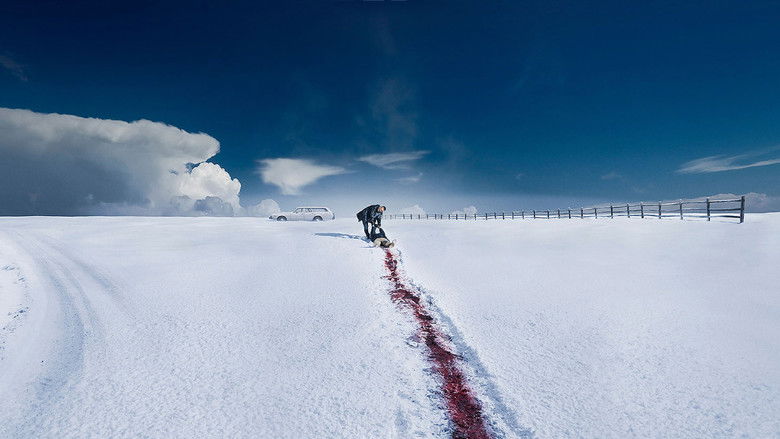
Season 1 (2014). Bullied insurance salesman Lester Nygaard meets drifting hitman Lorne Malvo in a hospital waiting room, and Malvo's casual offer to solve his problem is the spark that sets the whole anthology burning. Lester kills his wife, Malvo kills the police chief, and Lester's talent for lying blossoms into a new, confident, thoroughly corrupted man who eventually sacrifices others to save himself. Deputy Molly Solverson is right from the first hour and disbelieved for nine, while Gus Grimly — who let Malvo go during a traffic stop in the premiere — spends the season paying for that moment of cowardice. The blizzard of Buridan's Ass is the hinge, scattering the survivors and confirming that nobody is protected by decency alone. In Morton's Fork, the title's meaning lands: every remaining option is ruinous. Malvo is finally stopped by Gus, the man who had failed to act; Lester, still running, is destroyed by his own refusal to stop running; and Molly's reward is not glory but promotion and a quiet living room — the show's first statement that the prize for goodness is an ordinary life.
Season 2 (2015). A prequel set decades earlier that explains the Sioux Falls massacre referenced by the first season, with a young Lou Solverson — Molly's father — as its moral centre. The Gerhardt family's regional crime operation is being swallowed by a Kansas City syndicate, and the war is accidentally detonated by beautician Peggy Blumquist and her butcher husband Ed, who hit a Gerhardt with their car and then compound the accident with a series of catastrophically small decisions. The season's argument is that organized crime is simply corporate consolidation with bodies. In The Castle, the meticulously constructed motel ambush — Lou and Hank recapturing the Blumquists, the wire, the trap — is blown apart when a UFO appears overhead and distracts everyone, altering the course of the conflict entirely. The massacre happens not because of strategy but because the universe interrupted. The Gerhardts are annihilated, the syndicate absorbs everything, and the message is explicit: the corporation always wins, and nothing about it is personal.
Season 3 (2017). Twin brothers Emmit and Ray Stussy fall out over an inherited stamp; a bungled burglary kills the wrong man, and police chief Gloria Burgle — a woman whose defining curse is that automatic doors and sensors do not register her, as though the modern world literally cannot see her — begins pulling the thread. The true antagonist is V.M. Varga, a parasitic financier who infests Emmit's business and whose weapon is not violence but narrative: he manipulates records, manufactures plausibility, and makes the truth structurally unprovable. Ray dies absurdly; Nikki Swango's revenge campaign ends in a roadside encounter that reads as pure cosmic caprice; Emmit is eventually shot years later by someone with an old grudge. The finale ends in ambiguity, with Gloria and Varga facing each other across an interrogation table as Varga insists that agents are coming to free him and Gloria insists that she will still be there in five minutes. The show cuts before either is proven right — an unresolved standoff between truth and confident lying that many read as the series' most contemporary statement.
Season 4 (2020). Set in Kansas City, where successive immigrant crime syndicates have exchanged their youngest sons as hostages to keep the peace. Loy Cannon's Black syndicate and the Italian Fadda family collapse into open war, observed by teenager Ethelrida Pearl Smutny, whose narration frames the season as an argument about who is permitted to become American. The hostage exchange is the season's cruellest irony: Loy's son Satchel is raised inside the enemy family and, in the closing moments, is revealed to have grown up into a figure from a later season's story — the anthology's most explicit interlocking reveal, retroactively rewriting a previous season's antagonist as a product of this war. Loy wins his war and is then killed casually by someone with a grievance far smaller than the empire he built, confirming that in Fargo the ledger always gets settled, usually by the person you forgot.
Season 5 (2023–24). Dot Lyon, a cheerful Minnesota housewife, is abducted from her home in a sequence staged as a shot-for-shot homage to the 1996 film — the same living room, the same terror, but this time the victim fights back and escapes. The season reveals she is a former abused wife who fled a tyrannical sheriff, Roy Tillman, who believes the Bible entitles him to reclaim his property; her monstrous mother-in-law Lorraine Lyon, a debt-collection magnate, embodies the season's other face of power, the belief that everything can be priced. The wild card is Ole Munch, an ancient Welsh sin-eater hired to take Dot, who loses an ear and a partner to her and thereafter pursues the debt on principle. Tillman is defeated and imprisoned — notably, by the mechanism of institutional power rather than by vigilante violence, with Lorraine ensuring his ruin. Then the finale, Bisquik, delivers the real ending: Munch is waiting in Dot's living room to collect. She refuses the fight. She tells him \"what they do to us — make us swallow, like it's our fault,\" and prescribes the cure: \"You gotta eat something made with love and joy, and be forgiven.\" Munch, who explains that what he was fed centuries ago was not food but \"the sins of the rich, greed, envy, and disgust,\" makes biscuits with the family and eats one, and the centuries of enmity release.
What becomes clear only at the end. Watched whole, the anthology is a single escalating study of debt. Season 1's Lester owes for a lie; Season 2's Blumquists owe for an accident; Season 3's Stussys owe over an inheritance; Season 4's syndicates owe each other sons; Season 5 finally names the mechanism and then cancels it. The show's ultimate claim is that every one of its monsters was fed something poisonous first, and that violence is just a debt being passed down the table — which is why the only ending that could conclude fifty-one episodes of bloodshed is a shared meal offered freely.