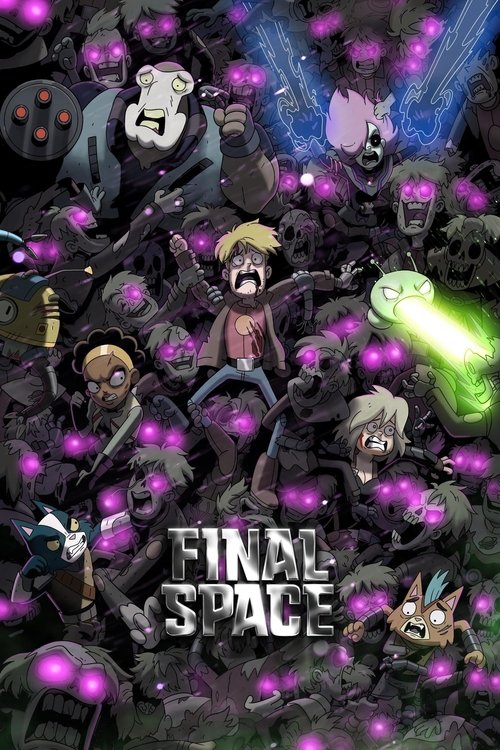
Final Space
Overview
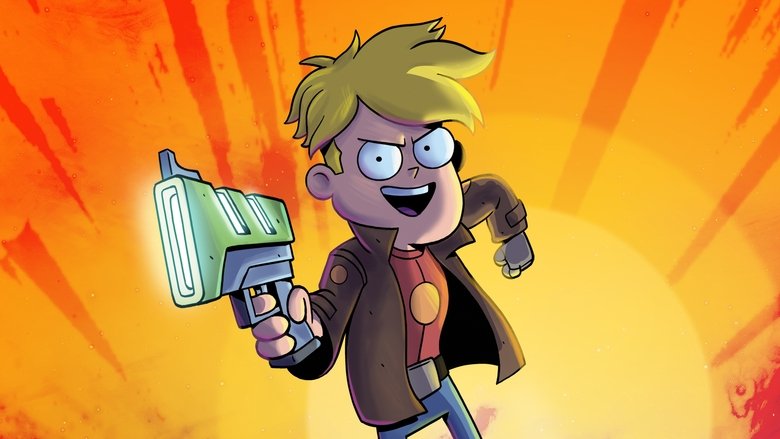
Final Space follows the intergalactic misadventures of Gary Goodspeed, an energetic but incompetent astronaut serving a prison sentence aboard the spacecraft Galaxy One. His solitary confinement is interrupted when he befriends a mysterious, planet-destroying alien he names Mooncake. This chance encounter thrusts Gary into a grand conflict against the sinister Lord Commander, a telekinetic dictator obsessed with unlocking the dimension known as "Final Space" to summon the chaotic titans known as Invictus.
As the series progresses, Gary assembles a ragtag crew of "Team Squad" members, including the bounty hunter Avocato, his son Little Cato, the stoic genius Quinn Ergon, and the annoying robot KVN. The narrative evolves from a serialized comedy into a darker, emotionally complex saga. They traverse the universe collecting Dimensional Keys, battling time-traveling adversaries, and facing betrayal from within. The stakes escalate from personal survival to saving the entire universe from being consumed by the darkness of Invictus.
In the final season, the crew finds themselves trapped inside Final Space itself, a realm of horrors where survival is a daily struggle. The tone shifts significantly towards survival horror and psychological drama as the characters face their traumas and the corrupting influence of Invictus. The series concludes with a massive cliffhanger that challenges the heroes' resolve, leaving their ultimate fate—and the fate of the universe—hanging in a precarious balance before its cancellation.
Core Meaning
At its heart, Final Space explores the concept that broken people can save each other. It posits that heroism isn't about competence or destiny, but about the willingness to keep trying despite repeated failure and overwhelming loss. The series suggests that even in a universe indifferent to your existence, filled with cosmic horrors and inevitable death, the connections formed with others provide the only true light and meaning.
Thematic DNA
Found Family and Belonging
The central pillar of the show is the formation of "Team Squad." Nearly every character begins in isolation—Gary in prison, Avocato as a shameful soldier, Quinn as a misunderstood genius. Across three seasons, they forge bonds stronger than blood. The show demonstrates that family is a choice made through shared sacrifice and unconditional acceptance of each other's flaws.
Redemption and Forgiveness
Characters constantly wrestle with their past sins. Avocato seeks atonement for his time as the Lord Commander's general; Sheryl Goodspeed tries to overcome her abandonment of Gary. The series treats redemption not as a single act, but as a painful, continuous process of making better choices, often highlighting that some guilt, like Avocato's secret about Little Cato's parents, can threaten to destroy everything.
The Inevitability of Loss
Unlike many animated comedies, Final Space allows consequences to stick. Major characters die, planets are destroyed, and trauma leaves permanent scars. The show balances its humor with the heavy reality of grief, teaching that loss is an unavoidable part of life (and space travel), and moving forward doesn't mean forgetting those left behind.
Destiny vs. Choice
The series plays with the idea of timelines and predetermined fates, particularly through the character of Nightfall (future Quinn). While the universe seems to have a grim script written for Gary and his friends, the characters persistently fight to rewrite their ending, asserting that even if the outcome is fixed, the way they face it matters.
Character Analysis
Gary Goodspeed
Olan Rogers
Motivation
Initially motivated by a desire for cookies and to impress Quinn, his motivation shifts to protecting Mooncake and, ultimately, saving his found family from Invictus, regardless of the personal cost.
Character Arc
Gary starts as an annoying, delusional prisoner pretending to be a captain. Over three seasons, he is forged by tragedy into a genuine leader. His bravado transforms into bravery, and his selfishness melts into self-sacrifice. He learns that being a hero isn't about glory, but about enduring pain to protect the 'squad' he loves.
Avocato
Coty Galloway
Motivation
To save and protect his son, Little Cato, and to wipe away the red from his ledger.
Character Arc
A former general for the villain, Avocato begins as a man running from his past. His arc is defined by his desperate love for his son, Little Cato. He moves from a cold killer to a loving father and loyal friend, though he is constantly haunted by the dark secrets of his service to the Lord Commander, leading to a complex struggle with guilt in Season 3.
Little Cato
Steven Yeun
Motivation
To make his father proud and to exact revenge on the Lord Commander.
Character Arc
Forced to grow up too fast, Little Cato evolves from a vengeful prisoner to a capable warrior. His journey is one of seeking identity and a father figure, transitioning his bond from Avocato to Gary. He faces the trauma of losing parents repeatedly and struggles to maintain his innocence in a war-torn adolescence.
Quinn Ergon / Nightfall
Tika Sumpter
Motivation
To save the Earth and the universe from the breach, often at the expense of her own happiness.
Character Arc
Quinn starts as a by-the-book Infinity Guard officer who realizes her organization is corrupt. She sacrifices herself to close the breach to Final Space. Through her future self, Nightfall, we see a hardened, tragic version of her who has watched Gary die countless times. The main Quinn's arc involves accepting Gary's chaotic love and realizing she doesn't have to carry the weight of the universe alone.
Lord Commander
David Tennant
Motivation
To unlock Final Space and become a Titan to gain eternal life and power.
Character Arc
A terrifying villain whose body deteriorates as his power grows. He believes he is chosen by the Titans. His arc is a descent into absolute madness, driven by an inferiority complex and a desperate need to become a Titan himself, eventually becoming a puppet for even darker forces.
Symbols & Motifs
Cookies
A symbol of death and acceptance, contrasting with their usual association with comfort.
In Season 1, Gary tells H.U.E. to visualize his running out of oxygen as "cookies" finishing baking. This metaphor turns a terrifying death into a moment of warm, childlike acceptance, recurring whenever Gary faces his mortality.
Mooncake
Represents innocence capable of great destruction and the burden of power.
Mooncake is visually adorable but acts as a superweapon. He symbolizes the show's duality: cute and funny on the surface, but harboring dark, universe-ending stakes underneath.
The Caterpillar
Symbolizes metamorphosis and the cyclical nature of time.
Before becoming a Titan, the entity Bolo helps the crew. The imagery of caterpillars and butterflies is used by the Lord Commander and Titans to describe their ascension, suggesting that destruction is just a form of cosmic evolution.
Dimensional Keys
Represent hope and the fragmentation of the team's goal.
In Season 2, the pursuit of these keys drives the plot. They physically represent the pieces of the puzzle needed to save the universe, but the quest to find them often fractures the emotional stability of the crew.
Memorable Quotes
Chookity Pok!
— Mooncake
Context:
Said throughout the series, often communicating complex emotions to Gary that only he seems to understand.
Meaning:
Mooncake's catchphrase, which can mean anything from 'I love you' to 'I'm scared' or 'Let's kill them.' It represents the simple, emotive heart of the show amidst complex sci-fi jargon.
It's good enough for me.
— John Goodspeed
Context:
In a flashback/vision where Gary asks his father, 'What if my best isn't good enough?' regarding their mission and life.
Meaning:
A defining moment of unconditional love. It validates Gary, who has always felt like a failure, teaching him that effort and heart matter more than success.
I will murder your face off!
— Gary Goodspeed / Avocato
Context:
Used variously by Gary to threaten enemies or by Avocato to show his protective nature over Little Cato.
Meaning:
A humorous threat that evolves into a term of endearment and a battle cry. It encapsulates the show's blend of violent action and goofy dialogue.
Tough titty wompus.
— Gary Goodspeed
Context:
Used when things go wrong, serving as a comedic coping mechanism for the constant disasters they face.
Meaning:
Gary's dismissive catchphrase for bad luck or difficult situations. It highlights his refusal to take the universe's cruelty seriously.
Episode Highlights
Chapter Six
Gary and Avocato storm the Lord Commander's prison to save Little Cato. In a shocking twist, just as they reunite, Avocato sacrifices himself to save the others from a bomb.
This episode established that Final Space was not just a comedy. The permanent death of a main character so early changed the stakes forever, proving no one was safe.
Chapter Ten
The Season 1 finale where Gary and Quinn fight to close the breach. Gary runs out of oxygen, drifting in space alone, while Earth is stolen by a Titan.
A devastatingly beautiful visual masterpiece that subverted the 'heroes win' trope. It left Gary expecting death and Earth lost, setting a bleak tone for the future.
The Other Side
A storm separates the crew, and Little Cato is trapped alone in space for sixty years (in his perception) while only moments pass for the others. He goes mad from isolation.
A psychological horror episode that deeply explored Little Cato's trauma and the terrifying relativity of time in space.
The Sixth Key
The crew finally frees the Titan Bolo, only to be betrayed. The scale of the conflict expands massively as they realize the Titans have their own agenda.
Sets up the cosmic horror of Season 3 and reshuffles the team's understanding of their allies and enemies.
The Devil's Den
The series finale. The crew fights Invictus in a desperate last stand. Ash betrays the team, possessed by Invictus, and the universe's fate is left on a massive cliffhanger.
The unintended conclusion of the TV run. It highlights the show's darkness, with the heroes scattered and the villain seemingly winning, sparking the fan campaign for a conclusion.
Philosophical Questions
Is redemption always possible?
Through Avocato, the series asks if a person who has committed genocide can ever truly be 'good' again. It suggests redemption is not a destination but a continuous choice to do better, even if the past cannot be erased.
What is the value of struggle in a determined universe?
Nightfall reveals that in every timeline, Gary dies. The show explores the Existentialist idea that even if the ending is fixed (death/failure), the struggle itself and the connections made along the way give life its meaning.
Alternative Interpretations
The Purgatory Theory: Some fans interpret 'Final Space' not just as a dimension, but as a metaphysical purgatory where characters must confront their 'final' traumas before moving on.
Invictus as Depression: The antagonist Invictus, who poisons minds with despair and hopelessness, is often read as a metaphor for severe depression or mental illness. It isolates characters (like Ash) and twists their perception of love and reality, making the Squad's battle a fight for mental resilience as much as physical survival.
Cultural Impact
Final Space holds a unique and somewhat tragic place in modern animation history. Created by a YouTuber (Olan Rogers), it bridged the gap between independent internet content and mainstream cable television (TBS/Adult Swim). It garnered a cult following for its cinematic visuals and emotional storytelling, often compared to Futurama but with a more serialized, dramatic edge.
Its legacy is heavily defined by its cancellation. It became a poster child for the volatility of the streaming era when Warner Bros. Discovery wrote the show off for tax purposes in 2022. This resulted in the show being erased from legal streaming platforms globally, sparking a massive #SaveFinalSpace movement. The situation highlighted the precarious nature of digital media preservation. Ultimately, the fan outcry allowed Olan Rogers to secure a deal to self-publish a graphic novel to finish the story, a rare victory for creator ownership in the face of corporate erasure.
Audience Reception
Season 1 was widely praised for its fresh voice, stunning animation, and the surprise emotional depth of its finale. Critics lauded David Tennant's performance but were initially divided on Gary's abrasive humor.
Season 2 received a more mixed response. While the animation improved, some fans felt the network (TBS) interfered, forcing more standalone episodes and forced humor, which disrupted the serialized flow.
Season 3 is often considered the best by hardcore fans. It embraced a darker, serialized tone (after moving to Adult Swim) that paid off long-standing character arcs. The cancellation was met with outrage and heartbreak, with the series holding a high audience score on Rotten Tomatoes and IMDB, cementing its status as a 'gone too soon' cult classic.
Interesting Facts
- The show originated from a 2010 YouTube web series by Olan Rogers called 'Gary Space'.
- Conan O'Brien's production company, Conaco, produced the series after Olan Rogers pitched it to him.
- Fred Armisen voices KVN, the robot designed to be the 'most annoying character in the universe,' a job he does so well that even the other characters hate him.
- The series was written off for tax purposes by Warner Bros. Discovery, leading to its removal from all digital platforms and streaming services internationally.
- David Tennant voices the Lord Commander, bringing a Shakespearean gravity to the small, green villain.
- Olan Rogers voices both Gary Goodspeed and Mooncake.
- A graphic novel titled 'Final Space: The Final Chapter' was announced to conclude the story after the show's cancellation, serving as the official ending.
Easter Eggs
Rick and Morty's Ship
In the pilot and some background shots, a ship resembling Rick Sanchez's cruiser can be seen, acknowledging the show's sci-fi animation peers.
Scarlet Lance
The name of a ship mentioned in the show is a reference to an old sketch comedy project by Olan Rogers' group 'BalloonShop'.
X-Wings and TIE Fighters
Debris fields often contain shapes heavily inspired by Star Wars ships, reflecting Olan Rogers' deep love for the franchise.
⚠️ Spoiler Analysis
Click to reveal detailed analysis with spoilers
Frequently Asked Questions
Explore More About This Movie
Dive deeper into specific aspects of the movie with our detailed analysis pages
Comments (0)
No comments yet. Be the first to share your thoughts!