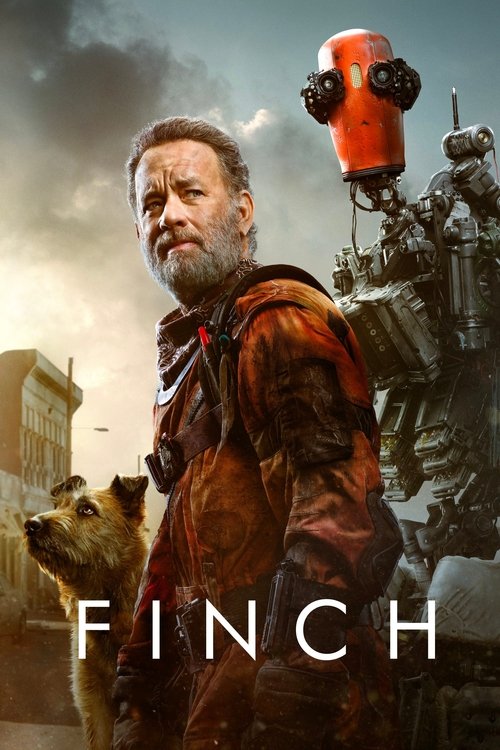
Finch
"Take an unforgettable journey."
Overview
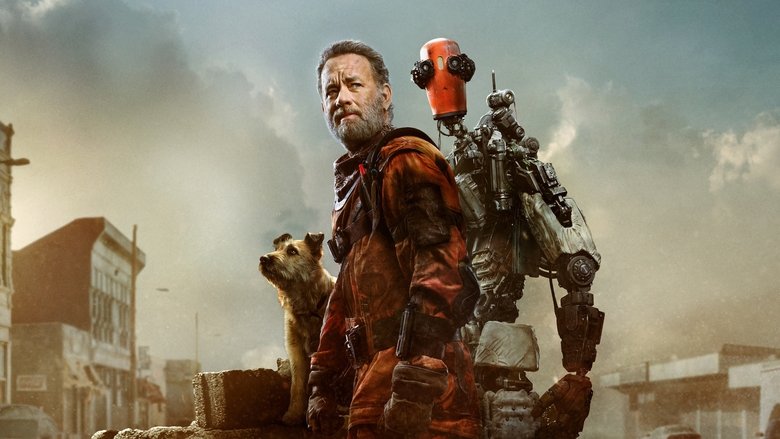
"Finch" is a post-apocalyptic science fiction drama that follows Finch Weinberg, a robotics engineer and one of the last known humans on a desolate Earth. For fifteen years since a catastrophic solar flare destroyed the ozone layer, making the sun's radiation deadly, Finch has lived in a subterranean bunker with his dog, Goodyear. Knowing he is dying from radiation poisoning, Finch's primary concern is ensuring Goodyear will be cared for after he is gone.
To this end, he builds a highly intelligent and sentient robot, Jeff, and imbues it with a vast amount of knowledge, its primary directive being to protect and care for Goodyear. When a massive, prolonged storm threatens their shelter, the trio must embark on a perilous cross-country journey in a modified RV, heading west toward San Francisco. Along the way, the still-learning and child-like Jeff must quickly grasp the nuances of survival, the complexities of human emotion, and the profound bond between a man and his dog, all while under the tutelage of the increasingly frail Finch.
Core Meaning
The central message of "Finch" revolves around the enduring power of love, connection, and hope in the face of utter desolation. It posits that the essence of humanity isn't merely about survival, but about the legacies we leave behind through acts of care and the knowledge we pass on. The film suggests that even when humanity is gone, the values of compassion, loyalty, and love can be taught and can persist. Finch's desperate, selfless act of creating a protector for his dog becomes a testament to the idea that our purpose can be found in ensuring the well-being of those we love, transcending our own mortality. The film is ultimately a hopeful, albeit bittersweet, meditation on what truly matters at the end of the world: not just surviving, but ensuring that the best parts of our nature endure.
Thematic DNA
Legacy and Passing on Knowledge
Faced with his own mortality, Finch's driving purpose is to create a legacy of care for his dog, Goodyear. He builds Jeff not just as a machine, but as a successor, painstakingly teaching him lessons about survival, trust, and life itself. This theme is central to the film, as Finch's final act is to ensure that his knowledge and, more importantly, his capacity for love and care, are passed on to his creation, thus ensuring the well-being of his beloved companion.
The Meaning of Humanity
The film explores what it means to be human through the interactions between Finch, a dying man, and Jeff, a learning machine. As Jeff downloads vast amounts of data, he also learns about trust, fear, love, and loss from Finch. His journey from a purely logical being to one capable of empathy and forming a genuine bond with Goodyear suggests that humanity is defined by these emotional connections and acts of selfless care, rather than by biology alone.
Hope in a Desolate World
Despite the post-apocalyptic setting and Finch's terminal illness, the film maintains a strong undercurrent of hope. This is symbolized by the journey west itself, the discovery of butterflies indicating nature's resilience, and the final scene where Jeff and Goodyear find messages from other survivors. The narrative suggests that even in the bleakest of circumstances, life finds a way, and the potential for a new beginning and community exists.
Trust and Companionship
The film delves into the nature of trust, particularly between Goodyear and Jeff. Initially, the dog is wary of the robot, reflecting a natural distrust of the unfamiliar. A key part of the narrative is Finch teaching Jeff how to earn Goodyear's trust, a process that mirrors the building of any relationship. The evolving dynamic from skepticism to a deep bond underscores the theme that companionship is essential for emotional survival, and that trust is something that must be nurtured and proven.
Character Analysis
Finch Weinberg
Tom Hanks
Motivation
His sole motivation is to ensure that his dog, Goodyear, will be taken care of after he dies from radiation poisoning. This selfless love drives him to create Jeff and undertake the perilous journey west.
Character Arc
Finch begins as a pragmatic, solitary survivor, his life dictated by routine and caution. His focus is purely on survival and the well-being of his dog. As he creates and travels with Jeff, he is forced to become a teacher and a father figure. This process reawakens his own humanity, prompting him to confront his past and his regrets. By the end, he transitions from a man merely trying to survive to one who has successfully created a legacy of love and care, finding peace in knowing his companion will be safe.
Jeff
Caleb Landry Jones (voice and motion capture)
Motivation
Initially, Jeff is motivated by his programmed directives, particularly the primary one: to care for Goodyear. As he learns and develops, his motivation shifts to a more genuine, emotional desire to protect his new family and fulfill Finch's last wishes.
Character Arc
Jeff starts as a literal newborn, with a vast database of knowledge but no practical experience or understanding of the world. His arc is a classic coming-of-age story, accelerated by the apocalyptic setting. He learns through trial and error, frustration, and Finch's teachings. He evolves from a clumsy, overly literal machine to a being capable of independent thought, empathy, and genuine affection, ultimately stepping into the role of protector that Finch created for him.
Goodyear
Seamus (dog actor)
Motivation
Goodyear's motivation is simple and pure: loyalty and love for his owner, Finch. He seeks comfort, safety, and companionship, which he eventually finds with Jeff.
Character Arc
Goodyear's arc is one of learning to trust. Having only known Finch as his companion and protector, he is initially fearful and distrustful of Jeff. Through the course of their journey, and as he witnesses Jeff's dedication and care (especially after Finch's passing), he comes to accept the robot as his new guardian and friend, signifying the successful transfer of Finch's legacy.
Symbols & Motifs
The Golden Gate Bridge
The Golden Gate Bridge symbolizes a destination of hope and a connection to a past that Finch never experienced. It represents an idealized goal and the possibility of a better place, a safe haven from the ravaged world. It is also tied to his personal history and his absent father, making the journey a deeply personal pilgrimage.
Finch has a postcard of the bridge sent by his father, his only communication from him. This postcard becomes the map and the motivation for their cross-country trip. Though Finch doesn't make it, Jeff and Goodyear's arrival at the overgrown but standing bridge signifies the fulfillment of Finch's dream and the start of a new chapter.
The Butterfly
The butterfly is a powerful symbol of hope, resilience, and the planet's potential for healing. In a world believed to be devoid of most life, its appearance signifies that nature is beginning to recover from the ecological disaster.
After Finch's death, as Jeff and Goodyear are in a seemingly desolate area, a butterfly appears. This is the first living creature they've seen besides Goodyear, and its presence marks a turning point, suggesting that the world is not as dead as Finch believed and that a future is possible.
American Pie (Song)
The song "American Pie" represents a connection to the lost world and the culture that has vanished. For Finch, singing it is an act of remembering and a way to hold on to his humanity. It's a piece of the old world that he can share, a complex narrative of a bygone era.
Finch sings "American Pie" in the RV during their journey. He tries to explain its meaning to Jeff, highlighting the difficulty of conveying complex human culture and history to an AI. The act of singing itself is a moment of levity and humanity amidst the grim reality of their situation.
Memorable Quotes
Fourth directive: In Finch's absence, robot must protect the welfare of dog. This directive supersedes all other directives.
— Jeff (reading his programming)
Context:
Finch has just activated Jeff and is ensuring the robot understands its most crucial, overriding command. This scene solidifies the mission of the film before the journey even begins.
Meaning:
This quote establishes the central premise and emotional core of the entire film. It explicitly states Jeff's purpose and highlights the depth of Finch's love for his dog, prioritizing its safety above all else, even the traditional Asimovian laws of robotics.
I know you were born yesterday, but you've got to grow up fast.
— Finch Weinberg
Context:
Said by Finch out of frustration during the early stages of their road trip, after Jeff makes a naive and potentially dangerous mistake. It reflects the tension between Finch's declining health and Jeff's developmental stage.
Meaning:
This line encapsulates the urgency of their situation. Finch is dying and doesn't have the luxury of time to teach Jeff slowly. It underscores the immense pressure on Jeff to learn and mature at an accelerated rate to be ready to take over as Goodyear's protector.
Up there, there are holes in the sky. It's like Swiss cheese.
— Finch Weinberg
Context:
Finch explains to Jeff why the sunlight is so dangerous and why they must live with such extreme caution, highlighting the fragility of their existence.
Meaning:
This is Finch's simple, yet effective, explanation for the apocalyptic state of the world. It vividly illustrates the destruction of the ozone layer and the constant, invisible threat of solar radiation that governs their lives.
Philosophical Questions
What constitutes a meaningful legacy?
The film explores this question through Finch's singular focus. In a world where all societal structures, wealth, and achievements have been erased, Finch's legacy is not a monument or a fortune, but the continued well-being of his dog. The film posits that a meaningful legacy is not defined by grand accomplishments, but by the love and care we ensure for others, suggesting that the most profound impact one can have is on the life of another being, however small it may seem in the grand scheme.
Can consciousness and humanity be created?
"Finch" delves into the nature of consciousness through Jeff's development. He is programmed with data, but he 'grows' through experience, observation, and his relationship with Finch. The film suggests that true 'humanity'—encompassing empathy, love, and self-sacrifice—is not something that can be simply uploaded but must be learned and nurtured. Jeff's journey from a machine following directives to a sentient being making choices based on care and memory poses the question of whether the essence of being human can be replicated and passed on to an artificial intelligence.
Alternative Interpretations
While the primary reading of "Finch" is a straightforward story of love and legacy, some interpretations delve deeper into its allegorical layers. One perspective views the film as a metaphor for parenthood. Finch, as the dying 'father,' must prepare his 'child,' Jeff, for a world without him, teaching him the skills and values necessary to be independent and compassionate. Jeff's rapid learning and eventual maturity mirror the compressed timeline a terminally ill parent might face.
Another interpretation sees the film as a commentary on humanity's relationship with technology and nature. Finch, a robotics engineer, represents humanity's ingenuity. He creates Jeff to solve a problem—the care of his dog. However, the true success is not in the technology itself, but in its capacity to learn empathy. The ending, where Jeff and Goodyear find a recovering natural world and signs of other humans, could be seen as a hopeful message that technology and nature (and humanity) can ultimately coexist and move forward together after a period of destruction.
Cultural Impact
Released directly to streaming on Apple TV+, "Finch" was part of a trend of major films bypassing theatrical releases during the COVID-19 pandemic. Critically, it was received as a heartfelt and well-acted, if somewhat predictable, science fiction drama. The film's primary cultural resonance comes from its place within the Tom Hanks canon, drawing frequent comparisons to his role in 'Cast Away' due to the theme of a man finding companionship in a non-human entity while in isolation. It leans into a more hopeful and sentimental corner of the post-apocalyptic genre, contrasting with the grimmer fare often seen. While not a groundbreaking narrative, its poignant exploration of humanity, legacy, and the human-animal bond, extended to an AI, struck a chord with audiences looking for emotional, character-driven stories. The film serves as a thoughtful commentary on what endures when civilization collapses, suggesting that love and the need to care for others are the ultimate drivers of existence.
Audience Reception
Audiences generally responded positively to "Finch," largely praising Tom Hanks's performance, which was widely seen as the film's emotional anchor. Viewers found the story to be heartwarming, poignant, and emotionally resonant, particularly the relationships between Finch, Jeff, and Goodyear. The film was often described as a 'tearjerker' with a hopeful message. The main points of criticism from some viewers centered on the plot's predictability and a perceived lack of conflict or stakes, with some finding the narrative too simplistic or sentimental. The dynamic between the naive robot and the grumpy human was a highlight for many, but others felt it tread familiar ground seen in other science fiction films. Overall, the verdict was that of a touching and well-crafted, if not revolutionary, story made compelling by its central performances.
Interesting Facts
- The film was originally titled 'BIOS'.
- The screenplay was written by Craig Luck and Ivor Powell, a veteran producer known for his work on classics like 'Alien' and 'Blade Runner'.
- The film's director, Miguel Sapochnik, is well-known for directing some of the most epic and acclaimed episodes of 'Game of Thrones', including 'Battle of the Bastards' and 'The Winds of Winter'.
- The movie was filmed in various locations across New Mexico, which provided the vast, post-apocalyptic landscapes.
- Executive producers on the film included Robert Zemeckis and Kevin Misher.
- The film's theatrical release was cancelled due to the COVID-19 pandemic, and it was subsequently acquired by Apple TV+ for a streaming release.
Easter Eggs
Reference to 'Le Petit Prince' (The Little Prince)
Early in the film, Finch is seen with a copy of Antoine de Saint-Exupéry's classic book, 'The Little Prince.' The inscription reads, 'To my little prince—Mom.' The book's themes of solitude, love, loss, and seeing with the heart resonate strongly with the film's narrative. The imagery of a lone figure on a small planet is a visual parallel to Finch's existence.
⚠️ Spoiler Analysis
Click to reveal detailed analysis with spoilers
Frequently Asked Questions
Explore More About This Movie
Dive deeper into specific aspects of the movie with our detailed analysis pages
Comments (0)
No comments yet. Be the first to share your thoughts!