Argentina 1985
Overview
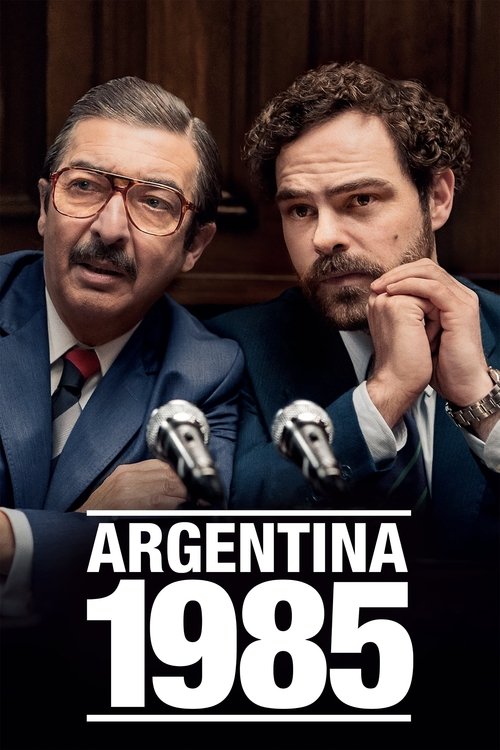
"Argentina, 1985" chronicles the real-life story of prosecutors Julio Strassera and Luis Moreno Ocampo, who dared to prosecute the leaders of Argentina's most brutal military dictatorship. The film is set in the fragile, nascent days of Argentine democracy following the end of the military junta that ruled from 1976 to 1983.
The narrative follows Strassera as he assembles a young, inexperienced legal team to take on the monumental and dangerous task of holding the architects of the "Dirty War" accountable for their crimes against humanity, which included kidnapping, torture, and murder of thousands of civilians. Facing death threats and a society still deeply divided and fearful, Strassera and his team race against time to gather evidence and build a case that will forever change the course of their country's history.

Core Meaning
The core message of "Argentina, 1985" is the profound importance of justice and memory in the construction of a true democracy. Director Santiago Mitre wanted to explore how a society can heal from immense trauma, not through forgetting, but by confronting its darkest chapters. The film posits that even ordinary people, when faced with extraordinary circumstances, can become agents of historical change. It serves as a powerful testament to the idea that no one is above the law and that the fight for human rights is a continuous and vital struggle. The final plea of "Nunca Más" (Never Again) encapsulates the film's central idea: that the memory of past atrocities must be preserved to prevent their recurrence.
Thematic DNA
Justice vs. Impunity
The central theme is the struggle to establish justice in a society where the perpetrators of horrific crimes still hold significant power and influence. The film explores the immense legal and political obstacles the prosecution team faced, from the military's refusal to recognize the civilian court's authority to the pervasive fear among potential witnesses. It highlights the David-and-Goliath nature of the trial, pitting a small, under-resourced legal team against the deeply entrenched impunity of the former military regime.
The Power of Memory and Testimony
"Argentina, 1985" underscores the critical role of collective memory in healing a nation's wounds. The film gives significant screen time to the harrowing testimonies of the victims of the dictatorship. These scenes are depicted with raw emotional power, emphasizing that the trial was not just a legal proceeding, but a platform for the voices of the silenced to finally be heard. The act of testifying becomes a courageous and essential act of reclaiming history from the oppressors.
Generational Conflict and Collaboration
The film portrays a significant generational dynamic. The seasoned, world-weary prosecutor Julio Strassera is initially skeptical and cautious, while his younger deputy, Luis Moreno Ocampo, and the team of university students they recruit, bring idealism and fearless energy. This collaboration between the skepticism of experience and the passion of youth is portrayed as essential to the trial's success. It also touches on the conflict within families, like Ocampo's, who had ties to the military establishment.
The Fragility of Democracy
The movie is set against the backdrop of a newly restored and very fragile democracy. The constant death threats, bomb scares, and political pressure underscore how easily the democratic project could have been derailed. The film serves as a cautionary tale about the need for constant vigilance and courage to protect democratic institutions from the forces that seek to undermine them.
Character Analysis
Julio César Strassera
Ricardo Darín
Motivation
His primary motivation evolves from a sense of professional duty to a deep-seated conviction that securing a conviction is the only way to ensure a peaceful and democratic future for Argentina, and for his own family. He is driven by a need to make up for his own past inaction during the dictatorship.
Character Arc
Strassera begins as a cynical and cautious bureaucrat, a man who, by his own admission, is not the type to make history. Initially overwhelmed by the monumental task, he is plagued by fear and doubt. Throughout the film, fueled by the courage of the victims and the dedication of his young team, he transforms into a determined and passionate advocate for justice, culminating in his historic and defiant closing argument.
Luis Moreno Ocampo
Peter Lanzani
Motivation
Ocampo is motivated by a strong sense of civic duty and a desire to prove that his generation can build a different Argentina. He is determined to break from his family's military-aligned past and contribute to the establishment of justice.
Character Arc
Ocampo starts as a junior prosecutor from a conservative, pro-military family. Joining the trial forces him to confront his family's beliefs and forge his own path. He grows from an eager but somewhat naive assistant into a confident and essential partner to Strassera, bridging the gap between the old guard and the new generation.
Silvia Strassera
Alejandra Flechner
Motivation
Her motivation is the safety and future of her family and her country. She understands the historical importance of her husband's work and provides the emotional support and encouragement he needs to face the immense pressure and danger.
Character Arc
Silvia is a constant source of support and strength for her husband. While she shares his fears, she consistently encourages him to persevere. Her character remains steadfast, representing the resilience of the ordinary Argentine family and their deep desire for justice and a return to normalcy.
Symbols & Motifs
The Typewriter
The typewriter symbolizes the methodical, relentless, and perhaps old-fashioned pursuit of justice. It represents the painstaking work of documenting testimonies and building a case brick by brick, contrasting with the brute force of the military dictatorship.
Julio Strassera is frequently shown at his typewriter, especially during moments of contemplation and when drafting his powerful closing argument. The film ends with the sound of his typewriter, indicating that the fight for justice is ongoing, as he prepares to appeal some of the sentences.
Family Meals
The recurring scenes of the Strassera family having meals together symbolize the private life and normalcy that are threatened by the public battle Strassera is waging. They represent what is at stake – the ability to live a normal, safe life in a functioning society.
Throughout the film, crucial conversations and moments of both tension and support occur around the dinner table in the Strassera household. These scenes ground the high-stakes legal drama in the everyday reality of a family trying to navigate a perilous time, providing much of the film's humor and humanity.
The Young Legal Team
The group of young, inexperienced law students and graduates who form the prosecution's investigative team symbolizes the future of Argentina. Their idealism and dedication represent a new generation committed to democratic values and breaking with the country's violent past.
When established lawyers refuse to join the prosecution out of fear or sympathy for the old regime, Strassera and Ocampo assemble a team of young people. Their tireless work traveling the country to gather testimonies is a central part of the film's narrative, showing their crucial role in the historic victory.
Memorable Quotes
Señores jueces: quiero utilizar una frase que no me pertenece, porque pertenece ya a todo el pueblo argentino. Señores jueces: Nunca más.
— Julio César Strassera
Context:
This is the powerful closing line of Strassera's final argument in the trial. After summarizing the horrific evidence presented, he delivers this plea, which became the rallying cry for human rights in Argentina. The courtroom erupts in applause, signifying a pivotal moment of catharsis for the nation.
Meaning:
This translates to "Your Honors: I want to use a phrase that is not my own, because it already belongs to the entire Argentine people. Your Honors: Never Again." This quote encapsulates the film's and the nation's core message. It transforms the trial from a mere legal procedure into a collective vow to never again allow such atrocities to occur.
La historia no la hacen los tipos como yo.
— Julio César Strassera
Context:
Strassera says this early in the film to a friend, expressing his disbelief and skepticism about being chosen to lead such a monumental trial. He sees himself as a cog in the machine, not a history-maker, which contrasts sharply with the historical figure he becomes.
Meaning:
"History is not made by guys like me." This line reveals Strassera's initial self-perception as an ordinary, unimportant bureaucrat. It highlights his everyman quality and sets up his character arc, making his eventual transformation into a national hero all the more powerful.
Philosophical Questions
What is the role of justice in national healing after a period of extreme trauma?
The film explores whether legal accountability is a sufficient condition for a society to heal. It presents the trial as a necessary act of public catharsis and a foundational moment for the new democracy. The harrowing testimonies suggest that justice involves not only punishing the guilty but also providing a platform for victims to have their truth officially acknowledged. The film argues that without this reckoning, represented by the trial, a nation cannot truly move forward or build a stable future.
Can ordinary individuals truly shape the course of history?
"Argentina, 1985" directly confronts this question through its protagonist. Strassera's initial belief that "history is not made by guys like me" is systematically dismantled by the narrative. The film proposes that historical change is often the result of ordinary people choosing to act with courage and conviction in extraordinary circumstances. It celebrates the collective effort of the prosecution team, suggesting that heroism is not the domain of a select few but a potential within many.
How can a society ensure that past atrocities are 'never again' repeated?
The film's famous closing line, "Nunca Más," is both a plea and a challenge. The film suggests that the primary defense against the recurrence of such events is collective memory and the robust defense of democratic institutions. It argues that justice must be active, not passive, and that the story of the past must be continually told and retold to new generations to serve as a warning and an inspiration.
Alternative Interpretations
While the film is largely seen as a heroic portrayal of the prosecution, some interpretations have focused on the nuances and complexities of the historical moment. One perspective is to view the film not just as a story of heroes, but as a critique of the societal complicity and silence that allowed the dictatorship to thrive. Strassera's own admission of his past inaction can be read as an acknowledgment of a broader societal failure.
Another interpretation centers on the film's ending. While celebratory, the verdict was not a complete victory, as several commanders received light sentences or were acquitted. The final shot of Strassera immediately beginning to work on an appeal can be interpreted as a commentary on the imperfect and ongoing nature of justice. It suggests that such historical victories are never final and require continuous effort to be upheld and expanded upon, especially given that some of the convicted were later pardoned before those pardons were eventually overturned.
Cultural Impact
"Argentina, 1985" had a significant cultural impact both within Argentina and internationally. Upon its release, it became the most-watched Argentine film of 2022, resonating deeply with audiences who saw it as a necessary and powerful revisitation of a pivotal moment in their nation's history. For many younger Argentinians, the film was an introduction to the horrors of the dictatorship and the heroic efforts to establish justice. The film sparked renewed conversations about memory, justice, and the importance of democratic institutions.
Internationally, the film was a critical success, winning the Golden Globe for Best Non-English Language Film and earning an Oscar nomination. It brought global attention to the Trial of the Juntas, a landmark case where a democratic government successfully prosecuted its dictatorial predecessors in a civilian court, a rare event in world history. Critics and audiences worldwide praised the film for its universal themes of courage, the fight for justice, and the fragility of democracy, making it relevant to contemporary political climates in many countries.
Audience Reception
Audience reception for "Argentina, 1985" was overwhelmingly positive. In Argentina, viewers praised the film for its emotional power and historical importance, with many screenings reportedly ending in applause, particularly after Strassera's closing speech. Audiences connected with the film's blend of tense legal drama, moments of humor, and deeply moving human stories. The performances of Ricardo Darín and Peter Lanzani were widely acclaimed.
Internationally, audiences who may have been unfamiliar with this chapter of Argentine history were captivated by the universal themes of the film. The main points of praise focused on its compelling narrative, its ability to be both educational and deeply engaging, and its relevance to contemporary struggles for democracy and human rights across the globe. There was very little significant criticism from audiences, with most finding it a powerful and well-crafted cinematic experience.
Interesting Facts
- The film was shot in the original courtroom at the Palace of Justice in Buenos Aires where the actual Trial of the Juntas took place.
- Ricardo Darín, who plays Julio Strassera, is one of Argentina's most acclaimed actors and also served as a producer on the film.
- Director Santiago Mitre and co-writer Mariano Llinás extensively used the actual trial transcripts and archival recordings to write the screenplay, lending a high degree of authenticity to the courtroom scenes.
- To achieve a sense of verisimilitude, the casting director chose many unknown actors to play the roles of the young investigators and the witnesses testifying in court.
- The actors, Ricardo Darín and Peter Lanzani, decided against doing a direct imitation of the real-life Strassera and Moreno Ocampo, opting instead for their own interpretations of the characters.
- Cinematographer Javier Juliá intentionally chose a contemporary look for the film, avoiding a nostalgic or dated feel, to make the events feel immediate and relevant to modern audiences.
⚠️ Spoiler Analysis
Click to reveal detailed analysis with spoilers
Frequently Asked Questions
Explore More About This Movie
Dive deeper into specific aspects of the movie with our detailed analysis pages
Comments (0)
No comments yet. Be the first to share your thoughts!