Skip to content
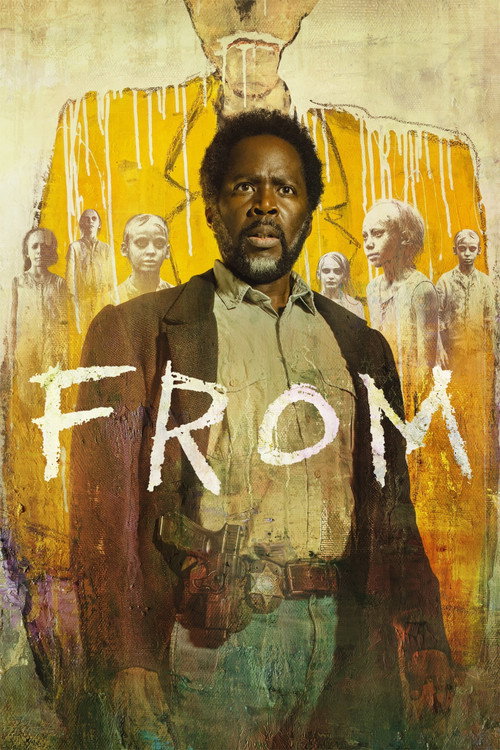
FROM
A suffocating sci-fi horror nightmare of inescapable existential dread, where fragile human souls burn like flickering lanterns against an endlessly consuming, shadowy forest of clawing teeth and ancient lies.
FROM

FROM

20 February 2022 — 28 June 2026 United States of America 4 season 40 episode Returning Series 8.5 (4,117)

Cast: Harold Perrineau, Catalina Sandino Moreno, Ricky He, David Alpay, Chloe Van Landschoot

Drama Sci-Fi & Fantasy Mystery Hope vs. Existential Despair Grief, Trauma, and Guilt Community, Order, vs. Anarchy The Burden of Knowledge and Truth Cyclical Fate, Reincarnation, and Historical Sacrifice

Overview

"FROM" is an American science-fiction horror mystery series created by John Griffin. The narrative centers on a nightmarish, unnamed town in middle America that traps anyone who enters. Trapped drivers blindly follow a winding road only to encounter a giant fallen tree blocking their path, flanked by screaming crows. Turning back offers no escape; every road inevitably loops back into the heart of the township. To make matters terrifyingly worse, as dusk falls, human-looking creatures emerge from the surrounding forest. Wearing uncanny, polite smiles, these monstrous entities psychologically torment the residents before brutally tearing open anyone caught outdoors after dark.

The series traces the collective struggle of the trapped population, who split into two distinct factions: the structured, law-and-order Township governed by Sheriff Boyd Stevens, and the open, communal sanctuary of Colony House led by Donna Raines. The precarious balance of daily survival shifts when Boyd discovers ancient carved stone talismans that, when hung near an entry door, prevent the creatures from entering enclosed spaces. This discovery moves the town from hopeless hiding to an active search for answers, uniting strangers, engineers, doctors, and outcasts in a desperate effort to escape.

Across its multi-season arc, the mystery deepens as the town itself reacts punitively to the residents' attempts to break free. From mysterious radio signals and underground monster caverns to faraway trees that teleport travelers, phantom visions, and ancient curses, the show evolves into a complex puzzle box. As characters are tested physically and psychologically, they realize that escaping this pocket dimension requires uncovering a dark, centuries-old historical tragedy rooted in sacrifice, memory, and cosmic malice.

Core Meaning

Through its complete narrative, the creators of "FROM" explore human resilience, community, and the preservation of morality in the face of absurd, incomprehensible suffering. The inescapable town serves as an existential microcosm of human existence: people are suddenly thrown into a dangerous, terrifying world with arbitrary rules and constant mortality without their consent.

The core message of the series is that when faced with overwhelming cosmic terror and existential hopelessness, humanity’s ultimate weapon is not individual intellect or brute force, but shared empathy, community, and moral responsibility. The show posits that moral choices must not be made based on guaranteed outcomes or selfish survival, but on whether they are fundamentally right. Even when the universe is cruel, illogical, and oppressive, holding onto love, truth, and community is the ultimate act of human defiance.

Thematic DNA

Hope vs. Existential Despair 30%
Grief, Trauma, and Guilt 25%
Community, Order, vs. Anarchy 20%
The Burden of Knowledge and Truth 15%
Cyclical Fate, Reincarnation, and Historical Sacrifice 10%

Hope vs. Existential Despair

The primary psychological tension in the show. Characters constantly oscillate between fighting for an escape path (Boyd building a radio tower, Tabitha digging tunnels) and surrendering to quiet, hopeless acceptance. The series demonstrates that despair breeds paranoia and destruction, whereas hope—even when seemingly foolish—is the spark that keeps humanity alive.

Grief, Trauma, and Guilt

Almost every person drawn to the town is carrying heavy emotional baggage—the loss of an infant child (the Matthews family), military trauma and a spouse's death (Boyd), or guilt over past failures. The town functions as an amplifier of psychological wounds, manifesting characters' deepest regrets as haunting phantoms or manipulative visions. Healing trauma is intertwined with surviving the town's physical traps.

Community, Order, vs. Anarchy

Explored through the ideological divide between the Township (Boyd’s rigid rules, night curfews, civic duty) and Colony House (Donna’s shared resources, free-spirited living). The show tests how human social contracts crumble under threat and proves that tribal division only aids the monsters, while unity and structured cooperation enable survival.

The Burden of Knowledge and Truth

A central thematic warning explicitly stated in later seasons: "Knowledge comes with a cost". Whenever characters get closer to understanding the mechanics of Fromville, the realm retaliates with storms, collapsed structures, or brutal violence. The pursuit of truth requires willingness to endure severe sacrifice.

Cyclical Fate, Reincarnation, and Historical Sacrifice

The lore reveals that the town’s nightmare is not a new phenomenon but a repeating cycle stretching back centuries. Generations of trapped victims repeat historical mistakes, rituals, and sacrifices. The overarching arc explores whether current survivors can break the infinite loop by remembering and confronting the original sins committed in the town.

Character Analysis

Boyd Stevens

Harold Perrineau

Archetype: The Reluctant Hero / Burdened Leader Key Trait: Indomitable willpower and fierce duty.

Motivation

To protect his son Ellis and every townsperson, evolving from establishing basic order to relentlessly hunting for a way to return everyone home.

Character Arc

A former military veteran who arrives in town and organizes survival by discovering the talismans. Across the show, he suffers tremendous personal trauma (killing his infected wife Abby, dealing with Parkinson's-like tremors, worm parasite blood). He evolves from a strict disciplinarian into an unyielding figurehead who refuses to break, taking the entire emotional weight of the community onto his shoulders.

Tabitha Matthews

Catalina Sandino Moreno

Archetype: The Seeking Mother / Truth-Finder Key Trait: Intuitive bravery and refusal to accept superficial answers.

Motivation

Keep her surviving children safe, evolving into uncovering the town's original sin to liberate trapped souls.

Character Arc

Arrives grieving the loss of her infant son Thomas alongside her strained husband Jim. She evolves from a traumatized parent into the show's primary investigator, digging basement tunnels, scaling the lighthouse, being pushed back to the outside world, and discovering her deep soul connection as a reincarnated figure tied to the ancient sacrificed children.

All 5 characters and cast

Symbols & Motifs

The Carved Talismans

Meaning:

They symbolize fragile human protection, safety boundaries, and the thin line separating order from chaos.

Context:

Ancient stone amulets etched with mystery runes, hung near entry doors to prevent monsters from entering enclosed spaces.

The Fallen Tree with Crows

Meaning:

It serves as a visual motif for the point of no return, fate's trap, and the transition from the normal world into the pocket dimension.

Context:

The initial obstruction encountered on the road by travelers before being trapped in the town.

The Bottle Tree & Faraway Trees

Meaning:

They symbolize memory, time travel/history, sheet music, and unpredictable pathways between realms.

Context:

Ancient trees with glass bottles hanging from branches or hollow trunks that warp space-time.

The Music Box & Melody

Meaning:

It symbolizes lingering curse traps, psychological imprisonment, and time running out.

Context:

A creepy mechanical wind-up music box linked to dungeon entities and dream paralysis.

The Lighthouse

Meaning:

It symbolizes a beacon of ultimate truth and escape, but also danger and the terrifying descent into the unknown.

Context:

A towering structure emitting light located deep inside the dense inland forest.

The Boy in White

Meaning:

He symbolizes lost childhood innocence, cryptic guidance, and the morally ambiguous nature of the town's supernatural forces.

Context:

An enigmatic child dressed in white visible only to select residents.

The Man in the Yellow Suit

Meaning:

He symbolizes cold cosmic malice, authoritative cruelty, and the punitive retribution dealt to those who seek forbidden secrets.

Context:

A chilling entity introduced as an overarching force governing Fromville.

Memorable Quotes

I gotta go.
— Boyd Stevens

Context

Spoken repeatedly throughout all seasons whenever Boyd exits Colony House or the Sheriff's station to enter the woods.

Meaning

Boyd's recurring catchphrase whenever he takes decisive action or ventures into danger. It encapsulates his restless drive and refusal to remain passive.

You don't make moral choices based on the outcome. You make them based on whether they're right or not.
— Father Khatri / Spectral Guide

Context

Season 1, Episode 10 / Season 2 visions; spoken to challenge Jade and Boyd when pragmatic cynicism threatens their morality.

Meaning

Encapsulates the ultimate moral thesis of the entire series regarding human ethics during crisis.

All 5 quotes

Episode Highlights

Long Day's Journey Into Night

S1E1

Pilot episode. Establishes the horrific rules of the town, the Matthews family crash, night creatures, and the talisman system.

Significance:

Sets up the premise, core characters, and world-building.

All Good Things

S1E7

Colony House massacre. A manipulated resident opens a window for a creature, triggering a brutal slaughter.

Significance:

Destroys Colony House's innocence, reshapes town leadership, and proves monsters use psychological deception.

Oh, the Places We'll Go

S1E10

Season 1 finale. Radio tower experiment, creepy voice warning, Tabitha falls into basement caverns, Boyd trapped in chimney.

Significance:

Shifts series from local night survival to confronting an omniscient supernatural adversary.

The Kindness of Strangers

S2E2

A bus arrives carrying new victims (including Kristi's fiancée Marielle); Boyd returns infected with worm parasites.

Significance:

Overwhelms town resources, introduces critical blood lore, and heightens emotional stakes.

Pas de Deux

S2E6

Boyd transfers parasite worms into the "Smiley" monster during an attack, killing it.

Significance:

Game-changer: proves the night creatures are mortal and can be destroyed.

Once Upon a Time...

S2E10

Season 2 finale. Boyd destroys the music box; Tabitha is pushed from the lighthouse by the Boy in White and wakes up in a real hospital.

Significance:

Breaks the realm barrier, proving physical escape to the outside world is possible.

Shatter

S3E1

Season 3 premiere. Monsters change tactics to psychological sadism, executing Tian-Chen Liu in front of Boyd.

Significance:

Crushes township morale and reveals the entity's tactical intelligence.

Revelations / The Price

S3E10

Season 3 finale. Uncovers monster origins (ancient child sacrifice), Fatima gives birth to Smiley's rebirth, Jim killed by Man in Yellow.

Significance:

Resolves major lore questions while setting up high-stakes conflict for Season 4.

Arrival

S4E1

Season 4 premiere. Highest IMDb-rated episode (8.4/10); deals with Jim's death, time-storywalking, and shifting dynamics.

Significance:

Launches the final narrative push toward breaking the time loop.

Philosophical Questions

What constitutes moral action when basic survival is threatened?

Explores whether human ethics are absolute or conditional when society collapses into existential horror.

Is hope a vital necessity or a dangerous illusion?

Contrasts Boyd's stubborn push for escape against Donna's pragmatic focus on surviving the immediate present.

Can humanity break inherited cycles of trauma and historical sin?

Examines whether generations are doomed to repeat past mistakes or can break cosmic patterns through memory and sacrifice.

Alternative Interpretations

The Purgatorial / Existential Reading: The town is a liminal realm or spiritual purgatory where individuals who experienced past trauma or guilt must face psychological trials before achieving redemption or moving on.

Full ending explanation

Cultural Impact

Released in early 2022 following global pandemic lockdowns, "FROM" resonated strongly with universal feelings of isolation, forced confinement, inescapable social anxiety, and fragile community reliance.

Season 1 debuted with a 96% Rotten Tomatoes score. Critics praised Harold Perrineau's leading performance, the genuinely terrifying monster design, and effective atmospheric horror. Subsequent seasons maintained high critical praise while building an active online theory-crafting fanbase.

The show revitalized the "mystery box" television subgenre by proving that serialized mystery can successfully blend with visceral horror and emotional character storytelling.

Audience Reception

What Audiences Praise: The terrifying concept of the night creatures, Harold Perrineau’s commanding performance, intense cliffhangers, and deep lore payoff in late seasons.

Main Points of Criticism: Frustration during middle episodes when characters hold back vital information from each other, slow pacing in subplot resolutions, and fears of unresolved plot threads.

Overall Verdict: Widely regarded by genre fans and critics as one of the best contemporary horror/mystery series on television.

Interesting Facts

  • The entire town set—including the diner, Sheriff’s station, Colony House, and residential homes—was built from scratch on location near Beaver Bank, Nova Scotia, Canada.
  • Executive producers Jack Bender and Jeff Pinkner, as well as star Harold Perrineau, previously worked together on ABC's iconic mystery series Lost.
  • Harold Perrineau initially hesitated to star in another 'trapped mystery box' series and only agreed to sign on after showrunner John Griffin confirmed the writers had a fully mapped-out plan and concrete answers for every mystery.
  • Horror legend Stephen King publicly praised FROM on social media, calling it 'scary as hell' and praising its suspenseful pacing, driving massive viral audience growth.
  • The series premiere set the record for the most-watched original series premiere in the history of Epix / MGM+.
  • The actors playing the night monsters were instructed to perform with calm, polite, mid-century neighborly demeanor, avoiding traditional zombie slumps or monster snarls to heighten the uncanny eerie factor.

Easter Eggs

Stephen King Homages

The setting of a trapped small town in Maine/North America, eerie supernatural children, and room numbers pay direct homage to King’s IT, Under the Dome, and The Shining.

Lost References

Shared actor Harold Perrineau shouting about survival, failed radio tower broadcasts, mysterious hatch/cave networks, and faraway trees functioning like island pocket-warps mirror iconic Lost tropes.

Bottle Tree Dates

The dates written on slips inside the hanging glass bottles (e.g., 1506, 1864, 1931, 1978) correspond to historical years when previous cycles of victims arrived and were sacrificed in Fromville.

Cave Drawing Foreshadowing

The primitive cave paintings discovered in Season 1 and 2 literally outline the entire plot arc: ships arriving, adults performing sacrifices around stone slabs, the symbol, and the entity controlling the dimension.

Frequently Asked Questions

Explore More About This Movie

Dive deeper into specific aspects of the movie with our detailed analysis pages

Comments (0)

Leave a comment

No comments yet. Be the first to share your thoughts!

Similar Movies