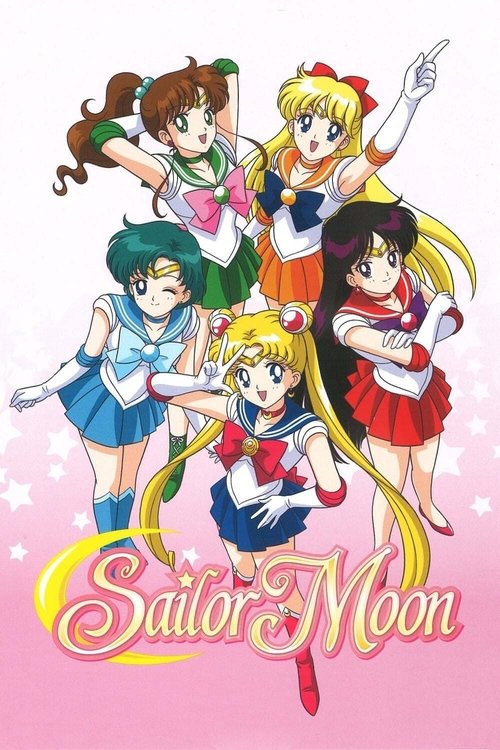
Sailor Moon
美少女戦士セーラームーン
"In the name of the Moon, I'll punish you!"
Overview
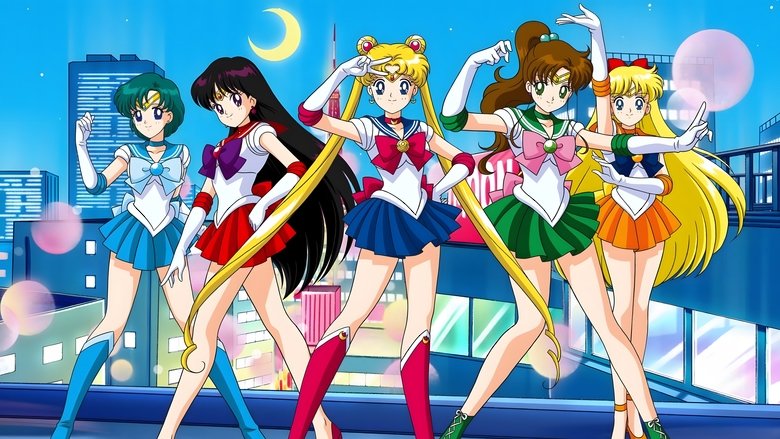
Sailor Moon chronicles the journey of Usagi Tsukino, a clumsy and crybaby middle school student who discovers she is the reincarnated leader of the Sailor Guardians, defenders of the solar system. Spanning five distinct seasons—Sailor Moon, R, S, SuperS, and Sailor Stars—the series follows Usagi and her growing team of planetary warriors as they protect Earth from a succession of interdimensional threats. What begins as a monster-of-the-week magical girl show evolves into a sprawling epic involving time travel, dystopian futures, and the ultimate battle for the galaxy.
As the series progresses, the narrative deepens, exploring the tragic fall of their ancient Moon Kingdom and the burden of their reincarnated destinies. The Guardians face adversaries ranging from the energy-draining Dark Kingdom to the silence-bringing Death Busters and the corrupted Sailor Galaxia. Through every conflict, the core group expands to include the Outer Guardians, creating a complex dynamic of differing philosophies on duty and sacrifice.
The saga concludes not with a display of superior firepower, but with an ideological confrontation about the nature of chaos and hope. Usagi's journey transforms her from a reluctant heroine into the messianic Neo-Queen Serenity, ultimately saving the universe through radical empathy and the refusal to destroy her enemies, affirming her belief that everyone deserves a chance at redemption.
Core Meaning
At its heart, Sailor Moon posits that femininity is a source of strength, not weakness, and that the greatest power lies in the capacity to love and forgive rather than to destroy. The series deconstructs the traditional hero narrative by replacing aggression with healing; Usagi triumphs not by killing her ultimate enemies, but by purifying them or reaching out to their lost humanity. It asserts that friendship is the strongest bond in the universe, capable of transcending time, death, and destiny.
Thematic DNA
The Power of Healing over Violence
Unlike traditional shonen heroes who defeat enemies with brute force, Sailor Moon's ultimate attacks are often restorative commands like 'Refresh' or 'Healing Escalation.' The series develops this theme by escalating the threats from simple monsters to complex, corrupted villains. By the final season, Usagi explicitly refuses to fight Sailor Galaxia with violence, choosing instead to endure pain to heal her opponent's corrupted soul, cementing the idea that true victory brings peace, not just the cessation of conflict.
Destiny vs. Self-Determination
The characters are bound by their past lives in the Silver Millennium, fated to be a princess and her guardians. However, the series constantly challenges this fatalism. Characters like Sailor Uranus and Neptune defy the status quo to save the world their way, and Usagi often rejects the 'necessary sacrifices' dictated by destiny. The show evolves to suggest that while the past shapes them, their choices in the present—specifically the choice to hope—define the future.
Female Friendship and Sisterhood
The bond between the Sailor Guardians is the emotional anchor of the entire series. It moves beyond simple camaraderie to a deep, spiritual sisterhood where they are willing to die for one another. The show portrays a diverse range of female relationships, from the maternal protection of Sailor Pluto to the competitive rivalry of Mars and Moon, and the devoted partnership of Uranus and Neptune, showcasing women supporting women as the foundation of saving the world.
Growth and Maturation
Usagi's arc is a slow-burn journey from a dependent child to a sovereign queen. The series uses the 'monster of the week' format to incrementally test her resolve. In the beginning, she cries and wants to quit; by the end of Sailor Stars, she faces the embodiment of universal chaos alone, fully accepting her responsibility. This theme reflects the painful but necessary transition from adolescence to adulthood.
Character Analysis
Usagi Tsukino / Sailor Moon
Kotono Mitsuishi
Motivation
Initially motivated by fear and the desire to protect her friends, her motivation evolves into a universal love for all living things and a duty to preserve the future of the galaxy.
Character Arc
Starts as a lazy, crybaby 14-year-old who actively rejects her call to adventure. Over five seasons, she doesn't lose her compassion or emotional vulnerability but learns to weaponize them as strength. Her journey culminates in her becoming Eternal Sailor Moon, a being capable of embracing the galaxy's chaos, proving that a 'soft' heart is the strongest force in the universe.
Mamoru Chiba / Tuxedo Mask
Toru Furuya
Motivation
To protect Usagi and the Earth, often serving as a sacrificial shield to allow Sailor Moon to deliver the final blow.
Character Arc
Begins as an antagonistic teaser but reveals himself as Usagi's protector and past-life lover, Prince Endymion. Unlike traditional male heroes, his role is supportive; he often gets captured, brainwashed, or incapacitated, allowing Usagi to be the savior. He evolves from a lone vigilante to the emotional anchor and future King who supports the Queen's rule.
Chibiusa / Sailor Chibi Moon
Kae Araki
Motivation
To prove her worthiness as an heir and to save her parents in the future.
Character Arc
Introduced in Sailor Moon R as a bratty intruder from the future, she struggles with an inferiority complex living in her mother's shadow. Through the SuperS season, she finds her own identity and capacity to love, maturing into a warrior who can fight alongside her mother rather than just being protected by her.
Haruka Tenou / Sailor Uranus
Megumi Ogata
Motivation
To save the world at any cost, even if it means dirtying her own hands or becoming a villain.
Character Arc
Represents the cynical, utilitarian view of heroism. She is willing to kill the few to save the many, contrasting sharply with Usagi's idealism. Her arc involves slowly learning to trust in Usagi's 'naive' hope, eventually acknowledging Sailor Moon as the true Messiah who can find a third option beyond sacrifice.
Symbols & Motifs
The Moon
Represents femininity, intuition, cycles of rebirth, and a guiding light in darkness. It serves as the source of Usagi's power and her royal heritage.
Used constantly in visual motifs, attacks, and background imagery. The full moon often signals pivotal moments of clarity or power, while the crescent moon on Usagi's forehead reveals her true royal identity as Princess Serenity.
The Silver Crystal (Maboroshi no Ginzuishou)
Symbolizes the ultimate power of purity and the life force of the Moon Kingdom. It represents the potential for both creation and destruction, fueled by the user's heart.
It is the central MacGuffin of the first season and Usagi's primary source of power. Its blooming lotus form appears in final battles, signifying spiritual enlightenment and the release of limitless energy through self-sacrifice.
Sailor Fuku (Uniforms)
Represents the intersection of innocence (schoolgirl uniform) and duty (soldier's uniform). It reclaims a symbol of patriarchal objectification or conformity as armor for female empowerment.
The transformation sequences, where the girls don these outfits, are ritualistic moments where they shed their civilian doubts and step into their power. The uniformity of the suits highlights their unity while color variations signal individual identities.
Mirrors
Truth, self-reflection, and the duality of dreams and nightmares. They often reveal hidden selves or trap characters in illusions.
Prominent in the SuperS season with the Dead Moon Circus, where villains look into 'Dream Mirrors' to find Pegasus. Sailor Neptune also uses her Deep Aqua Mirror to reveal the truth and dispel illusions.
Memorable Quotes
In the name of the Moon, I'll punish you!
— Sailor Moon
Context:
Spoken in almost every episode during her opening monologue before battling the monster of the week.
Meaning:
The iconic catchphrase that asserts her authority. It transforms the celestial body (the Moon) into a symbol of justice and retribution against evil.
The future is something you create yourself.
— Sailor Mercury
Context:
Often expressed during battles against villains who claim the world is doomed or determined by fate.
Meaning:
A rejection of fatalism. It underscores the show's theme that while the past (Silver Millennium) sets the stage, the characters have the agency to write their own destiny.
I'd rather choose to fall in love and be hurt. Sometimes I can't even sleep because I love someone too much. And there's always sadness in our lives. It's that sad feeling that keeps us going.
— Usagi Tsukino
Context:
Spoken during the climactic battles (notably in the movie Promise of the Rose and similar TV moments) defending the value of a painful but real life.
Meaning:
Validates emotional pain as a necessary part of the human experience. It rejects the villain's promise of a painless, stagnant eternity.
Enduring the pain while waiting for the one you love... that is also a form of love.
— Sailor Pluto
Context:
Reflects Pluto's lonely vigil guarding the Door of Time and Space, forbidden from ever leaving her post.
Meaning:
Highlights the mature, often tragic nature of love represented by the Outer Guardians, contrasting with the younger girls' romantic ideals.
Episode Highlights
Usagi - Sailor Moon
The origin story where Usagi meets Luna and transforms for the first time. It establishes the tone: Usagi is terrified, cries, and defeats the monster almost by accident, subverting the 'brave hero' trope immediately.
Sets the foundation for the entire magical girl genre revival and introduces the core conflict of normal life vs. extraordinary duty.
Memories Return: Usagi and Mamoru's Past
The pivotal reveal where Zoisite injures Tuxedo Mask, triggering Usagi's awakening as Princess Serenity. The Silver Crystal appears from her tear, and her memories of their tragic past romance return.
Transforms the series from a monster-of-the-week comedy into a tragic romance and high-stakes melodrama.
Usagi's Everlasting Wish: A New Reincarnation
The brutal season finale where the Sailor Guardians die one by one protecting Usagi. Usagi faces Queen Beryl alone, not with hatred, but with a wish to save everyone, ultimately resetting the timeline.
Famous for its shocking death toll and emotional weight, it proved that children's anime could handle dark, mature themes.
Journey to the Future: Battle in the Space-Time Corridor
Usagi and the team travel to the 30th century. It introduces Sailor Pluto and reveals the future Crystal Tokyo, where Usagi is the Neo-Queen Serenity and Chibiusa is her daughter.
Expands the lore significantly, linking the past, present, and future, and deepening the stakes of Chibiusa's arc.
The Shining Shooting Star: Saturn and the Messiah
The climax of the S season. Mistress 9 is defeated, and Sailor Saturn awakens to destroy the Pharoah 90 but plans to sacrifice herself. Super Sailor Moon dives into the destruction to save her.
Showcases the conflict between the Outer Guardians' pragmatism (kill Saturn) and Usagi's idealism (save everyone), with Usagi's compassion winning out.
Usagi's Love! The Moonlight Lights up the Galaxy
The series finale. Fighting Sailor Galaxia, Usagi refuses to draw her weapon. She strips completely (symbolizing purity and vulnerability) and embraces the corrupted Galaxia, healing her with the warmth of her Star Seed.
The ultimate expression of the show's philosophy: peace is achieved not by destroying the enemy, but by healing the pain that made them enemies.
Philosophical Questions
Does destiny negate free will?
The series constantly grapples with the idea that the characters are reincarnations destined to repeat history. However, Usagi repeatedly makes choices that defy the 'script' of the Silver Millennium (such as sparing villains or sacrificing herself), suggesting that while the role is destined, how one plays it is a matter of free will.
Is true strength violence or endurance?
While the Guardians have powerful attacks, the ultimate victories are almost always achieved through endurance, self-sacrifice, and healing. The show posits a philosophy where the ability to absorb pain and convert it into love is superior to the ability to inflict damage.
Can identity be fluid?
Through characters like Haruka (who speaks with male pronouns in Japanese) and the Starlights (who physically change sex), the series explores the idea that the soul transcends gender. It suggests that one's warrior spirit and capacity for love are not tied to a fixed biological or social identity.
Alternative Interpretations
The 'Dream' Ending of Season 1: Some critics analyze the end of the first season, where the girls lose their memories and return to normal life, as a meta-commentary on the loss of childhood innocence. The 'happy ending' of forgetting the trauma is actually a tragedy because it erases their growth, which they must painfully regain in Sailor Moon R.
Chibiusa as an Electra Complex: The 'Black Lady' arc in Sailor Moon R, where Chibiusa ages up and tries to replace her mother to be with her father (Tuxedo Mask), is often interpreted through a Freudian lens as a literal manifestation of the Electra complex, representing a girl's jealousy of her mother.
Galaxia as Usagi's Shadow: Sailor Galaxia is often viewed as a dark mirror of Sailor Moon—a guardian who gave into despair and the belief that power is the only way to save the galaxy. Her defeat represents Usagi conquering her own potential for cynicism.
Cultural Impact
Sailor Moon is widely credited with revitalizing the magical girl genre and introducing the concept of a sentai (team-based) dynamic to shoujo anime. Before this series, magical girls were typically solo figures; Sailor Moon combined the action of Power Rangers with the emotional depth of shoujo manga. It played a monumental role in the 1990s anime boom in the West, serving as a gateway series for an entire generation.
Culturally, it is a touchstone for feminist media, portraying girls who could be feminine, fashion-conscious, and emotional while also being the planet's fiercest defenders. It challenged gender norms, particularly through characters like Sailor Uranus and the Starlights, becoming an enduring icon for the LGBTQ+ community. Despite censorship in various international dubs, the queer subtext remained a powerful beacon for many young viewers.
Audience Reception
Upon its 1992 release, Sailor Moon was an instant ratings smash in Japan, appealing to both girls and boys. It revitalized the animation studio Toei and saved the shoujo magazine Nakayoshi. Internationally, the reception was massive but complicated by heavy localization edits (DiC dub) that tried to 'Westernize' the show, changing names and sanitizing gay content. Despite this, the show garnered a cult following.
Critics praised its empowering message and character depth but sometimes criticized the repetitive 'monster of the week' formula and animation quality inconsistencies. Over time, the reception has only grown more positive, with the series being recognized as a seminal work of 90s pop culture. The Sailor Stars season remains controversial among purists for its deviation from the manga, but is beloved by others for its dramatic stakes.
Interesting Facts
- In the original Japanese broadcast, the Outer Guardians Sailor Uranus and Sailor Neptune were depicted as lovers. The American English dub (DiC/Cloverway) famously censored this by calling them 'cousins,' which inadvertently made their affectionate scenes seem incestuous.
- The animation staff often included caricatures of themselves in background crowds or as minor characters. Director Junichi Sato and others can be spotted in Episode 21.
- Naoko Takeuchi, the creator, is a licensed pharmacist and has a degree in chemistry, which is why many villains (Jadeite, Nephrite, Zoisite, Kunzite) are named after minerals and gems.
- Sailor Moon's hair was originally going to be silver (like in the manga art) or pink, but was changed to yellow for the anime to make it stand out more on merchandise and posters.
- The show's production was so tight that the anime and manga were being produced simultaneously. This led to divergence in plotlines, such as the romance between the four Generals and the Inner Guardians, which was hinted at in manga art but never fully realized in the original anime.
- Usagi's voice actress, Kotono Mitsuishi, had to leave the show towards the end of the first season due to illness (appendicitis/ovarian cyst) and was temporarily replaced by Kae Araki, who later voiced Chibiusa.
- The legendary opening song 'Moonlight Densetsu' (Moonlight Legend) was used for the first four seasons, becoming one of the most recognized anime songs in history.
- In the 'Sailor Stars' season, the Sailor Starlights physically transform from male bodies on Earth to female Sailor Guardians in battle. In the manga, they are always female and just cross-dress. The anime director Kunihiko Ikuhara pushed for this gender-bending aspect.
Easter Eggs
Goldfish Warning! References
Characters and toys from the anime Goldfish Warning! (which director Junichi Sato also worked on) appear frequently in the background, on t-shirts, or as plushies in the arcade.
RoboCop Reference
In Episode 21, Sailor Mercury uses her visor to analyze an enemy, and the data readout includes text identical to RoboCop's directives, a nod to the sci-fi influences of the staff.
Runway Fashion
Naoko Takeuchi was a huge fan of haute couture. Many of the villain's outfits (like the Black Moon Clan and Ayakashi Sisters) are direct adaptations of real-life runway looks from Mugler, Christian Lacroix, and Chanel from the early 90s.
⚠️ Spoiler Analysis
Click to reveal detailed analysis with spoilers
Frequently Asked Questions
Explore More About This Movie
Dive deeper into specific aspects of the movie with our detailed analysis pages
Comments (0)
No comments yet. Be the first to share your thoughts!