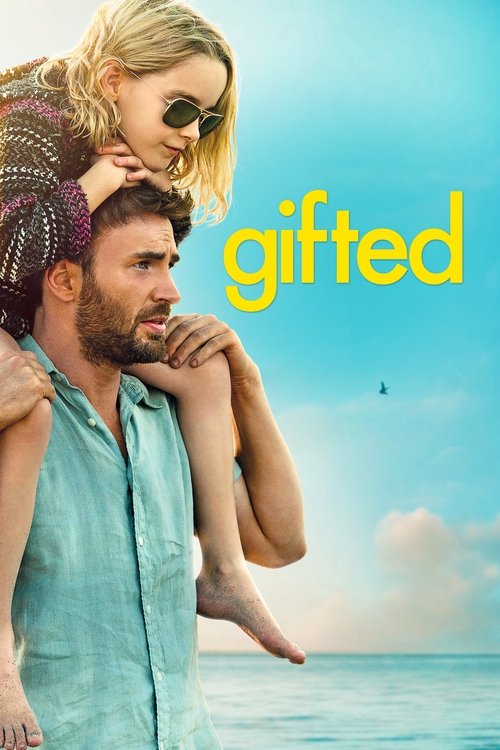
Gifted
A heart-wrenching yet uplifting drama that tenderly explores the delicate balance between nurturing extraordinary talent and cherishing the simple joys of childhood, painted against a sun-drenched Florida backdrop.
Gifted

Gifted

07 April 2017 United Kingdom 101 min ⭐ 8.0 (5,761)
Director: Marc Webb
Cast: Chris Evans, Mckenna Grace, Lindsay Duncan, Jenny Slate, Octavia Spencer
Drama Comedy
Nurturing Talent vs. Normal Childhood The Definition of Family The Burden of Genius Sacrifice and Love
Budget: $7,000,000
Box Office: $40,300,000

Overview

"Gifted" (2017), directed by Marc Webb, tells the story of Frank Adler (Chris Evans), a single man raising his spirited and intellectually gifted seven-year-old niece, Mary (Mckenna Grace), in a small coastal town in Florida. Frank is determined to provide Mary with a normal childhood, a promise he made to his late sister. However, his plans are disrupted when Mary's remarkable mathematical abilities are discovered by her first-grade teacher, Bonnie Stevenson (Jenny Slate), and the school principal.

The situation escalates when Frank's estranged mother, Evelyn (Lindsay Duncan), a formidable and ambitious woman, learns of her granddaughter's prodigious talent. Believing Mary's gift should be cultivated to its fullest potential, Evelyn sues Frank for custody, igniting a poignant legal battle that forces Frank to fight for what he believes is best for Mary's well-being and happiness. The film delves into the complexities of family, sacrifice, and the fundamental question of what it truly means to give a child a good life.


Core Meaning

The core meaning of "Gifted" revolves around the profound question of what constitutes a fulfilling life, particularly for a child with extraordinary abilities. The film posits that emotional well-being, social development, and the freedom to be a child are just as crucial, if not more so, than the cultivation of intellectual talents. Director Marc Webb aims to convey the message that love and a supportive, nurturing environment are paramount. The film challenges the societal pressure to push gifted individuals towards greatness at the expense of their happiness and personal growth, suggesting that a balanced life, filled with love and normal childhood experiences, is the greatest gift of all.

Thematic DNA

Nurturing Talent vs. Normal Childhood 40%
The Definition of Family 30%
The Burden of Genius 20%
Sacrifice and Love 10%

Nurturing Talent vs. Normal Childhood

The central conflict of the film is the clash between Frank's desire for Mary to have a normal childhood and Evelyn's insistence on honing her mathematical genius. Frank, having witnessed the detrimental effects of a high-pressure upbringing on his sister, believes that social skills and emotional development are paramount. Evelyn, on the other hand, sees Mary's gift as a responsibility to the world that must be nurtured at all costs. This theme is explored through the custody battle, where both sides present compelling arguments about what is truly in Mary's best interest.

The Definition of Family

"Gifted" presents a non-traditional family structure with Frank as Mary's sole guardian and their neighbor Roberta as a maternal figure. The film emphasizes that family is defined by love, support, and sacrifice, rather than by blood ties alone. The strong, loving bond between Frank and Mary is contrasted with the strained and dysfunctional relationship between Frank, his sister, and their mother, Evelyn. The custody battle further challenges the conventional notion of family, forcing the court to decide what environment will best serve Mary's overall well-being.

The Burden of Genius

The film explores the challenges and isolation that can accompany exceptional intelligence. Mary's mother, Diane, a brilliant mathematician, ultimately succumbed to the pressures of her gift and her mother's expectations, leading to her suicide. Mary also shows signs of social awkwardness and struggles to connect with her peers due to her advanced intellect. The film raises questions about the responsibility that comes with being gifted and whether it is a blessing or a curse.

Sacrifice and Love

Frank has sacrificed his career as a philosophy professor to raise Mary, choosing a simpler life as a boat mechanic to provide her with a stable and loving home. His love for Mary is the driving force behind all of his decisions, even when it means making difficult choices that could lead to heartbreak. The film illustrates that true love often involves putting the needs of another before one's own, a stark contrast to Evelyn's more self-serving motivations.

Character Analysis

Frank Adler

Chris Evans

Archetype: The Guardian
Key Trait: Selfless

Motivation

Frank's primary motivation is to honor his sister's wish for Mary to have a normal, happy life, free from the crushing expectations that their mother, Evelyn, placed on them. He is driven by a deep sense of love and responsibility for Mary.

Character Arc

Frank begins as a man living a quiet, unassuming life, dedicated to protecting his niece from the pressures that destroyed his sister. The custody battle forces him to confront his past and fight for his beliefs about what is best for Mary. He evolves from a passive protector to an active advocate for Mary's right to a childhood, ultimately finding a way to balance her intellectual needs with her emotional well-being.

Mary Adler

Mckenna Grace

Archetype: The Innocent Prodigy
Key Trait: Brilliant

Motivation

Mary's motivation is to be with her uncle, Frank, who is the only parent she has ever known. She craves his love and approval and wants to understand her place in the world. She is also intrinsically motivated by her love of mathematics.

Character Arc

Mary starts the film as a precocious and somewhat isolated child, aware of her intelligence but struggling to connect with her peers. Through her experiences in school and the emotional turmoil of the custody battle, she learns to navigate the complexities of relationships and begins to understand the value of friendship and a balanced life. She ultimately finds a way to embrace both her gift and her childhood.

Evelyn Adler

Lindsay Duncan

Archetype: The Ambitious Antagonist
Key Trait: Driven

Motivation

Evelyn is motivated by a desire to see her family's intellectual legacy fulfilled. Having been a mathematician herself, she believes that Mary has a duty to use her gift to its fullest extent. Her actions are also driven by a deep-seated, albeit misguided, belief that she knows what is best for Mary.

Character Arc

Evelyn is initially presented as a cold and calculating woman, obsessed with her granddaughter's potential. While she doesn't have a traditional redemptive arc, the revelation of her daughter's completed work and her final wishes forces Evelyn to confront the consequences of her actions. She is left to grapple with the legacy of her ambition and the emotional toll it has taken on her family.

Bonnie Stevenson

Jenny Slate

Archetype: The Ally
Key Trait: Compassionate

Motivation

Bonnie is motivated by a genuine concern for Mary's well-being. As an educator, she wants to see Mary challenged academically, but she also recognizes the importance of her social and emotional development. She is drawn to Frank's dedication to his niece.

Character Arc

Bonnie begins as Mary's concerned teacher, who recognizes her extraordinary abilities. She becomes an ally to Frank and Mary, offering them support and understanding. Her character arc is less about personal transformation and more about her growing involvement in their lives and her developing romantic relationship with Frank.

Roberta Taylor

Octavia Spencer

Archetype: The Nurturer
Key Trait: Loyal

Motivation

Roberta's motivation is her deep love for Frank and Mary. She considers them family and will do whatever it takes to protect them and keep them together. Her motivation is rooted in her strong sense of community and compassion.

Character Arc

Roberta is a consistent source of love and support for Frank and Mary throughout the film. Her character does not undergo a significant arc but serves as a steady, grounding presence in their lives. She is fiercely protective of Mary and acts as a surrogate mother figure.

Symbols & Motifs

Fred the One-Eyed Cat

Meaning:

Fred symbolizes the beauty in imperfection and the importance of unconditional love. Just as Fred is a beloved member of the family despite his physical flaw, Frank loves Mary for who she is, not just for her intellectual gifts. Fred represents the "normal" life that Frank wants for Mary, a life where she is accepted and cherished for her unique self.

Context:

Fred is a constant presence in Frank and Mary's lives. Mary brings him to show-and-tell, a moment that helps her connect with her classmates. When Fred is in danger of being euthanized, Frank's desperate efforts to save him highlight his compassionate nature and his commitment to protecting the vulnerable, which extends to his fierce protection of Mary.

The Navier-Stokes Problem

Meaning:

The unsolved Navier-Stokes problem represents the immense pressure and expectation placed upon gifted individuals. For Mary's mother, Diane, solving it became her life's work, but also a source of immense stress that contributed to her unhappiness. It symbolizes the potential for genius to be both a monumental achievement and a heavy burden.

Context:

Evelyn is obsessed with Diane's work on the problem and pushes for Mary to follow in her mother's footsteps. The eventual revelation of Diane's completed work, with the stipulation that it not be published until after Evelyn's death, serves as a final, poignant message about the human cost of relentless ambition.

The Hospital Maternity Ward

Meaning:

The scene in the maternity ward symbolizes the pure joy and unconditional love that comes with the birth of a child, regardless of their potential or abilities. It serves as a reminder of the fundamental bond between a parent and child, which Frank tries to preserve with Mary.

Context:

After a heated argument, Frank takes Mary to a hospital to watch families celebrate the birth of their babies. He tells her that this is how he and her mother felt when she was born, reinforcing that his love for her is not contingent on her intelligence.

Memorable Quotes

He's a good person. He wanted me before I was smart.

— Mary Adler

Context:

Mary says this to her teacher, Bonnie, expressing the deep bond she shares with her uncle and her understanding of his character.

Meaning:

This quote encapsulates the core theme of the film: the importance of unconditional love. Mary recognizes that Frank's love for her is not dependent on her intellectual abilities, which is a stark contrast to her grandmother's focus on her genius.

Frank says I'm not supposed to correct older people. Nobody likes a smartass.

— Mary Adler

Context:

Mary says this after pointing out a mistake in a complex mathematical equation to a professor, demonstrating both her intelligence and her awareness of social norms as taught by Frank.

Meaning:

This line highlights the humorous and challenging dynamic of raising a gifted child. It shows that Frank is trying to teach Mary social graces and humility, even as her intellect surpasses those around her.

My sister wanted Mary to be a kid. She wanted her to have friends and to be happy.

— Frank Adler

Context:

Frank says this during the custody hearing, explaining to the court why he has chosen to raise Mary in a normal school environment.

Meaning:

This quote clearly states Frank's motivation and the promise he made to his sister. It is the foundation of his argument in the custody battle and the guiding principle for how he raises Mary.

You're going to take that girl, you're going to loan her out to some think tank where she can talk nontrivial zeros with a bunch of old Russian guys for the rest of her life.

— Frank Adler

Context:

Frank confronts Evelyn with this accusation, highlighting the fundamental difference in their philosophies on how Mary should be raised.

Meaning:

This quote is a powerful indictment of Evelyn's plans for Mary. Frank paints a vivid and bleak picture of the isolated and passionless life he fears Mary will lead if her grandmother gains custody.

Philosophical Questions

What is the true meaning of a 'good life'?

The film explores this question through the conflicting ideologies of Frank and Evelyn. Frank believes a good life is one filled with love, friendship, and normal experiences, while Evelyn equates it with intellectual achievement and a lasting legacy. The film encourages the audience to consider what values are most important in life and whether a life of extraordinary accomplishment is inherently better than a life of ordinary happiness.

Do gifted individuals have a responsibility to use their talents for the betterment of society?

Evelyn argues that Mary's gift comes with an obligation to solve the world's most complex problems. Frank, however, prioritizes Mary's individual happiness and well-being. The film delves into the ethical dilemma of whether a person's potential should be harnessed for the greater good, even at the cost of their personal freedom and happiness.

What is more important in a child's development: intellectual stimulation or emotional support?

"Gifted" presents a case study on this enduring debate. While Mary's intellectual needs are undeniable, the film ultimately sides with the importance of a loving and emotionally stable environment. It suggests that without a strong emotional foundation, intellectual prowess can become a burden rather than a gift, as evidenced by the tragic story of Mary's mother.

Alternative Interpretations

While the film largely presents Frank as the hero and Evelyn as the villain, some interpretations suggest a more nuanced view of Evelyn's character. One could argue that she genuinely believes she is acting in Mary's best interest and that her methods, while harsh, are born from a desire to see her granddaughter reach her full potential and avoid the perceived mediocrity that she believes Frank has chosen. From this perspective, the film is not just about a simple right versus wrong, but a clash of two valid, albeit conflicting, philosophies on life and achievement. Some viewers have also questioned the film's ending, suggesting that it presents a somewhat idealized solution to a very complex problem, and that in reality, finding a balance between a normal childhood and the needs of a prodigious intellect would be far more challenging.

Cultural Impact

"Gifted" was well-received by critics and audiences for its heartfelt story and strong performances, particularly from Chris Evans and Mckenna Grace. While not a blockbuster, it resonated with many for its exploration of complex family dynamics and the ethical questions surrounding the upbringing of gifted children. The film sparked conversations about the definition of a good life and the potential downsides of pushing children to achieve academic excellence at all costs. It has been praised by educators and parents of gifted children for its nuanced portrayal of the challenges they face. The movie also showcased a different, more dramatic side of Chris Evans, who was widely known for his role as Captain America in the Marvel Cinematic Universe.

Audience Reception

Audiences generally responded very positively to "Gifted," praising its emotional depth, heartwarming story, and the strong chemistry between Chris Evans and Mckenna Grace. Many viewers found the film to be a touching and thought-provoking exploration of family and the challenges of raising a gifted child. The performances of the supporting cast, including Octavia Spencer and Lindsay Duncan, were also widely commended. Points of criticism were often directed at the film's perceived predictability and occasional sentimentality. Some viewers also found the legal aspects of the custody battle to be somewhat unrealistic. Despite these criticisms, the overall consensus from audiences was that "Gifted" is a compelling and emotionally resonant drama.

Interesting Facts

  • The screenplay for "Gifted", written by Tom Flynn, was featured on the 2014 Black List, an annual survey of the most-liked unproduced screenplays.
  • To help her remember the complex mathematical equations her character solves, Mckenna Grace and her mother created songs.
  • Chris Evans adopted a dog named Dodger from the animal shelter where they filmed a scene for the movie.
  • Mckenna Grace's stuffed seal, which has been in her family for over three decades, makes an appearance in the film.
  • The cast and crew had a swear jar on set, with Chris Evans reportedly owing a significant amount by the end of filming.
  • The filming took place in Savannah and Tybee Island, Georgia.

⚠️ Spoiler Analysis

Click to reveal detailed analysis with spoilers

Frequently Asked Questions

Explore More About This Movie

Dive deeper into specific aspects of the movie with our detailed analysis pages

Comments (0)

Leave a comment

No comments yet. Be the first to share your thoughts!