Hilda
"There’s a great big world out there."
Overview
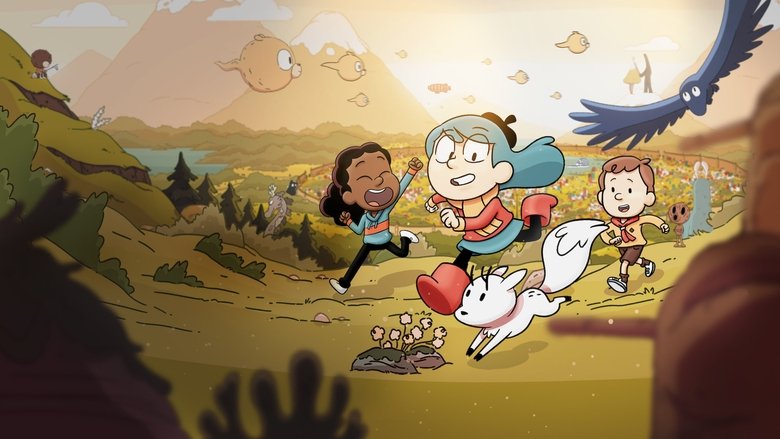
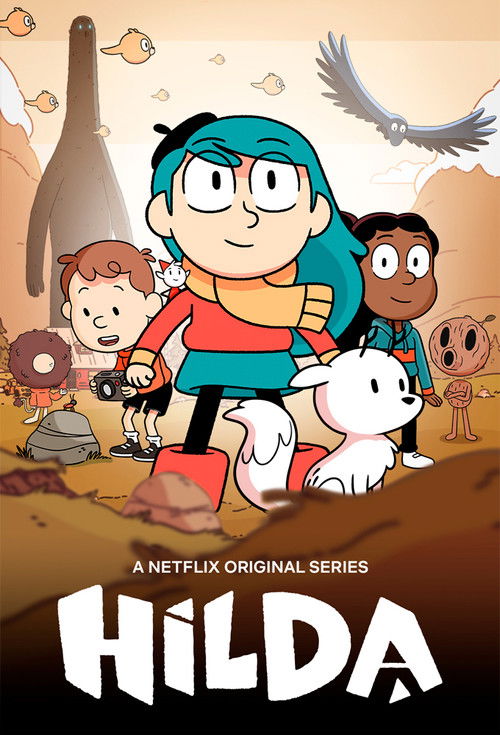
Hilda is a serialized animated adventure that follows the titular blue-haired girl who grows up in an enchanted forest but is forced to move to the walled city of Trolberg. The first season focuses on her reluctant adaptation to urban life, where she discovers that the city is just as filled with magical creatures—including elves, spirits, and trolls—as the wilderness she left behind. Along with her deerfox Twig and new friends Frida and David, Hilda becomes a Sparrow Scout and a bridge between the human world and the magical entities that surround it.
As the series progresses into its second season and the feature film Hilda and the Mountain King, the stakes rise significantly. The narrative explores the deep-seated fear humans have of trolls, culminating in a conflict that challenges the very walls of Trolberg. Hilda's journey forces her to confront her own identity and the prejudices of her society, transforming from a simple adventurer into a mediator who fights for coexistence. The story expands the lore to include witches, time travel, and the secret history of the city.
The third and final season brings the saga to a poignant close by exploring Hilda's personal history. It introduces her estranged father, Anders, and delves into the mysterious origins of her family. The series concludes with a mature look at growing up, the inevitability of change, and the realization that while the wilderness is a part of her, home is defined by the people she loves. The entire arc is a masterclass in world-building, transitioning from episodic creature-of-the-week stories to a deeply emotional serialized family drama.
Core Meaning
At its heart, Hilda is a profound meditation on empathy over fear. The series systematically deconstructs the idea of 'monsters' by showing that conflict often stems from misunderstanding rather than malice. It posits that the unknown—whether it be a giant troll or a new city—is not something to be conquered or fenced out, but something to be understood and respected. Ultimately, it suggests that true bravery isn't about fighting beasts, but about being willing to listen to them when no one else will.
Thematic DNA
Fear vs. Understanding
This is the show's central pillar. The walls of Trolberg represent humanity's fear of the wild, but Hilda constantly crosses these barriers. From the Trolls in Season 1 to the events of the movie, the series shows that what humans perceive as dangerous attacks are often defensive reactions or misunderstandings. Hilda's role is always to find the humanity in the monster, teaching the audience that fear is a barrier to connection.
Growth and Acceptance of Change
The series begins with a traumatic change—moving from the wilderness to the city. Throughout the seasons, Hilda learns to find magic in the mundane and accepts that life cannot stay static. This theme matures in Season 3, where the characters must accept the end of childhood and the shifting dynamics of their families, realizing that 'moving on' doesn't mean forgetting the past.
The Mother-Daughter Bond
The relationship between Hilda and her mother, Johanna, is the emotional anchor of the series. Unlike many cartoons where parents are oblivious, Johanna is deeply involved, protective, and sometimes flawed. The series realistically depicts the strain of raising a reckless adventurer, evolving from simple protectiveness in Season 1 to a relationship of mutual trust and shared history by the finale.
Nature vs. Civilization
The show creates a dialogue between the chaotic, magical wilderness and the ordered, bureaucratic city. Instead of villainizing the city, the series eventually suggests a harmony where nature and civilization can coexist, provided there is respect. This is personified in characters like Alfur (an elf obsessed with paperwork) and the integration of creatures into Trolberg life.
Character Analysis
Hilda
Bella Ramsey
Motivation
To explore the unknown and advocate for creatures that others fear. Later, to uncover the truth about her family.
Character Arc
Starting as a wild child resisting the city, Hilda evolves into a street-smart protector of Trolberg. Her journey forces her to temper her recklessness with responsibility. By Season 3, she confronts her own origins and learns that adventure isn't just about danger, but about understanding her family and her place in the world.
Johanna (Mum)
Daisy Haggard
Motivation
To provide a safe, stable home for Hilda while supporting her daughter's unique spirit.
Character Arc
Johanna transitions from an anxious mother trying to keep her daughter safe in a new city to a brave adventurer in her own right. Season 3 reveals her own history with the wilderness, showing that her protectiveness stems from past trauma, and she ultimately learns to trust Hilda's instincts while rediscovering her own spark.
David
Oliver Nelson
Motivation
To be a loyal friend and overcome his anxieties.
Character Arc
Initially defined by his phobias and bugs sticking to him, David has the most traditional growth arc. He doesn't lose his fear but learns to act in spite of it. By the end of the series, he is often the voice of reason and displays immense courage, proving that true bravery requires the presence of fear.
Frida
Ameerah Falzon-Ojo
Motivation
To achieve excellence and master the magical arts.
Character Arc
Frida starts as an overachieving Sparrow Scout who falls apart when she isn't perfect. Her arc involves learning to accept failure and pivoting her organizational skills into magic. She becomes a powerful witch, learning that intuition and messiness are sometimes as important as rules and badges.
Anders
John Simm
Motivation
To seek excitement and avoid being tied down.
Character Arc
Introduced in Season 3, Anders is the source of Hilda's adventurous spirit but lacks her responsibility. His arc serves as a foil to Johanna; he represents the pure, untethered freedom of adventure that Hilda idolizes, but the narrative reveals the selfishness inherent in that lifestyle, helping Hilda value her mother's stability.
Symbols & Motifs
Hilda's Blue Hair
It symbolizes her wild, magical origin and her inability to fully blend into the mundane human world. It marks her as a bridge between the two realms.
It stands out visually against the autumnal, muted palette of Trolberg, constantly reminding the viewer of her connection to the wilderness even when she is in a classroom or her apartment.
The Walls of Trolberg
They represent fear, segregation, and the false sense of security that comes from shutting out the unknown.
The walls are a constant visual presence, looming over the city. The climax of the series (in the movie and Season 3) often revolves around breaching, crossing, or questioning the necessity of these walls.
Sketchbook
Observation, curiosity, and the artist's desire to understand rather than destroy.
Hilda uses her sketchbook to document creatures rather than fight them. It is a tool of empathy; by drawing them, she sees them. This trait is revealed to be inherited from her mother, linking their shared perspective on the world.
Bells
A symbol of human aggression and the creatures' pain. They represent the harmful ways humans try to control nature.
In the pilot and throughout the troll storylines, bells are used to ward off trolls. Hilda eventually learns they cause the trolls physical pain, and her rejection of bells symbolizes her rejection of humanity's cruel methods.
Memorable Quotes
Well, that was quite traumatic. But such is the life of an adventurer.
— Hilda
Context:
Spoken in the first season after a particularly dangerous encounter, establishing her character's baseline attitude toward peril.
Meaning:
This quote perfectly encapsulates Hilda's resilience and her worldview that danger is just a natural part of living a full life.
I've forgotten grammar! And I love grammar! I don't even remember who I is!
— The Great Raven
Context:
In The Bird Parade, when the Great Raven loses his memory and dignity, highlighting the show's blend of whimsy and tragedy.
Meaning:
A humorous look at the loss of identity and the absurdity of the magical creatures' problems.
Fear is a healthy response to danger.
— David
Context:
Often said by David when Hilda is about to do something incredibly reckless.
Meaning:
This validates David's role in the group. It counters the 'fearless hero' trope by acknowledging that caution is a survival instinct, not a weakness.
Episode Highlights
The Deerfox
Often cited as the series' masterpiece, this episode explores the origin of Twig and his potential departure. It is a heart-wrenching story about letting go of those you love so they can be their true selves.
It deepens the bond between Hilda and Twig and serves as a major emotional maturation point for Hilda, dealing with themes of loss and sacrifice.
The Fifty Year Night
An intricate time-travel episode involving alternate timelines, a grumpy older Hilda, and a terrifying time worm. It is darker and more complex than usual.
It showcases the show's ability to handle complex sci-fi concepts and explores the consequences of trying to change the past.
The Stone Forest
Hilda and her mother are trapped in a troll-infested forest. The tension is high, and the climax changes the status quo of the entire series.
The cliffhanger ending (Hilda turning into a troll) fundamentally shifts the narrative, leading directly into the movie and the theme of human-troll empathy.
The Fairy Isle
The series finale where Hilda travels to a mystical island to rescue her father and discovers the truth about her family lineage.
It wraps up the entire show, resolving the mystery of Hilda's parents and providing a thematic conclusion about the balance between the magical and human worlds.
Philosophical Questions
Does civilization require the exclusion of the wild?
The series constantly asks if safety (Trolberg's walls) is worth the cost of isolation. It challenges the binary of 'civilized vs. savage' by showing that the 'monsters' have their own societies, rules, and cultures, suggesting that true civilization is inclusive rather than exclusive.
What is the nature of fear?
Through David and the citizens of Trolberg, the show explores fear as both a survival mechanism and a blinding force. It argues that while fear is natural, letting it dictate policy (like building walls or ringing bells) leads to cruelty and ignorance.
Alternative Interpretations
The Immigrant/Refugee Metaphor: Critics have noted that the Trolls, who are kept out by a massive wall and feared by the city's inhabitants, serve as a potent allegory for refugees or marginalized groups. Hilda's efforts to bridge this divide can be read as a pro-integration narrative.
Neurodivergence: Many viewers interpret Hilda's character—her specific interests, intense sense of justice, and difficulty with social norms in the city—as coded neurodivergent. Her blue hair symbolizes her difference, and the show is seen as a celebration of finding one's place when one's brain works differently from the 'civilized' norm.
Cultural Impact
Hilda arrived during a renaissance of 'kind' animation, sitting alongside shows like Steven Universe and Bluey that prioritize emotional intelligence over violence. It has been critically acclaimed for its portrayal of a single-parent household where the struggle is about time and safety rather than lack of love. The series is culturally significant for popularizing 'Scandi-folk' aesthetics in Western children's media, introducing a generation to nisse, trolls, and draugen. Critics have lauded it as a 'comfort show' that respects children's intelligence, refusing to sanitize the scary parts of folklore while maintaining a safe, cozy atmosphere. Its legacy is that of a modern classic that successfully translated the quiet, introspective pacing of a graphic novel into animation.
Audience Reception
Universal Acclaim: Hilda holds a rare 100% rating on Rotten Tomatoes for its first two seasons. Audiences and critics alike praised its soothing visual style, often describing it as 'hygge' (cozy) TV.
Evolution of Opinion: Season 1 was praised for its episodic charm. Season 2 received even higher marks for its serialized storytelling and darker stakes. The movie was seen as a cinematic peak. Season 3 was generally well-received, though some fans felt the introduction of Hilda's father and the rapid wrapping up of lore was slightly rushed compared to the leisurely pace of earlier seasons. However, the emotional payoff of the finale was widely considered satisfying and tear-jerking.
Interesting Facts
- Hilda's creator, Luke Pearson, worked as a storyboard artist on 'Adventure Time', which influenced Hilda's distinct visual style and humor.
- Bella Ramsey (voice of Hilda) reportedly cried while recording the emotional dialogue for the episode 'The Deerfox' due to its sadness.
- The series won a BAFTA for Children's Animation and multiple Annie Awards, praised specifically for its character design and writing.
- In Season 3, Hilda is canonically 13 years old, showing a clear passage of time and physical growth (like slightly longer limbs) compared to Season 1.
- The show's distinctive color palette uses a specific limited range of autumnal colors—muted oranges, browns, teals, and blues—avoiding pure black to maintain its soft, graphic novel aesthetic.
Easter Eggs
Adventure Time Comic
In one episode, a comic book with a cover resembling Adventure Time can be seen, a nod to Luke Pearson's previous work on that show.
Twig in Life is Strange
In the official Life is Strange comic series, a drawing of Twig appears, acknowledging the shared fanbase of emotional, indie-style storytelling.
John Simm as Anders
Hilda's father Anders is voiced by John Simm, who is famous for playing The Master in Doctor Who. This is a meta-nod to his character being a charismatic but chaotic figure who disappears and reappears.
⚠️ Spoiler Analysis
Click to reveal detailed analysis with spoilers
Frequently Asked Questions
Explore More About This Movie
Dive deeper into specific aspects of the movie with our detailed analysis pages
Comments (0)
No comments yet. Be the first to share your thoughts!