Skip to content
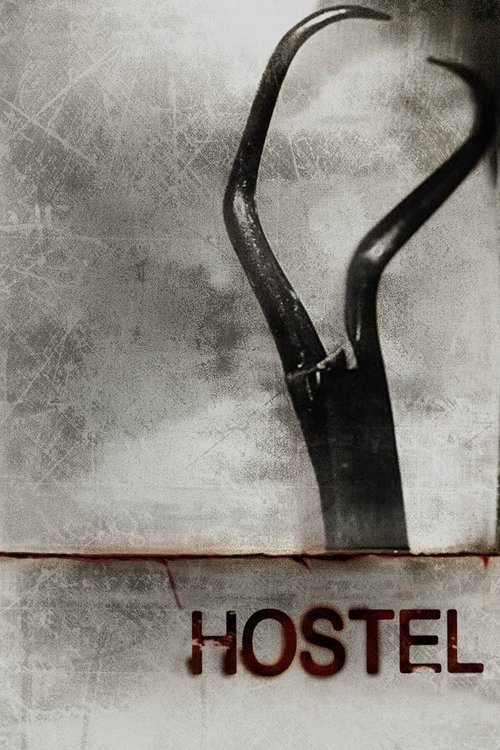
Hostel

A sun-bleached backpacker holiday curdles into a nightmare of commerce and flesh. Dread seeps through cheap hostel walls like damp, and every smile hides a price tag.

Hostel

Hostel

"Welcome to your worst nightmare."

06 January 2006 United States of America 94 min 6.0 (4,126)

Director: Eli Roth

Cast: Jay Hernandez, Derek Richardson, Eythor Gudjonsson, Barbara Nedeljakova, Jana Kaderabkova

Horror Commodification of human life American arrogance and naivety abroad Desire and its punishment Fear of the foreign Revenge and moral descent
Budget: $4,800,000
Box Office: $81,979,826

Overview

Two American college friends, Paxton and Josh, are backpacking across Europe with an Icelandic traveler, Oli. After drugs and sex in Amsterdam, they hear of a hostel in Slovakia where the women are said to be beautiful and eager. They follow the rumor to a remote town.

At first the hostel delivers. The three men share a room with two sexually forward women, Natalya and Svetlana. Then Oli vanishes without explanation, and Paxton and Josh feel increasingly trapped in an unfamiliar, hostile landscape. Their travelers' bravado starts to give way to unease.

Written and directed by Eli Roth and presented by Quentin Tarantino, the film moves in two halves. It begins as a raunchy European sex comedy in the vein of Eurotrip. It then turns into a tense splatter horror about a black market where people pay to torture and kill.

Core Meaning

The film is a satire of privilege and consumption. Young Americans travel the world expecting everything, including bodies, to be available to them. The film then flips the arrangement: they become the product, and wealthy clients buy them. Roth turns tourism and commerce into a literal market in human lives.

It also plays on fears of the foreign "other", and critics have noted that it doubles as a comment on American arrogance abroad. The film's own black humor and splatter make it equally an exploitation spectacle, so its message sits uneasily beside its pleasures.

Thematic DNA

Commodification of human life 30%
American arrogance and naivety abroad 25%
Desire and its punishment 20%
Fear of the foreign 15%
Revenge and moral descent 10%

Commodification of human life

The Elite Hunting Club sells victims by price tier, and Natalya brags about the money she gets for each one. Violence becomes a luxury service for the rich.

American arrogance and naivety abroad

Paxton, Josh and Oli treat Europe as a playground for drugs and sex. They ignore warnings and are punished for their entitlement.

Desire and its punishment

The sexual lure of the hostel leads directly to captivity. The film joins erotic and violent appetite together.

Fear of the foreign

Eastern Europe is shown as lawless, with corrupt police and menacing children. Slovakia was reportedly unhappy with this depiction.

Revenge and moral descent

The survivor escapes and then kills in return. The film asks whether the audience's satisfaction in that violence is itself a kind of complicity.

Character Analysis

Paxton

Jay Hernandez

Archetype: Reluctant hero / final survivor Key Trait: Resourceful everyman

Motivation

Pleasure at first, then survival and escape.

Character Arc

He starts as a wisecracking, hedonistic tourist and ends as a hardened survivor who takes violent revenge.

Josh

Derek Richardson

Archetype: The cautious friend / early victim Key Trait: Anxious, sensitive

Motivation

To find a more meaningful trip and to be safe.

Character Arc

He is the more reserved, museum-minded traveler. He is captured and killed in the torture chamber while begging to pay his way out.

All 4 characters and cast

Symbols & Motifs

The hostel

Meaning:

A trap dressed as hospitality and sexual promise.

Context:

It is advertised as a paradise of willing women and serves as the lure that feeds victims to the torture club.

Money

Meaning:

The currency that makes bodies disposable and turns the buyers into the villains.

Context:

The warning from the man leaving the club is that you could spend all your money in there. Josh begs to pay, and the Dutch Businessman answers that he is the one paying.

The surgeon's tools and masks

Meaning:

Clinical detachment applied to cruelty. It is the fantasy of power over life.

Context:

The Dutch Businessman describes wanting to be a surgeon, and the clients work in masks and surgical gear. A critic compared one such moment to Blue Velvet.

The train station

Meaning:

Escape and transit, where the fantasy of leaving is tested.

Context:

Paxton escapes to the station and takes revenge on the Dutch Businessman in a bathroom stall.

The gift-wrapped meal and the meat-eater speech

Meaning:

Consumption as a natural appetite, used to rationalize predation.

Context:

On the train, the Dutch Businessman talks about meat-eating and human nature, which foreshadows his later role.

Memorable Quotes

Be careful. You could, spend ALL your money... in there.
— Takashi Miike's character (the client leaving)

Context

Paxton asks a man leaving the club what it is like inside.

Meaning

A chilling warning that reduces torture to a purchase.

Did we come all the way to Europe to smoke pot?
— Josh

Context

He says it in Amsterdam. Oli replies that he came all the way from Iceland.

Meaning

It sets up Josh as the more culturally curious friend and mocks tourist habits.

All 6 quotes

Philosophical Questions

Can anything be bought if the price is high enough?

The Elite Hunting Club prices people by nationality, and the businessmen treat cruelty as a luxury service.

Is revenge justified, and does it corrupt the avenger?

Paxton's killing of the Dutch Businessman is framed as triumph, but it follows the club's logic of violence.

Are viewers complicit in watching suffering as entertainment?

The film lets the audience enjoy the gore, much like the clients, which invites self-examination.

How It Ends

Alternative Interpretations

One reading is that the film is political satire, in which Americans abroad become victims of the global market they exploit. Another is that it is simply an exploitation film, in which satire is a thin excuse for gore. Some read the final revenge as audience-pleasing catharsis, while others see it as an ironic mirror of the club's own cruelty. Reviewers such as Eye For Film also felt the black humor and crowd-pleasing ending undercut any seriousness.

Full ending explanation

Cultural Impact

Hostel is widely associated with the mid-2000s "torture porn" cycle, alongside Saw. It helped revitalize that genre and was a big commercial success on a small budget. Critics were divided: GameSpot summarized it as not exactly met with rave reviews, though praised for its mix of satire, survival horror and splatter. Its imagery, such as "the eye scene" and "the ankle bit", became shorthand among horror fans. It spawned the sequel Hostel: Part II (2007) and a direct-to-video third film made without Roth. Roth's own influences included Japanese extreme cinema, especially Takashi Miike. The portrayal of Slovakia caused controversy in the country.

Audience Reception

Reception was mixed. Screen Daily called it a thriller that would both repulse and excite, and said it delivered the goods for a horror feature. It praised Hernandez as an inspired lead. Eye For Film criticized the script as trite and the humor as undermining the horror. Common praise goes to the slow-building dread and the tonal shift. Common criticism targets the gore, misogyny, and xenophobic depiction of Eastern Europe. Overall it is seen as a divisive but influential horror hit.

Interesting Facts

  • The premise came from a website, based in Thailand, that claimed customers could pay $10,000 to commit murder; Ain't It Cool News founder Harry Knowles told Roth about it.
  • Quentin Tarantino encouraged Roth to make the idea as a low-budget film.
  • The film had a budget of $4.8 million and grossed roughly $80-82 million worldwide.
  • Roth cast Jay Hernandez because of his natural, everyman quality, and wanted actors who felt like guys he grew up with.
  • When Paxton begs in German before being tortured, Roth chose not to subtitle it; the lines translate roughly as that killing him would destroy the torturer's life.
  • In the original ending Paxton would kidnap the Dutch Businessman's young daughter rather than kill him; test audiences found it too bleak, so the theatrical ending was added in reshoots.
  • Barbara Nedeljakova reportedly did not enjoy appearing nude in the film.
  • Roth once considered making the film as a faux documentary using real locations.
  • Although often dated 2005, the film premiered at TIFF on September 17, 2005 and was released in the US on January 6, 2006.

Easter Eggs

Takashi Miike cameo

The director of Audition, a primary influence on Roth, appears as the client who warns Paxton about spending all his money.

Quentin Tarantino cameo

Tarantino appears as a shirtless German man yelling out of a window, at around nine minutes in.

Eli Roth cameo

Roth appears as a stoned American tourist in a Boston Red Sox jersey in the Amsterdam coffee shop.

<i>Pulp Fiction</i> on the hostel TV

People in a hostel are watching Tarantino's film, a nod to the film's presenter.

Echoes of <i>Blue Velvet</i> and <i>Psycho</i>

One reviewer noted a mask-breathing moment recalling Blue Velvet and music in the style of Bernard Herrmann's Psycho score.

Frequently Asked Questions

Explore More About This Movie

Dive deeper into specific aspects of the movie with our detailed analysis pages

Comments (0)

Leave a comment

No comments yet. Be the first to share your thoughts!

Similar Movies