Skip to content
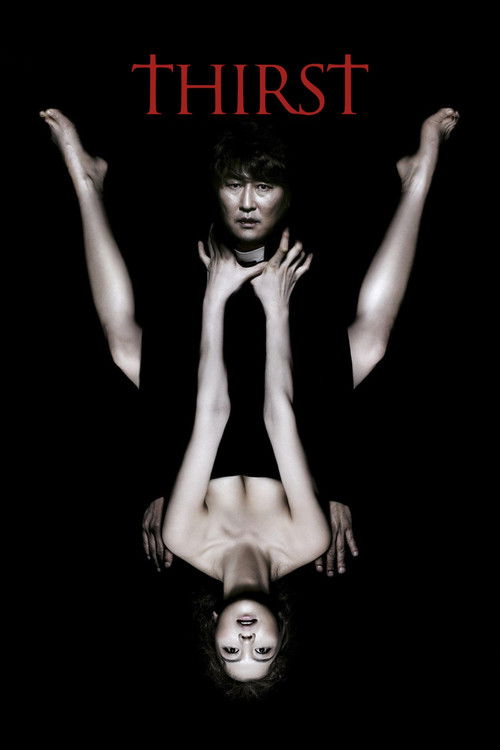
Thirst
A sensual, macabre theological horror soaked in guilt and carnal yearning, where a devout priest's desperate pursuit of sanctification crumbles into a fever dream of blood.
Thirst

Thirst

박쥐

"Lusting after sinful pleasures."

30 April 2009 South Korea 134 min 7.1 (1,118)

Director: Park Chan-wook

Cast: Song Kang-ho, Kim Ok-vin, Kim Hae-sook, Shin Ha-kyun, Park In-hwan

Drama Thriller Horror The Conflict Between Faith, Sin, and Carnal Desire Guilt, Conscience, and Psychological Torment Repression vs. Violent Liberation Humanism, Sanctity of Life, and the Limits of Morality
Budget: $5,000,000
Box Office: $13,085,023

Overview

Thirst (Bakjwi) is a 2009 supernatural psychological horror-drama directed, co-written, and co-produced by Park Chan-wook. Loosely adapting Émile Zola's classic 1867 naturalist novel Thérèse Raquin through the lens of modern vampire lore, the film follows Father Sang-hyun (Song Kang-ho), a dedicated and compassionate Catholic hospital priest experiencing a profound crisis of spiritual purpose. Seeking to perform a selfless act of sacrifice for humanity, Sang-hyun volunteers as a human test subject in Africa for a trial vaccine against the lethal and gruesome Emmanuel Virus (EV).

Although the infection proves fatal to all other subjects, Sang-hyun miraculously revives after receiving an emergency blood transfusion from an anonymous source. He returns to South Korea venerated as a miraculous healer, sought out by desperate believers seeking blessings and cures. However, his miraculous recovery conceals a dark condition: his disease is held in remission only by consuming fresh human blood, and he develops heightened sensory perception, superhuman strength, and a fatal sensitivity to direct sunlight.

Struggling desperately to maintain his core Christian ethics while quenching his physiological vampiric hunger by secretly draining blood bags and comatose hospital patients, Sang-hyun's fragile morality is shattered when he reconnects with Kang-woo (Shin Ha-kyun), a frail childhood acquaintance. Visiting Kang-woo's home, Sang-hyun becomes infatuated with Kang-woo's mistreated and suffocated wife, Tae-ju (Kim Ok-vin). As their forbidden affair intensifies, Sang-hyun is dragged into a vortex of lust, moral compromise, and escalating domestic violence.


Core Meaning

At its core, Thirst explores the friction between spiritual transcendence, human morality, and primal, animalistic biology (la bête humaine). Park Chan-wook subverts traditional Western vampire tropes by framing vampirism not as a romantic aristocratic curse, but as an uncontrollable biological affliction that exposes the frailty of human ethics.

The film's central message argues that human virtue is frequently fragile when tested against absolute physical need and unbridled desire. By contrasting Sang-hyun's Catholic devotion and guilt with Tae-ju's unfettered, liberating embrace of predatory nihilism, Park demonstrates how sin and redemption are inextricably linked: the harder one attempts to repress human instinct through dogma, the more explosive and destructive its eventual liberation becomes.

Thematic DNA

The Conflict Between Faith, Sin, and Carnal Desire 30%
Guilt, Conscience, and Psychological Torment 25%
Repression vs. Violent Liberation 25%
Humanism, Sanctity of Life, and the Limits of Morality 20%

The Conflict Between Faith, Sin, and Carnal Desire

Sang-hyun embodies the theological crisis of a righteous man forced to sin to survive. The holy sacrament of the Eucharist (drinking the blood of Christ) is corrupted into an actual, desperate need to drink the blood of fellow human beings.

Guilt, Conscience, and Psychological Torment

Rooted directly in Zola's Thérèse Raquin, the psychological aftermath of transgression manifests as inescapable guilt, mutual paranoia, and hallucinations that poison romantic passion.

Repression vs. Violent Liberation

Tae-ju represents the domestic confinement of a woman trapped in an abusive, stifling household. Her transformation into a vampire strips away societal and moral conditioning, unleashing an unchecked predatory thirst for retribution and hedonistic freedom.

Humanism, Sanctity of Life, and the Limits of Morality

Sang-hyun tries to construct an ethical code of non-lethal parasitism (feeding only from hospital surplus or the comatose), illustrating humanism's struggle against natural predatory instincts.

Character Analysis

Father Sang-hyun

Song Kang-ho

Archetype: Tragic Antihero / Fallen Saint Key Trait: Crippling Catholic guilt paired with genuine human empathy.

Motivation

Seeking spiritual purpose, maintaining moral conscience while quelling unholy physical hunger.

Character Arc

Begins as a saintly priest seeking martyrdom; descends into carnal addiction and complicity in murder, before accepting responsibility and orchestrating his own sacrificial redemption.

Tae-ju

Kim Ok-vin

Archetype: Femme Fatale / Unbound Id Key Trait: Volatile passion and unapologetic ruthlessness.

Motivation

Escape from domestic oppression and the pursuit of unfettered agency and pleasure.

Character Arc

Evolves from a passive, mistreated domestic drudge into a ruthless, bloodthirsty vampire reveling in power and predatory freedom.

All 5 characters and cast

Symbols & Motifs

The Flute / Recorder

Meaning:

Serves as an emotional compass and a symbol of pastoral simplicity, innocence, and ascetic life.

Context:

Carried and played by Sang-hyun throughout the film before it is subverted by carnal noise and bloodshed.

Mahjong Tiles & Footwear

Meaning:

Mahjong tiles symbolize domestic entrapment, rigid routine, and oppressive social surveillance. Tae-ju's bare feet represent vulnerability and yearning for escape, while Sang-hyun placing shoes on her feet represents protective devotion and complicity.

Context:

Featured during the weekly mahjong games in Madame Ra's house and when Tae-ju runs through midnight streets.

The Emmanuel Virus (EV) / Leprous Pustules

Meaning:

Serves as an outward physical manifestation of spiritual degradation and bodily corruption.

Context:

The weeping sores that erupt across the skin whenever fresh human blood is not regularly consumed.

Sunlight and the Burnt Car

Meaning:

Acts as the ultimate agent of divine judgment, purification, and physical obliteration.

Context:

Culminates in the climactic, sun-drenched coastal finale on a barren plateau.

Blood Bags and Medical IV Tubes

Meaning:

Deconstructs Gothic vampire mythology with sterile, clinical modernity, symbolizing an attempt to manage murder as a medical necessity.

Context:

Used by Sang-hyun in the hospital setting to feed non-lethally from comatose patients and medical surplus.

Memorable Quotes

우리 주 예수 그리스도의 이름으로 저에게 다음과 같은 것을 허락하소서...
— Father Sang-hyun

Context

Sang-hyun's opening prayer before the vaccine trial in Africa.

Meaning

Establishes Sang-hyun's drive toward martyrdom, irony, and the self-abnegating guilt that will haunt him once he becomes a vampire.

난 부끄러운 짓 안 해요. 남편을 죽였어도 당당해요.
— Tae-ju

Context

Spoken during her moral confrontation with Sang-hyun after the murder of Kang-woo.

Meaning

Encapsulates the ideological chasm between them: where Sang-hyun is bound by Christian guilt, Tae-ju rejects moral self-flagellation.

All 3 quotes

Philosophical Questions

Can morality survive when physical survival requires predation?

Explored through Sang-hyun's struggle to balance the absolute commandment not to kill with his inescapable physiological necessity to feed.

Is sin defined by action or intention?

Explored through Sang-hyun's compromises (such as drinking from comatose patients to avoid harm) contrasted with Tae-ju's gleeful active predation.

Does liberation without restraint inevitably devolve into tyranny?

Demonstrated through Tae-ju's sudden empowerment, which quickly leads not to true freedom, but to wanton slaughter and destruction.

Can atonement be achieved through self-annihilation?

Examined as Sang-hyun orchestrates their joint destruction in the morning sun as an act of ultimate moral responsibility.

Alternative Interpretations

Psychological Guilt vs. Supernatural Haunting: When Kang-woo's waterlogged corpse appears between Sang-hyun and Tae-ju in bed, it can be interpreted either as an actual supernatural haunting or as a shared psychosexual hallucination born of acute moral guilt.

Full ending explanation

Cultural Impact

Released during the late 2000s—when Western media was saturated with romanticized, adolescent vampire stories such as Twilight and True BloodThirst stood as an uncompromising, visceral counterweight. It addressed deep-rooted South Korean cultural tensions between burgeoning Christian evangelicalism/Catholicism and modern secular individual desires.

The film solidified Park Chan-wook's international auteur standing post-Vengeance Trilogy, showcasing the visual expressiveness and tonal agility characteristic of the New Korean Cinema movement. Its complex gender dynamics laid thematic groundwork for Park's later masterpiece, The Handmaiden (2016).

Audience Reception

Critics and audiences widely lauded the fearless, multi-layered performances of Song Kang-ho and Kim Ok-vin, Chung Chung-hoon's cinematography, the pitch-black comedic tone, and Park's bold reinvention of vampire mythology.

However, some critics found the sudden narrative shifts between bedroom farce, intense melodrama, and graphic slasher horror jarring. The disturbing church tent scene caused widespread debate among audiences regarding its tone and extremity.

Overall, Thirst is regarded as a singular entry in modern horror cinema, blending classic European naturalist literature with provocative Korean auteur filmmaking.

Interesting Facts

  • Park Chan-wook conceived the premise during the production of Joint Security Area (2000) and offered the lead role to Song Kang-ho nearly ten years before filming began in August 2008.
  • The film competed for the Palme d'Or at the 2009 Cannes Film Festival and won the prestigious Jury Prize (shared with Andrea Arnold's Fish Tank).
  • Thirst made history as the first mainstream South Korean production to receive co-financing and international distribution directly from an American major studio via Universal Pictures and Focus Features.
  • The film marked one of the first times an A-list, mainstream South Korean leading actor performed full-frontal male nudity in a major commercial production, executed during the church tent sequence to intentionally shatter his flock's religious worship.
  • Park Chan-wook famously noted in production interviews that he personally cannot watch traditional horror movies because he scares easily, leading him to structure Thirst as an existential romance-drama rather than a jump-scare creature feature.

Easter Eggs

Émile Zola's Naturalism

The plot structure closely mirrors Zola's Thérèse Raquin—including the suffocating haberdashery setting, the sickly husband Laurent/Kang-woo, the lake drowning, the paralyzed mother-in-law, and the paralyzing guilt.

Self-Referential Vampire Roots in Cut

In Park's 2004 short film Cut (from the omnibus horror Three... Extremes), a film director character is shown shooting an elaborate vampire movie—a direct nod to the concept Park was developing for Thirst.

Catholic Sacraments Inversion

The entire film systemically parodies Catholic liturgy: the Eucharist is literalized through blood consumption, Confession becomes an exchange of murder plots, and Baptism is mirrored in Kang-woo's drowning.

Frequently Asked Questions

Explore More About This Movie

Dive deeper into specific aspects of the movie with our detailed analysis pages

Comments (0)

Leave a comment

No comments yet. Be the first to share your thoughts!

Similar Movies