Skip to content
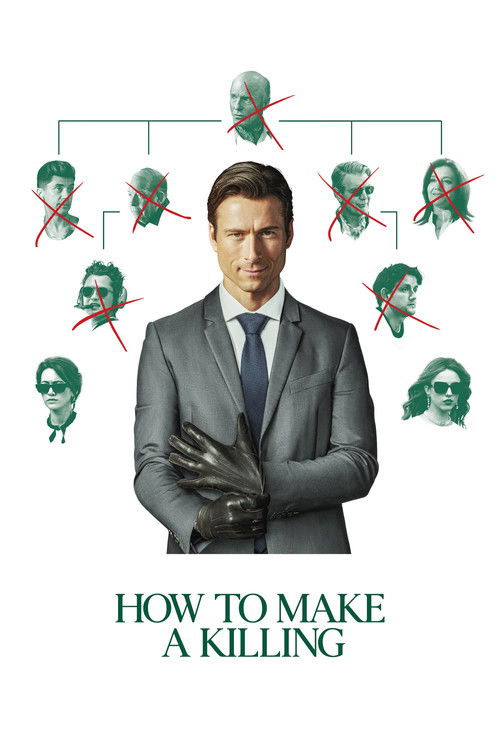
How to Make a Killing
A slick black comedy where gleaming Manhattan penthouses and sun-drenched yachts become slaughterhouses of vanity, capturing the hollow triumph of a disowned heir suffocating under the golden weight of his own monstrous ambition.
How to Make a Killing

How to Make a Killing

"$28 billion inheritance. 7 relatives standing in the way."

16 February 2026 United Kingdom 105 min 7.0 (692)

Director: John Patton Ford

Cast: Glen Powell, Margaret Qualley, Jessica Henwick, Bill Camp, Zach Woods

Thriller Comedy The Illusion of Meritocracy & Nepotism Class Resentment and the "Eat-the-Rich" Fantasy Identity, Performance, and Chameleon Ambition The Moral Corrosiveness of Entitlement Generational Sins and Dynastic Decay
Budget: $15,000,000
Box Office: $21,598,574

Overview

Directed and written by John Patton Ford, How to Make a Killing (originally developed under the working title Huntington) is an Americanized, modern-day dark comedy thriller loosely inspired by Robert Hamer's 1949 British Ealing classic Kind Hearts and Coronets and Roy Horniman’s 1907 satirical novel Israel Rank: The Autobiography of a Criminal.

The story centers on Becket Redfellow (Glen Powell), the disowned, illegitimate scion of an obscenely wealthy Long Island dynasty. Exiled since birth after his mother was banished in disgrace, Becket is raised in working-class New Jersey, painfully conscious of the vast fortune flowing into the hands of his estranged, insufferable relatives. When Becket reconnects with his ambitious childhood associate Julia Steinway (Margaret Qualley), he resolves to reclaim what he believes is his birthright.

Becket hatches a calculated plot to systematically eliminate all seven heirs standing between him and the multi-billion-dollar Redfellow estate. Moving from Wall Street yachts to hipster Bushwick art lofts and megachurch vestries, Becket adopts tailored personas to target his eccentric family members, setting off a chaotic spiral of greed, class resentment, and deception.
Core Meaning

Writer-director John Patton Ford uses the mechanics of a high-society murder spree to dissect the pathology of American meritocracy and generational wealth. The film argues that modern capitalism conflates moral worth with financial entitlement: Becket believes his violent crimes are not merely transactional, but a justified moral rebalancing against incompetent "nepo-babies".

Rather than framing Becket as a working-class champion, Ford demonstrates that the outsider desperate to breach the upper class often harbors the exact same soulless, transactional narcissism as those within it. The ultimate meaning underscores how generational dynasties poison both the insiders who coast on unearned privilege and the castaways obsessed with reclaiming it.

Thematic DNA

The Illusion of Meritocracy & Nepotism 30%
Class Resentment and the "Eat-the-Rich" Fantasy 25%
Identity, Performance, and Chameleon Ambition 20%
The Moral Corrosiveness of Entitlement 15%
Generational Sins and Dynastic Decay 10%

The Illusion of Meritocracy & Nepotism

Explored through the sheer incompetence and vanity of the legitimate Redfellow heirs, juxtaposed against Becket’s hyper-competent but psychopathic drive.

Class Resentment and the "Eat-the-Rich" Fantasy

Deconstructs the popular cultural desire to tear down oligarchs, illustrating how righteous indignation easily turns into self-serving brutality.

Identity, Performance, and Chameleon Ambition

Becket constantly swaps costumes, accents, and mannerisms to infiltrate distinct micro-cultures of wealth, highlighting how elite status is fundamentally performative.

The Moral Corrosiveness of Entitlement

Both Becket and his victims operate under an unshakable belief that the world owes them boundless luxury without accountability.

Generational Sins and Dynastic Decay

The cruelty of the patriarch Whitlow trickles down through generations, spawning an alienated, self-destructive family unit.

Character Analysis

Becket Redfellow

Glen Powell

Archetype: Ruthless Anti-Hero / Chameleon Key Trait: Smoldering, sociopathic charisma.

Motivation

Reclaiming his disinherited family fortune ($18–$28B).

Character Arc

Starts as a bitter outsider; becomes an unfeeling, methodical killer consumed by hubris.

Julia Steinway

Margaret Qualley

Archetype: Femme Fatale / Manipulator Key Trait: Cunning, enigmatic opportunism.

Motivation

Gaining leverage and access to high-society power.

Character Arc

Re-enters Becket’s life as a muse of destruction, matching his ambition step-for-step.

All 5 characters and cast

Symbols & Motifs

The Archery Bow & Target

Meaning:

Symbolizes both calculated predatory precision and the internalized obsession with elite markers.

Context:

Introduced during Becket’s childhood flashbacks where his mother trains him in aristocratic sports.

The Long Island Estate vs. The Newark Tenement

Meaning:

Visualizes structural inequality and Becket’s lingering territorial alienation.

Context:

Presented as contrasting physical spaces framing Becket's upbringing and obsession.

The Redfellow Family Tree Chart

Meaning:

Functions as an object of commodification where living human beings are reduced to mere hurdles and dollar amounts.

Context:

Serves as Becket’s literal hit list and family registry throughout his campaign.

Tailored Suits and Disguises

Meaning:

Signify the artificiality of elite social codes and the erasing of his true self in pursuit of status.

Context:

Worn during Becket's sartorial transformations to infiltrate distinct social circles.

Poison and Chemistry Vials

Meaning:

Represents the quiet, unseen toxins of family resentment and bureaucratic erasure.

Context:

Utilized as Becket's preferred covert murder weapon across multiple hits.

Memorable Quotes

This is not an apology. This is a tragedy.
— Becket Redfellow

Context

Becket speaks this line to frame his life story from confinement.

Meaning

Encapsulates his fatalistic self-delusion and refusal to acknowledge genuine remorse.

They aren’t spending money—they’re burning oxygen. I’m simply balancing the ledger.
— Becket Redfellow

Context

Delivered by Becket during a voiceover montage while tracking his relatives.

Meaning

Illustrates his utilitarian, psychopathic justification for cold-blooded murder.

All 4 quotes

Philosophical Questions

Does structural injustice justify individual violence against the beneficiaries of that injustice?

Explored through Becket's rationalization that murdering his wealthy relatives serves as a moral rebalancing rather than cold-blooded theft.

Is an outsider who kills for wealth inherently worse than an elite whose inheritance is built on generational exploitation?

Examined by comparing Becket's violent methods with the oppressive, exploitative legacy maintained by Patriarch Whitlow Redfellow.

Can performative identity ever be separated from authentic selfhood once one adopts masks to survive?

Reflected in Becket's constant cycling through disguises, accents, and personalities to the point where his authentic self is completely erased.

Is class mobility under hyper-capitalism achievable through merit, or strictly through theft and ruthlessness?

Investigated via Becket’s realization that working within legitimate low-paying gig systems offers no advancement compared to predatory crime.

Alternative Interpretations

The "Pure Sociopath" Reading: Becket never cared about his mother's honor or justice; the outcast narrative is merely a convenient myth he tells himself and his confessor to mask cold, narcissistic greed.The Systemic Determinism Reading: Becket was doomed the moment he was disowned. His mother instilled aristocratic expectations without the means to fulfill them, creating a psychological trap wher...

Full ending explanation

Cultural Impact

Released in early 2026, How to Make a Killing joined the modern wave of "Eat the Rich" cinematic satires popularized by Parasite, Saltburn, The Menu, and Triangle of Sadness. Coming at a time of widespread public discourse over billionaire wealth gaps and "nepo-baby" cultural saturation, the film sought to explore the American aristocracy through a contemporary lens.

While it capitalized on Glen Powell's post-Top Gun: Maverick and Hit Man box-office momentum, reception was polarizing. Critics noted that while its comedic setup was sharp, the film struggled to achieve the biting satire of its British predecessor.

Audience Reception

Reviewers commended Glen Powell’s charismatic lead performance, Todd Banhazl’s crisp cinematography, and the darkly comedic vignettes featuring character actors like Topher Grace, Bill Camp, and Zach Woods.

However, multiple major critics felt the film was too tame and episodic compared to Kind Hearts and Coronets or modern thrillers like The Menu, arguing that Becket's revenge lacked emotional weight or escalating narrative stakes. The cynical, abrupt final act divided audiences—some viewed the framing device as clever irony, while others found it rushed and unearned.

Overall, it was received as a stylish, mildly diverting black comedy that coasts on the wattage of its star cast, even if its social commentary lacks razor sharpness.

Interesting Facts

  • The project originated as a script titled Rothchild on the 2014 Black List, previously attaching Mel Gibson and Shia LaBeouf under director Jon S. Baird before Ford acquired and reworked it.
  • Filmed throughout mid-2024 under the working title Huntington, A24 and StudioCanal officially retitled the movie to How to Make a Killing in November 2025 prior to its February 2026 debut.
  • While set primarily in Long Island, New York City, and New Jersey, principal photography took place in Cape Town, South Africa, utilizing coastal estates to double for luxury American estates.
  • Todd Banhazl served as director of photography, pairing naturalistic daylight with sharp, neo-noir lighting schemes for Becket’s late-night hits.
  • The film features an original score by Academy Award nominee Emile Mosseri (Minari), blending whimsical chamber music with dissonant dark thriller cues.
  • In a deliberate satire of nepotism, Jude Law’s son Raff Law was cast as Taylor Exeter Redfellow, an entitled yacht-bro cousin heavily styled after Dickie Greenleaf from The Talented Mr. Ripley.

Easter Eggs

Ealing Studios / Kind Hearts and Coronets (1949)

The structural DNA directly mirrors Robert Hamer’s classic. Instead of Alec Guinness playing every victim, modern character actors portray distinct parodies of American grifts (crypto bro, megachurch pastor, phony artist).

The Talented Mr. Ripley

Raff Law's nautical setting and tailored leisurewear directly pay homage to Jude Law's aesthetic in Anthony Minghella's 1999 adaptation.

American Psycho Parallels

Glen Powell's narration, skincare rituals, and obsessive physical fitness scenes deliberately echo Christian Bale’s Patrick Bateman.

Emily the Criminal Self-Reference

John Patton Ford includes visual nods to his debut feature, such as Becket navigating low-paying service gig economies before turning to lethal crimes.

Frequently Asked Questions

Explore More About This Movie

Dive deeper into specific aspects of the movie with our detailed analysis pages

Comments (0)

Leave a comment

No comments yet. Be the first to share your thoughts!

Similar Movies