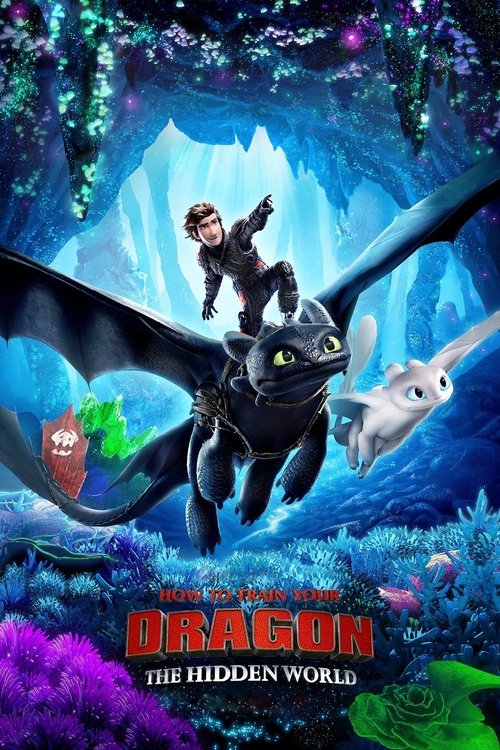
How to Train Your Dragon: The Hidden World
A bittersweet symphony of flight and farewell that marks the end of an era. Amidst bioluminescent caverns and sweeping aerial battles, it explores the poignant necessity of letting go to allow those we love to truly fly free.
How to Train Your Dragon: The Hidden World

How to Train Your Dragon: The Hidden World

"Fly on your own. Find your way home."

03 January 2019 United States of America 104 min ⭐ 7.7 (6,915)
Director: Dean DeBlois
Cast: Jay Baruchel, America Ferrera, F. Murray Abraham, Cate Blanchett, Gerard Butler
Animation Family Adventure
Letting Go Self-Worth and Leadership Wildness vs. Domestication Tolerance vs. Intolerance
Budget: $129,000,000
Box Office: $539,987,993

Overview

One year after the events of the second film, Hiccup has transformed Berk into a chaotic but joyful dragon-viking utopia. However, the island is becoming critically overcrowded, and the sudden appearance of a Light Fury—a female variation of the Night Fury species—coincides with a terrifying new threat: Grimmel the Grisly, a calculating dragon hunter who has killed every Night Fury except Toothless. Grimmel's ruthless pursuit forces Hiccup to make a difficult decision to uproot his entire village in search of the mythological "Hidden World," a safe haven for dragons that his father Stoick once told him about.

As the Berkians flee, Toothless bonds with the feral Light Fury, discovering a call to the wild that challenges his domestic bond with Hiccup. While Hiccup struggles with his own worthiness as a leader without his dragon, Grimmel uses the Light Fury as bait to capture Toothless and the other dragons. The climax forces Hiccup to realize that the only way to truly protect the dragons is not to hoard them, but to let them live in a world where humans cannot follow.
Core Meaning

The heart of the film is the bittersweet necessity of growing up. Director Dean DeBlois crafted a narrative that moves beyond the "boy and his dog" trope to explore the painful but essential act of separation. The film posits that true love is not about possession, but about granting freedom, even if it means saying goodbye. It transitions Hiccup from a boy defined by his dragon to a man defined by his own leadership and family.

Thematic DNA

Letting Go 40%
Self-Worth and Leadership 25%
Wildness vs. Domestication 20%
Tolerance vs. Intolerance 15%

Letting Go

The central theme involves the realization that loving someone means doing what is best for them, not oneself. Hiccup must let Toothless go to the Hidden World to ensure the dragon's safety and happiness, mirroring the parents' role of letting children leave the nest.

Self-Worth and Leadership

Hiccup struggles with "imposter syndrome," believing he is nothing without Toothless. Through the film, he learns that his value as a chief comes from his own courage and intellect, not just his connection to a powerful dragon.

Wildness vs. Domestication

The arrival of the Light Fury introduces the "call of the wild." She represents the natural state of dragons—untamed and instinctual—contrasting with Toothless's domesticated life and highlighting the unnatural (though loving) nature of his captivity on Berk.

Tolerance vs. Intolerance

The film contrasts Hiccup's philosophy of coexistence with Grimmel's philosophy of extermination. It questions whether peace is possible in a world where intolerance (represented by the trappers) is still rampant.

Character Analysis

Hiccup Horrendous Haddock III

Jay Baruchel

Archetype: The insecure leader / The empty-nester
Key Trait: Selflessness

Motivation

To create a world where dragons and humans can live in peace, and later, to ensure Toothless's survival at the cost of their partnership.

Character Arc

Hiccup moves from a codependent relationship with Toothless to independent leadership. He starts the film fearing he is "nothing" without his dragon and ends it as a confident chief who makes the ultimate sacrifice for his friend's safety.

Toothless

N/A (Voice effects)

Archetype: The Wild Child / The Alpha
Key Trait: Loyalty torn by instinct

Motivation

To protect Hiccup, but increasingly, to pursue the Light Fury and find a place where he truly belongs.

Character Arc

Toothless rediscovers his feral instincts through his courtship of the Light Fury. He transitions from a domestic companion to the King of Dragons, embracing his role as a leader of his own kind.

Grimmel the Grisly

F. Murray Abraham

Archetype: The Dark Mirror
Key Trait: Calculated cruelty

Motivation

To exterminate all Night Furies and prove human superiority over dragons. He hunts for sport and glory, driven by a twisted hero complex.

Character Arc

He serves as a static antagonist who challenges Hiccup's worldview. He represents what Hiccup could have become if he had killed the Night Fury in the first film instead of befriending it.

Astrid Hofferson

America Ferrera

Archetype: The Anchor / The Partner
Key Trait: Unwavering support

Motivation

To support Hiccup and protect Berk, ensuring the tribe does not lose its way in the chaos.

Character Arc

Astrid evolves from a warrior into a co-leader. She provides the emotional stability Hiccup lacks, constantly reminding him that his strength comes from within, not from his dragon.

Symbols & Motifs

The Prosthetic Tail

Meaning:

Symbolizes independence and maturity.

Context:

In the first film, Hiccup builds a tail that requires his active control to fly. In this film, he builds an automatic tail fin for Toothless, physically enabling the dragon to fly without him—a metaphor for preparing a loved one to survive on their own.

The Hidden World

Meaning:

Represents a return to nature and an ancestral safe haven.

Context:

Visually depicted as a bioluminescent womb inside the earth, it is a place where dragons belong but humans do not. It symbolizes the afterlife or a mythical realm where magic (dragons) retreats when the mundane world becomes too hostile.

The Light Fury

Meaning:

Symbolizes the future and the call of instinct.

Context:

Her shimmering, wild appearance contrasts with Toothless's dark, mechanical gear. She is the catalyst for Toothless's awakening as an alpha separate from Hiccup, representing the partner he needs to build a future.

Memorable Quotes

There were dragons when I was a boy.

— Hiccup

Context:

Spoken by an older Hiccup in the film's epilogue as he introduces his children to the legend of the dragons.

Meaning:

This is the opening line of Cressida Cowell's original book series. Its inclusion bridges the cinematic universe with the source material and frames the entire story as a retrospective legend told to future generations.

With love comes loss, son. It's part of the deal. Sometimes it hurts, but in the end, it's all worth it.

— Stoick the Vast

Context:

A flashback scene where Stoick comforts a young Hiccup, foreshadowing the pain Hiccup will face when letting Toothless go.

Meaning:

Encapsulates the film's central emotional thesis. It prepares Hiccup (and the audience) for the inevitable separation, framing grief as the price of meaningful connection.

Go on, bud. Lead them to the Hidden World. You'll be safe there.

— Hiccup

Context:

The emotional climax on the cliff edge, where Hiccup bids farewell to Toothless and all the dragons of Berk.

Meaning:

The moment of ultimate sacrifice. Hiccup releases Toothless from his duty to him, acknowledging that the dragon's safety is more important than their friendship.

Philosophical Questions

Is love about possession or liberation?

The film contrasts Grimmel's possessive control over his Deathgrippers with Hiccup's liberating love for Toothless. It asks whether one can truly love a wild creature without setting it free, ultimately concluding that true love requires prioritizing the other's needs over one's own desire for companionship.

Can peace exist without segregation?

The ending suggests a pessimistic view of human society: that peace between radically different groups (humans and dragons) is impossible in the current era due to human greed and intolerance. It raises the question of whether segregation (The Hidden World) is a valid long-term solution to conflict or merely a retreat.

Alternative Interpretations

The Necessity of Separation: While the text presents the separation as necessary for the dragons' safety, some critics and fans interpret it as a tragic commentary on human nature—that humanity is inherently too destructive to coexist with nature (dragons).
The 'Imaginary Friend' Metaphor: A psychological reading suggests the dragons represent childhood imagination. As Hiccup enters adulthood, marriage, and leadership, he must put away 'childish things' (dragons) to fully function in the adult world, making the Hidden World a metaphor for the subconscious where childhood magic is stored.

Cultural Impact

The Hidden World marked the definitive end of one of the most critically acclaimed animation trilogies of the 2010s. Unlike many franchises that continue indefinitely, this film was praised for providing a conclusive and emotional finale. Culturally, it cemented the franchise's legacy as a sophisticated coming-of-age saga that matured with its audience—viewers who were children when the first film was released (2010) were young adults by the conclusion (2019). It sparked discussions about the 'necessary tragedy' of growing up and influenced the trend of animated films tackling complex themes of loss and separation (comparable to Toy Story 3). Commercially, it was a success, grossing over $520 million worldwide, proving that original animated stories (even sequels) could still compete with superhero dominance.

Audience Reception

Praised: The film was widely acclaimed for its stunning animation (particularly the Hidden World sequence), the emotional weight of the ending, and the satisfying character arcs. John Powell's score was also highlighted as a masterpiece.
Criticized: Some critics felt the villain, Grimmel, was a generic retread of previous bad guys. A segment of the fanbase was divided by the ending, finding the sudden decision to separate from the dragons forced or rushed after three movies about fighting for coexistence.
Verdict: Generally considered a strong, worthy conclusion to the trilogy, earning a 90% on Rotten Tomatoes and an 'A' CinemaScore.

Interesting Facts

  • Visual consultant Roger Deakins (legendary cinematographer) advised on the lighting, pushing for 'restraint' and naturalism, which is why the firelight and shadows look so realistic compared to standard animation.
  • The Light Fury's design was inspired by snow leopards and axolotls to give her a sleek, wild, yet soft appearance.
  • Toothless's mating dance was based on the courtship rituals of birds of paradise and other animals seen in nature documentaries.
  • The film was the first at DreamWorks to use the 'MoonRay' lighting tool, allowing for complex ray-tracing of the Hidden World's bioluminescence.
  • F. Murray Abraham (Grimmel) recorded his lines separately but his character was animated to specifically mirror Hiccup's body language in a darker, more predatory way.
  • The title was originally rumored to be 'How to Train Your Dragon 3', but the subtitle 'The Hidden World' was chosen to emphasize the location-based plot.
  • Hiccup's fire sword gets an upgrade in this film, utilizing dragon saliva (monstrous nightmare gel) to coat the blade.

Easter Eggs

Toothless drawing in the sand

When courting the Light Fury, Toothless draws a picture of her in the sand. This directly mirrors the scene in the first film where Hiccup draws Toothless, symbolizing that the dragon has learned artistry and affection from his human.

Drago's Bewilderbeast

In the wide shots of the Hidden World, the massive Bewilderbeast from the second film (missing a tusk) can be seen in the background, confirming it retreated there after its defeat.

Book opening line

The film ends with the voiceover 'There were dragons when I was a boy,' which is the exact opening sentence of Cressida Cowell's first How to Train Your Dragon book.

Valka's Staff

The whistle mechanism in Valka's staff is used to communicate with dragons, a detail carried over from the second film that shows her deep, non-verbal connection to the species.

⚠️ Spoiler Analysis

Click to reveal detailed analysis with spoilers

Frequently Asked Questions

Explore More About This Movie

Dive deeper into specific aspects of the movie with our detailed analysis pages

Comments (0)

Leave a comment

No comments yet. Be the first to share your thoughts!