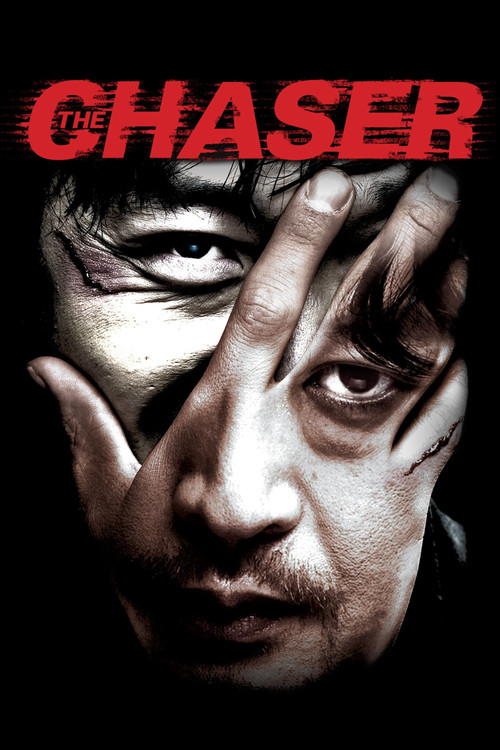
The Chaser
A visceral neo-noir thriller plunging into Seoul's rain-slicked underbelly. Amidst bureaucratic apathy, a morally bankrupt antihero seeks redemption through blood and desperation, chasing a hammer-wielding nightmare in a race against time.
The Chaser

The Chaser

추격자

"The hunter and the hunted, the ultimate chase begins."

14 February 2008 South Korea 125 min ⭐ 7.8 (1,448)
Director: Na Hong-jin
Cast: Kim Yun-seok, Ha Jung-woo, Seo Young-hee, Kim You-jung, Jeong In-gi
Crime Action Thriller
Institutional Incompetence Redemption through Suffering The Banality of Evil Urban Isolation
Budget: $2,600,000

Overview

Joong-ho, a corrupt ex-detective turned pimp, finds himself in a financial bind when his "girls" start disappearing without clearing their debts. Suspecting they are being sold by a rival, he sends the sickly Mi-jin to a client with the phone number ending in 4885, instructing her to send him the address. When he realizes this client was the last to see the missing women, a frantic pursuit begins.

After a minor car collision leads to the capture of the suspect, Je Yeong-min, the killer calmly confesses to the murders in police custody. However, the incompetent police force, obsessed with a recent PR disaster involving the mayor, fails to take him seriously or find physical evidence. With a 12-hour legal window ticking down before Yeong-min's release, Joong-ho hunts for the torture chamber where Mi-jin may still be alive, battling both the killer's madness and the system's indifference.
Core Meaning

Director Na Hong-jin presents a scathing critique of institutional incompetence and societal apathy toward the marginalized. The film argues that in a system paralyzed by bureaucracy and corruption, justice becomes a personal, violent burden. It explores the possibility of redemption for a man who commodifies women, suggesting that true humanity is found not in preserving the law, but in the desperate struggle to save a single, disregarded life.

Thematic DNA

Institutional Incompetence 35%
Redemption through Suffering 30%
The Banality of Evil 20%
Urban Isolation 15%

Institutional Incompetence

The police are portrayed as bumbling, bureaucratic, and more concerned with PR than public safety. Their inability to hold a confessing serial killer due to procedural red tape highlights a broken justice system that fails to protect its most vulnerable citizens.

Redemption through Suffering

Joong-ho begins as a parasite, viewing women solely as revenue sources. His frantic search for Mi-jin transforms from a debt-collection mission into a genuine crusade for human life, culminating in his care for her daughter, Eun-ji, marking his moral awakening.

The Banality of Evil

Je Yeong-min is not a criminal mastermind but a pathetic, impotent man who kills with tools of creation (hammers, chisels). His evil is terrifying because it is casual, senseless, and hidden in plain sight within a mundane neighborhood.

Urban Isolation

The film depicts Seoul's dark alleys and hillsides as a labyrinth where screams go unheard. The characters are isolated within the crowded city—Mi-jin trapped in a bathroom, Joong-ho running alone against the crowd—emphasizing the disconnect between people in modern society.

Character Analysis

Eom Joong-ho

Kim Yun-seok

Archetype: Antihero
Key Trait: Relentless determination

Motivation

Initially money and pride; later, a desperate need to save Mi-jin and protect her daughter, Eun-ji.

Character Arc

Starts as a greedy, abusive pimp treating women as property. Through the chase and his interaction with Mi-jin's daughter, he evolves into a desperate protector, realizing the value of the lives he exploited, though his redemption comes too late to save everyone.

Je Yeong-min

Ha Jung-woo

Archetype: Villain
Key Trait: Chilling calmness

Motivation

Sadistic pleasure derived from power and sexual impotence; a hatred for women and the wealthy.

Character Arc

A static character representing pure, unrepentant psychopathy. He maintains a calm, almost bored demeanor throughout, revealing no remorse, only frustration at being inconvenienced.

Kim Mi-jin

Seo Young-hee

Archetype: The Victim / The Martyr
Key Trait: Resilience

Motivation

Survival and the desire to return to her young daughter.

Character Arc

She fights desperately for her life, escaping the killer's clutches once, only to be failed by society again. Her suffering is the emotional anchor that humanizes the narrative.

Symbols & Motifs

The Hammer and Chisel

Meaning:

Symbolizes the brutal, manual nature of the violence. Unlike guns, these tools require physical effort and proximity, reflecting the visceral and intimate horror of the crimes.

Context:

Yeong-min uses these tools, typically associated with construction or sculpture, to destroy life in his bathroom torture chamber.

The Number 4885

Meaning:

Represents the digital footprint of evil and the commodification of the victims. It serves as the only link between the disparate missing women.

Context:

Joong-ho realizes the pattern by checking his call logs, shouting the iconic line identifying the killer by these last four digits.

Rain and Night

Meaning:

A classic noir motif symbolizing hopelessness, confusion, and the moral murkiness of the world the characters inhabit. It washes away evidence but traps the characters in gloom.

Context:

Most of the chase sequences and the grim discovery of the truth happen during heavy downpours or in the dead of night.

The Church/Crucifix

Meaning:

Represents the silence of God and the irony of salvation. The killer works on religious sculptures, hiding his evil behind a facade of holiness.

Context:

Bodies are buried in the yard of a house near a church, and Yeong-min is shown carving a crucifix, juxtaposing sacred imagery with profane acts.

Memorable Quotes

Hey, 4885... Is that you?

— Eom Joong-ho

Context:

Joong-ho spots a car in an alley and realizes the phone number matches the client who took his missing girls.

Meaning:

The realization moment where the hunter identifies the prey. It has become one of the most famous lines in South Korean cinema history.

I didn't sell them. I killed them.

— Je Yeong-min

Context:

Spoken calmly inside the police station while officers are joking around, changing the entire tone of the investigation.

Meaning:

This casual confession shocks the police and the audience, subverting the thriller trope where the villain tries to hide their guilt. It highlights his arrogance and madness.

Do you think this is a joke?

— Je Yeong-min

Context:

During the interrogation when the police are confused by his lack of clear motive or evidence.

Meaning:

Reveals the killer's detachment from reality and his mockery of the legal system that fails to comprehend his nature.

Philosophical Questions

Does a 'dirty' life have value?

The police and society show little interest in the missing women because they are prostitutes. The film challenges the audience to find empathy for victims deemed 'disposable' by society, asking if the worth of a life is determined by social standing.

Is justice possible within a broken system?

The film suggests that legal justice is a farce, bound by red tape that protects the guilty. True justice is shown as primal and personal, yet ultimately futile, raising the question of how to confront evil when the law fails.

Alternative Interpretations

Some critics view the ending not just as a tragedy, but as a religious allegory where Joong-ho's final silence represents the complete abandonment of faith. The killer, who worked on church sculptures, represents an 'anti-creator' destroying life under the nose of religion. Others interpret the film as a purely sociopolitical satire, where the incompetence of the police is the true antagonist, and the serial killer is merely a symptom of a sick society that lets evil fester in its blind spots.

Cultural Impact

The Chaser revitalized the South Korean thriller genre, moving it away from the polished aesthetics of earlier hits like Shiri toward a grittier, 'realist' violence reminiscent of Memories of Murder. It was a massive box office success, drawing over 5 million admissions. The film launched Na Hong-jin to international stardom (screening at Cannes) and cemented Kim Yun-seok and Ha Jung-woo as A-list actors. Culturally, it sparked debates about the efficacy of the Korean police force and the death penalty, given its inspiration from the Yoo Young-chul case.

Audience Reception

The film received near-universal acclaim from both critics and audiences. Viewers praised the relentless pacing, the chemistry between the leads, and the subversion of genre tropes (like the early capture of the killer). The main point of criticism—and simultaneously praise—was the overwhelming frustration caused by the police incompetence and the bleak, uncompromising ending, which left many viewers emotionally exhausted but impressed by the film's audacity.

Interesting Facts

  • The film is loosely based on the real-life case of Yoo Young-chul, a serial killer who murdered 20 people in Seoul in the early 2000s.
  • This was Na Hong-jin's directorial debut, which is considered one of the strongest debuts in Korean film history.
  • Ha Jung-woo (the killer) and Kim Yun-seok (the pimp) reunited as leads in Na Hong-jin's next film, 'The Yellow Sea' (2010).
  • Ha Jung-woo studied the psychology and behavior of real serial killers to prepare for his role, aiming for a 'bored' rather than 'manic' portrayal.
  • The film was shot largely on location in the Mangwon-dong district to capture the gritty, authentic texture of Seoul's backstreets.
  • Warner Bros. purchased the remake rights for $1 million shortly after its release, with Leonardo DiCaprio rumored to be interested, though the remake never materialized.

Easter Eggs

The '4885' Phone Number

The number 4885 has become iconic in Korean pop culture, often referenced in variety shows and other media as a shorthand for impending danger or a villainous reveal.

Ha Jung-woo's Art

In real life, actor Ha Jung-woo is a painter. While not explicitly an easter egg in the film, the character Yeong-min's 'artistic' background (working on sculptures) parallels the actor's real-life creative side, twisted into something dark.

⚠️ Spoiler Analysis

Click to reveal detailed analysis with spoilers

Frequently Asked Questions

Explore More About This Movie

Dive deeper into specific aspects of the movie with our detailed analysis pages

Comments (0)

Leave a comment

No comments yet. Be the first to share your thoughts!