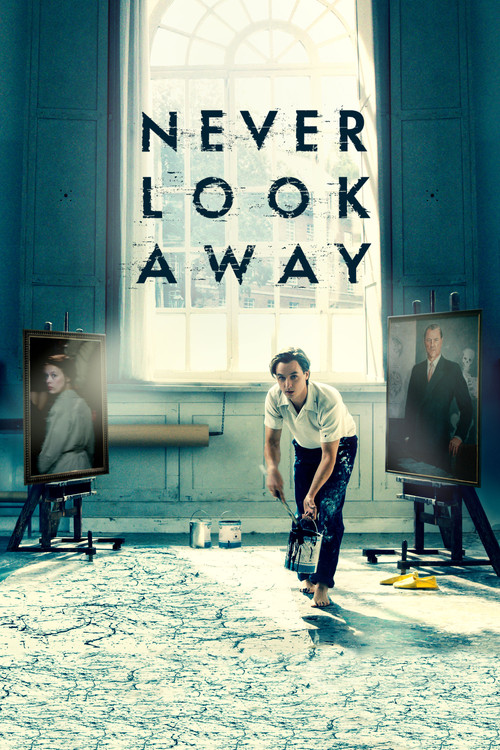
Never Look Away
Werk ohne Autor
Overview
Never Look Away (Werk ohne Autor) is a sprawling odyssey spanning three tumultuous decades of German history. The story follows Kurt Barnert, a young boy in Nazi Germany who witnesses the tragic downfall of his artistic and sensitive aunt, Elisabeth, due to the regime's merciless eugenics program. Traumatized but resilient, Kurt grows up in East Germany, studying art under the stifling dogma of Socialist Realism, all while unknowingly falling in love with Ellie, the daughter of Professor Carl Seeband—the very SS doctor responsible for his aunt's death.
As Kurt and Ellie defect to the West seeking creative freedom, Kurt struggles to find his artistic voice at the avant-garde Düsseldorf Art Academy. Haunted by suppressed memories, he begins to channel his subconscious trauma into a new style of photorealistic paintings that blur the lines between photography and painting. These works inadvertently expose the hidden connections between his victimized aunt and his villainous father-in-law, revealing a truth that words could never capture.

Core Meaning
At its heart, the film posits that art is an instrument of truth that bypasses rational defense mechanisms to heal deep-seated trauma. The director, Florian Henckel von Donnersmarck, suggests that true artistic genius comes from confronting, rather than evading, painful realities. The mantra "Never look away" evolves from a literal instruction to a philosophical imperative: only by facing the darkest parts of history and oneself can an artist create work that is undeniably true and, therefore, beautiful. It explores the idea that victims and perpetrators in post-war Germany were often inextricably bound together, living in a silence that only art could break.
Thematic DNA
Art as Truth and Healing
The central theme asserts that "Everything that is true is beautiful." Kurt's journey from Socialist Realism (propaganda) to Capitalist experimentation (emptiness) ends only when he paints his personal pain. The film argues that great art transforms suffering into something transcendent.
The Persistence of the Past
History does not disappear; it changes shape. The film illustrates how the crimes of the Nazi era (represented by Seeband) continued to exist beneath the surface of post-war German society. The characters cannot escape their interconnected fates, no matter how far they run.
Interconnectedness of Good and Evil
The film relies on the devastating coincidence that Kurt marries the daughter of his aunt's murderer. This highlights the claustrophobic nature of post-war Germany, where victims and perpetrators lived side-by-side, their bloodlines and histories merging.
Ideology vs. Individual Expression
Kurt navigates three distinct ideological art worlds: the Nazis' "Degenerate Art" hatred, the GDR's "Socialist Realism" conformity, and the West's "anything goes" modernism. The film critiques all rigid systems, championing the individual's subjective truth as the only valid compass.
Character Analysis
Kurt Barnert
Tom Schilling
Motivation
To understand the confusing world around him and to remain faithful to the truth his aunt taught him, even when he doesn't fully understand it yet.
Character Arc
Starts as a passive witness to trauma, becomes a skilled but hollow craftsman in the East, and finally evolves into a visionary artist in the West by integrating his suppressed memories into his work.
Professor Carl Seeband
Sebastian Koch
Motivation
To maintain control, purity, and superiority. He is driven by a eugenicist ideology that views weakness as something to be eradicated.
Character Arc
A static villain who seamlessly transitions from high-ranking Nazi doctor to respected Communist professor to successful Western doctor. He never repents, only adapts.
Elisabeth May
Saskia Rosendahl
Motivation
To experience the intensity of life and beauty without barriers.
Character Arc
She is the spiritual catalyst of the film. Her sensitivity is labeled as madness by the Nazis. Her death haunts the narrative, and her spirit guides Kurt's artistic breakthrough.
Ellie Seeband
Paula Beer
Motivation
To live a free life with Kurt and escape her father's controlling grip.
Character Arc
Struggles to separate herself from her domineering father. She becomes Kurt's anchor and muse, suffering physically (through the abortion her father forces) but remaining resilient.
Symbols & Motifs
The Blur
Represents the ambiguity of memory and the subconscious. It softens the blow of the harsh truth while simultaneously making it more universal and haunting. It reflects the refusal to make a definitive, dogmatic statement (unlike the Nazis or Communists).
Used in Kurt's final paintings (mimicking Gerhard Richter's style) and visually when characters hold their hands in front of their eyes to soften the focus of the world.
The Open Note / A Note
Symbolizes the underlying harmony of the universe that only sensitive souls (like Elisabeth and Kurt) can perceive. It represents connection to the divine or the absolute truth.
Elisabeth plays this note on the piano while nude; later, the bus horns harmonize to a specific pitch that Kurt recognizes, linking him back to her.
The Tree
A place of sanctuary and perspective. It represents rising above the mundane and the traumatic to see the world clearly.
Kurt hides in trees as a child during the war; as an adult, he climbs a tree at the art academy to find inspiration.
Blue Bus Number
The banality of evil and the bureaucratic nature of death. It links the mechanism of the Holocaust to everyday life.
The bus horns that sound the 'A' note are from the buses used to transport patients to extermination camps; Kurt later hears the same pitch in the West.
Memorable Quotes
Never look away. Everything that is true is beautiful.
— Elisabeth May
Context:
Spoken to young Kurt before she is taken away to the asylum, instructing him how to view the world.
Meaning:
The film's thesis statement. It suggests that beauty is not about aesthetics but about honesty. Even pain and horror possess beauty if they are true.
Numbers are the most beautiful thing. They are precise. They are clean.
— Professor Carl Seeband
Context:
Seeband explaining his philosophy, contrasting sharply with the artistic soul of Kurt and Elisabeth.
Meaning:
Reveals the chilling inhumanity of Seeband's worldview. He values sterile order over messy human life.
I don't make statements.
— Kurt Barnert
Context:
Kurt speaking to journalists at his first major exhibition when asked what his paintings mean.
Meaning:
Reflects the artist's refusal to be used for propaganda or simple messages. He lets the image speak for itself.
Philosophical Questions
Can art reveal truths that the artist themself does not consciously know?
Kurt paints the collage of Seeband and Elisabeth intuitively, without knowing the factual link. The film suggests art taps into a collective or subconscious knowledge that transcends facts.
Is morality relative to the political system?
The film shows Seeband flourishing under Nazism, Communism, and Capitalism. It asks if 'success' in society is divorced from morality, and if the only true moral compass is the internal artistic one.
Alternative Interpretations
The 'Just' Universe: While some critics see the coincidence of Kurt marrying his aunt's killer's daughter as melodramatic, others interpret it as a metaphysical assertion that the universe demands truth; the crimes of the past inevitably surface, physically manifesting in the next generation's relationships.
Seeband's Escape: The ending, where Seeband escapes justice, can be read not just as a failure of the legal system, but as a commentary on post-war Germany's 'Economic Miracle' being built on the expertise of former Nazis who were never truly punished.
Cultural Impact
Never Look Away reignited the debate about Vergangenheitsbewältigung (coming to terms with the past) in German cinema. While it was celebrated internationally, receiving two Oscar nominations (Best Foreign Language Film and Best Cinematography), it was polarizing in Germany. Critics praised its ambitious scope and visual majesty but criticized its melodramatic approach to serious history. The most significant cultural ripple was the friction between the director and Gerhard Richter, sparking discussions on the ethics of 'biopics' that claim to be fiction while heavily exploiting real biography. It stands as a modern attempt to create a 'Great German Novel' on film, linking the Nazi era, the GDR, and the Federal Republic.
Audience Reception
Praised: Audiences were mesmerized by the cinematography, the epic storytelling, and the emotional resonance of the love story. The visual representation of the artistic process was highlighted as a standout element.
Criticized: The runtime (over 3 hours) was a hurdle for many. Some critics found the sex scenes excessive and the 'male gaze' problematic. The reliance on a massive coincidence (the father-in-law connection) was dismissed by some as soap-opera writing, despite being based on true events.
Interesting Facts
- The film is loosely based on the life of famous German artist Gerhard Richter, who publicly disavowed the movie, calling it a 'distortion' and 'abuse' of his life story.
- Director Florian Henckel von Donnersmarck and cinematographer Caleb Deschanel spent hours studying Richter's actual paintings to replicate the lighting and 'blur' effect on camera.
- At 189 minutes, it is one of the longest German films to be nominated for an Academy Award.
- The character of Professor Antonius van Verten (the hat-wearing teacher) is a direct reference to the legendary artist Joseph Beuys and his mythologized backstory involving plane crashes and felt.
- The painting 'Mother and Child' shown in the film corresponds to Richter's real painting 'Aunt Marianne', which was the key to unlocking the real-life family secret.
- Sebastian Koch (Professor Seeband) previously starred in the director's Oscar-winning film 'The Lives of Others' as the sympathetic protagonist, playing against type here as the villain.
Easter Eggs
The Title 'Werk ohne Autor'
Translates to 'Work Without Author,' which is the actual term Gerhard Richter used to describe his early photo-paintings, implying the artist disappears behind the mechanical reproduction of the photo.
Joseph Beuys' Hat
The character of Van Verten never takes off his hat. This references the real Joseph Beuys, who always wore a felt hat to cover metal plates in his head (according to his own myth).
The Address
The street addresses and locations in Düsseldorf closely mimic the real locations where Richter and his contemporaries lived and worked.
⚠️ Spoiler Analysis
Click to reveal detailed analysis with spoilers
Frequently Asked Questions
Explore More About This Movie
Dive deeper into specific aspects of the movie with our detailed analysis pages
Comments (0)
No comments yet. Be the first to share your thoughts!