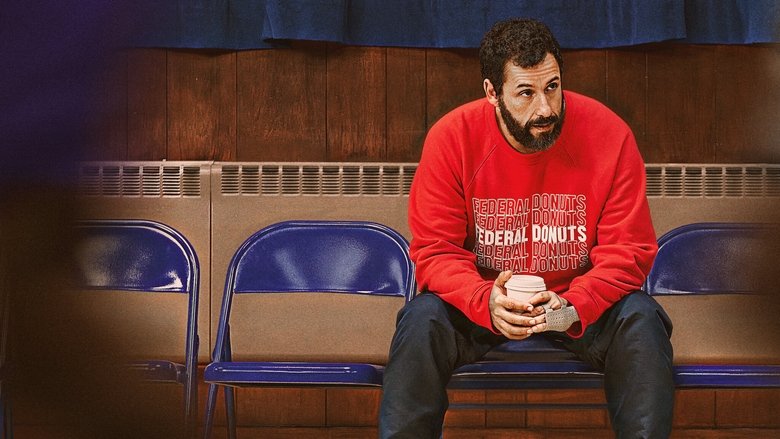
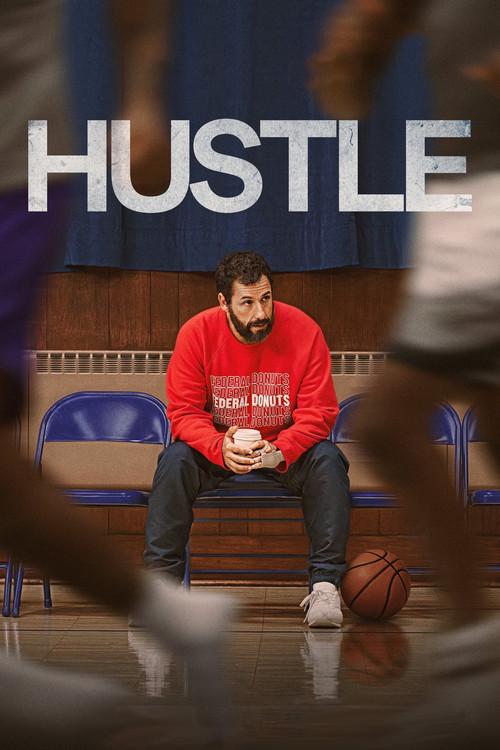
Hustle
"Are you obsessed with this game?"
Overview
Stanley Sugerman (Adam Sandler) is a weary international scout for the Philadelphia 76ers who dreams of coaching but is trapped in a life of endless travel and hotel rooms. His career hits a breaking point when the team's owner dies, and his ambitious son, Vince Merrick (Ben Foster), demotes Stanley. While searching for talent in Spain, Stanley stumbles upon Bo Cruz (Juancho Hernangómez), a construction worker with a troubled past but raw, explosive talent. Seeing Bo as his ticket back to the bench, Stanley brings him to the U.S. without the team's approval.
The duo faces immense challenges, from Bo's lack of professional discipline to Vince's active sabotage. As they train for the NBA Draft Combine, Stanley acts as both coach and father figure, helping Bo overcome the psychological warfare of rival player Kermit Wilts (Anthony Edwards). The film culminates in a high-stakes journey where both men must prove that their passion for the game outweighs their past failures.
Core Meaning
At its heart, Hustle is a deconstruction of the "talent myth," positing that obsession is the only true currency in professional sports. Director Jeremiah Zagar moves beyond the physical montage to explore the mental fortitude required to succeed. The film argues that redemption is a team sport; no one makes it alone, and true mentorship requires vulnerability. It separates the glamour of the NBA from the grinding reality of the work required to get there.
Thematic DNA
Obsession vs. Talent
The film repeatedly asks, "Do you love this game?" distinguishing between those who play and those who live for it. Stanley teaches Bo that physical gifts are useless without the obsessive drive to overcome humiliation and fatigue.
Fatherhood and Mentorship
Stanley's relationship with Bo mirrors his relationship with his own daughter. The film explores the sacrifices fathers make and how mentorship is a form of parenting, filling the void left by Bo's absent father.
Resilience and Mental Toughness
Represented by the "Never Back Down" mantra. The conflict isn't just physical (training) but psychological, specifically how Bo learns to control his emotions against trash-talking provocateurs.
The Business of Sport
The film exposes the cold, transactional nature of the NBA front office, contrasting the purity of the game on the street with the politics of the boardroom.
Character Analysis
Stanley Sugerman
Adam Sandler
Motivation
To prove he is more than just a scout and to leave a legacy in the game he loves.
Character Arc
Starts as a jaded scout fearing he's wasted his life. Through Bo, he reignites his passion for coaching and confronts his past guilt over a drunk-driving accident.
Bo Cruz
Juancho Hernangómez
Motivation
To provide a better life for his daughter and mother.
Character Arc
Transforms from a hot-tempered streetballer protecting his family into a disciplined professional who can master his emotions.
Vince Merrick
Ben Foster
Motivation
To prove he is smarter than his father and the "old guard" of basketball.
Character Arc
Remains static as the embodiment of nepotism and ego. His refusal to see value in Bo ultimately leads to his loss of control over the team.
Kermit Wilts
Anthony Edwards
Motivation
To maintain his status as the Alpha dog.
Character Arc
Serves as the physical and mental barrier Bo must overcome. He represents the elite, arrogant talent that dominates the league.
Symbols & Motifs
The Boa Constrictor
Symbolizes Bo's defensive style—suffocating his opponent—but also his potential to be consumed by his own anger if not controlled.
Used as a nickname and marketing tool during the viral challenge where streetballers try to score on Bo.
The Tree Tattoo
Represents roots, growth, and the motto "Never Back Down." It signifies Bo's acceptance of Stanley's influence on his life.
Revealed at the end of the film on Bo's arm, honoring the bond they formed during training.
Construction Boots
Symbolizes Bo's humble, working-class origins and the raw, unpolished nature of his game compared to the pampered academy players.
Bo plays in them during his initial discovery in Spain, emphasizing his natural ability over equipment.
The Rocky Steps
A meta-symbol of the quintessential Philadelphia underdog story.
Stanley makes Bo run up a steep hill (the "Manayunk Wall"), visually quoting the training montage from Rocky, rooting the film in Philly's cinematic heritage.
Memorable Quotes
Obsession is gonna beat talent every time.
— Stanley Sugerman
Context:
Stanley gives a passionate speech to Bo in the hotel room, questioning if he truly loves the game enough to succeed.
Meaning:
The central thesis of the film. It redefines success not as a gift, but as a result of total consuming dedication.
Scottie Pippen and a wolf had a baby.
— Stanley Sugerman
Context:
Stanley describing Bo's playing style to his contacts to generate interest.
Meaning:
A vivid scouting description that perfectly captures Bo's defensive prowess and feral intensity.
Do you love this game? I mean, love it with your whole heart? Because if you don't, let's not even bother.
— Stanley Sugerman
Context:
The pivotal moment where Stanley decides whether to commit to training Bo.
Meaning:
Establishes the emotional stakes. It's not about money or fame, but a spiritual connection to basketball.
Never back down.
— Bo Cruz / Stanley Sugerman
Context:
Repeated throughout training and immortalized in Bo's tattoo at the end.
Meaning:
The shared mantra that binds the two characters, symbolizing resilience against life's setbacks.
Philosophical Questions
Is obsession a prerequisite for greatness?
The film suggests that talent is common, but the willingness to suffer for a goal is rare. It asks whether a balanced life is compatible with elite performance.
Can we redeem our past through the success of others?
Stanley projects his own failed dreams onto Bo. The film explores the ethics of living vicariously through a protégé and whether mentorship is an act of altruism or selfishness.
Alternative Interpretations
While ostensibly a sports movie, some critics interpret Hustle as a meta-commentary on Adam Sandler's own career: a talented veteran (Stanley) who knows he has more to offer than the clownish roles he's known for (or in Stanley's case, the grind of scouting), seeking to prove his worth as a serious craftsman (Coach/Actor). Additionally, the ending—where Bo plays for the Celtics (Philly's rival)—can be interpreted as a realistic nod to the lack of sentimentality in pro sports: the goal was to make the league, not the fairytale of playing for the hometown team.
Cultural Impact
Hustle solidified the "Sandler Renaissance" (or Sandler-aissance), proving that his dramatic turn in Uncut Gems was not a fluke. It was widely praised as one of the best sports movies of the modern era, specifically for its authentic portrayal of the NBA scouting process and the "business" side of the league. Critics noted it as a quintessential "Dad Movie"—emotionally sincere, focused on mentorship and work ethic. It also successfully showcased that active NBA players (like Anthony Edwards and Juancho Hernangómez) could deliver genuine acting performances, raising the bar for casting in future sports dramas.
Audience Reception
The film holds a high "Fresh" rating on Rotten Tomatoes (around 93%). Praised for: Adam Sandler's grounded and empathetic performance, the electric chemistry between him and Hernangómez, and the realistic, well-shot basketball sequences (avoiding the "shaky cam" often used to hide actors' lack of skill). Criticized for: A predictable, formulaic plot that follows the standard Rocky beats without deviation. Some viewers felt the antagonist (Vince) was too cartoonishly evil.
Interesting Facts
- Juancho Hernangómez, who plays Bo Cruz, is a real NBA player (formerly Utah Jazz, Raptors, Celtics), and his brother Willy also cameos.
- The character Kermit Wilts is played by NBA star Anthony Edwards, who was praised for his surprisingly convincing performance as a villain.
- Adam Sandler's injury in the film (his hand) was written in, but he actually pulled his groin for real while playing basketball during shooting.
- The film features a massive number of NBA cameos including Julius 'Dr. J' Erving, Shaquille O'Neal, Charles Barkley, Dirk Nowitzki, Trae Young, and Luka Dončić.
- LeBron James produced the film through his SpringHill Company.
- The 'Manayunk Wall' hill that Bo runs up is a real, famous steep street in Philadelphia known for its difficulty for cyclists and runners.
- Sandler's character watches a clip of 'The Professor' (Grayson Boucher), a real-life streetball legend who also cameos in the viral video montage.
Easter Eggs
Dirk Nowitzki on FaceTime
Stanley uses a call with NBA legend Dirk Nowitzki to prove he is a real scout. It highlights Sandler's real-life connections to the NBA world.
The 'Federal Donuts' Shoutout
Stanley references this specific Philadelphia donut shop, a nod to the local culture and authenticity of the setting.
Allen Iverson's Jersey
Bo wears an Iverson jersey at one point, paying homage to the 76ers legend who embodied the 'Hustle' spirit in real life.
⚠️ Spoiler Analysis
Click to reveal detailed analysis with spoilers
Frequently Asked Questions
Explore More About This Movie
Dive deeper into specific aspects of the movie with our detailed analysis pages
Comments (0)
No comments yet. Be the first to share your thoughts!