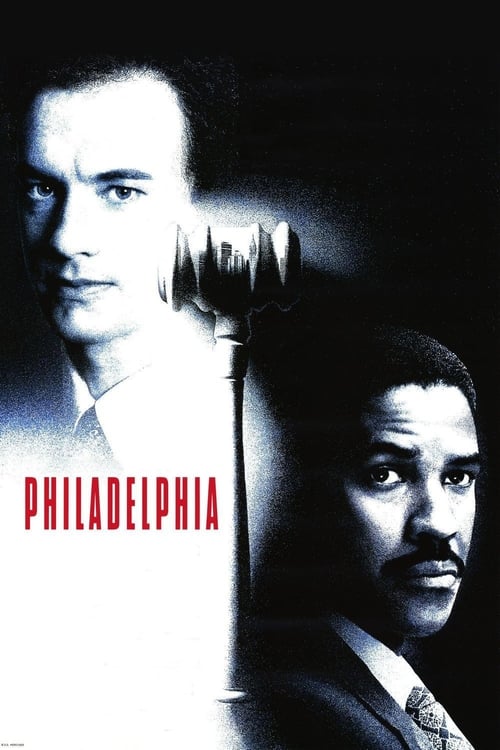
Philadelphia
"No one would take on his case... until one man was willing to take on the system."
Overview
Andrew Beckett is a brilliant, rising star at a prestigious Philadelphia law firm who conceals his homosexuality and HIV status from his conservative colleagues. When a visible lesion appears on his forehead and an important file mysteriously goes missing, Andrew is abruptly fired for alleged incompetence. Convinced he was terminated due to his illness, he decides to sue the firm for discrimination but struggles to find representation.
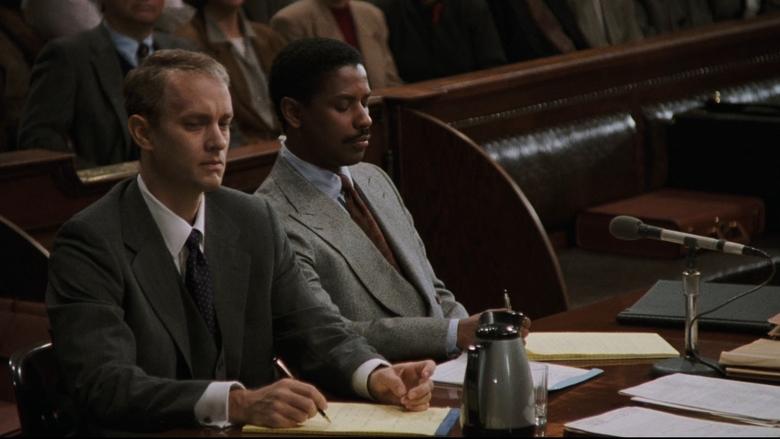
Enter Joe Miller, a small-time personal injury attorney with his own deep-seated homophobic prejudices. Initially reluctant, Joe agrees to take the case after witnessing the subtle social ostracism Andrew faces at a law library. As the trial unfolds, the film juxtaposes the brutal physical decline of Andrew against Joe's gradual moral awakening, challenging the jury—and the audience—to look past fear and stigma to see the human being underneath.
Core Meaning
At its heart, Philadelphia is a plea for empathy over ignorance. Director Jonathan Demme utilized the conventions of a traditional courtroom drama to bring the AIDS crisis into mainstream American living rooms, humanizing victims who had been demonized or ignored. The film argues that discrimination based on fear is not just a legal violation but a moral failure, asserting that the "City of Brotherly Love" must extend its promise of liberty to all citizens, regardless of sexual orientation or health status.
Thematic DNA
Prejudice and Homophobia
The film ruthlessly exposes both overt and subtle forms of homophobia. From Joe Miller's initial recoil at shaking Andrew's hand to the defense's aggressive questioning about Andrew's sexual history, the narrative demonstrates how fear of the 'other' manifests as hatred and exclusion.
The Law vs. Justice
A central tension exists between the letter of the law and the spirit of justice. While the courtroom battles focus on legal precedents and wrongful termination, the true trial is about social justice—affirming the human dignity of those marginalized by society.
Physical Mortality vs. Spiritual Transcendence
As Andrew's body wastes away due to AIDS, his spirit seemingly grows stronger. This inverse relationship is highlighted in moments where he finds solace in opera and family, suggesting that while disease can claim the body, it cannot destroy the capacity for love and beauty.
Transformation through Proximity
Joe Miller's character arc embodies the theme that contact dissolves prejudice. It is only by spending time in Andrew's presence, sharing his space and breathing his air, that Joe deconstructs his own bigoted misconceptions.
Character Analysis
Andrew Beckett
Tom Hanks
Motivation
To prove that he is a victim of discrimination and to affirm his worth as a lawyer and a human being before he dies.
Character Arc
Andrew begins as a successful, closeted lawyer trying to play by the rules. Stripped of his career and health, he transforms into a courageous public figure, sacrificing his privacy to secure dignity for himself and others like him. He dies vindicated but physically destroyed.
Joe Miller
Denzel Washington
Motivation
Initially money and publicity; later, a genuine desire for justice and anger at the mistreatment of his client.
Character Arc
Joe starts as a slick, homophobic ambulance chaser who fears AIDS. Through his defense of Andrew, he confronts his own biases, ultimately becoming a fierce advocate for civil rights and a genuine friend to Andrew, overcoming his fear of physical contact.
Charles Wheeler
Jason Robards
Motivation
To protect the reputation of his firm and maintain the conservative social order.
Character Arc
Wheeler represents the establishment—powerful, conservative, and unyielding. He maintains his stance that Andrew was fired for incompetence, refusing to acknowledge his own prejudice even as he loses the legal battle.
Miguel Alvarez
Antonio Banderas
Motivation
To love and care for Andrew until the very end.
Character Arc
Miguel is the emotional anchor, providing unconditional love and care. He moves from a supporting partner to a grieving survivor, embodying the personal toll of the epidemic on loved ones.
Symbols & Motifs
The Opera Scene (La Mamma Morta)
Represents the raw, unmediated expression of suffering and the divine power of life. It serves as Andrew's spiritual escape from his decaying body.
In a pivotal scene bathed in red firelight, Andrew translates the aria for Joe, exposing his soul. The aria's lyrics about love amid death mirror Andrew's own reality, bridging the emotional gap between the two men.
The Law Library
Symbolizes the systemic isolation of the diseased. It is a public space where social contracts break down under the weight of stigma.
Andrew is relegated to a back table, eyed suspiciously by staff and patrons. This visual of exclusion is what finally compels Joe to take the case, recognizing the parallel to racial segregation.
The Mirror
Represents self-confrontation and the inescapable reality of the disease.
Demme frequently uses direct-to-camera close-ups and shots of characters looking into mirrors, forcing them—and the audience—to confront the truth without looking away.
Andrew's Sailor Suit
A political statement on the "Don't Ask, Don't Tell" era and a celebration of gay culture and joy amidst sorrow.
During a costume party, Andrew and his partner Miguel dance in full dress whites. It asserts their patriotism and humanity in the face of a country that rejects them.
Home Movies
Symbolize the innocence of childhood and the tragedy of a life cut short, serving as a stark contrast to the courtroom's coldness.
The film ends with grainy footage of Andrew as a healthy child, projected at his wake, reminding the mourners of the vibrant life that existed before the illness.
Memorable Quotes
Now, explain it to me like I'm a four-year-old.
— Joe Miller
Context:
Used repeatedly by Joe during consultations and court proceedings to break down legal jargon.
Meaning:
Joe's catchphrase highlights his legal strategy of simplifying complex deception into undeniable truth. It cuts through the defense's obfuscation to reveal the core discrimination.
It was during this sorrow that love came to me. ... I am love! I am love!
— Andrew Beckett (translating Maria Callas)
Context:
The scene in Andrew's apartment where he is connected to an IV, listening to opera with Joe.
Meaning:
This translation of the aria La Mamma Morta serves as the emotional climax, revealing Andrew's inner world where suffering and divine love coexist.
In this courtroom, Mr. Miller, justice is blind to matters of race, creed, color, religion, and sexual orientation.
— Judge Garrett
Context:
The judge admonishing Joe Miller during a heated moment in the trial.
Meaning:
An ironic statement of the ideal vs. the reality. The judge states what should be true, but the trial proves how difficult this is to achieve.
We don't live in this courtroom, though, do we?
— Joe Miller
Context:
The immediate response to Judge Garrett's claim that justice is blind.
Meaning:
Joe's rebuttal to the judge, acknowledging that outside the sanitized legal system, prejudice is a very real force that dictates people's lives.
What do you call a thousand lawyers chained together at the bottom of the ocean? ... A good start.
— Andrew Beckett
Context:
Andrew joking with Joe, signaling a moment of bonding between the two attorneys.
Meaning:
Andrew uses a self-deprecating lawyer joke to break the tension, showing his retained humanity and humor despite his suffering.
Philosophical Questions
Can the law compel morality?
The film explores whether legal victories can actually change hearts and minds. While Andrew wins the lawsuit, the question remains whether the prejudice that caused the firing has been truly eradicated or just legally penalized.
What is the difference between tolerance and acceptance?
Joe Miller moves from intolerance to tolerance and finally to acceptance. The film asks the audience to distinguish between merely allowing someone to exist (legal tolerance) and recognizing their humanity (moral acceptance).
Does the right to privacy supersede public health fears?
The central legal conflict revolves around Andrew's right to keep his illness private versus the firm's (prejudiced) claim that his condition affected his work and the safety of others.
Alternative Interpretations
A common critical reading of the film suggests that Joe Miller is the true protagonist, not Andrew. In this view, Andrew serves as a saintly, static martyr figure designed to teach Joe (and the straight audience) a lesson in tolerance, rather than a fully realized character with flaws. This interpretation posits that the film was calculated to comfort straight viewers about their own potential for redemption rather than to radically challenge the system. Another interpretation focuses on the silence of sexuality; by cutting the bedroom scene and focusing on the "innocent" transmission (Andrew is rarely shown as a sexual being), the film suggests that empathy was conditional on the "respectability" of the victim.
Cultural Impact
Philadelphia is widely regarded as a watershed moment in Hollywood history. Released at the height of the AIDS epidemic, it was the first big-budget studio film to explicitly address HIV/AIDS and homophobia. While some critics and activists argued it was too "safe" or sanitized (focusing on a white, affluent lawyer and desexualizing the gay relationship), its impact on the general public was monumental. It played a crucial role in destigmatizing the disease for mainstream America, shifting the narrative from fear to compassion. Tom Hanks' Oscar win and moving acceptance speech further cemented the film's legacy as a tool for social change. It opened the door for future LGBTQ+ cinema, proving that stories about gay characters could be commercially successful and critically acclaimed.
Audience Reception
Upon release, Philadelphia was a massive commercial success and received high praise from general audiences, particularly for the powerhouse performances of Tom Hanks and Denzel Washington. It was celebrated for its emotional resonance and for breaking the silence on AIDS. However, reception was more polarized within the LGBTQ+ community. While many appreciated the visibility, others (like activist Larry Kramer) criticized it for being inaccurate, unchallenging, and for "de-gaying" the main character to make him palatable to straight audiences. Despite this, the consensus remains that it was a necessary and well-intentioned step forward for cinema.
Interesting Facts
- Tom Hanks lost nearly 30 pounds for the role to realistically portray the progression of AIDS, while Denzel Washington was asked to gain weight to contrast his vitality.
- The film was inspired by the real-life discrimination lawsuits of attorneys Geoffrey Bowers and Clarence B. Cain.
- Daniel Day-Lewis was the studio's first choice for the role of Andrew Beckett, but he turned it down to work on 'In the Name of the Father'.
- Director Jonathan Demme cast actual people with HIV/AIDS as extras in the hospital and clinic scenes to provide authenticity.
- Bruce Springsteen wrote the Oscar-winning song 'Streets of Philadelphia' after Demme asked him for a rock song; he sent a haunting ballad instead.
- A bedroom scene showing more intimacy between Andrew and Miguel was filmed but cut to ensure the film appealed to a broader, more conservative audience.
- The scene where Andrew and Miguel dance in sailor uniforms was considered a subtle political statement regarding the military's exclusion of gay people.
- The film was the first major Hollywood studio production to tackle the AIDS crisis head-on, paving the way for greater awareness.
- The courtroom scenes were filmed in a real courtroom in Philadelphia that was not in use at the time.
- Tom Hanks' acceptance speech for the Best Actor Oscar for this film inspired the plot of the movie 'In & Out'.
Easter Eggs
Roger Corman Cameo
Legendary B-movie producer Roger Corman, who gave Jonathan Demme his start in the industry, appears as Mr. Laird, one of the law firm partners.
Demme's Regulars
Actors Charles Napier and Tracey Walter, who frequently appeared in Demme's films (like Silence of the Lambs), have small roles as the judge and the librarian, respectively.
Real-Life Activist Extras
Many of the extras in the film were associated with 'Action AIDS' in Philadelphia, immortalizing real members of the community who were fighting the disease.
Liberty Bell Imagery
The Liberty Bell and Independence Hall are frequently shown to juxtapose the city's historical symbols of freedom with the current reality of discrimination.
⚠️ Spoiler Analysis
Click to reveal detailed analysis with spoilers
Frequently Asked Questions
Explore More About This Movie
Dive deeper into specific aspects of the movie with our detailed analysis pages
Comments (0)
No comments yet. Be the first to share your thoughts!