Skip to content
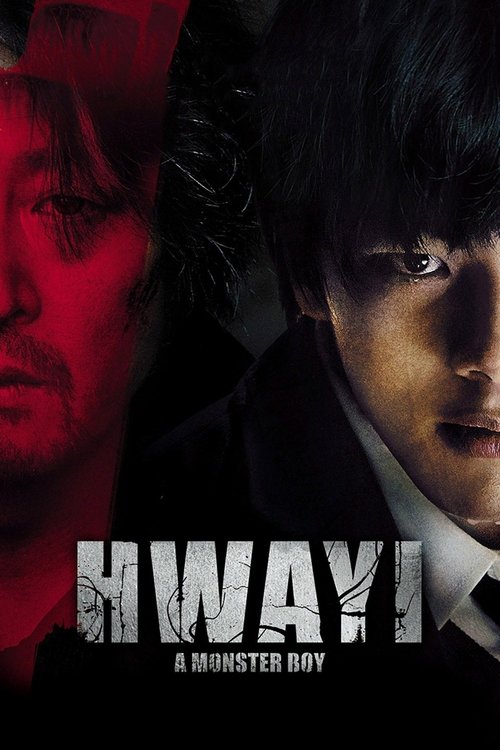
Hwayi: A Monster Boy
A blood-warm coming-of-age nightmare where a boy raised by five criminal fathers learns that the monster stalking his vision has his own face, and that love and cruelty were poured from the same cup.
Hwayi: A Monster Boy

Hwayi: A Monster Boy

화이: 괴물을 삼킨 아이

"Raised to be a killer."

09 October 2013 South Korea 125 min 7.4 (260)

Director: Jang Joon-hwan

Cast: Kim Yun-seok, Yeo Jin-goo, Cho Jin-woong, Jang Hyun-sung, Kim Sung-kyun

Crime Action Thriller Nature versus nurture, and the manufactured monster Fatherhood as ownership and inheritance The cycle of violence and revenge Identity and the right to know your own origin Lost adolescence and the impossibility of innocence
Budget: $16,400,000
Box Office: $16,400,000

Overview

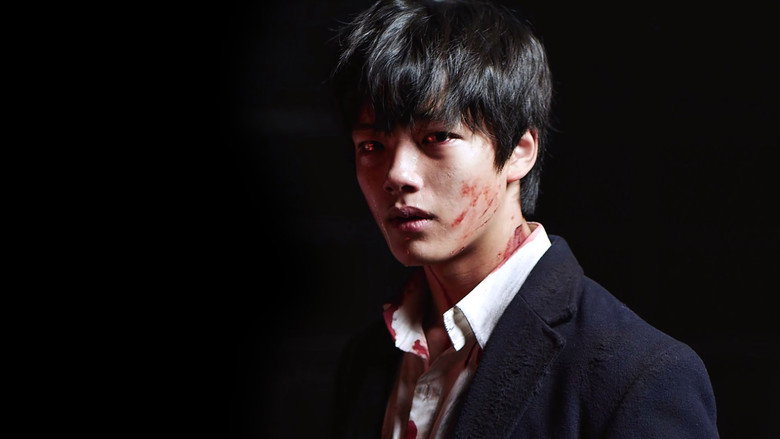
Hwayi: A Monster Boy (화이: 괴물을 삼킨 아이) is a 2013 South Korean crime thriller directed by Jang Joon-hwan, his first feature in ten years after the cult favourite Save the Green Planet. It centres on Hwayi (Yeo Jin-goo), a sixteen-year-old raised in an isolated house by five criminal men — a gang known as the Day Breakers — each of whom he calls "father." One teaches him to shoot, another to drive, another to fight, another to think coldly; together they have shaped a boy into an instrument.

Hwayi is not a captive in any simple sense. He is loved, in a warped and possessive way, and the film's early stretches are as much domestic comedy as crime picture: five hard men bickering over a teenager's schooling, appetite and moods. But Hwayi is haunted by a monster only he can see, a shape that appears at the edges of his vision whenever the world tilts toward violence. As he approaches adulthood, the questions he has never been allowed to ask — where he came from, why he was raised this way — begin pressing against the walls of the only life he knows.

When the gang's leader Seok-tae (Kim Yun-seok) decides the boy is ready and takes him along on a job, Hwayi crosses a threshold he cannot uncross. What he learns in the aftermath detonates the family he was given and sends him out into a world of fathers, debts and buried crimes, carrying a gun and a growing suspicion about what, exactly, has been raised inside him.
Core Meaning

Jang Joon-hwan made a genre thriller that is really an argument about inheritance. The film asks whether monstrousness is something a person is born with or something poured into them by the adults who claim to love them — and it answers, uncomfortably, that the distinction may not matter to the child who has to live inside the result. Hwayi is not corrupted by an enemy; he is corrupted by care. Every skill that makes him lethal was a gift from a father.

The director has been explicit about the intended takeaway. He said he hoped audiences would leave the cinema carrying the questions "Who am I? Where did the monster inside me come from, and why does it torment me?" The title itself — literally "Hwayi: The Child Who Swallowed a Monster" — frames the story not as possession by an external evil but as ingestion: the boy takes the monster in, digests it, and becomes it.

Underneath sits a bleak reading of patriarchy as such. Five men and one absent biological father all claim ownership of the same boy, and not one of them can imagine fatherhood as anything other than the transmission of appetite, debt and violence. The film's tragedy is that Hwayi's only available act of self-authorship is the very thing his fathers taught him.

Thematic DNA

Nature versus nurture, and the manufactured monster 30%
Fatherhood as ownership and inheritance 25%
The cycle of violence and revenge 20%
Identity and the right to know your own origin 15%
Lost adolescence and the impossibility of innocence 10%

Nature versus nurture, and the manufactured monster

The central engine of the film. Hwayi has been engineered by five specialists into a perfect weapon, then asked to be a normal son. The 'monster' he hallucinates is the film's literalisation of the question: is it a demon he was born carrying, or the accumulated residue of everything the adults poured into him?

Crucially, the film refuses a clean verdict. Hwayi's capacity for violence is demonstrably taught, but his capacity for relish is left ambiguous — and that ambiguity is the horror.

Fatherhood as ownership and inheritance

Hwayi has five fathers and, it emerges, more claims on his paternity than that. Each man's love takes the form of a lesson in harm, and each expects loyalty as the return on investment. Seok-tae in particular treats parenthood as authorship: he does not want a son so much as a continuation of himself.

The film systematically strips the word 'father' of tenderness until it means only debt, control and replication.

The cycle of violence and revenge

Once Hwayi turns on the men who made him, he can only pursue them with the methods they gave him. Every act of retribution confirms the fathers' work rather than repudiating it, and the body count spirals outward to touch people who never chose any of it.

Jang stages this as tragedy rather than catharsis: the avenger's competence is itself the proof of his ruin.

Identity and the right to know your own origin

Hwayi's rebellion begins not with a beating but with a question the household has forbidden — where did I come from? The film treats concealed origin as a form of violence in itself, arguing that a person denied their own history has been robbed of the raw material for a self.

Yeo Jin-goo plays this as a slow, physical dawning: a boy learning that the ground under his feet was never real.

Lost adolescence and the impossibility of innocence

Hwayi's brushes with ordinary teenage life — a girl, a school, an unremarkable street — read as glimpses of a life already foreclosed. The film's coming-of-age structure is deliberately perverse: the rite of passage into manhood is a killing, and adulthood arrives as contamination rather than freedom.

Character Analysis

Hwayi (화이)

Yeo Jin-goo

Archetype: Tragic protagonist / corrupted innocent turned avenger Key Trait: Preternatural composure hiding a boy who has never been allowed to want anything

Motivation

Initially, to be told the truth about where he came from and to be permitted an ordinary life; afterwards, revenge — and beneath that, the hope that punishing his makers might separate him from them.

Character Arc

Begins as a guarded, obedient teenager living inside a fiction he half-senses is false. A forced first kill and the discovery of his suppressed history shatter him, and he turns his fathers' training against them.

His arc is a descent disguised as an awakening: every step toward the truth about himself makes him more precisely the thing his fathers designed. By the end he has authority, autonomy and nothing recognisably his own.

Seok-tae (석태)

Kim Yun-seok

Archetype: Dark mentor / monstrous father-god Key Trait: Magnetic, paternal warmth deployed as a weapon

Motivation

To create and keep a son who is an extension of himself — to be, permanently, the origin of another person. Losing that authorship is the only thing he cannot tolerate.

Character Arc

The leader of the Day Breakers and the architect of Hwayi's education. He moves from possessive, almost tender paternal pride to open predation as the boy slips his control, revealing that his 'love' was always a claim of ownership.

Kim Yun-seok plays him as charismatic and domestically banal, which makes the character's cruelty land as something familiar rather than exotic.

All 3 characters and cast

Symbols & Motifs

The monster in Hwayi's vision

Meaning:

The film's title figure and its governing image. It represents the violence Hwayi has absorbed but not yet named — a projection of inherited capacity that appears before he can consciously admit what he is about to do.

Because only Hwayi sees it, it also stands for the privacy of moral corruption: no one else can witness the thing that is eating him.

Context:

It surfaces at moments of threat and temptation, particularly around acts of killing, and its behaviour changes as Hwayi's self-understanding changes — from something that torments him from outside to something indistinguishable from him.

The five fathers as a single distorted family

Meaning:

A parody of the nuclear family in which every parental function has been reassigned to a criminal specialty. Together they symbolise a society that reproduces itself by handing children its worst tools and calling it upbringing.

Context:

The early domestic scenes — meals, arguments, lessons — are shot with genuine warmth, which is precisely what makes the later revelations obscene. The audience is made complicit in finding this household charming.

The gun and the shooting lesson

Meaning:

The inheritance made physical. A firearm is the one heirloom these fathers have to pass down, and Hwayi's marksmanship is simultaneously his greatest gift and the proof that he was never raised for a life of his own.

Context:

Established early as a bonding ritual between Seok-tae and Hwayi, then reprised in the film's final movement, where the same skill is turned outward with no father left to approve of it.

'Swallowing' — the Korean title's central verb

Meaning:

괴물을 삼킨 아이 means the child who swallowed a monster. Ingestion rather than infection: the monstrous is taken in voluntarily, becomes part of the body, and cannot be expelled. It reframes Hwayi as both victim and vessel.

Context:

The idea is echoed throughout in imagery of feeding, appetite and the family table — the household literally feeds the boy into the shape it wants.

The orphanage and the missing origin

Meaning:

The gang's shared past in an orphanage marks them all as children of nobody, and explains the compulsion to manufacture a son. It symbolises the way abandonment reproduces itself down generations.

Context:

Revealed as backstory binding the five men together and connecting them, fatefully, to the family whose child they took.

The anonymous crowd

Meaning:

The ordinary world Hwayi was never allowed to belong to, and the only refuge available to him once he is finished. It symbolises the terrifying invisibility of the monster among us.

Context:

Used in the film's closing image, where Hwayi vanishes into a mass of unremarkable people — the story's last statement on how completely he has been absorbed by what he was made into.

Philosophical Questions

Is a person responsible for what they were made into?

Hwayi's every lethal capability was installed by adults before he could consent. The film grants him full moral agency in the second half — he chooses his targets — while never letting the audience forget who wrote the source code. It refuses to let responsibility rest entirely with either the boy or his makers.

Can love and abuse be the same act?

The Day Breakers are not sadists toward Hwayi; they feed him, argue over his schooling, take pride in him. The film's most disquieting proposition is that this affection is genuine and that it constitutes the abuse — that possessive love may be the most efficient instrument of harm available to a parent.

What is a self without an origin?

Denied his history, Hwayi has no ground from which to evaluate his own impulses. The film treats knowledge of where one came from as a precondition for having a self at all, and dramatises the discovery of origin as a detonation rather than a healing.

Does revenge ever end a cycle, or only extend it?

Every retributive act Hwayi performs uses a technique he was gifted by the man he is punishing. The structure argues that vengeance is the cycle's preferred mode of reproduction — the mechanism by which violence recruits its next generation while feeling, from the inside, like justice.

If the monster is inside us, is naming it a cure or a surrender?

Jang framed the film around the questions of where one's inner monster comes from and why it torments us. Hwayi's arc suggests a third, worse possibility: that recognising the monster may not free you from it but simply end the exhausting work of pretending it is someone else.

Alternative Interpretations

The monster as psychological symptom. The most common reading takes Hwayi's visions as dissociation — the mind of an abused child externalising the violence it has been taught, so it can be attributed to something other than the self. Under this reading the film is a clinical portrait of trauma, and the monster's eventual convergence with Hwayi is simply the moment denial fails.

Full ending explanation

Cultural Impact

Hwayi arrived at a moment when the Korean revenge thriller was a mature, internationally legible export — the terrain of Park Chan-wook's Vengeance Trilogy, I Saw the Devil and The Chaser (which had made Kim Yun-seok a star of the genre). Jang Joon-hwan's contribution was to graft that machinery onto a coming-of-age story, so that the familiar apparatus of pursuit and retribution doubles as a portrait of adolescent formation. Critics have described it as a blood-soaked coming-of-age tragedy that pushes the idea of toxic parenting to its logical extreme, and as a notably more controlled entry in a genre by then well established and comparatively safe.

Its greatest immediate cultural effect was on Yeo Jin-goo's career. A child actor transitioning to adult roles, he swept the new-actor prizes of the 2013–2014 Korean awards season for this performance, and the film became the pivot on which that transition turned. Kim Yun-seok's Seok-tae, meanwhile, extended his run of charismatic Korean screen predators.

Reception was genuinely split. Domestically it performed strongly, taking 1.2 million admissions in five days and finishing near 2.4 million with a warm audience rating, and Mowg's score won at the Blue Dragons. Internationally, the response was cooler: Variety judged that its 'bristling violence may initially whet genre appetites, but its oblique storytelling and pretentious dialogue will try fanboys' patience offshore,' calling the thriller muddled. That gap — a film that plays as emotionally coherent to viewers steeped in its idiom of fathers, debts and orphanages, and as opaque to those outside it — has become part of the film's reputation.

Over time it has been reassessed by cinephile audiences as a companion piece to Save the Green Planet: both are films about a damaged young man, a captor-captive intimacy, and a reality that may be a symptom. It remains a touchstone in discussions of the Korean cinema of patriarchy — the long line of films in which national trauma is transmitted through fathers to sons.

Audience Reception

What was praised. The performances dominate the positive response. Kim Yun-seok's Seok-tae was singled out as one of his most magnetic villains, and Yeo Jin-goo's turn was widely regarded as a breakout — the awards bore this out, with new-actor prizes at the Blue Dragon Film Awards, the Korean film critics' awards, the journalists' association awards and the Directors Cut Awards. Mowg's score, a Blue Dragon winner, was frequently cited as a major contributor to the film's dread. Audiences also responded to the ensemble of five fathers, whose domestic bickering gives the first act an unexpected warmth that makes the later turns land hard.

Where it divided viewers. The most persistent criticism concerns storytelling clarity. Variety called the film muddled, faulting its oblique construction and what the review termed pretentious dialogue, and predicting the violence would draw genre fans in before the narrative tested their patience. Many viewers echo this: the middle stretch is dense with backstory and shifting allegiances, and some plot connections are conveyed elliptically enough to require a second viewing — which the director has said was partly by design.

Contested elements. The intensity of the violence against and by a minor divided viewers, some finding it a necessary condition of the film's argument and others finding it exploitative. The tonal swings between family comedy and brutal thriller were similarly polarising. And the ending is the film's chief debating point, read alternately as hard-won freedom and as complete damnation.

Overall verdict. Domestically it was a solid commercial success — 1.2 million admissions in five days, roughly 2.39 million in total, about US$16.4 million, with strong netizen ratings — and it is generally regarded as an ambitious, superbly acted, structurally overloaded thriller. Reactions abroad ran cooler than at home, and the film's standing has been steadier among viewers who value its psychological argument than among those who came for a clean revenge machine.

Interesting Facts

  • The film was Jang Joon-hwan's first feature in ten years, following his 2003 cult film Save the Green Planet, and his return was one of the most anticipated events of the 2013 Korean film year.
  • Jang stated in interviews that he wanted audiences to leave the theatre carrying the questions: 'Who am I? Where did the monster inside me come from, and why does the monster torment me?'
  • In an interview with Ten Asia, Jang said he intended to make an accessible, thrilling genre film while also planting 'many hidden seeds' so that the movie would look different on each viewing.
  • The director has said he deliberately restrained his own stylistic flourishes on this production, focusing instead on serving his actors' performances and on delivering genre pleasures.
  • The film opened in South Korea on 9 October 2013 and drew 1.2 million admissions in its first five days.
  • It finished its domestic run with 2,394,418 admissions and earned roughly US$16.4 million at the box office.
  • Yeo Jin-goo, then a teenager, won Best New Actor honours for the role at the Blue Dragon Film Awards, the Korean Association of Film Critics Awards, the Korea Journalists Association film awards and the Directors Cut Awards, among others.
  • Composer Mowg won the Best Music award at the Blue Dragon Film Awards for his score.
  • The ensemble of criminal 'fathers' assembled several of the most in-demand Korean character actors of the era — Kim Yun-seok, Cho Jin-woong, Jang Hyun-sung, Kim Sung-kyun and Park Hae-joon — opposite Yeo Jin-goo as the boy.

Frequently Asked Questions

Explore More About This Movie

Dive deeper into specific aspects of the movie with our detailed analysis pages

Comments (0)

Leave a comment

No comments yet. Be the first to share your thoughts!

Similar Movies