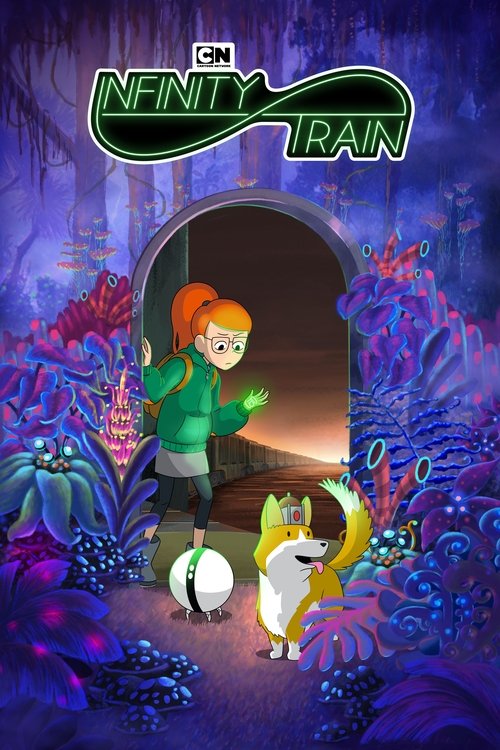
Infinity Train
A rhythmic carousel of steel and shadows where green numbers pulse like heartbeats, guiding fractured souls through a kaleidoscope of pocket dimensions toward the cold, hard light of self-acceptance.
Infinity Train

Infinity Train

05 August 2019 — 15 April 2021 United States of America 4 season 40 episode Canceled ⭐ 8.4 (290)
Cast: Ashley Johnson, Owen Dennis, Jeremy Crutchley, Kirby Howell-Baptiste, Kyle McCarley
Animation Sci-Fi & Fantasy Action & Adventure
Identity and Autonomy The Nature of Trauma and Grief Accountability vs. Victimhood Systems of Authority Codependency and Communication

Overview

Infinity Train is a high-concept animated anthology series that unfolds aboard a massive, mysterious locomotive traversing a desolate wasteland. Each season, known as a "Book," introduces new passengers who find themselves abruptly transported onto the train during moments of profound personal crisis or emotional stagnation. The train serves as a surreal, interdimensional rehabilitation center where every car contains a unique, self-contained world—ranging from a kingdom of talking corgis to a landscape made of unfinished sketches.

The core mechanic of the series is a glowing green number on each passenger's palm, which acts as a literal quantification of their emotional baggage. To exit the train, passengers must confront their deep-seated traumas and evolve as individuals, causing their numbers to count down toward zero. However, the train is far from safe; it is filled with "denizens" (entities born of the train) and lethal "Ghoms" that prey on those who refuse to change. Over four seasons, the show shifts from a mystery-adventure into a dark psychological drama, exploring the consequences of refusing growth and the ethics of a system that forces personal evolution through survival.


Core Meaning

The series serves as a profound meditation on the non-linear nature of healing and the radical necessity of accountability. Through its central metaphor of an endless train, the creators suggest that while trauma can feel like an inescapable loop, the only way off the tracks is through active, often painful, self-confrontation. It posits that growth cannot be forced or simulated; it requires the genuine willingness to admit one's own flaws and the empathy to recognize the humanity in others, regardless of whether they are "real" people or "denizens" of the system.

Thematic DNA

Identity and Autonomy 25%
The Nature of Trauma and Grief 25%
Accountability vs. Victimhood 20%
Systems of Authority 15%
Codependency and Communication 15%

Identity and Autonomy

Throughout the series, characters grapple with who they are versus who they are expected to be. This is most powerfully explored in Book 2 through Lake (MT), a reflection who refuses to be a mere copy of another person. The theme evolves from Tulip’s simple self-discovery to a broader philosophical argument for the rights of the individual against deterministic systems.

The Nature of Trauma and Grief

The train itself is a manifestation of unresolved pain. Characters like Amelia and Simon illustrate how grief can turn into a destructive force if one tries to control or overwrite the past. The series emphasizes that healing is not about returning to how things were, but adapting to a world that has been irrevocably changed.

Accountability vs. Victimhood

A critical shift occurs in Book 3, where the series examines the radicalization of youth. It contrasts Grace and Simon, showing how two people can use the same traumatic environment to either seek redemption or justify cruelty. The show argues that past pain does not excuse present harm, and that choosing to stay "static" is an act of moral regression.

Systems of Authority

The train is a rigid, often uncaring bureaucracy. The show critiques the idea of quantifiable morality (the Numbers), suggesting that a system designed to "fix" people can be just as dehumanizing as the problems it seeks to solve. This is highlighted through One-One's dual nature as a helpful guide and a detached, algorithmic administrator.

Codependency and Communication

Book 4 focuses on the friendship between Ryan and Min-Gi, exploring how toxic relationship patterns—such as projection and fear of abandonment—hinder individual growth. It demonstrates that true connection requires the courage to be honest with both oneself and one's partner.

Character Analysis

Tulip Olsen

Ashley Johnson

Archetype: The Analytical Hero
Key Trait: Pragmatic Intellectualism

Motivation

Originally driven by a desperate need to reach game design camp, her motivation shifts to restoring the train's order and helping her companions, Atticus and One-One.

Character Arc

Initially a logical but self-absorbed teen fleeing her parents' divorce, Tulip learns to embrace emotional uncertainty. She moves from trying to "solve" the train like a game to understanding it as a journey of empathy.

MT / Lake

Ashley Johnson

Archetype: The Rebel / Existentialist
Key Trait: Fierce Independence

Motivation

Her primary drive is survival and freedom from the Reflection Police (Flecs) and the train's deterministic rules.

Character Arc

A reflection who gains sentience and escapes the Mirror World. Her arc is a harrowing struggle for recognition as a person rather than a reflection, eventually renaming herself Lake to cement her autonomy.

One-One

Jeremy Crutchley (Glad) / Owen Dennis (Sad)

Archetype: The Fragmented Mentor
Key Trait: Bipolar Logic

Motivation

Initially searching for his "mother," his motivation becomes the efficient maintenance of the train's therapeutic mission.

Character Arc

A robot split into two personalities (Glad-One and Sad-One) representing optimism and nihilism. He eventually regains his position as the Conductor, becoming a more stable but still emotionally detached guardian of the train.

Grace Monroe

Kirby Howell-Baptiste

Archetype: The Fallen Leader / Antihero
Key Trait: Performative Charisma

Motivation

Starts with a desire for power and validation, which evolves into a humble effort to undo her mistakes and protect the children she misled.

Character Arc

The charismatic leader of a cult (The Apex) that believes high numbers are a sign of divinity. Her arc is one of radical deconstruction as she realizes the harm she has caused and begins the grueling process of true redemption.

Simon Laurent

Kyle McCarley

Archetype: The Tragic Antagonist
Key Trait: Intellectual Rigidity

Motivation

Driven by a crippling fear of abandonment and a need for absolute control over his reality, leading him to reject any truth that challenges his ego.

Character Arc

A former companion of Grace who falls into a downward spiral of denial. Unlike other characters, Simon refuses to change, becoming more murderous and delusional until his trauma completely consumes him.

Symbols & Motifs

The Glowing Number

Meaning:

A physical manifestation of a passenger's psychological burden and their progress toward emotional resolution.

Context:

Appearing on the hand of every passenger, the number fluctuates based on the character's actions and realizations, serving as the show's primary visual metric for character development.

Ghoms

Meaning:

The literal consumption of the soul by stagnation and fear; they represent the ultimate consequence of refusing to move forward.

Context:

These insectoid-canine creatures inhabit the Wasteland outside the train and hunt passengers who have given up on their journey or tried to escape the system through denial.

Mirror World

Meaning:

The internalized self-image and the struggle for personhood beyond societal reflection.

Context:

Used extensively in Book 2 to explore Lake’s quest for a unique identity, separate from the person she was originally meant to mirror.

Memory Tapes

Meaning:

Objective truth and the danger of nostalgic distortion.

Context:

Stored in the Engine, these tapes play back a passenger's life. Characters often try to hide in their tapes or rewrite them to avoid facing their mistakes.

Memorable Quotes

I'm not a Tulip! I'm my own person!

— MT / Lake

Context:

Book 2, Episode 10: "The Train Car," as she fights for her right to exist independently from the passenger she mirrors.

Meaning:

The definitive declaration of self-actualization. It marks the moment a character breaks free from a predetermined role to define their own existence.

The train is whatever we make it.

— Simon Laurent

Context:

Book 3: Used as a mantra by the Apex to justify their mistreatment of train denizens.

Meaning:

A chilling example of how subjective reality can be used to justify cruelty. It highlights the danger of discarding external truth for personal convenience.

You can't change the past, but it will be okay.

— Tulip Olsen

Context:

Book 1, Episode 10: "The Engine," as she finally accepts her parents' divorce and prepares to return home.

Meaning:

The core thesis of the series regarding acceptance. It acknowledges that while trauma is indelible, it doesn't have to define one's future.

Episode Highlights

The Chrome Car

S1E7

Tulip meets her own reflection, who has gained her own consciousness. This episode introduces the series' most complex character (MT/Lake) and shifts the show into existential territory.

Significance:

It establishes that the train's "constructs" are sentient beings with their own rights, setting the stage for the moral conflicts of the following seasons.

The Ball Pit Car

S1E8

A seemingly fun episode that ends in a shocking tragedy when Atticus is transformed into a mindless Ghom by the Conductor. This was the moment the series proved it was not a typical children's show.

Significance:

It raises the stakes of the train's dangers and serves as the catalyst for Tulip's final confrontation with Amelia.

The Engine

S1E10

The season finale where Tulip confronts the "False Conductor," Amelia. Instead of a standard battle, it becomes a dialogue on grief and the futility of trying to rewrite the past.

Significance:

It resolves Tulip's arc and reveals the true purpose of the train while leaving Amelia as a recurring figure of failed redemption.

The New Apex

S3E10

The climax of the Grace/Simon conflict. Simon’s number reaches an impossible height before he is killed by a Ghom, marking one of the darkest endings in modern animation.

Significance:

It serves as a warning about the finality of refusing empathy and marks Grace's commitment to fixing the cult she built.

The Art Gallery Car

S4E6

A surreal trip through the shared memories of Ryan and Min-Gi, visualized as abstract paintings. It forces them to confront the toxicity of their codependency.

Significance:

It is the emotional peak of Book 4, utilizing the show's visual creativity to dissect a failing friendship.

Philosophical Questions

Can personal growth be quantified by an external system?

The series explores this through the Numbers, showing that while they provide a goal, they can also lead to 'gaming the system' or a false sense of righteousness, as seen with the Apex.

What is the boundary between a 'person' and a 'construct'?

Through Lake and the denizens, the show asks if consciousness and the capacity for suffering are enough to grant moral rights, regardless of biological origin.

Alternative Interpretations

Many viewers and critics interpret Lake's arc as a trans allegory, specifically focusing on her rejection of a 'birth identity' and the struggle for a name and body that reflects her true self. Others view the train as a secular Purgatory, where the 'wasteland' is a literal void and the passengers are souls caught in a recursive loop of their own making. A more cynical 'Simulation Theory' suggests the entire world is a massive AI experiment where the passengers are merely data points for a cosmic learning algorithm managed by One-One.

Cultural Impact

Infinity Train is a landmark in Western animation for its refusal to talk down to its audience. It successfully bridged the gap between children's cartoons and adult psychological drama, influencing a wave of serialized, theme-heavy animation. Its legacy, however, is heavily tied to the 'Streaming Era Purge' of 2022. Its sudden removal from HBO Max for tax write-offs became a flashpoint in the discussion of digital preservation and creators' rights. The show's survival through digital storefronts and fan advocacy has made it a symbol of the 'cult classic' in the age of algorithmic cancellations.

Audience Reception

The series received universal critical acclaim for its writing and voice acting (particularly Ashley Johnson). Audiences were initially drawn by the mystery of the train but stayed for the emotional intensity of Books 2 and 3. While some viewers found the lighter tone of Book 4 jarring after the tragedy of Book 3, most appreciated it as a necessary 'breather' and a nuanced look at friendship. The cancellation and subsequent removal from streaming services transformed the fan base into a highly organized activist group, keeping the show's memory alive through 'Infinity Train Day' and trend campaigns.

Interesting Facts

  • The series began as a viral 2016 pilot on Cartoon Network's YouTube channel, which gained millions of views and a massive fan campaign before being greenlit.
  • Creator Owen Dennis was a writer and storyboard artist on 'Regular Show' before creating Infinity Train.
  • Each season is referred to as a 'Book' and features a different color scheme and musical tone to match its protagonist's emotional state.
  • Book 5 was planned as a prequel movie about Amelia's rise to power, but it was canceled by HBO Max for reportedly not having a 'child entry point.'
  • In 2022, the series was part of a controversial 'purge' by Warner Bros. Discovery, where it was removed from HBO Max and its social media presence was scrubbed, leading to intense industry-wide backlash.

Easter Eggs

The 'Infinity' motif in Adventure Time

Fellow animator Cole Sanchez pointed out that Adventure Time featured a train with infinity symbols, which initially worried Owen Dennis until he realized the themes were distinct.

Amelia's shell code

The technical jargon Amelia uses to manipulate the train often references real-world coding and game design, mirroring Tulip's own passion.

⚠️ Spoiler Analysis

Click to reveal detailed analysis with spoilers

Frequently Asked Questions

Explore More About This Movie

Dive deeper into specific aspects of the movie with our detailed analysis pages

Comments (0)

Leave a comment

No comments yet. Be the first to share your thoughts!