
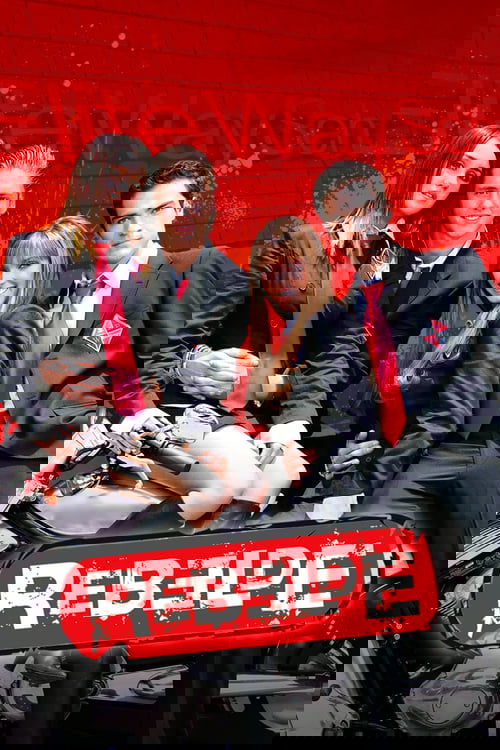
Rebelde
High-society uniforms meet untamed pop-rock spirits in a vibrant explosion of teenage angst, where music acts as a bridge across deep social divides and the suffocating shadows of parental legacy.
Rebelde

Rebelde

04 October 2004 — 09 June 2006 Mexico 3 season 440 episode Ended ⭐ 8.4 (5,177)
Cast: Anahí, Alfonso Herrera, Dulce María, Christopher Von Uckermann, Maite Perroni
Drama Comedy
Class Warfare and Social Stratification The Search for Identity vs. Parental Legacy Music as a Transcendent Force Loyalty and Chosen Family

Overview

Rebelde is a sprawling Mexican teen drama set within the prestigious walls of Elite Way School (EWS), a private boarding academy for the children of the country's wealthiest families. The series follows a diverse group of teenagers, notably Mia, Miguel, Roberta, Diego, Lupita, and Giovanni, as they navigate the treacherous waters of adolescence, social hierarchy, and the crushing weight of family expectations. While the school is designed to produce the next generation of leaders, it becomes the stage for a revolution when these six students from disparate social classes form a secret band called RBD.

Across three seasons, the narrative expands from typical high-school rivalries to deeper conflicts involving La Logia (The Lodge)—a secret society of elite students dedicated to purging the school of scholarship students. The story tracks the slow dissolution of class barriers as the band members learn to prioritize loyalty and artistic expression over their parents' prejudices. By the final season, the characters transition from rebellious students to mature young adults, finding that their true identity lies not in their surnames, but in the music that united them.
Core Meaning

At its heart, Rebelde is a critique of pre-determined destiny. The creators aimed to show that "rebellion" is not merely about breaking rules, but about the courage to be authentic in a world that demands conformity. Through the formation of RBD, the series suggests that shared passion and art can dismantle systemic classism and heal generational trauma. The complete story arc emphasizes that breaking free from the psychological chains of one's parents is the ultimate act of adulthood.

Thematic DNA

Class Warfare and Social Stratification 30%
The Search for Identity vs. Parental Legacy 25%
Music as a Transcendent Force 25%
Loyalty and Chosen Family 20%

Class Warfare and Social Stratification

The central tension lies between the Becados (scholarship students) and the wealthy elite. Throughout the seasons, this evolves from physical bullying by La Logia to a more nuanced internal struggle where characters like Miguel and Giovanni must reconcile their humble origins with their newfound social status.

The Search for Identity vs. Parental Legacy

Almost every character is defined by their relationship with a powerful parent—whether it's Mia's overprotective father, Diego's corrupt politician father, or Roberta's superstar mother. The series tracks their journey toward psychological independence.

Music as a Transcendent Force

RBD is more than a plot point; it serves as a visual and auditory metaphor for harmony. Music is the only space where the characters' social status is irrelevant, acting as their primary tool for emotional survival and public protest.

Loyalty and Chosen Family

As biological families fail them, the protagonists form a deep, unbreakable bond. The series highlights that friendship is the most effective defense against systemic corruption and personal despair.

Character Analysis

Mía Colucci

Anahí

Archetype: The Spoiled Princess / The Empath
Key Trait: Charismatic Empathy

Motivation

Initially motivated by popularity and her father's approval; later moves toward finding her mother and protecting the unity of RBD.

Character Arc

Mía begins as a superficial, self-centered trendsetter. Over 440 episodes, she transforms into a compassionate protector of her friends, eventually discovering the truth about her mother and learning that true value isn't found in material wealth.

Miguel Arango

Alfonso Herrera

Archetype: The Avenger / The Hero
Key Trait: Noble Integrity

Motivation

Avenging his father's death, which eventually evolves into a desire to protect those he loves and succeed on his own merits.

Character Arc

Entering EWS on a scholarship with a vendetta against the Colucci family, Miguel's arc is one of redemption through love. He abandons his quest for revenge when he realizes his feelings for Mía are more powerful than his hatred for her father.

Roberta Pardo

Dulce María

Archetype: The Rebel / The Truth-Teller
Key Trait: Fierce Independence

Motivation

Autonomy and authenticity; she wants to be seen as Roberta, not just Alma Rey's daughter.

Character Arc

Fiercely anti-establishment, Roberta uses her rebellion as a shield against the shadow of her famous mother. Her journey involves softening her edges to allow for intimacy and finding a constructive way to use her voice through music.

Diego Bustamante

Christopher Von Uckermann

Archetype: The Puppet / The Independent
Key Trait: Sensitive Resilience

Motivation

Breaking the cycle of his father's corruption and emotional abuse.

Character Arc

The son of a powerful, abusive politician, Diego spends much of the series trying to meet impossible standards. His arc concludes with him finally standing up to his father and choosing a career in music over a coerced political future.

Symbols & Motifs

The Red Tie

Meaning:

Symbolizes both conformity and rebellion.

Context:

Worn loosely or modified by the students, the tie represents their shared identity as EWS students while its disarray signals their refusal to follow the school's strict codes of conduct.

Mia's Forehead Star

Meaning:

Symbolizes vulnerability masked by vanity.

Context:

Mia Colucci frequently wears a small sticker star on her forehead; while it appears as a fashion statement of a "princess," it often highlights her need for attention and her inner loneliness.

The Lodge Logo (La Logia)

Meaning:

Symbolizes systemic oppression and elitism.

Context:

The branding and masked presence of this secret society represent the invisible barriers that scholarship students face in elite environments.

Memorable Quotes

Y soy rebelde cuando no sigo a los demás.

— RBD (Theme Song)

Context:

The opening lyrics of the series, serving as a recurring anthem for the characters' personal growth and defiance. Season 1-3.

Meaning:

The show's definitive manifesto: "And I am a rebel when I don't follow the others."

Yo digo R, tú dices BD!

— The Group

Context:

Used during concerts and pivotal group moments to rally the band and the audience. Season 1 finale onwards.

Meaning:

A call to unity and a symbol of the fandom's collective power.

Qué difícil es ser yo.

— Mía Colucci

Context:

Originally used as a comedic, superficial line about her beauty, it takes on a tragic meaning in later seasons as she deals with intense family trauma. Season 1.

Meaning:

"How hard it is to be me."

Episode Highlights

Capítulo 1

S1E1

The introduction of the main cast as they arrive at Elite Way School. It establishes the immediate friction between Roberta and Mía, and Miguel's arrival with a secret mission.

Significance:

Sets the foundational social dynamics and the central mystery of Miguel's vendetta.

The Lodge Exposed

S1E215

The Season 1 finale where the band finally identifies the members of La Logia and the secret society is dismantled.

Significance:

This is a major turning point where the scholarship students prove they cannot be intimidated, leading to the official formation of the band.

The Reality of Marina

S2E100

Mía finally learns that her mother, Marina Caceres, is alive and was a drug addict, shattering the "perfect" image her father created.

Significance:

Crucial for Mía's development from a girl into a woman, forcing her to confront real-world pain.

Diego Stands Up

S3E115

Diego finally confronts his father, Leon Bustamante, about his corruption and emotional manipulation during a public event.

Significance:

The culmination of Diego's 3-season struggle for independence.

The Graduation / Final Concert

S3E440

The students graduate from Elite Way School and the band performs one last time as students before heading into the real world.

Significance:

A symbolic transition where the characters leave their protected "bubble" to face the world as the phenomenon they created.

Philosophical Questions

Can true equality exist in an environment built on hierarchy?

The series explores this through the EWS scholarship program, showing that even when the 'Lodge' is defeated, social stigmas and systemic disadvantages remain part of the students' daily lives.

To what extent is our identity 'inherited'?

The show constantly pits the characters' innate desires against their family 'brands,' questioning if a Bustamante can ever truly be something other than a politician, or a Colucci something other than a socialite.

Alternative Interpretations

Critics have often debated whether the show is truly 'rebellious' or if it ultimately reinforces the status quo. One interpretation suggests that despite the characters' defiance, they remain within a neoliberal framework where their 'rebellion' is commodified into pop music and merchandise. Another perspective views the show as a modern Greek tragedy, where the children are fated to pay for the sins and secrets of their parents (Miguel's father's suicide, Mía's mother's disappearance), and the band is their only way to break the cycle of karma.

Cultural Impact

Rebelde was more than a TV show; it was a cultural epoch for the "Millennial" generation in Latin America, Brazil, and Spain. It pioneered the 360-degree entertainment model, where a fictional band transcends the screen to become a global touring act. The 'Rebelde Phenomenon' influenced fashion (the denim-skirt-and-boots trend), language (introducing 'fresa' slang to a global audience), and even social politics. Christian Chávez's coming out during the show's peak served as a significant moment for LGBTQ+ visibility in the conservative Mexican media landscape. Its legacy continues through the 2023 sold-out 'Soy Rebelde' stadium tour, proving its enduring emotional resonance.

Audience Reception

The series was a massive commercial success but received mixed reviews from critics who found the soap-opera tropes melodramatic. However, the audience reception was unprecedentedly loyal. Fans praised the chemistry between the leads and the relatability of the characters' emotional struggles. While the first season is often cited as the strongest due to the 'The Lodge' mystery, the later seasons maintained high ratings through the intense romantic arcs of 'Mía/Miguel' and 'Roberta/Diego'. Criticism often focused on the repetitive nature of the plot across 440 episodes and the sometimes exaggerated portrayal of school life.

Interesting Facts

  • The band RBD became a real-life musical phenomenon, selling over 15 million albums and becoming one of the best-selling Latin groups in history.
  • The series was originally going to be titled 'Ricos y Malcriados' (Rich and Spoiled) before settling on 'Rebelde'.
  • Belinda was the producers' first choice for the role of Mía Colucci, but she turned it down, leading to Anahí's iconic casting.
  • The school used for filming the exterior of Elite Way School is actually a real country club in Mexico City called 'Club de Golf Bosques'.
  • Mattel released a line of Barbie dolls based on the three main female characters (Mía, Roberta, and Lupita) in 2007.
  • Christian Chávez made history during the show's run by becoming one of the first major Mexican stars to publicly come out as gay.

Easter Eggs

Cameos from the original Argentine cast

Occasional nods to Rebelde Way, the original series by Cris Morena, were hidden in character names and background details to honor the show's origins.

Netflix Sequel Connection

The 2022 Netflix series 'Rebelde' is a direct sequel; Celina Ferrer (Mía's best friend) appears as the Principal, and the original RBD uniforms are kept in a museum within the school.

⚠️ Spoiler Analysis

Click to reveal detailed analysis with spoilers

Frequently Asked Questions

Explore More About This Movie

Dive deeper into specific aspects of the movie with our detailed analysis pages

Comments (0)

Leave a comment

No comments yet. Be the first to share your thoughts!