Skip to content
Iron Man 3
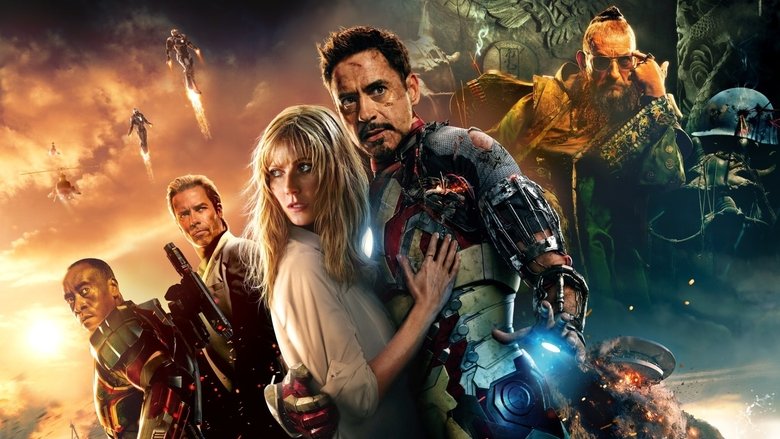
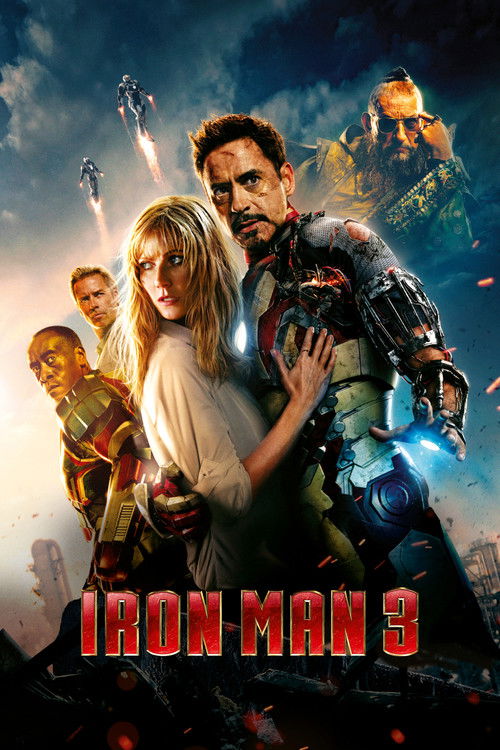
A snow-dusted Christmas noir in a blockbuster's armor: a sleepless genius, haunted by a wormhole in the sky, finds that the man inside the metal shell is the only weapon he has left.
Iron Man 3

Iron Man 3

"Unleash the power behind the armor."

18 April 2013 United States of America 130 min 6.9 (23,841)

Director: Shane Black

Cast: Robert Downey Jr., Gwyneth Paltrow, Don Cheadle, Guy Pearce, Rebecca Hall

Action Adventure Science Fiction Trauma and PTSD Identity and false faces Manufactured fear and media manipulation We create our own demons Ingenuity over technology
Budget: $200,000,000
Box Office: $1,215,577,205

Overview

After the Battle of New York, Tony Stark is no longer the untouchable showman he used to be. He can't sleep, he has panic attacks, and he spends his nights in the workshop building suit after suit, which puts a strain on his relationship with Pepper Potts, who now runs Stark Industries. Meanwhile a terrorist called the Mandarin is carrying out a string of bombings that no one can explain and taunting America through hijacked television broadcasts.

When the violence hits close to home, Tony dares his enemy in public and pays for it. His Malibu mansion is destroyed, his suit is broken, and he wakes up stranded in snowy rural Tennessee with no lab and no support. With only his wits and the help of an unlikely young ally, he has to work out what links the bombings to a secret, unstable technology called Extremis, which scientist Maya Hansen and the ambitious think-tank founder Aldrich Killian both have a stake in.

Shane Black directs the film like a wisecracking buddy thriller set at Christmas. It has as much dialogue and character comedy as it has spectacle, and it asks what Tony Stark is actually worth once you take away his toys.

Core Meaning

Shane Black takes the superhero apart to find the man inside. The film is openly about trauma and PTSD. Tony carried a nuke through a wormhole, and now he hides in endless armor instead of facing his fear. Black and co-writer Drew Pearce said they wanted to explore "false faces" and Tony's dual identity: he defines himself through the mask of Iron Man. The Mandarin, a terrorist who turns out to be a performance, mirrors that idea. Both men hide behind a constructed image.

The message is that identity is not equipment. When Tony finally says he is Iron Man with no suit on at all, the film argues that heroism comes from ingenuity, responsibility and the courage to face your own demons, not from the metal. The film also warns that fear can be manufactured and sold, both to the public and to the self.

Thematic DNA

Trauma and PTSD 30%
Identity and false faces 25%
Manufactured fear and media manipulation 20%
We create our own demons 15%
Ingenuity over technology 10%

Trauma and PTSD

After New York, Tony has insomnia, panic attacks and compulsive suit-building. The film treats his anxiety as real and doesn't mock it. Critics said this broke with the "tough guy" superhero model and showed what heroism costs.

Identity and false faces

Is Tony the suit or the man? The Mandarin twist reflects that question, because the villain's face is a costume worn by an actor. The writers built the film around dual personas and masks.

Manufactured fear and media manipulation

Killian invents a terrorist figurehead to cover up Extremis failures and to profit from both sides of a war. The film comments on how public fear can be scripted and broadcast.

We create our own demons

Tony's opening narration frames the story. Years earlier he arrogantly brushed off Killian and Maya, and those snubs created the threats he now faces. His past carelessness comes back to hit him.

Ingenuity over technology

With the suit broken for much of the second act, Tony has to rely on improvisation, hardware-store gadgets and his mind. The film insists the mechanic matters more than the machine.

Character Analysis

Tony Stark / Iron Man

Robert Downey Jr.

Archetype: Wounded hero Key Trait: Improvisational genius masking anxiety

Motivation

Protecting Pepper and redeeming the damage his old arrogance caused.

Character Arc

He starts the film traumatized, sleepless and hiding in his armor. Stripped of his tech, he rebuilds himself through his wits, faces his past mistakes and ends by letting go of the reactor and the suits while claiming his identity as Iron Man.

Pepper Potts

Gwyneth Paltrow

Archetype: Partner / hero in her own right Key Trait: Grounded strength

Motivation

Loving Tony while demanding that he face his problems. She also refuses to be a prize.

Character Arc

She goes from frustrated partner to a captive given Extremis, and then to the person who saves Tony and defeats Killian herself.

All 5 characters and cast

Symbols & Motifs

The arc reactor

Meaning:

Tony's dependence on armor, and the literal and emotional shrapnel still lodged in his heart.

Context:

In the final act, Tony has the shrapnel surgically removed and throws the reactor into the sea. It shows that he no longer needs a device in his chest to be himself.

The endless suits (the Iron Legion)

Meaning:

Compulsion, avoidance and the armor Tony builds around his trauma. He called it a "cocoon."

Context:

Tony builds dozens of suits during sleepless nights. In the climax, the "House Party Protocol" sends them all out, and at the end he destroys them as a gesture to Pepper.

The Mandarin's persona

Meaning:

A false face. It shows how easily fear can be manufactured and how an image can replace the truth.

Context:

The persona appears in slick propaganda videos, and then the audience learns it is a performance by actor Trevor Slattery that Killian arranged.

Christmas and snow

Meaning:

Isolation, a stripped-down existence and the chance of renewal. This is typical of Shane Black's holiday-set thrillers.

Context:

The film is set at Christmas and Tony is stranded in snowy Rose Hill, Tennessee. Small touches, like a stocking hung for JARVIS and a giant stuffed bunny, mark the season.

Extremis glow

Meaning:

Human ambition overheating. It is power without stability, and it corrupts the body.

Context:

People given Extremis glow red-hot and sometimes explode. The film uses this to explain the "terrorist" bombings.

Memorable Quotes

We create our own demons.
— Tony Stark

Context

Tony's voice-over opens the film, introducing it as a story told looking back.

Meaning

The film's thesis. It also nods to the classic Iron Man comic "Demon in a Bottle." Tony's villains are the consequences of what he himself did.

I am Iron Man.
— Tony Stark

Context

It's the final line, spoken after Tony gives up the reactor and the suits.

Meaning

It echoes the last line of the first film. Here it means Iron Man is who Tony is, not what he wears.

Philosophical Questions

Is identity defined by what we have or by who we are?

The film takes away Tony's house, suit and lab to test whether "Iron Man" survives. The final line answers that it does, and that identity is internal.

Do we create our own enemies?

Killian and Maya's grievances come straight from Tony's thoughtless 1999 behavior. The film suggests that our villains are often people we carelessly shaped.

How much of what we fear is manufactured?

The Mandarin is a staged image designed to terrify a nation and hide someone else's agenda. The film asks viewers to question the narratives the media gives them.

Can technology cure trauma, or does it only armor it?

Tony's suits are coping mechanisms that isolate him. The film suggests healing needs vulnerability and connection, not more armor.

How It Ends

Alternative Interpretations

Satire or betrayal? One reading sees the fake Mandarin as a sharp comment on how governments and corporations stage enemies to sell fear and weapons, and on how a media image can replace reality. Another reading treats it as a bait-and-switch that wastes the comics' iconic villain.

Full ending explanation

Cultural Impact

Iron Man 3 was the first film after The Avengers and opened Marvel's Phase Two. It took the MCU's first major event and dealt with its psychological fallout. Critics have called its portrayal of PTSD "a huge leap forward for superhero movies," because it offers an alternative to the invulnerable tough-guy hero.

Its box office of more than $1.215 billion made it the second-biggest film of 2013. It broke opening-day records in China, where an extended cut was released. The Mandarin twist became one of the most argued-about decisions in franchise history. It was praised as a subversive satire of manufactured terror and attacked by fans as a betrayal of Iron Man's greatest comic villain. Marvel kept returning to it: the One-Shot All Hail the King revisited Trevor Slattery, and later projects such as Wonder Man have been described as "fixing" the twist. Retrospective writers increasingly call the film the MCU's "boldest character study."

Audience Reception

The film is Certified Fresh at 79% on Rotten Tomatoes, with a 78% audience score, and audiences gave it an "A" CinemaScore. Viewers praised Downey's vulnerable, funny performance, Shane Black's witty dialogue and buddy-comedy energy, the bond between Tony and the kid Harley in the Tennessee section, and the unusually honest treatment of anxiety.

Criticism centers on the Mandarin twist. It split fans into those who loved it and those who called it "sacrilegious." Others criticized the Extremis mechanics, the crowded suit-heavy climax and the neat ending in which Tony simply gives up the suits. Overall, it remains one of the MCU's most divisive entries, but it made a lot of money and its reputation has improved as a character-driven outlier.

Interesting Facts

  • Principal photography ran from May 23 to December 17, 2012, mainly at EUE/Screen Gems Studios in Wilmington, North Carolina.
  • Other Wilmington locations included the Cape Fear Country Club, the Port of Wilmington, the Cape Fear River, New Hanover Regional Medical Center, Stevens Hardware and Wilmington International Airport.
  • Production was halted on August 15, 2012, when Robert Downey Jr. injured his ankle and neck during a stunt. He jumped about 12 feet between platforms for the climax and broke his ankle, which stopped filming for roughly five to six weeks.
  • The shot in which Downey broke his ankle is the same one used in the final film.
  • Producer Stephen Broussard said the injury delay gave the team time to refine the third act. It also let composer Brian Tyler start the score earlier.
  • An extended version of the film was made specifically for Chinese audiences.
  • The film grossed more than $1.215 billion worldwide. It was the second-highest-grossing film of 2013 and the sixteenth film ever to pass $1 billion.
  • Shane Black and Drew Pearce built the Mandarin twist around the theme of 'false faces' and Tony's dual identity. The Marvel One-Shot 'All Hail the King' later revisited Trevor Slattery.

Easter Eggs

"We all create our own demons"

This refers to the famous comic arc "Demon in a Bottle," about Tony Stark's alcoholism.

Ho Yinsen at the 1999 party

In the flashback, Tony meets Yinsen, who later helps him build the first suit. It pays off Yinsen's line in Iron Man (2008) about meeting a drunk Tony at a conference.

The name "Ellis"

President Ellis is named after Warren Ellis, who wrote the Extremis comic storyline the film loosely adapts.

JARVIS's Christmas stocking

Tony hangs a stocking for JARVIS in red, green and yellow, which are the colors of the Vision, the character JARVIS later becomes.

Frequently Asked Questions

Explore More About This Movie

Dive deeper into specific aspects of the movie with our detailed analysis pages

Comments (0)

Leave a comment

No comments yet. Be the first to share your thoughts!

Similar Movies