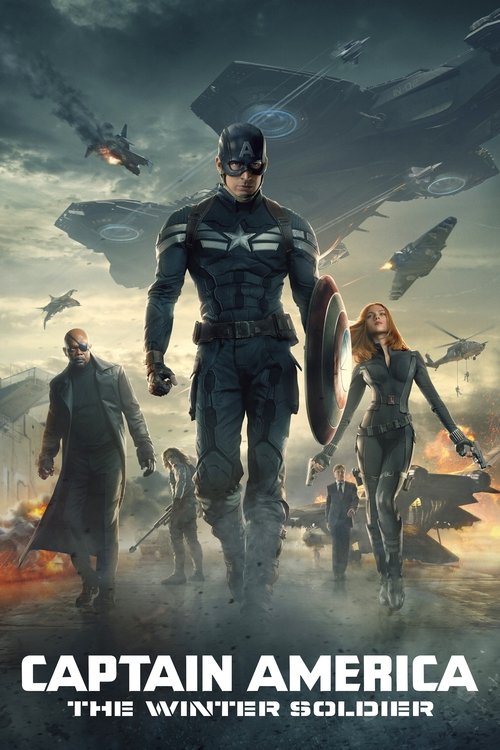
Captain America: The Winter Soldier
"In heroes we trust."
Overview
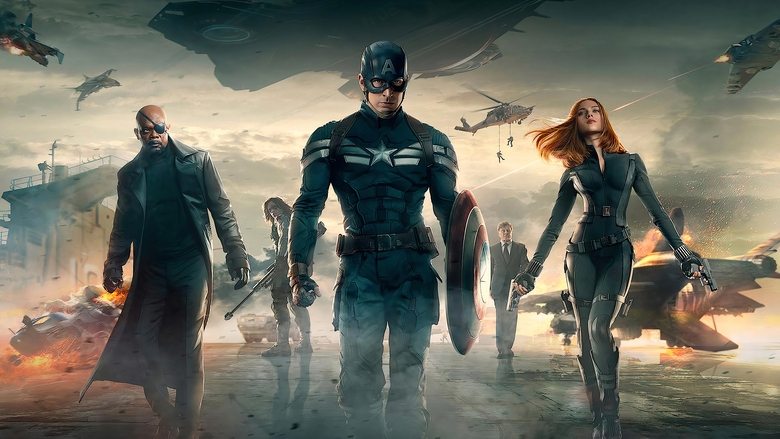
Set two years after the events of The Avengers, Steve Rogers resides in Washington D.C., struggling to adapt to the moral complexities of the 21st century. While working for the espionage agency S.H.I.E.L.D., he uncovers a widespread conspiracy that threatens global security. As the lines between allies and enemies blur, Steve finds himself questioning the very institutions he swore to protect.
Forced to go on the run, Captain America teams up with Natasha Romanoff (Black Widow) and a new ally, Sam Wilson (Falcon), to expose the corruption rotting S.H.I.E.L.D. from the inside out. Their mission becomes increasingly perilous when they are confronted by a mysterious and formidable ghost from the past known only as the Winter Soldier, an unstoppable assassin with ties to Steve's former life.
Core Meaning
At its core, Captain America: The Winter Soldier explores the fragile balance between freedom and security in a post-9/11 world. The directors, the Russo brothers, utilize the framework of a 1970s political thriller to ask unsettling questions about preemptive strikes, mass surveillance, and the cost of liberty. The film ultimately argues that true heroism lies not in blind allegiance to a government or institution, but in an unwavering commitment to personal morality and the protection of human rights, even when the price is steep.
Thematic DNA
Freedom vs. Security
The central ideological conflict pits Steve Rogers' belief in individual liberty against Alexander Pierce's philosophy that humanity must surrender its freedom for absolute security. Through Project Insight, the film directly criticizes real-world concepts of preemptive strikes and mass surveillance.
Trust and Paranoia
Drawing from 70s conspiracy thrillers, the film is saturated with paranoia. Steve is constantly reminded not to trust anyone, a theme visualized by the infiltration of S.H.I.E.L.D. by Hydra. The blurring lines of who is a friend or foe force the characters to rely solely on their closest bonds.
Friendship and Loyalty
Steve's unwavering devotion to Bucky Barnes forms the emotional anchor of the narrative. Despite Bucky's brainwashing and transformation into an assassin, Steve refuses to abandon him, famously declaring his loyalty until the end of the line.
Identity and The Man Out of Time
Steve struggles to reconcile his black-and-white WWII morality with the gray, cynical modern world. Meanwhile, Bucky's arc represents a literal loss of identity, as his memories and personhood are systematically wiped to turn him into a living weapon.
Character Analysis
Steve Rogers
Chris Evans
Motivation
To protect the innocent and uphold true freedom, resisting any compromise of fundamental human rights.
Character Arc
Evolves from a dutiful soldier taking orders to a definitive leader who dismantles the system when he realizes it has become corrupt.
Bucky Barnes
Sebastian Stan
Motivation
Initially driven by Hydra's programming, but ultimately motivated by a desperate, confusing desire to understand his past.
Character Arc
Begins as a mindless, brainwashed assassin, but slowly experiences fractured memories that lead him to question his handlers and spare Steve's life.
Natasha Romanoff
Scarlett Johansson
Motivation
To wipe the red from her ledger and find an anchor of truth, which she discovers through her trust in Steve.
Character Arc
Transitions from a cynical spy comfortable living in moral gray areas to someone who exposes her own dark past to the world in order to destroy Hydra.
Alexander Pierce
Robert Redford
Motivation
To establish world order and security through mass murder, believing that humanity cannot be trusted with its own freedom.
Character Arc
Maintains a facade of diplomacy and peace while secretly orchestrating a global coup, eventually dying as his master plan crumbles.
Symbols & Motifs
Captain America's Shield
A symbol of American ideals, protection, and uncorrupted morality.
Initially used to defend the innocent, the shield's symbolic weight is challenged when wielded by the Winter Soldier, reflecting how American ideals can be co-opted and weaponized. In the climax, Steve drops it to prove his personal devotion to Bucky above his role as a soldier.
Project Insight Helicarriers
A manifestation of overreaching government control, mass surveillance, and the weaponization of fear.
Looming over the sky with guns targeted at millions, they physically represent the threat of preemptive warfare. Their destruction symbolizes the tearing down of corrupt, fear-based institutions.
The Winter Soldier's Metal Arm
The loss of humanity, mechanization of war, and literal erasure of personhood.
Attached after Bucky's fall, the arm is a physical reminder of Hydra's control over him. It makes him a formidable weapon but serves as a constant emblem of his lack of autonomy.
Memorable Quotes
Before we get started, does anyone wanna get off?
— Steve Rogers
Context:
Spoken to a group of Hydra agents masquerading as S.H.I.E.L.D. strike team members moments before the iconic elevator fight sequence.
Meaning:
Showcases Steve's unparalleled confidence, his innate sense of fairness, and a touch of snark even in life-threatening situations.
The price of freedom is high, it always has been. And it's a price I'm willing to pay. And if I'm the only one, then so be it. But I'm willing to bet I'm not.
— Steve Rogers
Context:
Broadcasted over the Triskelion's PA system to reveal S.H.I.E.L.D.'s infiltration by Hydra and rally the remaining loyal agents to fight back.
Meaning:
A perfect encapsulation of Captain America's worldview. It emphasizes that true liberty requires sacrifice and inspires others to stand up to tyranny.
Then finish it. 'Cause I'm with you 'til the end of the line.
— Steve Rogers
Context:
Spoken aboard the crashing helicarrier as Steve drops his shield, refusing to fight his brainwashed best friend any longer.
Meaning:
Represents the pinnacle of unconditional friendship and loyalty. It triggers Bucky's suppressed memories and ultimately saves Steve's life.
On your left.
— Steve Rogers / Sam Wilson
Context:
First used by Steve as he repeatedly laps Sam while running in Washington D.C., and later playfully echoed by Sam at Steve's hospital bedside.
Meaning:
A recurring motif that establishes the friendly rivalry and immediate camaraderie between Steve and Sam.
This isn't freedom. This is fear.
— Steve Rogers
Context:
Steve's immediate, critical response when Nick Fury shows him the Project Insight helicarriers.
Meaning:
A sharp critique of the surveillance state and the preemptive strike philosophy, summarizing the film's core political theme.
Philosophical Questions
Is it ethical to sacrifice freedom in the name of security?
The film uses Project Insight—which eliminates potential threats before they happen—to explore the moral boundaries of preemptive action. It asks whether safety bought through fear and surveillance is actually a prison in disguise.
Can a person be held morally responsible for actions committed without free will?
Through Bucky Barnes' brainwashing, the narrative questions the nature of culpability. The Winter Soldier commits horrific atrocities, but because his autonomy was systematically erased, the film challenges the audience to view him as a victim rather than a monster.
When an institution becomes corrupt, is it better to reform it from within or tear it down completely?
While Nick Fury initially wants to salvage parts of S.H.I.E.L.D., Steve Rogers insists that it is fundamentally compromised and must be completely dismantled alongside Hydra, exploring the philosophy of radical institutional change.
Alternative Interpretations
While surface readings view the film as a straightforward condemnation of authoritarianism and surveillance, some critics note an underlying irony in its resolution. Despite its strong anti-establishment message, the day is ultimately saved by elite individuals operating outside of democratic oversight—essentially replacing one form of unilateral power (Hydra/S.H.I.E.L.D.) with another (Captain America and his allies).
Another perspective focuses on the character of the Winter Soldier as a metaphor for the systemic mistreatment of military veterans. In this interpretation, Bucky represents the soldier who is broken, manipulated, and discarded by the military-industrial complex, fighting wars he doesn't understand. Steve's refusal to fight him can be read as a radical statement of pacifism and an acknowledgment that the real enemy is the system that corrupted his friend, not the friend himself.
Cultural Impact
Captain America: The Winter Soldier drastically altered the trajectory of the Marvel Cinematic Universe by proving that superhero films could successfully blend with other distinct genres, specifically the 1970s paranoid political spy thriller. Released during a time of heightened public discourse surrounding Edward Snowden's NSA leaks, drone strikes, and global surveillance, the film's critique of preemptive security and government overreach resonated powerfully with contemporary historical anxieties.
Critically acclaimed for its grounded, hard-hitting practical action sequences and mature thematic depth, it elevated Captain America from a perceived outdated boy scout to one of the most compelling and popular characters in modern cinema. The movie effectively dismantled S.H.I.E.L.D., shifting the entire power dynamic of the MCU and setting a new, higher standard for comic book adaptations. It is widely regarded by audiences and critics alike as one of the greatest superhero films ever made.
Audience Reception
Audience reception for Captain America: The Winter Soldier was overwhelmingly positive, with many fans citing it as the crown jewel of the MCU. Viewers universally praised the Russo brothers' direction, highlighting the visceral, Bourne-style hand-to-hand combat and the practical car chases which felt like a breath of fresh air compared to typical CGI-heavy superhero spectacles.
The complex relationship between Steve and Bucky sparked massive emotional investment from the fandom, while the political thriller tone was applauded for giving the story real-world stakes. Some minor criticisms pointed out that despite the grounded tone, the final act still devolved into a standard blockbuster finale with giant falling airships. Nevertheless, the bold choice to permanently destroy S.H.I.E.L.D. left audiences stunned and deeply appreciative of the film's lasting consequences.
Interesting Facts
- Comic book writer Ed Brubaker, who created the Winter Soldier storyline, has a cameo as one of the scientists working on Bucky's brainwashing.
- To ground the film as a political thriller, the Russo brothers drew heavy inspiration from 1970s cinema, particularly the film 'Three Days of the Condor' which also starred Robert Redford.
- Steve Rogers' notebook of pop-culture items he needs to catch up on was customized for different countries. The US version includes 'Steve Jobs' and 'Disco', while the UK version includes 'The Beatles' and the Korean version features 'Oldboy'.
- Nick Fury's gravestone bears the epitaph 'The path of the righteous man... Ezekiel 25:17', which is a direct nod to Samuel L. Jackson's iconic monologue in 'Pulp Fiction'.
- The film prioritized practical effects, including shooting a real car chase on three miles of closed freeway in Cleveland, Ohio.
Easter Eggs
Stephen Strange name-drop
During his interrogation, Jasper Sitwell lists potential threats to Hydra targeted by Zola's algorithm, including 'Stephen Strange', teasing Doctor Strange's arrival in the MCU years before his solo film.
Crossbones' origins
S.H.I.E.L.D. operative Brock Rumlow is shown being pulled from the Triskelion rubble with severe burns and crossed straps across his chest, foreshadowing his transformation into the villain Crossbones.
Zola's robotic screen face
When Arnim Zola's consciousness is revealed to be preserved inside a massive 1970s supercomputer, his face appears on a central monitor. This is a clever, grounded adaptation of his comic book counterpart, who is a robot with a screen on its chest.
WarGames reference
When Black Widow boots up the secret underground computer, she says, 'Shall we play a game?' and Cap replies, 'Love to. How about Global Thermonuclear War?'—a direct reference to the 1983 sci-fi thriller WarGames.
⚠️ Spoiler Analysis
Click to reveal detailed analysis with spoilers
Frequently Asked Questions
Explore More About This Movie
Dive deeper into specific aspects of the movie with our detailed analysis pages
Comments (0)
No comments yet. Be the first to share your thoughts!