
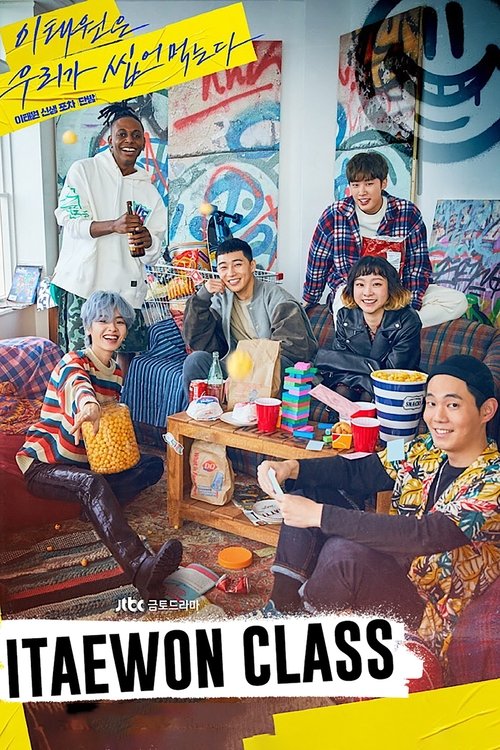
Itaewon Class
A gritty neon-lit odyssey where iron-willed integrity collides with corporate tyranny. In the heart of Seoul's melting pot, a bittersweet revenge transforms into a vibrant anthem of resilience and found family.
Itaewon Class

Itaewon Class

이태원 클라쓰

"I want to live a life in which you can't put a price on your convictions."

31 January 2020 — 21 March 2020 South Korea 1 season 16 episode Ended ⭐ 8.4 (382)
Cast: Park Seo-jun, Kim Da-mi, Kwon Na-ra, You Chea-myung, Ahn Bo-hyun
Drama
Integrity vs. Power The Power of Found Family Diversity and Social Inclusion The Cost of Revenge Entrepreneurship and Ambition

Overview

Itaewon Class tells the sprawling story of Park Sae-ro-yi, a young man whose life is shattered after he is expelled from school for punching a bully and later imprisoned following the death of his father. Upon his release, Sae-ro-yi refuses to let his past define him. He sets a fifteen-year plan in motion to open a pub named DanBam in the multicultural district of Itaewon, aiming to topple the Jangga Group, the powerful food conglomerate responsible for his family's ruin.

As the series progresses, Sae-ro-yi gathers a team of social misfits, including a sociopathic but genius manager, an ex-con, a transgender chef, and a Guinean-Korean server. Together, they navigate the cutthroat world of the food industry, facing constant sabotage from Chairman Jang Dae-hee. The narrative evolves from a simple revenge plot into a complex exploration of what it means to succeed without compromising one's soul, set against the backdrop of Seoul's most diverse and energetic neighborhood.


Core Meaning

The core meaning of Itaewon Class lies in the power of unwavering integrity and the definition of true success. It posits that a life lived according to one's own principles—no matter how costly—is the ultimate victory over those who use power to oppress others. The show argues that success is not merely about wealth or corporate dominance, but about the people you carry with you and the strength to remain human in an inhumane world. It is a celebration of the marginalized, suggesting that those deemed "misfits" by society are the ones capable of bringing about genuine change.

Thematic DNA

Integrity vs. Power 30%
The Power of Found Family 25%
Diversity and Social Inclusion 20%
The Cost of Revenge 15%
Entrepreneurship and Ambition 10%

Integrity vs. Power

The central conflict pits Sae-ro-yi's rigid moral code against Chairman Jang's "law of the jungle" philosophy. Throughout the series, Sae-ro-yi is repeatedly pressured to kneel or compromise, yet he remains steadfast, proving that conviction can eventually dismantle even the most entrenched hierarchies.

The Power of Found Family

The staff of DanBam represents a group of individuals rejected by traditional Korean society. Their evolution from coworkers to a deeply bonded family unit highlights the series' message that true support comes from shared values and mutual respect rather than blood ties or social status.

Diversity and Social Inclusion

The show explicitly tackles taboos in South Korean culture, including transgender rights and racial discrimination. By centering characters like Ma Hyeon-yi and Kim Toni, the series explores the struggle for acceptance and the beauty of a multicultural society.

The Cost of Revenge

While revenge drives the plot, the series examines how it can consume a person. Sae-ro-yi's growth involves shifting his focus from destroying his enemy to building a future for his loved ones, ultimately finding happiness through creation rather than just destruction.

Entrepreneurship and Ambition

The series serves as a modern "rags-to-riches" tale, detailing the strategic and emotional hurdles of building a brand from scratch. It emphasizes that a business's greatest asset is its people, contrasting Sae-ro-yi's human-centric management with Jangga's cold efficiency.

Character Analysis

Park Sae-ro-yi

Park Seo-jun

Archetype: Hero
Key Trait: Unwavering Integrity

Motivation

Initially fueled by a desire to avenge his father's death, his motivation evolves into a quest to create a world where he and his "people" can live freely and happily.

Character Arc

Sae-ro-yi transforms from a hot-headed, idealistic teenager into a strategic, visionary CEO. His arc is defined by his ability to maintain his moral purity while navigating the compromises required by business and love.

Jo Yi-seo

Kim Da-mi

Archetype: Antihero / Catalyst
Key Trait: Pragmatic Brilliance

Motivation

Her motivation shifts from seeking entertainment in a boring world to a singular, fierce devotion to making Sae-ro-yi's dreams a reality.

Character Arc

A high-IQ sociopath who initially views the world with cold pragmatism. Through Sae-ro-yi, she learns empathy and the value of human connection, eventually dedicating her genius to his success.

Jang Dae-hee

Yoo Jae-myung

Archetype: Villain
Key Trait: Ruthless Authoritarianism

Motivation

Driven by the need to protect the Jangga Group at all costs, viewing any challenge to his authority as a personal insult that must be crushed.

Character Arc

A self-made titan who becomes a cautionary tale of how power can corrupt. He spends the series trying to break Sae-ro-yi, only to realize in his final days that he has built a hollow empire.

Oh Soo-ah

Kwon Na-ra

Archetype: Foil
Key Trait: Compromised Realism

Motivation

Primarily motivated by self-preservation and the desire for a stable life, which puts her at constant odds with Sae-ro-yi's risky path.

Character Arc

Caught between her loyalty to Sae-ro-yi and her survival instincts at Jangga. Her arc concludes with her choosing independence, finally acting on the evidence she gathered against the company for years.

Symbols & Motifs

The Chestnut Haircut

Meaning:

Represents Sae-ro-yi's stubbornness, simplicity, and refusal to change his essence despite the passage of time and the weight of his hardships.

Context:

Sae-ro-yi maintains this specific buzz cut from high school through his time in prison and into his success as a CEO, becoming a symbol of his unyielding character.

DanBam (Sweet Night)

Meaning:

Symbolizes the hope for a life where the bitterness of the past is replaced by sweetness. It represents the "sweet night" Sae-ro-yi wishes for after his long, bitter struggle.

Context:

It is the name of his pub in Itaewon and later becomes the foundation of his global corporation, IC (Itaewon Class) Group.

The Diamond (Poem)

Meaning:

Symbolizes resilience and the process of becoming stronger under extreme pressure. It specifically represents the strength of those who are different.

Context:

Jo Yi-seo recites a poem about a rock that refuses to break and becomes a diamond to encourage Ma Hyeon-yi during the "Greatest Pub" cooking competition.

The Wristwatch

Meaning:

Represents his father's legacy and the value of time. It serves as a reminder of the goal Sae-ro-yi is working toward.

Context:

The watch belonged to his father and is one of the few items Sae-ro-yi keeps as a constant connection to his past and his motivation.

Memorable Quotes

내 가치를 네가 정하지 마. 내 인생 이제 시작이고, 난 내가 원하는 거 다 이루면서 살 거야.

— Park Sae-ro-yi

Context:

Said to Seung-kwon in prison when the latter suggests that their lives as ex-cons are already over. Episode 2.

Meaning:

"Don't decide my value. My life is just starting, and I'm going to live achieving everything I want." This quote encapsulates Sae-ro-yi's defiance against social labeling and his belief in self-determination.

나는 돌덩이. 뜨겁게 달궈보아라. 나는 움직이지 않는 돌덩이.

— Jo Yi-seo (reciting)

Context:

Yi-seo recites this poem over the phone to Ma Hyeon-yi to give her strength before the final cooking challenge. Episode 12.

Meaning:

"I am a rock. Go ahead and heat me up. I am a rock that will not move." This represents the resilience of the marginalized and the refusal to be broken by prejudice.

술맛이 어떠냐? ... 달아요.

— Park Sae-ro-yi / Park Sung-yeol

Context:

First asked by his father when he teaches him to drink (Episode 1), and echoed in the finale when Sae-ro-yi finally feels his life has become "sweet."

Meaning:

"How does the alcohol taste? ... It's sweet." In the show's lore, sweet soju means you've had a meaningful or successful day, while bitter soju represents a life full of hardship.

Episode Highlights

Episode 1

S1E1

The tragic origin story where Sae-ro-yi's principles lead to his expulsion and his father's death. It establishes the blood feud with the Jang family and Sae-ro-yi's core values.

Significance:

Provides the emotional foundation for the entire 16-episode journey and introduces the central theme of integrity vs. servility.

Episode 10

S1E10

Chairman Jang is forced to choose between his company and his son, Geun-won, after the hit-and-run truth is exposed. He chooses Jangga, showing his ultimate ruthlessness.

Significance:

A major turning point where the protagonist gains his first significant victory, shifting the power dynamic of the series.

Episode 12

S1E12

Ma Hyeon-yi is outed as transgender during a national cooking competition. Instead of hiding, she stands tall and wins the round.

Significance:

The most culturally impactful episode, addressing LGBTQ+ representation and the theme of individual strength under social pressure.

Episode 14

S1E14

Sae-ro-yi finally realizes his feelings for Yi-seo, but the episode ends in a cliffhanger with a violent confrontation and a life-threatening accident.

Significance:

The peak of the romantic arc and the beginning of the final high-stakes conflict that leads to the resolution of the revenge plot.

Episode 16

S1E16

The final showdown where Sae-ro-yi achieves his goal, Chairman Jang finally kneels, and Sae-ro-yi chooses to find happiness with Yi-seo.

Significance:

Concludes the 15-year revenge saga, emphasizing that the greatest victory is not the enemy's downfall, but the protagonist's personal peace.

Philosophical Questions

Can success be achieved without moral compromise?

The series tests this by placing Sae-ro-yi in situations where kneeling or lying would lead to immediate profit. His refusal to do so suggests that while the path is longer and harder, a "clean" victory is the only one worth having.

What is the true meaning of a 'Sweet Night'?

The show explores whether peace comes from the destruction of enemies or the presence of loved ones. It concludes that revenge is a bitter drink, and sweetness only arrives when the heart is free from hatred.

Alternative Interpretations

While widely viewed as an underdog revenge story, some critics interpret the series as a critique of late-stage capitalism, where the hero must become a corporate giant himself to find justice. Another interpretation focuses on the romantic choice: many fans argue that Oh Soo-ah was a more realistic and tragic character whose life of compromise was a more accurate reflection of society than Sae-ro-yi's idealism. There is also a reading of the show as a coming-of-age allegory for South Korea itself—moving away from rigid, authoritarian 'father' figures (Chairman Jang) toward a more inclusive, youth-driven future.

Cultural Impact

Itaewon Class had a profound cultural impact by challenging traditional K-drama tropes. It significantly advanced the conversation on diversity in South Korean media by featuring a transgender main character and a Black Korean character, both of whom were treated with dignity and depth. The show sparked the 'Park Saeroyi Syndrome,' influencing men's fashion and hair trends across Asia. Furthermore, its portrayal of the Itaewon district as a vibrant, multicultural hub boosted local tourism. The series is frequently cited in South Korea as a source of entrepreneurial inspiration, with its lessons on leadership and business ethics being studied by young professionals and university students.

Audience Reception

Itaewon Class was a massive hit, reaching a peak viewership of 16.5% in South Korea and becoming a global phenomenon on Netflix. Audiences praised its inclusive casting and the magnetic performance of Park Seo-jun. The character of Jo Yi-seo was polarizing, with some finding her refreshing and others finding her 'sociopathic' traits off-putting. The final two episodes faced criticism for relying on overused K-drama tropes like kidnapping, which some felt clashed with the show's grounded, business-oriented roots. However, the overall verdict remains overwhelmingly positive, cemented by its win for Best Drama Series at the 25th Asian Television Awards.

Interesting Facts

  • Itaewon Class was the first drama produced by Showbox, a major South Korean film distribution company.
  • The series is based on a popular Daum webtoon written and illustrated by Jo Gwang-jin, who also wrote the drama's screenplay.
  • Park Seo-jun's 'chestnut' haircut became a massive trend in South Korea, often referred to as 'Park Saeroyi Syndrome.'
  • BTS member V (Kim Tae-hyung) composed and sang the OST 'Sweet Night' specifically for the show as a gift to his close friend Park Seo-jun.
  • The character of Kim Toni was included to highlight and critique racial prejudice against non-ethnic Koreans in South Korea.
  • The bridge where Sae-ro-yi and Yi-seo often talk is the Noksapyeong Bridge, which became a popular tourist destination after the show aired.

Easter Eggs

Park Bo-gum Cameo

Actor Park Bo-gum makes a surprise appearance in the final episode as a chef auditioning for Oh Soo-ah's new restaurant, nodding to his previous collaboration with the director in Love in the Moonlight.

Tiffany & Co. Placement

The jewelry Yi-seo wears and the necklace Sae-ro-yi buys for her are prominent Tiffany & Co. pieces, symbolizing high-end aspirations and modern romantic tokens.

⚠️ Spoiler Analysis

Click to reveal detailed analysis with spoilers

Frequently Asked Questions

Explore More About This Movie

Dive deeper into specific aspects of the movie with our detailed analysis pages

Comments (0)

Leave a comment

No comments yet. Be the first to share your thoughts!