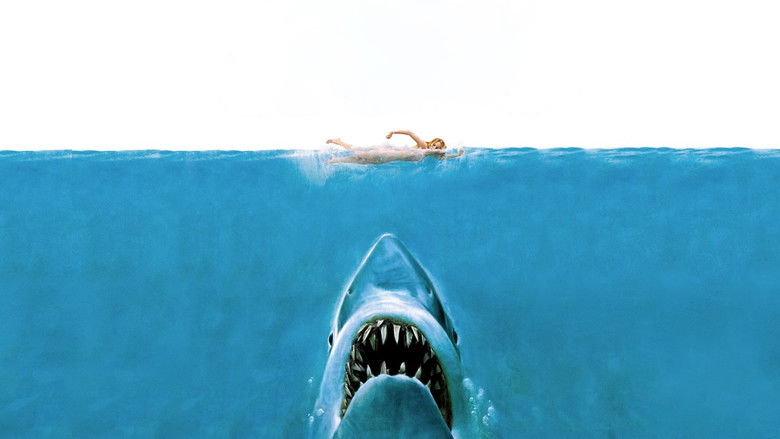
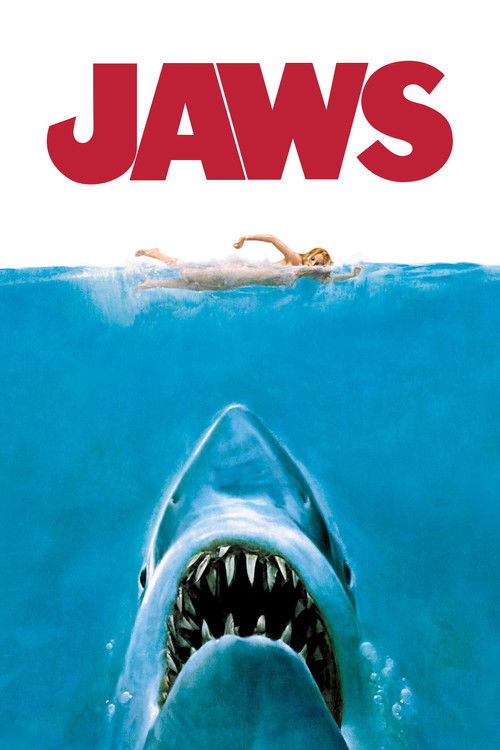
Jaws
Thriller/Adventure. Primal fear meets summer sunlight. An unseen leviathan embodies the terror of the unknown, turning the vast, indifferent ocean into a claustrophobic trap where man fights nature for survival.
Jaws

Jaws

"The terrifying motion picture from the terrifying No. 1 best seller."

20 June 1975 United States of America 124 min ⭐ 7.7 (11,278)
Director: Steven Spielberg
Cast: Roy Scheider, Robert Shaw, Richard Dreyfuss, Lorraine Gary, Murray Hamilton
Thriller Adventure Horror
Man vs. Nature Capitalism vs. Public Safety Masculinity and Heroism Fear of the Unknown
Budget: $7,000,000
Box Office: $470,653,000

Overview

When a gigantic great white shark begins to menace the small island community of Amity, a police chief, a marine scientist, and a grizzled fisherman set out to stop it. The film meticulously builds tension as the local mayor refuses to close the beaches during the lucrative Fourth of July weekend, fearing economic ruin over public safety.

As the body count rises, Chief Brody, Quint, and Hooper embark on a perilous hunt aboard the Orca. Their journey into the open ocean becomes a battle of wills and survival, stripping them of civilization's comforts and forcing them to confront a primal, unstoppable force of nature.
Core Meaning

At its heart, Jaws is a parable about man's fragility in the face of nature and the consequences of greed. It critiques institutions that prioritize profit over human life (represented by the Mayor's refusal to close the beaches) and explores the different ways humanity confronts the unknown: through law (Brody), science (Hooper), and brute force (Quint).

Thematic DNA

Man vs. Nature 30%
Capitalism vs. Public Safety 25%
Masculinity and Heroism 25%
Fear of the Unknown 20%

Man vs. Nature

The shark represents an indifferent, unstoppable force of nature that cannot be reasoned with or controlled. The film shows how helpless humans are when removed from their element (land) and placed in nature's domain (the ocean).

Capitalism vs. Public Safety

Mayor Vaughn's refusal to close the beaches to save the summer tourist dollars serves as a critique of capitalism. The system's greed directly leads to further loss of life, highlighting the conflict between economic interests and moral responsibility.

Masculinity and Heroism

The three main characters represent different archetypes of masculinity: the working-class tough guy (Quint), the intellectual elite (Hooper), and the vulnerable everyman (Brody). The film deconstructs these roles, showing that true heroism comes from facing one's fears rather than machismo.

Fear of the Unknown

By keeping the shark hidden for most of the film, Spielberg taps into the primal fear of what lies beneath the surface. The ocean becomes a symbol of the vast, terrifying unknown that humanity cannot fully comprehend.

Character Analysis

Martin Brody

Roy Scheider

Archetype: The Everyman Hero
Key Trait: Vulnerability

Motivation

To protect the community and his family, driven by a sense of duty and moral responsibility.

Character Arc

Starts as a water-phobic police chief who feels like an outsider. He overcomes his crippling fear of the ocean to protect his family and community, ultimately facing the beast alone.

Quint

Robert Shaw

Archetype: The Obsessed Hunter / The Captain
Key Trait: Hubris

Motivation

Revenge against sharks and a desire to prove his dominance over nature.

Character Arc

A hardened survivor of the USS Indianapolis who represents primal force and traditional masculinity. His obsession with killing the shark becomes his undoing, as he refuses help and underestimates the creature's intelligence.

Matt Hooper

Richard Dreyfuss

Archetype: The Scientist / The Mentor
Key Trait: Intellect

Motivation

Scientific curiosity and a fascination with sharks.

Character Arc

A wealthy oceanographer who brings modern technology and knowledge. He clashes with Quint's old-world methods but gains respect for the shark's power. He learns that theory pales in comparison to reality.

Symbols & Motifs

The Shark (Bruce)

Meaning:

It symbolizes inevitable death, nature's wrath, and a punishment for human hubris. It is a 'remorseless eating machine' that acts without malice but with devastating efficiency.

Context:

Often seen only as a fin or a shadow, or represented by the yellow barrels, emphasizing its unstoppable and ubiquitous presence.

The Orca (The Boat)

Meaning:

Represents society and civilization—a fragile wooden vessel that is the only thing separating the men from the abyss. Its gradual destruction mirrors the breakdown of their safety and control.

Context:

As the hunt progresses, the boat begins to fail and sink, forcing the characters to rely on themselves rather than their technology.

Yellow Barrels

Meaning:

They symbolize the futility of human attempts to control nature. They are meant to tire and mark the beast, but the shark pulls them under, defying the laws of physics and human expectation.

Context:

Used during the chase sequences; seeing the barrels resurface triggers dread and indicates the shark's relentless pursuit.

Eyeglasses

Meaning:

For Brody and Hooper, glasses represent vision and intellect. Losing them signifies a loss of civilized perception and vulnerability.

Context:

Brody wears glasses when trying to learn about sharks; Hooper wears them as a scientist. The shark's violence often threatens this 'civilized' view of the world.

Memorable Quotes

You're gonna need a bigger boat.

— Martin Brody

Context:

Brody says this to Quint immediately after seeing the massive size of the shark for the first time while chumming the water.

Meaning:

A realization of the overwhelming magnitude of the problem versus their inadequate resources. It has become a cultural idiom for underestimating a challenge.

Y'know the thing about a shark, he's got... lifeless eyes, black eyes, like a doll's eyes.

— Quint

Context:

Part of the famous USS Indianapolis monologue where Quint recounts his traumatic experience of watching his crewmates get eaten.

Meaning:

Describes the soulless, mechanical nature of the predator. It highlights the horror of being eaten by something that shows no emotion or recognition of your humanity.

Smile, you son of a b...

— Martin Brody

Context:

Spoken just before Brody shoots the pressurized air tank in the shark's mouth, causing it to explode.

Meaning:

The final moment of triumph where the 'everyman' defeats the monster, reclaiming control and releasing all built-up tension.

Philosophical Questions

Is nature inherently malevolent?

The film questions whether the shark is 'evil' or simply fulfilling its biological imperative. Hooper respects it as a 'miracle of evolution,' while Quint sees it as a monster to be destroyed, highlighting the clash between scientific understanding and anthropocentric morality.

What is the cost of greed?

The Mayor's decision to keep the beaches open for profit directly leads to death. The film asks whether economic stability is ever worth risking human life, a question that remains relevant in modern crises.

Alternative Interpretations

Some critics view the film as a Post-Watergate parable, where a corrupt authority figure (the Mayor) covers up a deadly threat to maintain the status quo, forcing individuals to take matters into their own hands.

Others interpret it through a Freudian lens: the Shark as the Id (uncontrollable impulse), Brody as the Ego (mediator/reality), and Hooper as the Superego (intellect/moral conscience). Alternatively, the shark has been viewed as a metaphor for the Cold War enemy or a punishment for the sexual liberation of the 1960s (beginning with the death of the naked swimmer).

Cultural Impact

Jaws is a watershed moment in cinema history, widely credited with inventing the summer blockbuster. Before 1975, summer was considered a graveyard slot for movies; Jaws changed this with its massive wide release and heavy TV marketing campaign.

Culturally, it instilled a generational fear of sharks (galeophobia), leading to a tragic decline in real-world shark populations due to hunting, a consequence Spielberg later regretted. John Williams' simple two-note score became one of the most recognizable pieces of music in history, synonymous with approaching danger.

Audience Reception

Upon release, Jaws was a phenomenon, with lines around the block. Audiences were terrified, with many refusing to swim in the ocean for years. Critics praised the direction, editing, and score, though some initial reviews criticized the 'B-movie' plot.

Today, it is universally regarded as a masterpiece of suspense and one of the greatest films ever made. The only significant criticism in retrospect concerns the demonization of sharks, which has had negative real-world ecological effects.

Interesting Facts

  • The mechanical shark, nicknamed 'Bruce' after Spielberg's lawyer, malfunctioned constantly, forcing Spielberg to show the shark less, which accidentally increased the film's suspense.
  • The famous line 'You're gonna need a bigger boat' was improvised by Roy Scheider.
  • The film is considered the first true 'summer blockbuster,' changing Hollywood's release model forever.
  • Robert Shaw was reportedly intoxicated during the first take of the USS Indianapolis speech but nailed it the next day in one take.
  • Author Peter Benchley makes a cameo as a news reporter on the beach.
  • The shooting star seen during the night scene on the boat was a real, lucky capture, not a special effect.
  • Spielberg originally wanted to direct a James Bond film and included a subtle reference (license plate 007) inside the tiger shark.
  • The screeching sound when the shark dies is the same sound effect used for the truck falling off the cliff in Spielberg's earlier film 'Duel'.

Easter Eggs

Louisiana License Plate 007 981

When Hooper pulls a license plate from the tiger shark's stomach, it starts with '007', a nod to Spielberg's desire to direct a James Bond movie. The plate is from Louisiana, referencing the film Live and Let Die.

Director's Voice Cameo

Steven Spielberg's voice can be heard on the Orca's radio as the Amity Point dispatcher calling Quint's boat.

Yellow Raft from the book

The yellow raft used by the boy Alex Kintner is a visual nod to the opening of the original novel, though the victim in the book was different.

⚠️ Spoiler Analysis

Click to reveal detailed analysis with spoilers

Frequently Asked Questions

Explore More About This Movie

Dive deeper into specific aspects of the movie with our detailed analysis pages

Comments (0)

Leave a comment

No comments yet. Be the first to share your thoughts!