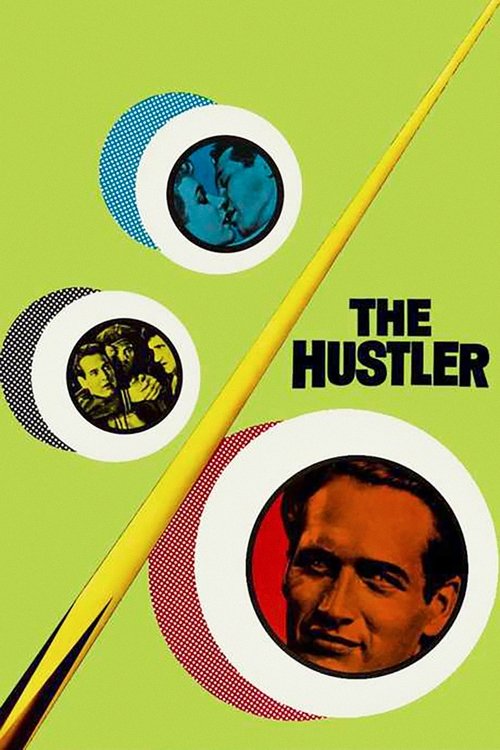
The Hustler
"They called him Fast Eddie. He was a winner. He was a loser. He was a hustler."
Overview
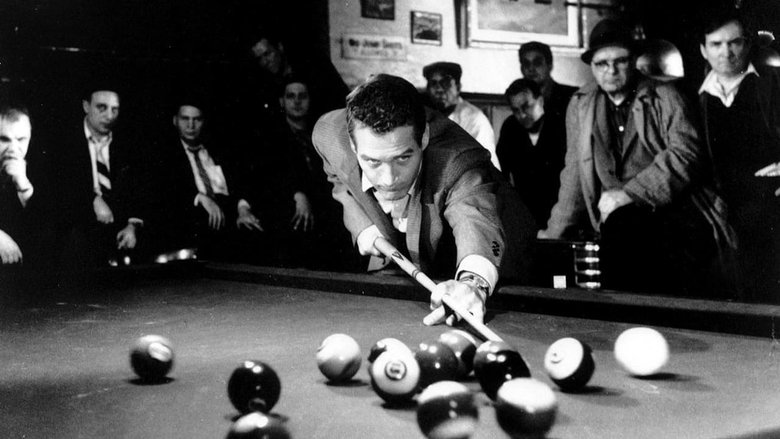
The Hustler follows the journey of Fast Eddie Felson (Paul Newman), a small-time pool hustler with immense talent but a self-destructive lack of character. Accompanied by his partner Charlie, Eddie travels to New York City to challenge the legendary Minnesota Fats (Jackie Gleason). In a marathon high-stakes match that lasts over 25 hours, Eddie initially dominates but eventually crumbles under the pressure and Fats' psychological consistency, losing his entire bankroll.
Broke and adrift, Eddie separates from Charlie and meets Sarah Packard (Piper Laurie), a lame, alcoholic aspiring writer who becomes his lover and emotional anchor. As Eddie struggles to rebuild his confidence, he falls under the influence of Bert Gordon (George C. Scott), a ruthless gambler who offers to stake him in exchange for a steep percentage of his winnings and total control. Bert identifies Eddie's fatal flaw as a lack of "character" and pushes him into a brutal world where winning is the only virtue.
The narrative culminates in a tragic trip to the Kentucky Derby, where Eddie hustles a wealthy socialite at billiards. The toxic triangle between Eddie, Sarah, and Bert leads to a devastating personal loss that forces Eddie to confront the cost of his ambition. He returns to face Minnesota Fats one last time, not just to win a game, but to reclaim his humanity from the soulless grip of Bert Gordon.
Core Meaning
At its heart, The Hustler is a profound meditation on the difference between talent and character. Director Robert Rossen uses the game of pool as a metaphor for the capitalist struggle, where "winning" often requires a surrender of one's humanity. The film argues that true victory is not about beating an opponent, but about conquering one's own demons and refusing to sell one's soul for success. It suggests that one can be a "winner" at the table but a "loser" in life, and that redemption often comes only after a terrible, irreversible loss.
Thematic DNA
Talent vs. Character
The central conflict of the film. Eddie has the raw skill to beat anyone, but lacks the discipline and self-knowledge—what Bert calls "character"—to be a true champion. The film posits that talent without character is self-destructive.
The Price of Ambition
Eddie's relentless drive to be "the best" blinds him to the human cost of his actions. The film explores how ambition, when unchecked by moral boundaries, leads to the exploitation of others and the destruction of personal relationships.
Winning and Losing
The film deconstructs the concepts of winning and losing. Bert Gordon defines winning solely by money and dominance. Sarah and eventually Eddie realize that "winning" at the cost of one's soul makes you a loser in life. Eddie ultimately "wins" by rejecting Bert's definition of success.
Masculinity and Vulnerability
The pool hall is a hyper-masculine space where vulnerability is a weakness. Eddie's physical injury (broken thumbs) and emotional dependence on Sarah challenge his machismo, forcing him to confront his own fragility.
Character Analysis
Fast Eddie Felson
Paul Newman
Motivation
To be the best pool player in the world; to prove he isn't a "loser" by beating the legend, Minnesota Fats.
Character Arc
Starts as an arrogant, talented hustler who defines himself by winning. He is broken by his lack of character, descends into "loser" status, finds love but fails to value it, and finally achieves a hollow victory that redeems his soul but destroys his career.
Minnesota Fats
Jackie Gleason
Motivation
To maintain his dignity and status as the best; to play the game with elegance and control.
Character Arc
Remains a static icon of composure and "character." He represents the standard Eddie tries to reach. He respects Eddie's talent but recognizes his flaw. In the end, he graciously accepts defeat.
Sarah Packard
Piper Laurie
Motivation
To find connection and meaning; to be loved for who she is, not used.
Character Arc
A lonely alcoholic who finds a kindred spirit in Eddie. She tries to save him from Bert's corrupt world but is ultimately destroyed by it when she realizes Eddie has "traded her in" for a game.
Bert Gordon
George C. Scott
Motivation
To own people; to win by controlling the odds and the money.
Character Arc
The unchanging force of malevolence. He successfully manipulates Eddie into making money but ultimately fails to own Eddie's soul, though he succeeds in destroying Sarah.
Symbols & Motifs
The Pool Table
A battleground and a purgatory. It represents the closed, artificial world where Eddie seeks validation. Its geometric precision contrasts with the messy, chaotic reality of human relationships outside the pool hall.
Filmed in CinemaScope to emphasize its width, the table often separates characters physically and emotionally. It is where Eddie feels most alive but also where he is most isolated.
Hands and Thumbs
The tools of the trade and the seat of talent. They symbolize vulnerability and the fragility of a hustler's livelihood. "Character" is said to be in the fingers.
Bert Gordon threatens to break Eddie's thumbs, and later his thugs actually do so. This physical breaking serves as the catalyst for Eddie's emotional rebuilding.
Sarah's Limp
A physical manifestation of being damaged and "crippled" by the world. It parallels Eddie's internal, emotional crippling. It represents the "twisted" nature of the world Bert thrives in.
Sarah describes herself as "crippled" and later writes "Perverted, Twisted, Crippled" on a mirror before her suicide, linking her physical state to the moral decay around her.
Bert Gordon
The Devil / Mephistopheles. He represents cold, calculating capitalism and the corrupting power of money. He trades souls for "percentage."
He is often framed looking down on Eddie or lurking in the shadows. He offers Eddie a "contract of depravity" to gain the world but lose his soul.
Memorable Quotes
Fat man, you shoot a great game of pool.
— Fast Eddie Felson
Context:
Spoken by Eddie to Minnesota Fats at the conclusion of their matches.
Meaning:
Acknowledges Fats' skill and character. Initially said with arrogance, repeated at the end with genuine respect and finality.
So I got talent? So what beat me?
— Fast Eddie Felson (and Bert Gordon)
Context:
Eddie asks this after losing to Fats. Bert replies: "Character."
Meaning:
The pivotal moment where the film's central thesis is delivered. Talent isn't enough; you need the mental fortitude to handle pressure.
You're a born loser.
— Bert Gordon
Context:
Bert explaining to Eddie why he lost the first match against Fats despite being ahead.
Meaning:
Bert's assessment of Eddie. He believes Eddie plays to lose because he can't handle the responsibility of winning.
I loved her, Bert. I traded her in on a pool game.
— Fast Eddie Felson
Context:
The final confrontation where Eddie refuses to pay Bert his percentage.
Meaning:
Eddie's moment of tragic realization. He acknowledges the terrible price he paid for his ambition and rejects Bert's worldview.
Top of the world, Ma! Top of the world!
— Sarah Packard
Context:
Sarah drunk at the Kentucky Derby party, mocking the high society facade.
Meaning:
A bitter, ironic reference to White Heat, highlighting her despair and the fake "victory" they are chasing.
Philosophical Questions
What is the true definition of a 'winner'?
The film contrasts Bert's material definition (money, dominance) with Sarah's humanistic definition (love, integrity). It asks if one can be a winner in the game of life while being a loser in the game of pool, and vice versa.
Does greatness require the sacrifice of humanity?
Bert argues that to be the best, one must eliminate all other concerns and be "dead inside." The film explores whether artistic or athletic perfection is worth the cost of one's soul and relationships.
Is character innate or learned through suffering?
Eddie has talent from the start, but lacks character. The film suggests that character is not something one is born with, but something forged through loss, humiliation, and tragedy.
Alternative Interpretations
The Hollow Victory: Many critics view the ending not as a triumph but as a tragedy. Eddie wins the game, but he is "blackballed" and has lost the only person who loved him. The victory is purely symbolic, an act of defiance rather than success.
Political Allegory: Director Robert Rossen was a victim of the HUAC blacklists. Some analyze the film as a metaphor for the McCarthy era, with Bert Gordon representing the committee that forces people to "sell out" their friends (character) for a career. Eddie's refusal to pay Bert at the end is Rossen's cinematic reclaiming of his own dignity.
Queer Theory: Some interpretations look at the homosocial environment of the pool hall and the intense, almost romantic rivalry between men, with women (Sarah) being pushed to the margins or destroyed by this masculine obsession.
Cultural Impact
The Hustler is credited with single-handedly sparking a massive resurgence in the popularity of pool in the United States, transforming it from a seedy backroom activity to a respectable pastime. The film cemented Paul Newman as a Hollywood icon and the definition of the "cool" antihero. It was selected for preservation in the National Film Registry in 1997. Culturally, it challenged the traditional Hollywood "sports movie" formula by focusing on psychological defeat rather than physical victory. The term "Minnesota Fats" became synonymous with pool excellence, and the film's gritty, cynical take on capitalism and ambition reflected the shifting tides of 1960s America.
Audience Reception
The Hustler was a critical and commercial success upon release. Audiences and critics praised the gritty realism, the sharp dialogue, and the powerhouse performances, particularly Newman and Gleason. The film was nominated for nine Academy Awards. Contemporary reviews lauded its refusal to adhere to a happy ending. Modern audiences continue to regard it as a masterpiece of character study and atmospheric filmmaking, often ranking it as one of the greatest sports movies ever made, though some note its pacing is deliberate and slow compared to modern edits.
Interesting Facts
- Paul Newman practiced pool for hours daily, often at a girls' high school in disguise, to prepare for the role.
- Jackie Gleason was an excellent pool player in real life and performed his own trick shots. The camera angles were often wide to prove it was him.
- Willie Mosconi, the 14-time World Champion, served as the technical advisor and performed some of the most difficult trick shots for Newman. He also has a cameo as the stake-holder.
- Real street thugs were hired as extras to give the pool halls a gritty, authentic atmosphere.
- The character 'Minnesota Fats' was fictional, but a real pool hustler named Rudolf Wanderone adopted the name after the film's release and became famous.
- Filmed in CinemaScope (widescreen), which was unusual for a drama at the time, but necessary to capture the width of the pool table and the isolation of the characters.
- George C. Scott refused his Academy Award nomination for Best Supporting Actor, believing that acting competitions were unfair.
- In the famous "whisper scene" where Bert whispers to Sarah, George C. Scott reportedly said nothing or whispered gibberish, letting Piper Laurie's reaction convey the horror.
- Originally, the studio wanted to cut the opening pool scenes, fearing they were too long and technical. Director Robert Rossen held a screening for Broadway actors, whose enthusiastic response saved the scenes.
- Jake LaMotta, the real-life 'Raging Bull', has a cameo as a bartender in the film.
Easter Eggs
Willie Mosconi Cameo
The man holding the stakes during the big match between Eddie and Fats is Willie Mosconi, the greatest pool player of the era and the film's technical advisor.
The Carnation Continuity Error
In one shot during the game with Fats, the negative was flipped to make a shot work, causing the carnation on Jackie Gleason's lapel to jump from his left to his right side.
Jake LaMotta Cameo
Famous boxer Jake LaMotta appears as a bartender. This adds to the gritty, authentic texture of the film's sporting underworld.
⚠️ Spoiler Analysis
Click to reveal detailed analysis with spoilers
Frequently Asked Questions
Explore More About This Movie
Dive deeper into specific aspects of the movie with our detailed analysis pages
Comments (0)
No comments yet. Be the first to share your thoughts!