JUJUTSU KAISEN
呪術廻戦
"A boy fights... for "the right death.""
Overview
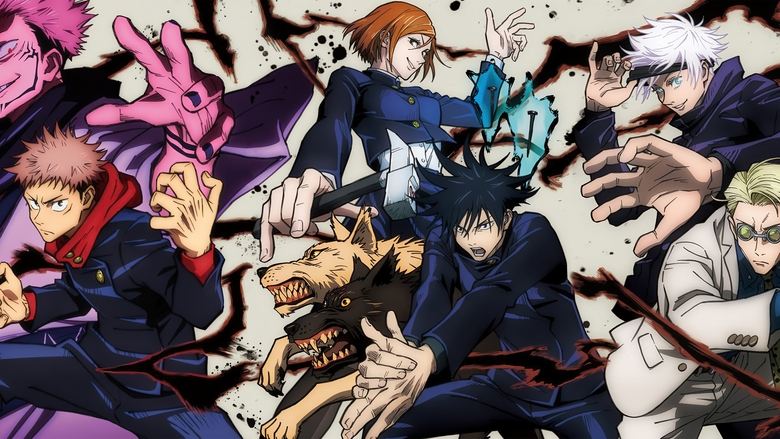
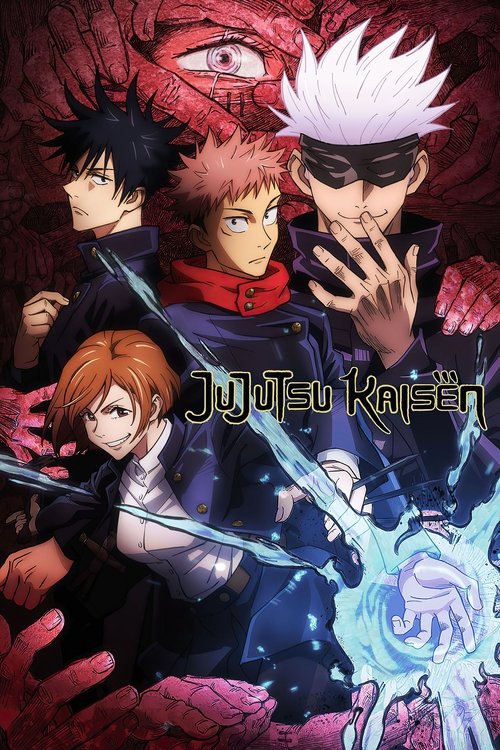
JUJUTSU KAISEN follows Yuji Itadori, a high school student with immense physical strength who lives a normal life. However, his world is turned upside down when he encounters Megumi Fushiguro, a Jujutsu Sorcerer, and ends up swallowing a cursed object – a finger belonging to the powerful King of Curses, Ryomen Sukuna. By doing so, Yuji becomes Sukuna's vessel, sharing his body with the ancient and malevolent entity.
Facing immediate execution by the Jujutsu society, Yuji is given a stay of execution by the most powerful sorcerer, Satoru Gojo. Gojo's plan is for Yuji to absorb all of Sukuna's fingers before being executed, thus eradicating the King of Curses once and for all. Yuji enrolls in Tokyo Jujutsu High, an academy where sorcerers are trained to fight Curses. Alongside Megumi and the tenacious Nobara Kugisaki, Yuji learns to control his newfound cursed energy, battling horrific monsters born from human negativity while navigating the complex, tradition-bound, and often unforgiving world of Jujutsu Sorcerers.
The series chronicles the trio's growth as they face increasingly dangerous threats, from rogue cursed spirits with human-like intelligence to internal conflicts within the rigid structure of the Jujutsu world. The story escalates into a massive, city-wide conflict in Shibuya, where the sorcerers face an all-out war orchestrated by ancient curses and a mysterious figure named Kenjaku, forcing every character to confront their limits and the devastating consequences of their battles.
Core Meaning
At its heart, JUJUTSU KAISEN explores the nature of life, death, and the meaning of a "proper death." The creator, Gege Akutami, has stated that a core idea is that "no one holds the ultimate truth, the 'good guys' as well as the 'bad guys.'" The series posits that negative human emotions are the source of all curses, creating a world where the struggle is constant and unending. It's a story about finding purpose in a seemingly endless cycle of struggle and violence. Ultimately, the series delves into the idea that true strength and happiness are not found in individual power, but in forming healthy relationships and connections with others, allowing one to die without regrets, surrounded by those they care for.
Thematic DNA
The Nature of Good, Evil, and Morality
The series consistently blurs the lines between right and wrong. Jujutsu Sorcerers fight to protect humanity, but the Jujutsu world's leadership is often rigid, conservative, and cruel, sacrificing its own to maintain the status quo. Curses are born of negative emotions, yet some, like the Disaster Curses, possess complex motivations and a semblance of camaraderie. Gege Akutami emphasizes that no single character holds the absolute truth; each is guided by their own ethics, forcing the audience to question who the real villains are.
Death, Regret, and the Value of Life
The central motivation for the protagonist, Yuji Itadori, stems from his grandfather's dying wish: "help people" so that Yuji will be surrounded by others when it's his time to die. This establishes the theme of a "proper death" versus a death filled with regret. The series constantly grapples with the fragility of life, with characters facing gruesome deaths and the survivors left to carry the emotional weight. Characters like Kento Nanami express the hardship of adulthood as an accumulation of small despairs, reinforcing the idea that finding value and dying without regret is the ultimate goal in their brutal profession.
The Burden of Power and Isolation
Great power in Jujutsu Kaisen often leads to profound loneliness. Satoru Gojo, the strongest sorcerer, is isolated by his immense strength, making it impossible for others to truly understand him. His playful exterior hides the burden of being the pillar of the Jujutsu world. This theme is also explored through antagonists like Sukuna, whose desire for dominance leaves him utterly alone. The series critiques power structures, like the traditionalist Zenin clan, showing how the pursuit of power without empathy can be destructive.
Friendship, Teamwork, and Connection
In a world defined by struggle and loss, the bonds between characters are their greatest source of strength. The relationship between Yuji, Megumi, and Nobara evolves into a deep, familial connection built on trust and mutual support. The series suggests that while individual strength is important, true success and happiness can only be achieved through healthy relationships. Gojo's motivation for teaching is to raise a new generation of powerful allies, believing he cannot change the world alone.
Character Analysis
Yuji Itadori
Junya Enoki
Motivation
Yuji's primary motivation is to give people "proper deaths" and to fulfill his grandfather's last wish. Initially, this is a broad desire to help others, but it becomes a specific, desperate mission to exorcise curses so no one else has to suffer the horrific fates he witnesses. After the Shibuya Incident, his motivation is fueled by a profound sense of responsibility and guilt for the destruction Sukuna caused using his body.
Character Arc
Yuji begins as a cheerful, physically gifted high schooler with little purpose beyond his grandfather's dying words: to help others and die surrounded by people. After becoming Sukuna's vessel, he is thrust into a cruel world and sentenced to death. His initial idealism is brutally shattered after witnessing the deaths of friends and mentors, particularly at the hands of the curse Mahito. This forces him to confront his role as a "cog" in the Jujutsu machine, accepting that he must keep killing curses to prevent further tragedy. His arc is a journey from naive optimism to a hardened, resolute determination, grappling with the immense guilt and responsibility of containing a monster while trying to uphold his core values.
Satoru Gojo
Yuichi Nakamura
Motivation
Gojo's motivation is to fundamentally reset the corrupt and conservative Jujutsu world. He believes the current leadership stifles potential and causes unnecessary sacrifice. His goal isn't just to exorcise curses, but to raise a generation of sorcerers (like Yuji, Megumi, and Yuta) who are powerful and compassionate enough to change the system itself, so he is no longer the only one bearing the burden.
Character Arc
Introduced as the laid-back but insurmountably powerful mentor, Gojo's arc is one of confronting the limits of his own strength. The "Hidden Inventory" arc reveals his past, showing a more arrogant young sorcerer whose failure to protect a young girl and the subsequent betrayal by his best friend, Suguru Geto, fundamentally changed him. This loss fuels his desire to reform the corrupt Jujutsu society from the ground up by nurturing a new generation of strong, moral sorcerers. His arc culminates in the Shibuya Incident, where he is sealed away, proving that even the "strongest" is not invincible and that his reliance on his own power left the world vulnerable in his absence. His story is a tragic exploration of how absolute power leads to absolute isolation.
Megumi Fushiguro
Yuma Uchida
Motivation
Megumi's core motivation is to protect his stepsister, Tsumiki, who is afflicted by a curse. This personal stake drives his desire to become stronger. More broadly, he is motivated by a personal moral code to ensure that kind people get to live happy lives, even if the world is unfair. This motivation is constantly challenged and refined as he is forced to make difficult choices and confront the limits of his own ideals.
Character Arc
Megumi starts as a stoic, pragmatic, and seemingly cold Jujutsu sorcerer. His arc is about moving past his reserved exterior and self-sacrificial tendencies to embrace his own potential and desire to live. Initially, he is driven by a skewed sense of justice, wanting to save "good" people while being willing to sacrifice himself. Through his interactions with Yuji and Nobara, he begins to open up and value his own life more. A major turning point is when he is pushed to unleash his full potential, including his incomplete Domain Expansion, realizing that "risking death to win" is different from simply "dying to win." His journey is one of self-acceptance, overcoming the shadows of his past with the Zenin clan and his father, Toji Fushiguro, to become a sorcerer who fights for those he cares about.
Symbols & Motifs
Sukuna's Fingers
The fingers symbolize fragmented, uncontrollable power and the allure of evil. Each finger represents a piece of an ancient, malevolent being that can corrupt and destroy, yet also grant immense power. They are the catalyst for the entire series.
Yuji Itadori's consumption of the first finger initiates the main plot, binding him to Sukuna. The central mission of the early series is for Yuji to locate and consume all twenty fingers, after which he is to be executed, thus destroying Sukuna forever. They are the primary objects of desire for many curses and villains who wish to resurrect the King of Curses.
Domain Expansion
Domain Expansion is the ultimate expression of a sorcerer's or curse's power. It symbolizes the inner self and soul of the user, made manifest as a physical reality. It represents the pinnacle of Jujutsu, a sorcerer's ability to impose their will upon the world.
Used by powerful characters like Satoru Gojo, Sukuna, and Mahito. Gojo's "Unlimited Void" overwhelms opponents with infinite information, reflecting his immense perception. Mahito's "Self-Embodiment of Perfection" allows him to reshape the souls of anyone trapped within, representing his twisted understanding of the soul. Megumi Fushiguro's development of an incomplete domain marks a major turning point in his growth as a sorcerer.
Black Flash
A critical hit that amplifies a user's cursed energy, Black Flash symbolizes a state of supreme focus and connection to the core of cursed energy. It is not a technique that can be used at will; rather, it is a state that a sorcerer enters. Achieving it signifies a higher level of understanding and potential.
Yuji Itadori becomes known for his ability to use Black Flash consecutively, demonstrating his immense potential and natural talent. Other characters like Nobara and Aoi Todo also achieve it during pivotal moments in battle, signifying their growth and heightened concentration under pressure.
Memorable Quotes
Throughout Heaven and Earth, I alone am the honored one.
— Satoru Gojo
Context:
Season 2, Episode 4. Gojo utters this after surviving a fatal attack from Toji Fushiguro and mastering the Reverse Cursed Technique, ascending to a new level of power.
Meaning:
This quote, originally from Buddhist scripture, signifies the moment Gojo truly awakens to the pinnacle of his power. It's a declaration of his absolute strength and transcendence, marking his transformation into the strongest sorcerer alive. It encapsulates both his immense power and the profound isolation that comes with it.
Love is the most twisted curse of all.
— Satoru Gojo
Context:
Said to Yuta Okkotsu in the prequel movie, Jujutsu Kaisen 0, to explain the nature of Rika's curse.
Meaning:
A dark, philosophical statement that encapsulates a core theme of the series: that powerful emotions are the source of Cursed Energy. This quote explains how Yuta Okkotsu's overwhelming love and grief for his childhood friend Rika accidentally turned her spirit into a monstrously powerful curse upon her death.
I don't want to regret the way I've lived.
— Yuji Itadori
Context:
Season 1, Episode 2. Yuji says this to Principal Yaga when asked for his reason for enrolling in Jujutsu High, cementing his commitment to his new path.
Meaning:
This is Yuji's core philosophy, born from his grandfather's death. It is his justification for swallowing Sukuna's finger and choosing the difficult path of a Jujutsu Sorcerer. It represents his unwavering resolve to live a life of purpose, even if it leads to his own execution.
My Six Eyes tell me you're Suguru Geto. But my soul knows otherwise!
— Satoru Gojo
Context:
Season 2, Episode 9. Gojo confronts the villain Kenjaku, who is possessing the body of his deceased friend Suguru Geto, during the Shibuya Incident.
Meaning:
An emotionally devastating line that highlights the deep bond Gojo shared with his former best friend. It shows his struggle to reconcile the logical information from his special ability (the Six Eyes) with the heart-wrenching truth that the person standing before him is not his friend, but an imposter inhabiting his corpse.
Finding more fallen-out hairs on my pillow, watching my favorite bread disappear from the convenience store... the accumulation of those little despairs is what makes a person an adult.
— Kento Nanami
Context:
Season 1, Episode 9. Nanami explains his philosophy to Yuji while investigating the mysterious deaths caused by Mahito.
Meaning:
This quote perfectly encapsulates Nanami's weary, pragmatic worldview. He explains to Yuji that adulthood isn't about a single, traumatic event, but about enduring a continuous stream of minor disappointments and learning to move on. It's a poignant and realistic take on growing up.
Episode Highlights
Ryomen Sukuna
The first episode masterfully introduces the world of Curses and the protagonist, Yuji Itadori. It establishes his incredible physical prowess, his compassionate nature driven by his grandfather's final words, and the central conflict of the series when he swallows Sukuna's finger to save Megumi, making a fateful, life-altering decision.
This episode sets the entire plot in motion. Yuji's transformation into Sukuna's vessel establishes the primary goal of the series and introduces the fundamental concepts of Cursed Energy and Jujutsu Sorcerers, laying the groundwork for everything that follows.
Curse Womb Must Die -II-
The first-years' mission at a detention center goes horribly wrong when they encounter a special-grade curse. The episode demonstrates the terrifying power gap between the students and high-level threats. It culminates in Yuji allowing Sukuna to take over, who easily defeats the curse but then rips out Yuji's heart, leading to the protagonist's first death.
This episode is a brutal reality check, establishing the high stakes of the series and showing that no character, not even the protagonist, is safe. It solidifies the volatile and dangerous nature of the pact between Yuji and Sukuna.
To You, Someday
A brutal and emotionally devastating episode where Yuji is forced to fight Junpei Yoshino, a boy who was manipulated and transfigured into a monster by the curse Mahito. Yuji is unable to save him, forcing him to confront the cruel reality and limitations of his desire to help everyone.
This episode is a crucial turning point for Yuji's character. It shatters his initial naivety and hardens his resolve, establishing his deep-seated rivalry with Mahito and cementing his understanding that being a sorcerer involves immense loss and difficult choices.
Hidden Inventory 4
The climax of Gojo's past arc. After being seemingly killed by Toji Fushiguro, a young Satoru Gojo pushes his abilities to the absolute limit, mastering Reverse Cursed Technique and unleashing his devastating Hollow Technique: Purple for the first time. He transcends his limits and becomes "the honored one."
This episode is fundamental to understanding Gojo's character, his immense power, and the origins of his god-like status. It also marks a turning point in his friendship with Geto, as Gojo's ascension to a new level of power begins to create a rift between them, setting Geto on his dark path.
The Shibuya Incident - Gate, Open
The villains' plan to neutralize Satoru Gojo comes to fruition. Despite Gojo's overwhelming display of power, including a 0.2-second Domain Expansion to minimize civilian casualties, he is emotionally stunned by the appearance of his dead friend Geto's body, now controlled by Kenjaku. This hesitation allows him to be sealed within the Prison Realm.
This is arguably the most impactful event in the series. The sealing of the world's strongest sorcerer completely upends the power balance, plunging the world into chaos and forcing the remaining characters to face an unprecedented crisis without their invincible protector.
Thunderclap, Part 2
A showcase of raw, destructive power. After Megumi is pushed to the brink and summons the untamed Shikigami Mahoraga, Sukuna takes over Yuji's body to fight it. The resulting battle lays waste to a significant portion of Shibuya, demonstrating the terrifying, cataclysmic scale of Sukuna's power.
This episode provides the most visceral look at Sukuna's true strength and his interest in Megumi's potential. It highlights the immense danger Yuji carries within him and the sheer devastation he could unleash, leaving Yuji to grapple with the immense guilt of the destruction caused.
Philosophical Questions
What constitutes a 'proper' or 'meaningful' death?
This is the central question of the series, posed by Yuji's grandfather on his deathbed. Yuji's entire journey is a quest to live in a way that will grant him a meaningful end, surrounded by people who care for him. The series contrasts this with the horrific, meaningless deaths caused by curses and the lonely deaths of powerful sorcerers. Characters like Nanami find meaning in their final moments by passing the torch to the next generation, suggesting a 'proper death' is less about personal achievement and more about the connections and legacy one leaves behind.
Is there an inherent morality, or is everything relative?
JUJUTSU KAISEN constantly challenges the idea of absolute good and evil. The sorcerers fight for humanity, but their society is deeply flawed and cruel. The curses are destructive, but they are also a natural product of humanity's own negative emotions. Creator Gege Akutami has stated that a key message is that no one has a monopoly on the truth and that every character is guided by their own distinct ethics. The series forces viewers to consider whether actions can be judged objectively or if morality is always dependent on one's perspective and motivations.
Does immense power inevitably lead to isolation?
The character of Satoru Gojo is the primary vehicle for this question. He is the strongest, but he is also profoundly alone. His power creates a gulf between him and everyone else, and his greatest desire is to raise others to his level so he is no longer isolated. The series explores how both the heroes and villains who possess overwhelming strength, like Gojo and Sukuna, are ultimately defined by their loneliness. This suggests that true connection requires a degree of vulnerability and equality that immense power makes impossible.
Alternative Interpretations
One significant area of debate among fans is the nature of Yuji Itadori's true identity and origin. While the series explains his physical prowess as innate, some theories suggest a more complex background. A popular interpretation, fueled by a key reveal late in the story, is that the main villain, Kenjaku, orchestrated Yuji's birth, making him a perfect vessel for Sukuna from the very beginning. This interpretation reframes Yuji from a boy caught in events by chance to a character whose destiny was manipulated before he was even born.
Another area of discussion revolves around the series' ending, which some fans found rushed. Alternative interpretations suggest that the seemingly abrupt conclusion was a deliberate thematic choice by Akutami to reflect the chaotic and unforgiving nature of the Jujutsu world, where clean resolutions and satisfying conclusions are a luxury the characters are never afforded. The ending can be read not as a perfect victory, but as a bittersweet survival that underscores the theme of enduring an endless cycle of struggle.
Cultural Impact
JUJUTSU KAISEN quickly became a global phenomenon and a defining series of the 2020s. Along with series like Chainsaw Man and Hell's Paradise, it is considered part of the "Dark Shonen Trio," praised for its mature themes, morally complex characters, and willingness to kill off major characters, subverting traditional shonen tropes. Its popularity was significantly amplified by the high-quality anime adaptation by studio MAPPA, which was lauded for its fluid and dynamic animation.
The series has had a significant impact on pop culture, with characters like Satoru Gojo becoming instantly iconic and breaking into mainstream conversations beyond the typical anime community. Gojo's popularity, in particular, helped attract a wider and more diverse audience to anime. The series' success is reflected in its massive manga sales, making it one of the best-selling manga of all time. It has also inspired a wave of fan content, merchandise, and discussions, cementing its legacy as a cultural reset that proved audiences crave darker, more unpredictable narratives in the shonen genre.
Audience Reception
JUJUTSU KAISEN has received widespread critical and audience acclaim since its debut. The anime adaptation is frequently praised for its stunning, high-octane animation produced by Studio MAPPA, which many fans feel elevated the source material. The series is particularly lauded for its well-developed characters, dark fantasy themes, and intricate power system. Satoru Gojo became a breakout character, achieving massive popularity worldwide.
Season 1 was met with near-universal praise for establishing the world and its compelling characters. Season 2, which adapted the 'Hidden Inventory' and 'Shibuya Incident' arcs, was considered by many to be a masterpiece, despite some controversy surrounding MAPPA's demanding production schedule. The 'Shibuya Incident' arc, in particular, was hailed for its relentless pace, emotional weight, and shocking plot twists. However, the manga's conclusion received a more polarized response, with some readers feeling that the ending was rushed and left certain plot threads unresolved, while others found it a fittingly bleak conclusion to a dark series. Overall, the series remains one of the most popular and influential anime of its generation.
Interesting Facts
- The creator of the series, Gege Akutami, is highly private and their identity, including their gender, is unknown to the public. They often use a cat avatar and have even appeared at interviews in cosplay to remain anonymous.
- Gege Akutami has stated that the series Neon Genesis Evangelion was a major influence on the mythological aspects of Jujutsu Kaisen, along with various horror and found footage films.
- The prequel story, now known as Jujutsu Kaisen 0, was originally a short series Akutami created called 'Tokyo Metropolitan Curse Technical School' before Jujutsu Kaisen was officially greenlit for serialization.
- The series name 'Kaisen' (廻戦) is not a real Japanese word but was created by Akutami. It combines the characters for 'revolve' or 'cycle' (廻) and 'battle' (戦), implying a theme of an eternal, cyclical battle against curses.
- The first season's director, Sunghoo Park, worked closely with Akutami to adapt the manga, particularly in designing the complex 'Domain Expansion' scenes.
- Despite its immense success, the manga's run was relatively short for a major shonen series, running from March 2018 to September 2024.
⚠️ Spoiler Analysis
Click to reveal detailed analysis with spoilers
Frequently Asked Questions
Explore More About This Movie
Dive deeper into specific aspects of the movie with our detailed analysis pages
Comments (0)
No comments yet. Be the first to share your thoughts!