Your Lie in April
四月は君の嘘
Overview
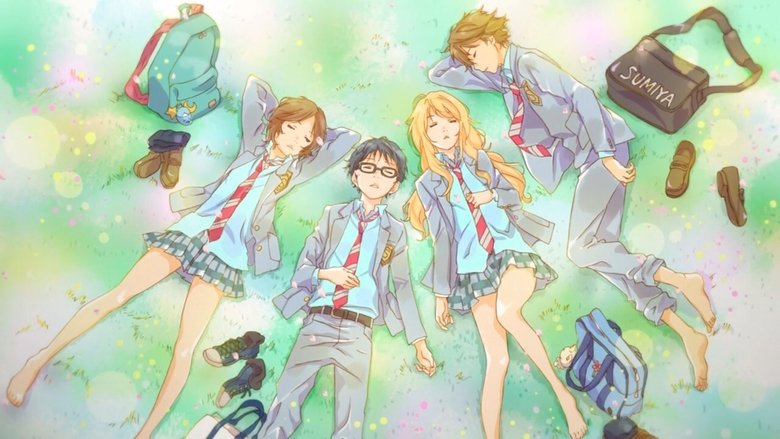
"Your Lie in April" follows Kōsei Arima, a prodigious young pianist who is left emotionally scarred and unable to hear the sound of his own playing after the death of his abusive mother. His world is a monotonous, colorless existence until he meets the vivacious and free-spirited violinist, Kaori Miyazono. Kaori's passionate and unconventional approach to music reignites Kōsei's own love for the art form, slowly pulling him out of his shell.
As Kaori encourages Kōsei to become her accompanist, he finds himself drawn back into the world of classical music competitions, not as the rigid "human metronome" he once was, but as an artist rediscovering his own voice. Through their shared musical journey, Kōsei begins to see the world in vibrant color again. However, a heartbreaking secret lies beneath Kaori's cheerful demeanor, and the series delicately explores themes of love, loss, friendship, and the profound impact one person can have on another's life. The story is a deeply emotional journey of healing and finding the courage to move forward in the face of tragedy.
Core Meaning
The central message of "Your Lie in April" is the transformative and healing power of music and human connection in the face of trauma, grief, and loss. The series posits that life, much like a musical piece, is full of contrasting dynamics – joy and sorrow, light and darkness – and that embracing this full spectrum is essential to living a meaningful life. It suggests that even in the depths of despair, a single person can bring color and vibrancy back into one's world, inspiring them to confront their past and find a new reason to move forward.
Ultimately, the creators wanted to convey that memories, both beautiful and painful, shape who we are, and that carrying the legacy of those we've lost can be a source of strength and inspiration. The "lie" of the title becomes a poignant symbol of selfless love, a necessary catalyst for growth and healing, even if it is born from a place of impending tragedy.
Thematic DNA
The Healing Power of Music
Music is the central driving force of the narrative, acting as a medium for emotional expression that transcends words. For Kōsei, the piano is both the source of his trauma and the path to his recovery. His inability to hear the notes is a psychosomatic manifestation of his grief and guilt. Kaori's vibrant and free-spirited violin playing challenges Kōsei's rigid, technical approach, teaching him that music is not just about perfection, but about conveying emotion and connecting with others. The series beautifully illustrates how engaging with music, both as a performer and a listener, can be a profound and cathartic experience, allowing characters to process their pain and find solace.
Love and Loss
The series is a poignant exploration of young love blossoming under the shadow of impending loss. Kōsei's journey is catalyzed by his love for Kaori, which gives him the strength to face his past and the future. The narrative intertwines the beauty and excitement of first love with the deep sorrow of grief. It portrays love not just as a romantic endeavor, but as a powerful force for personal growth and change. The theme of loss is ever-present, not only in Kōsei's past with his mother but also in the unfolding tragedy of Kaori's illness, teaching the characters and the audience about the fragility of life and the importance of cherishing the time we have with loved ones.
Overcoming Trauma
Kōsei's character arc is a deep dive into the psychological effects of childhood trauma. His mother's abusive and demanding tutelage, followed by her death, leaves him in a state of arrested development. The series realistically portrays his struggles with anxiety, depression, and PTSD, which manifest in his inability to play the piano. His journey is not a linear path to recovery but a series of steps forward and backward. "Your Lie in April" emphasizes that healing is a gradual process that requires support from others and the courage to confront painful memories. Kaori's influence helps Kōsei to re-contextualize his past and find a new, healthier relationship with his music and himself.
Friendship and Support
While the central romance is pivotal, the series also highlights the importance of friendship. Kōsei's childhood friends, Tsubaki Sawabe and Ryōta Watari, provide a crucial support system for him, even when they don't fully understand the depths of his struggles. Tsubaki's evolving feelings for Kōsei and her unwavering presence by his side underscore the idea that different forms of love and support are all vital for healing. The series shows that it is through these connections with friends and rivals that the characters find the strength to face their personal challenges and grow as individuals.
Character Analysis
Kōsei Arima
Natsuki Hanae
Motivation
Initially, Kōsei's motivation is simply to survive his monotonous existence. After meeting Kaori, his motivation shifts to a desire to support her as her accompanist and to be able to share the stage with her. As he rediscovers his passion for music, his motivation becomes more intrinsic: to express his own feelings through the piano and to connect with others. Ultimately, his motivation is to live a life that honors Kaori's memory and the lessons she taught him.
Character Arc
Kōsei begins the series as a withdrawn and emotionally scarred teenager, unable to touch a piano due to the trauma of his mother's abusive upbringing and subsequent death. His world is colorless and silent. Through his relationship with Kaori, he embarks on a painful but ultimately rewarding journey of healing. He learns to confront his past, reinterpreting his memories of his mother and forgiving both her and himself. By the end of the series, Kōsei has transformed from a passive victim of his past into a passionate musician who plays with his whole heart. He learns to live with his grief and carry the memory of those he's lost as a source of inspiration, finally able to embrace a future full of color and music.
Kaori Miyazono
Risa Taneda
Motivation
Kaori's primary motivation is to play the violin with Kōsei before she dies. She was inspired by his piano playing as a child and switched from piano to violin in the hopes of one day performing with him. Aware of her terminal illness, she lives with a sense of urgency, determined to make a lasting impression on Kōsei and to help him find his love for music again. Her lie about liking Watari is a means to this end, a selfless act to bring color back into Kōsei's life without burdening him with the truth of her condition and feelings until the very end.
Character Arc
Kaori is introduced as a vibrant, free-spirited, and somewhat eccentric violinist who lives life to the fullest. Her playing style is as passionate and untamed as her personality. Her arc is one of selfless love and a race against time. Knowing her life will be short, she crafts a lie to get close to Kōsei, whom she has admired from afar since childhood. Her goal is to reignite his passion for music and to live on in his heart. While she appears strong and cheerful, she has moments of vulnerability and fear, especially as her illness progresses. Her arc is not about personal growth in the traditional sense, but about the profound and lasting impact she has on those around her, inspiring them to live more fully.
Tsubaki Sawabe
Ayane Sakura
Motivation
Tsubaki's initial motivation is to see Kōsei happy and to bring him out of his depressive state. She introduces him to Kaori with this hope. As her feelings for him become clear, her motivation becomes more complex. She is motivated by a desire to be with him and a fear of being left behind as he re-enters the world of music. Ultimately, her deepest motivation is her unconditional love for Kōsei, which leads her to support him through his grief over Kaori, promising to be his lifelong companion.
Character Arc
Tsubaki starts as Kōsei's supportive and athletic childhood friend, who sees him as a younger brother she needs to protect. Her arc is one of self-discovery and the painful realization of her romantic feelings for Kōsei. As she watches Kōsei and Kaori grow closer through music, she feels left behind and is forced to confront her own emotions. She struggles with her identity and future, especially in comparison to Kōsei's clear talent. Tsubaki's journey is about understanding the nature of her love for Kōsei and finding her own path while continuing to be a pillar of support for him. By the end, she accepts his bond with Kaori and promises to always be by his side, her love for him maturing into a deep and unwavering companionship.
Ryōta Watari
Ryota Osaka
Motivation
Watari is motivated by his friendships and his passion for soccer. He genuinely cares for Kōsei and Tsubaki and often acts as a mediator or offers a different perspective. While he enjoys the attention of many girls, he shows genuine affection for Kaori. Despite this, he is perceptive enough to understand the deeper connection between Kōsei and Kaori and selflessly steps back, offering Kōsei advice and encouragement. His motivation is to be a good friend and to live without regrets.
Character Arc
Watari is Kōsei's and Tsubaki's childhood friend, the popular and charismatic captain of the soccer team. He appears to be a carefree playboy, but his arc reveals a more perceptive and supportive side. He is the initial object of Kaori's supposed affection, but he never acts with jealousy or possessiveness as he observes the growing bond between Kaori and Kōsei. Watari's development is more subtle than the other main characters; he serves as a source of surprisingly insightful advice on love and life. His arc shows him maturing and providing quiet strength and understanding to his friends as they navigate their emotional turmoil.
Symbols & Motifs
The Black Cat
The black cat serves as a multifaceted symbol throughout the series, primarily representing Kōsei's trauma and internal struggles related to his mother. There are instances of a yellow-eyed cat symbolizing his self-doubt and guilt, and a blue-eyed cat that represents hope and Kaori's influence.
A black cat was a pet Kōsei had as a child that his mother got rid of after it scratched him. This event becomes a source of guilt for him. The appearance of a black cat often coincides with moments of Kōsei's emotional distress and his psychological inability to hear the piano. However, the cat can also symbolize Kaori and hope, as seen in the final episode where a blue-eyed cat appears before Kōsei finds and reads her letter, suggesting that her memory will continue to guide him.
Cherry Blossoms
Cherry blossoms are a classic symbol in Japanese culture representing the transient, beautiful, and ephemeral nature of life. In "Your Lie in April," they are intrinsically linked to Kaori Miyazono and the brief but profound impact she has on Kōsei's life.
Kōsei meets Kaori under a sky of blooming cherry blossoms, marking the beginning of the colorful change in his life. The cherry blossoms appear at pivotal moments, often framing scenes with Kaori. Their fleeting beauty mirrors Kaori's own life, which is vibrant and beautiful but tragically short. The reappearance of cherry blossoms at the end of the series signifies a new beginning for Kōsei, one where he carries Kaori's memory forward into a new spring.
The Deep, Dark Ocean
The deep ocean is a visual metaphor for Kōsei's psychological state of being unable to hear the piano. It represents his fear, anxiety, and the suffocating weight of his trauma.
Whenever Kōsei attempts to play the piano, he envisions himself sinking into the dark, silent depths of the ocean, unable to hear the notes he's playing. This imagery powerfully conveys his feeling of being overwhelmed and disconnected from his music. As he begins to heal with Kaori's help, there are moments where he is in shallower water, with light filtering through, symbolizing his gradual recovery and the return of hope.
Color and Monetone
The contrast between a vibrant, colorful world and a monochrome existence is a direct representation of Kōsei's emotional state. Color symbolizes life, passion, and happiness, while monochrome represents his depression and detachment from the world.
Before meeting Kaori, Kōsei describes his world as monotone. The moment he sees her, his world begins to fill with color. The series' visual style often employs a bright, vivid color palette, especially in scenes with Kaori, to emphasize her impact on Kōsei. Conversely, his moments of despair are often depicted with more muted or gray tones. Kaori's declining health is also subtly indicated by her hair and skin becoming less vibrant over time.
Memorable Quotes
The moment I met her, my life changed. Everything I saw, everything I heard, everything I felt, all the scenery around me... started to take on color.
— Kōsei Arima
Context:
Kōsei says this in an internal monologue, reflecting on his first encounter with Kaori and how she single-handedly brought vibrancy and meaning back into his life. This is a recurring sentiment throughout the first season.
Meaning:
This quote encapsulates the central theme of the series: the transformative power of love and connection. It perfectly describes the profound impact Kaori has on Kōsei's monotonous and grief-stricken world.
Maybe there's only a dark road up ahead. But you still have to believe and keep going. Believe that the stars will light your path, even a little bit.
— Kaori Miyazono
Context:
Kaori says this to Kōsei to inspire him to move forward despite his fears and trauma. It is a testament to her strength and her role as his guiding light. This occurs in Season 1, Episode 3.
Meaning:
This quote embodies Kaori's philosophy of life. Despite her own tragic circumstances, she holds onto hope and encourages others to do the same. It's a message of resilience in the face of adversity.
Spring will be here soon. Spring, the season I met you, is coming. A spring without you... is coming.
— Kōsei Arima
Context:
This is from Kōsei's monologue in the final episode (Season 1, Episode 22) after reading Kaori's letter. It is a moment of profound sadness but also a sign of his emotional growth and his readiness to face the future.
Meaning:
A bittersweet and poignant reflection on the cyclical nature of time and the pain of loss. It signifies Kōsei's acceptance of Kaori's death and the beginning of his journey to live on without her physically by his side.
Was I able to live inside someone's heart? Was I able to live inside your heart? Do you think you'll remember me at least a little? ... Don't forget me, okay? That's a promise, okay? I'm glad it's you, after all. Will I reach you? I hope I can reach you.
— Kaori Miyazono
Context:
These lines are read by Kōsei from Kaori's posthumous letter in the final episode (Season 1, Episode 22). It is the emotional climax of the series, where all of her hidden feelings are laid bare.
Meaning:
These are Kaori's final thoughts, expressed in her letter to Kōsei. They reveal her deepest vulnerabilities and her ultimate desire: to have made a lasting impact on the person she loved. It's a heartbreakingly human plea to be remembered.
Episode Highlights
Monotone/Colorful
The first episode masterfully establishes Kōsei's traumatic past and his current state of depression. It introduces the main characters and sets the stage for the central conflict. The moment Kōsei first sees Kaori, the world literally bursts into color, a powerful visual metaphor for her impending impact on his life.
This episode is crucial as it lays the entire groundwork for the series. It effectively communicates Kōsei's emotional state and the stark contrast that Kaori represents, immediately hooking the viewer into their journey.
Set Out
Kōsei accompanies Kaori in a violin competition, his first time on stage in years. He has a panic attack, envisioning himself at the bottom of the ocean, and their performance falls apart. Kaori stops and encourages him to start over, defying the competition rules. Their second attempt is raw and emotional, showcasing their burgeoning connection.
This episode is a major turning point for Kōsei. It's his first step back into the world of music and demonstrates Kaori's powerful influence on him. Their disastrous yet heartfelt performance solidifies their musical and emotional bond.
Light of Life
Kōsei performs in a piano competition alone for the first time since his return. He initially struggles but then has an epiphany, realizing he is no longer playing for his mother but for Kaori and for himself. His performance is transformative, full of emotion and color, and it moves the audience, including his rivals.
This episode marks a significant milestone in Kōsei's healing process. He begins to break free from his mother's shadow and develops his own identity as a musician. It's a moment of profound emotional release and artistic rebirth.
Hand in Hand
Kōsei visits Kaori in the hospital, and her condition has visibly worsened. They share an emotional conversation on a snow-covered rooftop. Tsubaki also confronts Kōsei about his feelings for Kaori, leading to an emotional moment between the two childhood friends.
This episode intensifies the dramatic tension as Kaori's mortality becomes undeniable. It features raw and honest conversations that push the characters' emotional development forward, particularly Tsubaki's realization of her own feelings.
Spring Breeze
The series finale. Kōsei performs in the finals of a piano competition while Kaori undergoes a high-risk surgery. During his performance, he has a vision of playing a final duet with her before she fades away, signifying her death. Later, he reads a letter from her that reveals her "lie" and her true feelings for him.
This episode is the emotional culmination of the entire series. It delivers a heartbreaking yet beautiful conclusion to Kōsei and Kaori's story. The revelation of Kaori's lie provides a new, poignant context to the entire narrative, solidifying the series' themes of selfless love and living on through memory.
Philosophical Questions
Does tragedy give life meaning?
The series explores the idea that confronting sorrow and loss is essential for personal growth. Kōsei's life is stagnant until he is touched by Kaori's vibrant existence, which is itself defined by her impending death. Her determination to live fully in the face of her mortality forces Kōsei to confront his own emotional paralysis. The narrative suggests that it is through the pain of loss that we can truly appreciate the beauty of life and the connections we make, and that our most profound moments of growth are often born from our greatest tragedies.
How do we live on in the hearts of others?
Kaori's central goal is to be remembered, to live on in Kōsei's heart. The series delves into the nature of memory and legacy. It posits that a person's impact is not measured by the length of their life, but by the depth of their influence on others. Kaori achieves a form of immortality through her music and the inspiration she instills in Kōsei. His future performances become a tribute to her, ensuring that her spirit and passion are never forgotten. This raises the question of what it truly means to leave a mark on the world.
Is it nobler to protect someone from painful truths?
Kaori's "lie" is a central ethical dilemma in the series. She chooses to deceive Kōsei about her feelings and her illness to protect him and to achieve her goal of playing with him. The series explores the consequences of this decision, suggesting that while her intentions were selfless, the eventual revelation of the truth is profoundly painful. It prompts the viewer to consider whether such a lie, intended to shield a loved one from suffering, is ultimately a kindness or a disservice, and whether honesty, however painful, is a more respectful path.
Alternative Interpretations
While the main narrative of "Your Lie in April" is fairly straightforward, there are a few areas where audiences and critics have found room for alternative interpretations, primarily concerning the titular "lie" and the ending.
One interpretation of "the lie" is simply Kaori's fabrication that she had a crush on Ryōta Watari to get closer to Kōsei. A deeper interpretation suggests the lie is more complex, encompassing the cheerful facade she maintains despite her terminal illness. This "lie" is her pretense of being a healthy, carefree girl so as not to burden Kōsei and to live her remaining time to the fullest. Another, more heartbreaking interpretation is that her promise to Kōsei that they would perform together again was also a lie, one she desperately wanted to be true.
Regarding the ending, while it is definitively tragic, some viewers interpret it as ultimately hopeful. They argue that Kaori's death, while devastating, was the necessary catalyst for Kōsei's complete emotional and artistic rebirth. In this view, her spirit lives on through his music, and her sacrifice allows him to finally break free from his past and embrace life. Another perspective focuses on Tsubaki's role, suggesting that the ending hints at a future romantic relationship between her and Kōsei, representing a quieter, more stable form of love after the passionate and tragic romance with Kaori. This interpretation, however, is debated among fans, with some feeling it would diminish the significance of Kōsei and Kaori's connection.
Cultural Impact
"Your Lie in April" has had a significant cultural impact, particularly within the anime community, where it is often cited as a modern classic of the romance and drama genres. Upon its release, it was lauded for its beautiful animation by A-1 Pictures, its stirring classical music score, and its deeply emotional narrative. It won the award for Best Shōnen Manga at the 37th Kodansha Manga Awards in 2013, indicating its success even before the anime adaptation.
The series has been praised for its mature handling of themes like grief, trauma, and terminal illness, which resonated strongly with audiences worldwide. It has been credited with introducing a new generation of anime fans to classical music, with many viewers seeking out the pieces featured in the show. The series' popularity led to a live-action film adaptation in 2016, as well as a stage musical, further cementing its place in popular culture. Despite some criticism for its use of melodrama and occasional tonal inconsistencies, its legacy is that of a powerful and beautifully crafted story that masterfully blends music, art, and human emotion, leaving a lasting impression on its viewers and often being recommended as a "must-watch" for fans of emotional storytelling.
Audience Reception
"Your Lie in April" was met with widespread acclaim from audiences upon its release, and it consistently ranks high on lists of the best romance and drama anime. Viewers overwhelmingly praised its beautiful and vibrant animation, its moving classical music score, and its powerful emotional narrative. The character development, particularly Kōsei's journey of healing, was a major point of praise, with many finding his struggles relatable and his growth inspiring. The series is notorious for its heartbreaking ending, and it is often cited as one of the saddest anime of all time, with many viewers sharing their emotional reactions online.
The main points of criticism, though less common, typically revolve around the show's use of comedic relief, which some viewers found to be jarringly inserted into otherwise serious and emotional scenes, creating tonal whiplash. A minority of viewers also found the pacing in the middle of the series to be somewhat slow, with too much time spent on the internal monologues of the characters. Some criticism has also been directed at the character of Tsubaki, with some finding her treatment of Kōsei at times to be overly aggressive. Despite these critiques, the overall verdict from the audience is overwhelmingly positive, with the series being remembered as a beautiful, poignant, and unforgettable experience that has left a lasting emotional impact on many.
Interesting Facts
- The creator, Naoshi Arakawa, was inspired to write a music-themed manga after seeing a single, beautiful picture of a person playing the violin.
- Arakawa's primary motivation for the emotional depth of the story was to make his editor, Shinichi Eda, cry.
- The anime production was given five times more pre-production time than the average TV anime, much of which was spent on accurately portraying the musical performances.
- To animate Kaori's violin performances realistically, the staff filmed a live violinist as a reference.
- Many of the locations in the anime are based on real places in Nerima City, Japan.
- Naoshi Arakawa initially considered an ending where Kaori survived the surgery but ultimately stuck with the original, more tragic conclusion because he had already communicated it to the anime production team.
- The acclaimed creator of "One Piece," Eiichiro Oda, praised "Your Lie in April" for its ability to portray music so effectively in a manga format.
Easter Eggs
In the second episode, Kaori is the fourth performer in the violin competition.
In Japanese and other East Asian cultures, the number four is considered unlucky because it can be pronounced as "shi," which is also the word for death. This subtly foreshadows Kaori's tragic fate.
⚠️ Spoiler Analysis
Click to reveal detailed analysis with spoilers
Frequently Asked Questions
Explore More About This Movie
Dive deeper into specific aspects of the movie with our detailed analysis pages
Comments (0)
No comments yet. Be the first to share your thoughts!