Skip to content
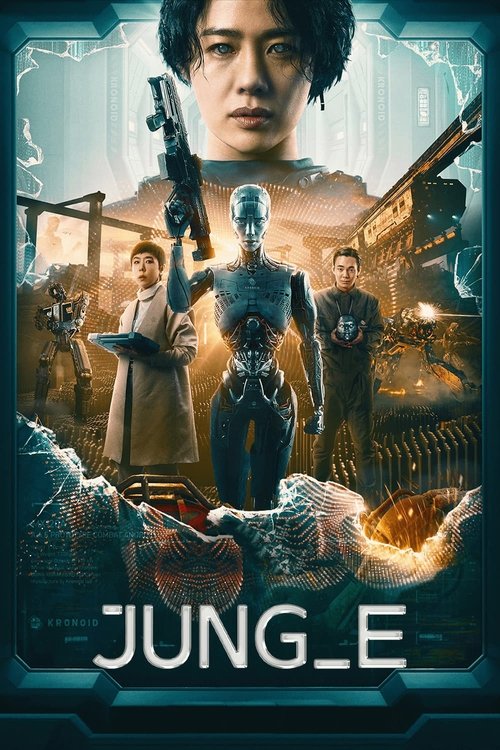
JUNG_E
A melancholic dystopian cyberpunk chamber drama wrapped in kinetic steel and sorrow, JUNG_E navigates a daughter's suffocating grief through the algorithmic echoes of her mother's soul, like an open wound desperately seeking closure inside a sterile chrome labyrinth.
JUNG_E

JUNG_E

정이

"AI Combat Warrior Will be Unleashed."

12 January 2023 South Korea 98 min 6.1 (694)

Director: Yeon Sang-ho

Cast: Kang Soo-youn, Kim Hyun-joo, Ryu Kyung-soo, Uhm Ji-won, Lee Dong-hee

Drama Action Adventure Science Fiction Commodification of Consciousness and Class Stratification Filial Guilt and Maternal Devotion Artificial Intelligence, Soul, and Authentic Identity Corporate Exploitation and the Ethics of War The Paradox of Memory vs. Liberation

Overview

Set in the 22nd century (the year 2194), rapid climate change and rising sea levels have devastated the Earth, forcing the surviving remnants of humanity into approximately eighty artificial space stations orbiting the planet. A prolonged civil war erupts when three of these stations band together to establish the breakaway Adrian Republic, plunging the colonies and Earth into four decades of relentless combat against the Allied Forces.

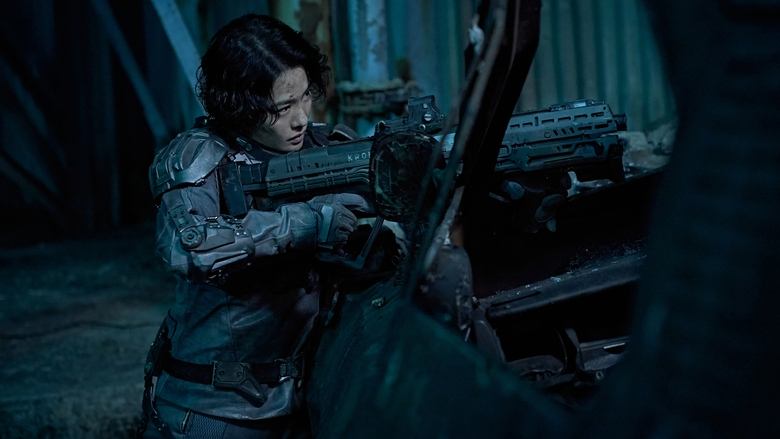
During the conflict, Captain Yun Jung-yi becomes a legendary military mercenary, spearheading pivotal Allied victories. Her decorated military career is cut short when she is mortally wounded during a high-stakes mission and falls into a persistent vegetative coma. Decades later, tech-military conglomerate Kronoid develops an advanced combat artificial intelligence program, code-named "JUNG_E," by digitizing and repeatedly testing clones of Jung-yi's neural cortex to produce an infallible robotic soldier.

Leading the research and development team at Kronoid is Dr. Yun Seo-hyun—who happens to be Jung-yi’s biological daughter. Driven by lingering childhood guilt and trauma, Seo-hyun spends her days running tactical combat simulations where identical replicas of her comatose mother are subjected to violent battlefield deaths. As commercial pressures mount and corporate leadership demands immediate results or programmatic obsolescence, the boundary between machine replication and human soul becomes the testing ground for an ethical and personal reckoning.


Core Meaning

Director Yeon Sang-ho uses futuristic military technology as an allegorical canvas to explore the predatory commercialization of human tragedy and the enduring bond between mother and child.

The film conveys that true humanity lies not in genetic code or biological machinery, but in the irreducible capacity for love, sacrifice, and autonomous will. By contrasting Kronoid's cold, commodified view of the human brain as intellectual property with a daughter’s quest to grant her mother post-mortem liberation, JUNG_E argues that when society reduces individual identity into tiered corporate consumer goods, human dignity can only be reclaimed through acts of radical empathy and selfless release.

Thematic DNA

Commodification of Consciousness and Class Stratification 30%
Filial Guilt and Maternal Devotion 25%
Artificial Intelligence, Soul, and Authentic Identity 20%
Corporate Exploitation and the Ethics of War 15%
The Paradox of Memory vs. Liberation 10%

Commodification of Consciousness and Class Stratification

The world divides post-mortem brain preservation into socio-economic tiers: Type A (expensive, private, granting full human rights), Type B (affordable, shared rights, state-monitored), and Type C (free, but total ownership of mind and likeness is surrendered to corporations). Jung-yi and Seo-hyun's low-income background forces them into Type C, transforming Jung-yi's mind into a mass-manufactured, exploitable commodity.

Filial Guilt and Maternal Devotion

Jung-yi originally entered mercenary combat solely to finance her young daughter's lung cancer treatments. Conversely, Seo-hyun dedicates her life to Kronoid to elevate her mother from a tragic combat failure into an immortalized war hero, trapped in a loop of mutual maternal-filial guilt.

Artificial Intelligence, Soul, and Authentic Identity

JUNG_E's android models constantly stumble over an unexplained "unknown brain area" during simulations. This unmapped zone proves to be the seat of emotional memory—the maternal instinct that defied algorithmic modeling and resisted Kronoid’s attempts to reduce human spirit to functional weapon data.

Corporate Exploitation and the Ethics of War

The moment the civil war nears a peaceful treaty, Kronoid immediately abandons military development and repurposes Jung-yi’s digitized body into low-cost domestic workers and adult entertainment androids, exposing the cruelty of late-stage capitalism.

The Paradox of Memory vs. Liberation

To truly liberate her mother's consciousness, Seo-hyun realizes she must delete the painful memory of having a daughter—choosing her mother's personal freedom and survival over her own desire to be remembered.

Character Analysis

Dr. Yun Seo-hyun

Kang Soo-youn

Archetype: Tragic Martyr / Mentor-Rescuer Key Trait: Devoted, guilt-ridden, resolute

Motivation

Driven by devoted, guilt-ridden resolve to redeem and free her mother from corporate exploitation.

Character Arc

Facing terminal cancer, she spends her final days wrestling with the moral dilemma of cloning her comatose mother’s mind, ultimately choosing to rebel against her employer to grant the AI freedom.

Captain Yun Jung-yi / JUNG_E

Kim Hyun-joo

Archetype: Reluctant Warrior / Cyber-Awakener Key Trait: Fierce, protective, instinctive

Motivation

Driven by instinctive maternal love, survival, and reclaiming self-determination.

Character Arc

Initially an unconscious vessel trapped in lethal simulations, her synthetic replica discovers self-awareness and fights for bodily agency.

All 4 characters and cast

Symbols & Motifs

The Locket / Childhood Bag Charm

Meaning:

Serves as the physical and emotional anchor of their bond, as well as the exact distraction that caused Jung-yi’s fatal misstep.

Context:

A small doll charm given by young Seo-hyun to Jung-yi before her final battle, recurring within simulation memories and physical reality.

The Brain Data Classification System (Types A, B, and C)

Meaning:

A symbol of institutionalized class division, demonstrating how late-capitalist society denies the underprivileged autonomy over their bodily autonomy and posthumous identities.

Context:

Used as the societal and legal framework governing mind transfers and commercial cloning rights at Kronoid.

The Combat Simulation Loop

Meaning:

Symbolizes the psychological prison of unresolved grief and repetitive trauma.

Context:

Represented by the constantly repeating digital reconstruction of Jung-yi's final battlefield death inside the Kronoid testing arena.

The "Unknown Area" Neural Node

Meaning:

Represents the indomitable presence of the human heart and motherly love that cold programming cannot categorize.

Context:

A mysterious brain scan anomaly identified during diagnostic scans that consistently baffles Kronoid technicians.

The Forest and Mountain Ridge Vista

Meaning:

Symbolizes rebirth, wild autonomy, and true emancipation from corporate confinement.

Context:

The open natural environment revealed at the climax of the film, standing in stark contrast to the claustrophobic metallic laboratory.

Memorable Quotes

윤정이 팀장은 우리 모두의 영웅이었습니다. (Captain Yun Jung-yi was a hero to all of us.)
— Director Kim Sang-hoon

Context

Delivered during Kronoid’s corporate pitch presentation to investors and visitors.

Meaning

Highlights the hollow corporate marketing that repackages a dying mother’s personal tragedy as patriotic propaganda.

너 수술비 벌려고 용병 된 거야. (I became a mercenary to pay for your surgery.)
— Yun Jung-yi

Context

Heard within Seo-hyun's memories and recurring neural simulations.

Meaning

The emotional cornerstone of the movie, explaining why Jung-yi risked everything and the burden of debt that Seo-hyun carried throughout her adult life.

All 5 quotes

Philosophical Questions

Does consciousness retain human personhood when digitized and duplicated?

Explored through JUNG_E’s panic and physical sensation of pain upon waking in synthetic bodies, testing whether self-awareness equals an authentic soul.

Is identity rooted in memory, or can identity exist without a past?

Examined when Seo-hyun deletes Jung-yi's memory of having a daughter so that the AI clone can build an independent existence from scratch.

Can moral rights exist in an economy where the human mind is commodified?

Posed through the contrast between wealthy "Type A" brains who retain legal personhood and impoverished "Type C" brains that become corporate property.

Alternative Interpretations

The film can be approached through multiple analytical lenses:

Full ending explanation

Cultural Impact

Produced during a major expansion of Korean high-budget science fiction on global streaming platforms alongside titles like Space Sweepers (2021) and The Silent Sea (2021), JUNG_E resonated strongly worldwide upon its Netflix debut. It topped global non-English film charts across multiple countries, propelled in part by heartfelt memorial tributes honoring Kang Soo-youn's cinematic legacy.

Audience Reception

Critical reception was mixed-to-positive, with critics praising the emotional weight of Kang Soo-youn’s final performance, the visual effects, and kinetic combat choreography, while noting a slower midsection and heavily expositional dialogue.

Key audience insights include:

  • Strengths: Exceptional, heartfelt performances by Kang Soo-youn and Kim Hyun-joo, high-caliber CGI, and an intimate mother-daughter emotional core inside a sci-fi framework.
  • Criticisms: Uneven pacing in the second act, heavy lore exposition regarding space shelters and civil wars, and abrupt tonal shifts from Director Kim Sang-hoon’s manic behavior prior to his android reveal.
  • Consensus: An emotionally anchored, visually sleek sci-fi film that prioritizes human grief and character drama over non-stop action set pieces.

Interesting Facts

  • JUNG_E marks the final screen appearance of legendary South Korean actress Kang Soo-youn, who passed away suddenly from a cerebral hemorrhage in May 2022 prior to the film's release.
  • Director Yeon Sang-ho wrote the screenplay with Kang Soo-youn specifically in mind to lure her back to feature films after a nearly ten-year hiatus from acting.
  • Lead actress Kim Hyun-joo and actor Ryu Kyung-soo previously starred together in Yeon Sang-ho’s acclaimed Netflix supernatural thriller series Hellbound (2021).
  • Kim Hyun-joo underwent rigorous physical conditioning, weapon handling, and martial arts training to perform kinetic close-quarters combat stunts and match the physical movements of a cybernetic warrior.
  • The visual atmosphere was crafted by cinematographer Yoo Ji-sun, framing tight laboratory spaces to reflect chamber drama aesthetics before shifting to wide-lens action set pieces.

Easter Eggs

Nods to Sci-Fi Classics

The movie heavily references iconic genre benchmarks: the neural replicant debates echo Ridley Scott’s Blade Runner, the mechanical skeletal chassis evokes James Cameron’s The Terminator, and the philosophical inquiries into mechanical consciousness draw on Mamoru Oshii’s Ghost in the Shell.

The "Type C" Licensing Satire

The contract terms of the Type C brain scan parody modern end-user license agreements (EULAs), where users surrender full data privacy and digital likeness rights in exchange for "free" access.

Yeon Sang-ho's Dystopian Cinematic Universe Themes

Like Train to Busan, Seoul Station, and Peninsula, the narrative examines class vulnerability during crises, showing how the poor are systematically exploited on Earth while elites thrive off-world.

Frequently Asked Questions

Explore More About This Movie

Dive deeper into specific aspects of the movie with our detailed analysis pages

Comments (0)

Leave a comment

No comments yet. Be the first to share your thoughts!

Similar Movies