Skip to content
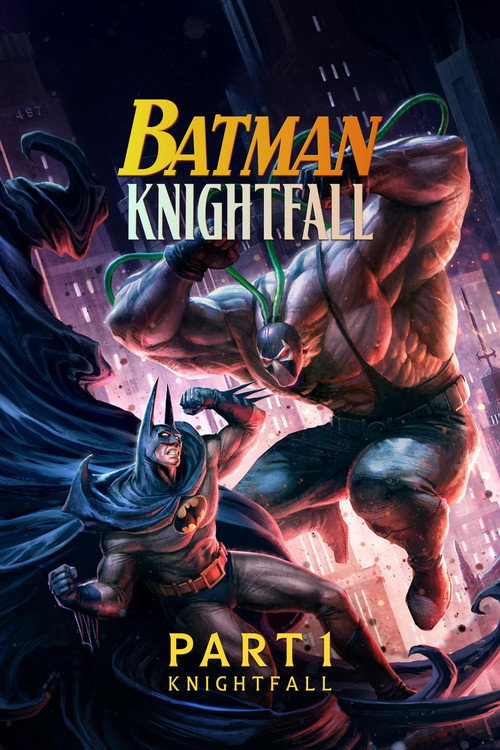
Batman: Knightfall Part 1: Knightfall
A grim, bruising crime opera in animation: Gotham as an open wound, and a hero grinding himself to dust one sleepless night at a time, while something patient and enormous waits at the end of the corridor.
Batman: Knightfall Part 1: Knightfall

Batman: Knightfall Part 1: Knightfall

23 June 2026 United States of America 79 min 9.1 (225)

Director: Jeff Wamester

Cast: Anson Mount, Michael Mando, Pablo Schreiber, Jeff Bennett, Luis Bermudez

Drama Crime Animation Action Adventure Science Fiction Attrition and the limits of the body Unprocessed grief and the ghost of Jason Todd Inheritance and the succession of the mantle Intelligence versus force Gotham as a system that consumes its guardians

Overview

Adapted from the 1993–1994 DC Comics event, Batman: Knightfall Part 1: Knightfall is the opening chapter of an R-rated animated trilogy directed by Jeff Wamester from a script by Jeremy Adams. It finds Bruce Wayne already worn thin — psychologically fractured by the death of Jason Todd, physically hollowed out by an unbroken run of sleepless nights — at precisely the moment Gotham is about to demand more of him than he has left.

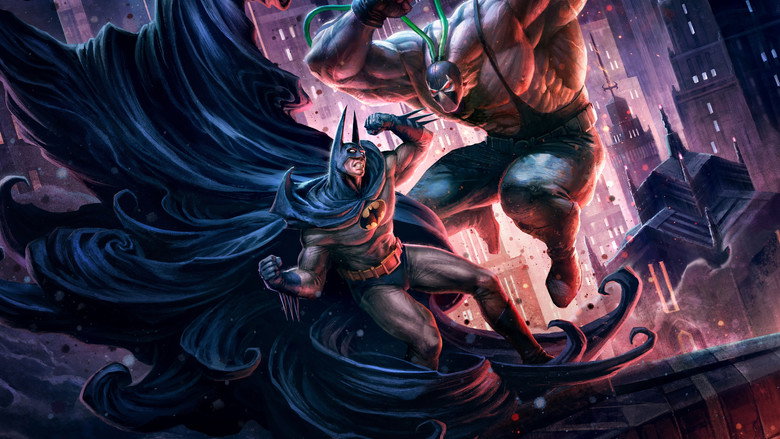
The catalyst is Bane, a Caribbean mastermind whose plan is less an attack than a siege. Rather than face the Dark Knight directly, he empties Arkham Asylum, releasing Batman's entire rogues gallery into the city at once and forcing his enemy to fight a war of attrition he cannot win. Every villain recaptured is another hour of sleep lost, another fraction of judgment eroded.

Around Bruce orbit the people trying to hold him together and the one preparing to replace him: Tim Drake, the third Robin, eager and untested, whose presence terrifies a mentor who has already buried one partner; Commissioner Gordon, watching the city slip; and Jean-Paul Valley, the young man called Azrael, carrying inherited programming he does not fully understand. The film is structured as a countdown rather than a mystery — we know what Bane is building toward, and the dread comes from watching Batman refuse to notice.
Core Meaning

The film argues that Batman is not defeated by a punch — he is defeated by arithmetic. Bane's insight, and the movie's thesis, is that endurance is a finite resource dressed up as a virtue. Bruce Wayne has built an identity on the promise that he will always get up, and the story systematically demonstrates that this promise is a lie he tells himself to avoid grieving.

Wamester and Adams treat the R rating not as license for shock but as a truth-telling device: if Batman's body is a machine he abuses nightly, the film insists on showing the damage that a family-friendly register would elide. The message is that the mask does not protect the man — it prevents him from admitting he needs protecting. What breaks in this chapter is not merely a spine; it is the myth of the unbreakable protector, and the film asks whether the symbol can survive the man's collapse, or whether it will simply be picked up by someone less careful.

Thematic DNA

Attrition and the limits of the body 30%
Unprocessed grief and the ghost of Jason Todd 22%
Inheritance and the succession of the mantle 20%
Intelligence versus force 16%
Gotham as a system that consumes its guardians 12%

Attrition and the limits of the body

The film's engine is exhaustion. Bane's plan is designed to make Batman fight everyone, so that each victory costs more than it earns. Critics identified this as the dominant theme: Bruce Wayne losing control over his life, body and mind by wearing himself down to an exhausted pile of misery, while Bane accrues power through patience and planning.

Structurally, the movie refuses the usual escalation of set pieces; it instead accumulates fatigue, so that the same choreography that thrilled in the first act reads as desperation by the third.

Unprocessed grief and the ghost of Jason Todd

Bruce enters the story already psychologically fragmented by the death of his second Robin. Grief is not a subplot here but a vulnerability Bane can exploit — a wound that makes Batman work harder, sleep less, and trust no one.

The theme surfaces most painfully in his handling of Tim Drake, whom he cannot look at without seeing a boy he failed to bring home.

Inheritance and the succession of the mantle

Two young men shadow Bruce: Tim Drake, who has taken up Robin and wants to be trusted, and Jean-Paul Valley, whose Azrael identity is an inheritance he did not choose. The film keeps asking who is permitted to carry a symbol, and what the symbol does to whoever carries it.

Audiences at the Annecy premiere responded particularly to the prominence given to Tim Drake, whose eagerness is framed as both the film's warmth and its scariest liability.

Intelligence versus force

Bane is written as a mastermind first and a behemoth second. His physical dominance is real, but the film is careful to establish that the Arkham breakout — not the fistfight — is the actual weapon. He beats Batman at the one thing Batman believes he owns: preparation.

This reframes the antagonist as a dark reflection of the World's Greatest Detective rather than a simple wall of muscle.

Gotham as a system that consumes its guardians

Arkham's revolving door is presented not as a plot convenience but as an indictment: a city that manufactures the same crises indefinitely and expects one man to absorb them. Gordon's vantage point makes the institutional failure explicit.

The film suggests Batman's breakdown is the predictable output of a broken civic machine, not a personal failing.

Character Analysis

Bruce Wayne / Batman

Anson Mount

Archetype: Tragic hero / self-destroying protector Key Trait: Pathological endurance

Motivation

To keep the promise that no one else dies on his watch, which he pursues by removing himself from the only support that could save him.

Character Arc

Begins already depleted — grieving Jason Todd, sleepless, unwilling to delegate — and is methodically dismantled across the film. His arc is not growth but erosion: every competent decision costs him a reserve he does not replenish, until willpower alone is asked to do the work of a body that has quit.

Bane

Michael Mando

Archetype: Shadow / mastermind antagonist Key Trait: Strategic patience

Motivation

To prove that the Bat is a man, and that any man can be broken by someone willing to be more patient than he is.

Character Arc

Introduced as a rumor and a silhouette, he steadily converts reputation into control over Gotham through planning and physical dominance. His confidence never wavers because his victory was arranged long before the first confrontation.

All 5 characters and cast

Symbols & Motifs

Arkham's open gates

Meaning:

The collapse of containment — psychological as much as penal. Every door Bane opens is a compartment in Bruce's mind that will not close again.

Context:

The inciting act of the film: Bane frees Batman's entire rogues gallery at once, converting the asylum from a destination into a source.

The cowl

Meaning:

Armor and prison. It conceals how badly the man beneath is deteriorating, which is precisely why he cannot take it off.

Context:

Anson Mount's performance codes the difference through voice alone — a softer Bruce, a hardened Batman — so the mask becomes audible before it is visible.

Bane's mask and tubing

Meaning:

Chemical will: strength that is administered rather than earned. It mirrors Batman's own reliance on gadgetry and stimulants to keep going.

Context:

Bane's design foregrounds the apparatus, making his power visibly external — a pointed contrast to a hero who insists his own limits are internal and infinite.

The Robin costume

Meaning:

Hope and dread in the same garment. It represents continuity of the mission and the possibility of another funeral.

Context:

Tim Drake wears the suit of a predecessor who died; Batman's anxiety about his new protégé shadows every scene they share.

The flaming sword of Azrael

Meaning:

Righteousness untempered by mercy — justice as inherited dogma rather than chosen restraint.

Context:

Jean-Paul Valley's presence seeds the trilogy's central question of what happens when the mantle passes to a man whose moral code was installed rather than developed.

Night without dawn

Meaning:

Time itself as antagonist. The absence of daylight visualizes sleeplessness as a moral condition.

Context:

The film's near-unbroken nocturnal palette turns Gotham into one continuous shift Batman is never allowed to clock out of.

Philosophical Questions

Is endurance a virtue or a form of self-destruction?

The film builds its entire dramatic architecture on Batman's refusal to stop, then insists on showing the physiological and psychological bill. By making exhaustion the antagonist's chosen weapon, it reframes a trait usually celebrated in the character as the precise vulnerability that dooms him.

Can a symbol survive the collapse of the person carrying it?

With Tim Drake in the Robin suit and Jean-Paul Valley waiting at the margins, the story stages the question as succession: if the Bat is an idea, it should be transferable; if it is a man, it is mortal. The film deliberately withholds a verdict, leaving it to the trilogy.

Does grief that is never processed become a weapon someone else can use?

Bruce's fracturing over Jason Todd predates Bane's campaign, and the plan works because that wound is already open. The film suggests private mourning, left unattended, becomes a public liability.

What separates justice from vengeance when both wear the same armor?

Azrael's inherited, absolutist creed is placed alongside Batman's chosen restraint, implying that the difference lies not in the acts performed but in whether the code was arrived at freely or installed by someone else.

Is a city that endlessly regenerates its own monsters worth saving one night at a time?

Arkham's mass breakout literalizes the futility of the revolving door, and Gordon's institutional perspective underlines that no individual heroism can fix a structurally broken system. The film lets the question sit unanswered.

Alternative Interpretations

Bane as diagnosis rather than villain. One reading treats Bane less as an antagonist than as an accurate observer: he does not create Batman's fragility, he merely measures it and applies pressure. Under this view the film is a study of a man who was going to collapse regardless, and Bane is only the date on the calendar.

Full ending explanation

Cultural Impact

\"Knightfall\" is one of the two great 1990s superhero demolition events — the story that broke Batman as \"The Death of Superman\" killed Superman — and it has cast a long shadow over screen adaptations, most visibly informing Christopher Nolan's The Dark Knight Rises. Coverage of the 2026 film framed it explicitly against that legacy, arguing that its bloody, R-rated Bane storyline delivers a higher-stakes version of the confrontation than the live-action attempt.

Its release also carried industrial significance: outlets noted the film as marking the end of a long-running era of DC's direct-to-video animated output, positioning the trilogy as a reset for the line under a harder rating and a more adult register. That gamble was validated immediately — a 96% Tomatometer from an initial six critics, a near-perfect 96% audience score, an ecstatic Annecy premiere and a San Diego Comic-Con showcase, with some reviewers calling it a masterpiece and an instant classic.

Culturally, the film sits inside a broader turn toward adult animation as a legitimate vehicle for serious genre drama rather than a children's format, and it revives a specific 1990s anxiety — about burnout, replacement and the cost of always being on call — for an audience that now reads those pressures as everyday rather than melodramatic.

Audience Reception

Overwhelmingly positive. The film debuted with a near-perfect 96% audience score on Rotten Tomatoes alongside a 96% Tomatometer from an initial six critics, and its Annecy world premiere drew thunderous applause. Reviewers reached for superlatives — \"masterpiece\" and \"instant classic\" both appeared in coverage — with several noting that a project that could easily have been cash-grab filler instead delivered something substantial.

Most praised: Anson Mount's Batman, singled out for playing Bruce and the cowl as audibly different people rather than one growl; the R-rated action, described as gnarly and unfiltered, and widely judged a higher-stakes Bane confrontation than The Dark Knight Rises offered; the prominence and warmth of Tim Drake's Robin, which Annecy audiences responded to directly; and the willingness to sit in genuine darkness, with reviewers calling it Batman's darkest story yet.

Main criticisms: Not all reviews were glowing. Some critics found the opening chapter a sluggish start to the trilogy and its structure messy in the early going — an unavoidable hazard of a first installment that must empty Arkham and establish three protagonists before it can pay anything off.

Contested ground: The R rating itself divided some viewers, between those who saw the bloodier register as the story's necessary honesty and those who read it as escalation for its own sake. The film's status as a marker for the end of a long-running era of DC animated features also drew mixed feeling from longtime fans of that line.

Verdict: A confident, punishing opening chapter whose reception suggests the trilogy gamble paid off, with the caveat that a deliberate first act asks for patience.

Interesting Facts

  • Directed by Jeff Wamester from a screenplay by Jeremy Adams, adapting the 1993–1994 DC Comics event "Knightfall."
  • It is the first installment of an R-rated animated Batman trilogy — a rating rarely applied to a Batman feature.
  • The film world-premiered at the Annecy International Animation Film Festival on June 23, 2026, where it reportedly played to thunderous applause.
  • It also screened at San Diego Comic-Con ahead of its wider release.
  • Digital release followed on August 25, 2026, with 4K UHD and Blu-ray editions arriving September 8, 2026.
  • Anson Mount (Star Trek: Strange New Worlds) voices Batman, deepening his voice only subtly for the cowl and playing Bruce noticeably softer than Batman.
  • Michael Mando voices Bane and Pablo Schreiber (Halo) voices Jean-Paul Valley / Azrael.
  • Bruce Boxleitner, of Tron, voices Commissioner Gordon.
  • Jack Giffon voices Tim Drake / Robin, the third Robin, whose prominent role was one of the most-cited elements of the Annecy reaction.
  • The film opened at a 96% Tomatometer score (from six critics) and a near-perfect 96% audience score on Rotten Tomatoes.

Frequently Asked Questions

Explore More About This Movie

Dive deeper into specific aspects of the movie with our detailed analysis pages

Comments (0)

Leave a comment

No comments yet. Be the first to share your thoughts!

Similar Movies